
Sep 4, 2026Buying Guides
Why Two Stainless Steel Enclosure Quotes Can Be 30% Apart
A stainless steel enclosure quote varies by 2–5× depending on grade, thickness, finish, IP rating, and certifications. Here are the seven factors that move the number, and the questions to ask before
Stainless Steel Enclosure Quotation: What Drives the Price
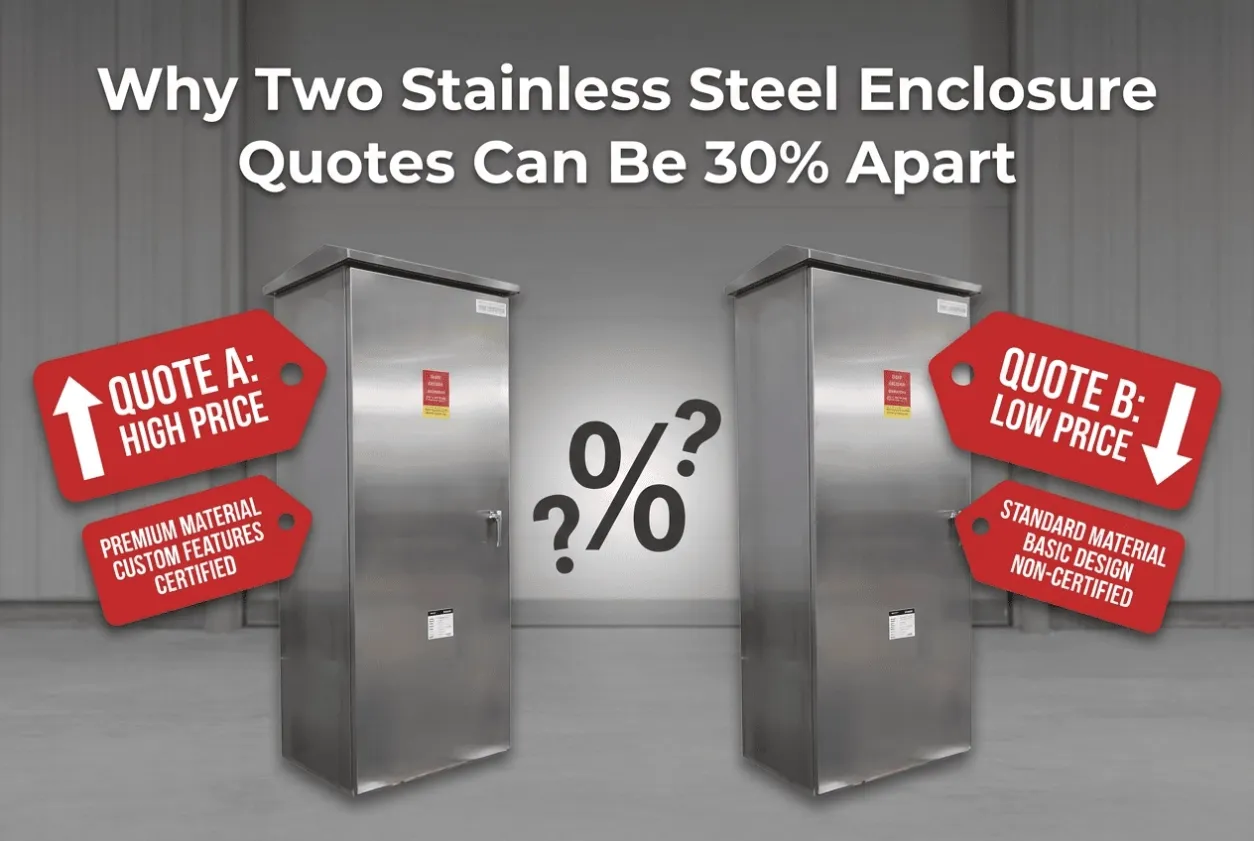
A stainless steel enclosure can be quoted at ¥1,800 or at ¥9,000 for the same external dimensions. The difference is not the supplier's mood—it is seven specific decisions in the spec that move the price in predictable ways. Knowing which knob turns the number lets you control the budget instead of guessing where it will land.
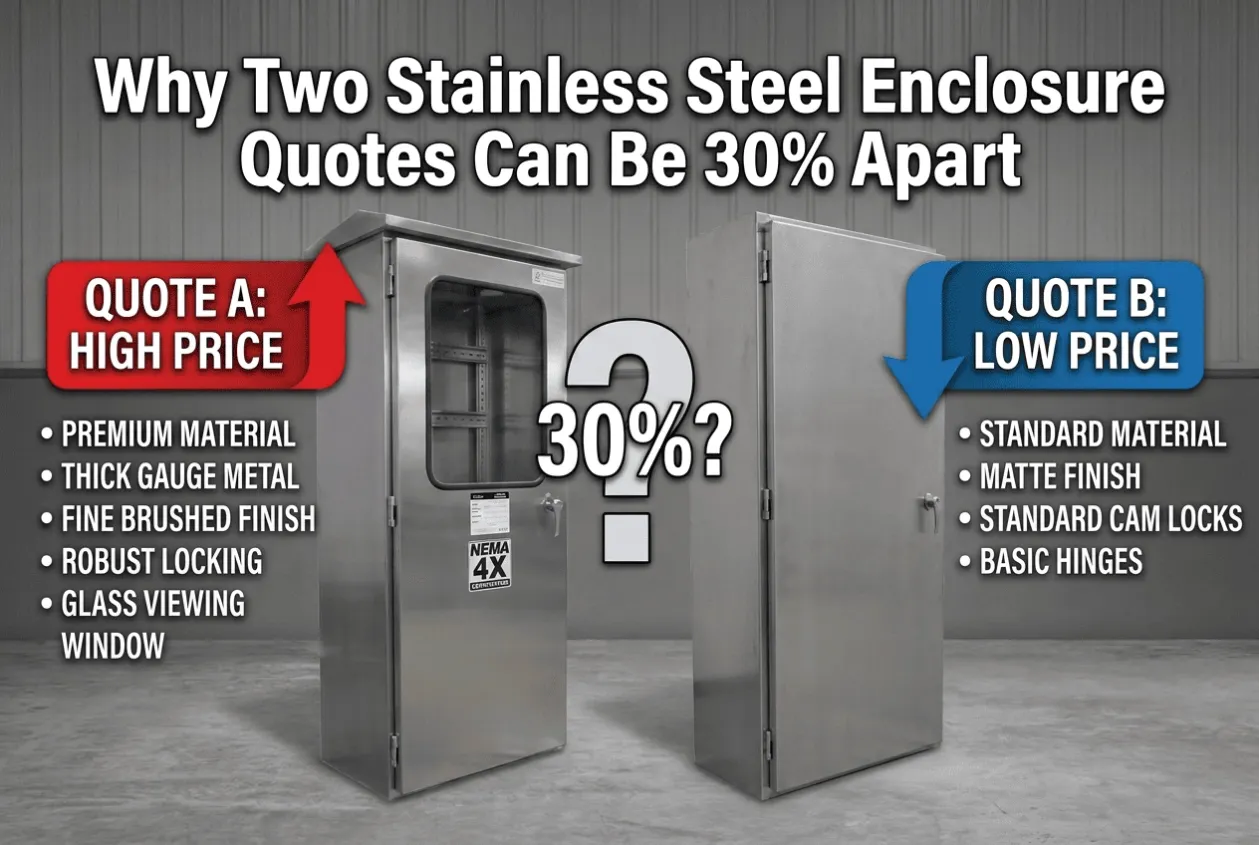
This guide walks through the seven things that change a stainless enclosure quotation, in the order they usually come up on a quote sheet. It also flags the questions to send with your RFQ so the suppliers you contact are quoting the same thing—which is the only way to compare prices fairly.
If you are still at the "should I spec stainless at all" stage, our guide to enclosure material selection compares carbon steel, galvanized, 304, and 316 head-to-head.
1. Grade—304 vs. 316 stainless
The single largest swing in stainless enclosure pricing is the grade. 304 is the workhorse; 316 is the same grade plus 2–3% molybdenum, which fights chloride pitting.
Grade | Typical price multiplier vs. carbon steel | Best for |
|---|---|---|
Carbon steel (powder-coated) | 1.0× | Indoor, dry, non-corrosive |
304 stainless | 1.8–2.4× | Outdoor, mild atmosphere, food processing |
316 stainless | 2.3–3.0× | Coastal, chemical, marine, de-icing salt exposure |
If your site is more than 1 km from a saltwater coastline and does not see chloride exposure, 304 is usually enough. If the enclosure will sit on a pier, in a chemical plant, or anywhere with regular salt spray, 316 pays back the premium in avoided rust repair. The full comparison is in our 304 vs 316 stainless enclosure guide.
A common mistake we see: buyers spec 316 "just in case," then pay 30% extra for chloride resistance the site never sees. Other buyers spec 304 for a coastal site, then replace the enclosure within 18 months. Both are real costs—just on different timelines.
2. Thickness—1.2 mm vs 1.5 mm vs 2.0 mm
The enclosure body and door are sheet metal. Going from 1.2 mm to 1.5 mm increases material cost by roughly 20–25%. Going to 2.0 mm adds another 30% on top of that, plus welding time, plus heavier hinges, plus higher freight cost per enclosure.
What thickness actually changes:
- 1.2 mm—Indoor wall-mount, light-duty, no mechanical impact risk
- 1.5 mm—The default for outdoor wall-mount and small floor-standing panels
- 2.0 mm—Floor-standing panels over 1.2 m tall, panels with frequent door access, panels in public spaces where impact is possible
For most outdoor enclosures under 800 × 600 × 250 mm, 1.5 mm is the cost-effective default. Above that size, or for any panel that takes regular door access, 2.0 mm is worth specifying. If you do not specify, expect 1.2 mm on the cheapest quote and 2.0 mm on the most expensive—the same drawing, different price.
The places where thickness bites you in service: panel doors that sag over time (under-spec door on a wide enclosure), mounting brackets that flex when you open the door with one hand, gland plates that dimple when you torque the glands. None of these is dramatic on day one. All of them show up in year three. We list the 10 outdoor cabinet design features that are easiest to under-spec — thickness is the most common one we see buyers miss.
3. Surface finish—brushed, polished, bead-blasted
Three common finishes:
- 2B (mill finish): cheapest, brushed but not directional, what 90% of "stainless enclosures" ship with
- Brushed (No. 4): directional grain, looks better, adds 5–10% cost
- Bead-blasted (matte): even matte texture, hides fingerprints, adds 10–15% cost
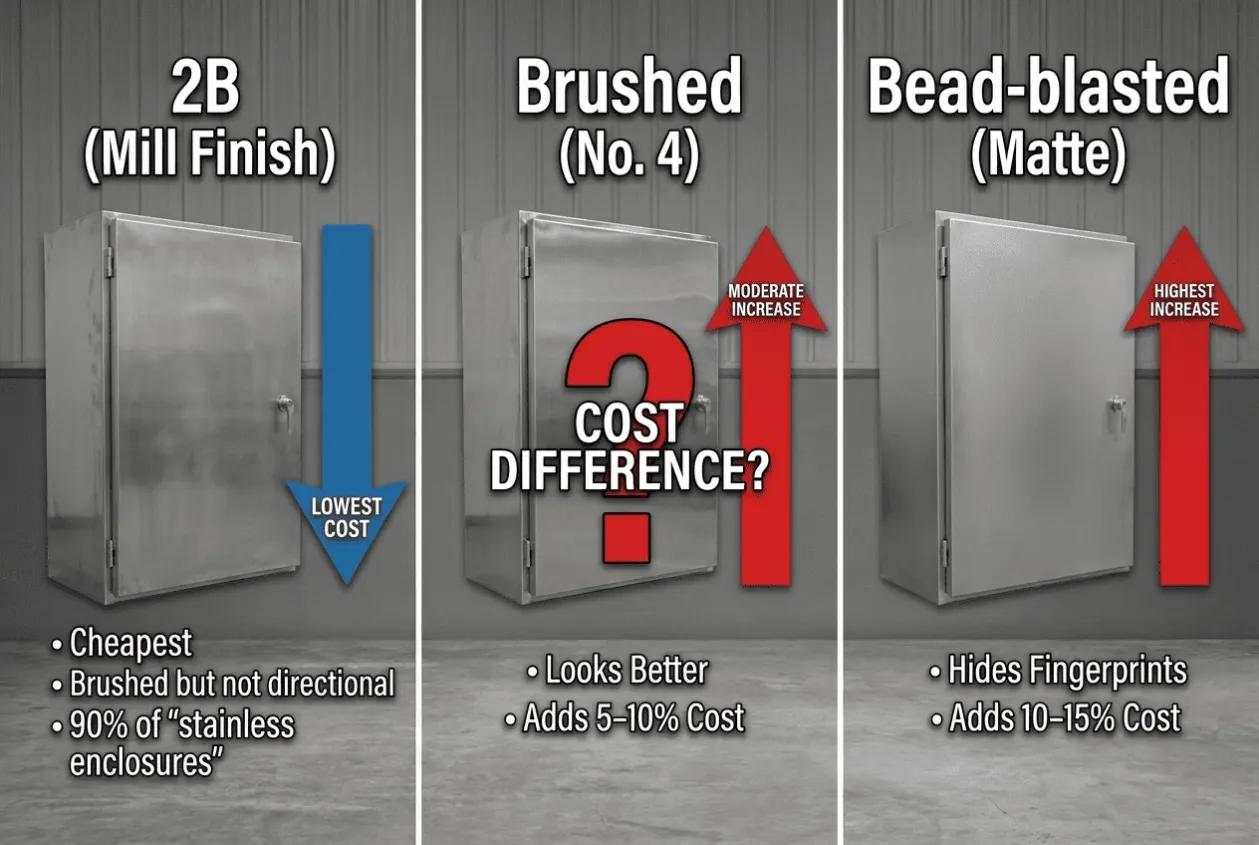
For most industrial buyers, 2B is fine. For food, pharmaceutical, or architectural projects where the panel is visible, No. 4 brushed or bead-blasted is standard. Specifying "stainless finish" without naming which one usually gets you 2B.
4. IP or NEMA rating
The rating changes how the enclosure is built and gasketed. Higher rating = more cost.
- IP54 / NEMA 12: indoor, dust-protected, no water jet
- IP65 / NEMA 4: outdoor, water-jet resistant
- IP66 / NEMA 4X: outdoor plus heavy water jet or temporary flooding
The jump from IP65 to IP66 is usually small (better gasket, possibly a drip shield). The jump from IP54 to IP65 is larger—polyurethane or silicone gasket vs foam. The full outdoor comparison is in IP65 vs IP66 outdoor cabinets.
For coastal or chemical wash-down environments, NEMA 4X (316 stainless + better gasketing) is common. We walk through what the 4 vs 4X difference actually means in the field in NEMA 4 vs 4X enclosures.
One thing stainless outdoor enclosures get wrong more than any other is condensation management. The metal body and the sun-warmed interior air create ideal conditions for water droplets to form on the inside of the door and drip onto the breakers. Adding a vent or a low-wattage heater strips most of that risk. We cover the five fixes that work in preventing condensation in outdoor electrical cabinets. The cheapest of those fixes is also the most overlooked: specify the enclosure with a sloped top rather than a flat top. Flat tops pool water and channel it toward the gasket when they age.
5. Cut-outs, windows, and hinges
Every hole, window, gland plate, and hinge is a manual operation. A plain enclosure with one door and no cut-outs is the cheapest. Add these and the price climbs:
Feature | Typical cost adder (relative) |
|---|---|
Cut-out per opening | +¥80–150 per cut-out (small), +¥300–600 per cut-out (large) |
Viewing window (tempered glass) | +¥450–900 per window |
Hinged door with quarter-turn latch | +¥200–400 (vs fixed screw-down door) |
3-point latching | +¥350–700 |
Inner door / swing panel | +¥600–1,500 |
A common surprise: buyers spec "viewing window for HMI" and discover the HMI cut-out, the window, the door stiffener to support the window, and the special gasket together add ¥1,500–2,500 per enclosure. Mentioning the HMI up front lets the supplier price it as a single package.
6. Mounting and accessories
- Wall-mount brackets: usually included for wall-mount enclosures, but confirm
- Floor-standing plinth / 100 mm base: typically ¥300–600 extra
- Lifting eyes: ¥150–350 per pair, standard on panels over 1.2 m tall
- Cable gland plate (bottom entry): ¥200–500; side or top entry adds more
- Inner mounting plate (zinc-plated or stainless): usually included, but check—sometimes quoted separately
- Rain canopy / sun shield: ¥400–900 for wall-mount outdoor enclosures
- Earthing studs, nameplates, and lifting handles: small but add up across many enclosures
The same enclosure with and without a plinth and lifting eyes can be ¥800 apart—usually skipped by buyers who do not realize these are line items.
7. Quantity, certifications, and lead time
These three work together:
- Quantity: 5 units is the typical low-volume MOQ for a custom stainless enclosure from a China supplier; below 5 units, the per-unit price climbs 40–80%. Our RFQ checklist covers the minimum information that gets you a useful quote from a supplier.
- Certifications: UL-listed enclosures need UL-listed components, a UL-recognized shop, and a UL field label if you want it on the nameplate. The cost adder is 15–30% on the enclosure itself; the lead-time adder is 2–4 weeks. If your project is shipping to the US and will be inspected, the cost is justified. If not, drop it. We cover the trade-off in UL-listed enclosures from China.
- Lead time: standard production is 15 days for cabinet-grade builds in stainless. Rush orders under 10 days add 15–30%. Quoting "standard lead time" without specifying it usually gets you the slowest tier.
A note on the mistakes that show up in every cheap quote. Buyers looking for the lowest stainless enclosure price often pay more in total because the quote is missing items they later have to add. The top 10 mistakes we see on outdoor enclosure specs — missing gland plates, no earthing studs, underspec'd hinges, no lifting eyes — adds 20–40% to the per-unit cost when added after the fact. Specifying them up front costs 5–10% extra on the original quote and ships on the same truck.
How to send your RFQ so the quotes you get are comparable
Send every supplier the same package:
- Overall dimensions (H × W × D) and mounting type (wall, floor, pole)
- Grade and thickness of stainless (e.g., 316 / 1.5 mm)
- Surface finish (2B / No. 4 / bead-blasted)
- IP or NEMA rating
- List of cut-outs, windows, and gland entries with positions
- Door count, hinge side, latch type
- Inner mounting plate, plinth, lifting eyes—yes or no
- Certifications needed (UL, CE, none)
- Quantity per size and lead-time target
Suppliers that quote on this package are quoting the same job. The price spread between two comparable quotes should be 10–20%; anything wider means the suppliers did not read the spec the same way. Our RFQ checklist for large outdoor cabinets has a longer version of this list if you are quoting a more complex project.
How we quote at Uni Regal
We are a sourcing partner based in Foshan, China, not a factory. When you send us an RFQ for a stainless steel enclosure, here is what happens:
- We read your spec and flag any decision that is missing or under-specified (grade, thickness, finish, IP rating, certifications). Most RFQs need one or two clarifying questions before a quote is meaningful.
- We get a written quote from 1–3 vetted Foshan enclosure suppliers, depending on the certification and finish you need. We pick the supplier by capability, not by the cheapest price they offer you. The same approach applies when we source the control panel electronics that go inside — our guide to control panel manufacturers lists the questions we ask before we put a panel shop on our shortlist.
- We add our sourcing fee on top of the supplier's price—typically 8–15%, transparent line by line.
- We give you a single fixed quote with a 15-day production lead time, a 5-piece MOQ for cabinet-grade builds, and a 3–5 day ship-out window for stocked PLC / breaker / HMI components if you are sourcing the panel as a complete assembly.
If the same enclosure is sourced as part of a control panel build, we can bundle the enclosure quote with the component quote and ship it as one integrated panel. This usually saves 8–15% versus sourcing them separately. If that panel also has motor feeders, we spec the motor starting method at the same time—you can read how to choose the right motor starting method to see why DOL vs. star-delta vs. VFD changes the contactor cost and the enclosure size.
If your stainless enclosure houses any control electronics that cannot tolerate a power blip—PLCs, HMIs, instrumentation loops — add an industrial UPS sized for the panel load to the spec. A 1 kVA UPS for a small panel is roughly ¥1,800–2,500 and adds 1 week to the panel lead time. The cost of one UPS is less than the cost of one unplanned shutdown caused by a brownout. Lead time, certification, and FAT testing for UPS-equipped panels are covered in our control panel FAQ on lead time, certification, and testing.
If your project lives outdoors in a hot climate and the heat load is high enough to derate the breakers, you will need forced cooling. Our outdoor cabinet air-conditioner guide compares enclosure air conditioners, vortex coolers, and filtered fans side by side. The cheapest cooling option that still keeps the panel inside its derating curve is almost always a filtered fan + exhaust, not an air conditioner—the air conditioner is worth it only when ambient is consistently above 40°C or the panel sits in direct sun on a dark surface.
Send your RFQ to natalie@uniregal.com with the spec list above, and you will get a comparable quote within 48 hours. If you want the full supplier-side checklist (what we ask before we price anything), our page on working with an electrical enclosure supplier in China has the longer version.
Frequently asked questions
What is the typical MOQ for a custom stainless steel enclosure from a China supplier?
5 units per size for cabinet-grade builds from a Foshan workshop. Below 5 units, the per-unit price climbs 40–80% because setup time is the same regardless of batch size. If you only need 1–2 units, ask for stock modified-to-spec enclosures first.
Can I get a sample before committing to a batch?
Yes. Most suppliers will produce one sample unit at 2–3× the per-unit batch price, refundable against the production order. Sample lead time is typically 10–15 days. Confirm the sample-refund policy in writing before paying the sample fee.
Does a stainless steel enclosure still need powder coating?
Usually no. 304 and 316 stainless are used unpainted for most industrial and outdoor applications. Powder coating is occasionally applied for color coding or where the enclosure must match a brand color. If you do not need color, skip the powder coat—it adds 8–15% cost and 3–5 days.
How long does a 316 stainless enclosure last outdoors?
In a typical industrial atmosphere, 15–25 years. Coastal sites with regular salt spray expect 10–15 years before cosmetic pitting, longer before structural concern. Carbon steel in the same conditions is 3–7 years even with powder coating. The premium for 316 pays back across this lifespan.
Do I need UL if I am shipping to the US?
Only if the inspector on the project site checks. UL 508A is a panel-level certification (the assembled control panel), while the enclosure itself usually only needs UL-listed construction (recognized components, proper grounding). If your panel is going to be inspected, ask for UL from the start—retrofitting UL after the fact is more expensive than building it in. We cover what UL actually costs and when you need it in UL-listed electrical enclosures from a China supplier.
Can I order spare parts (gaskets, hinges, and latches) with the enclosure?
Yes. Most suppliers will quote spare parts at cost plus 10–20%. Order them at the same time as the enclosure so they ship together. Spare gaskets in particular are worth buying—they are the highest-wear item on an outdoor enclosure, and they degrade faster than the stainless body.