
Aug 22, 2026Buying Guides
Top 10 Industrial UPS Manufacturers
A buyer-focused comparison of top industrial UPS manufacturers, covering application fit, UPS selection framework, supplier red flags, panel integration, maintenance, runtime, and quotation preparatio
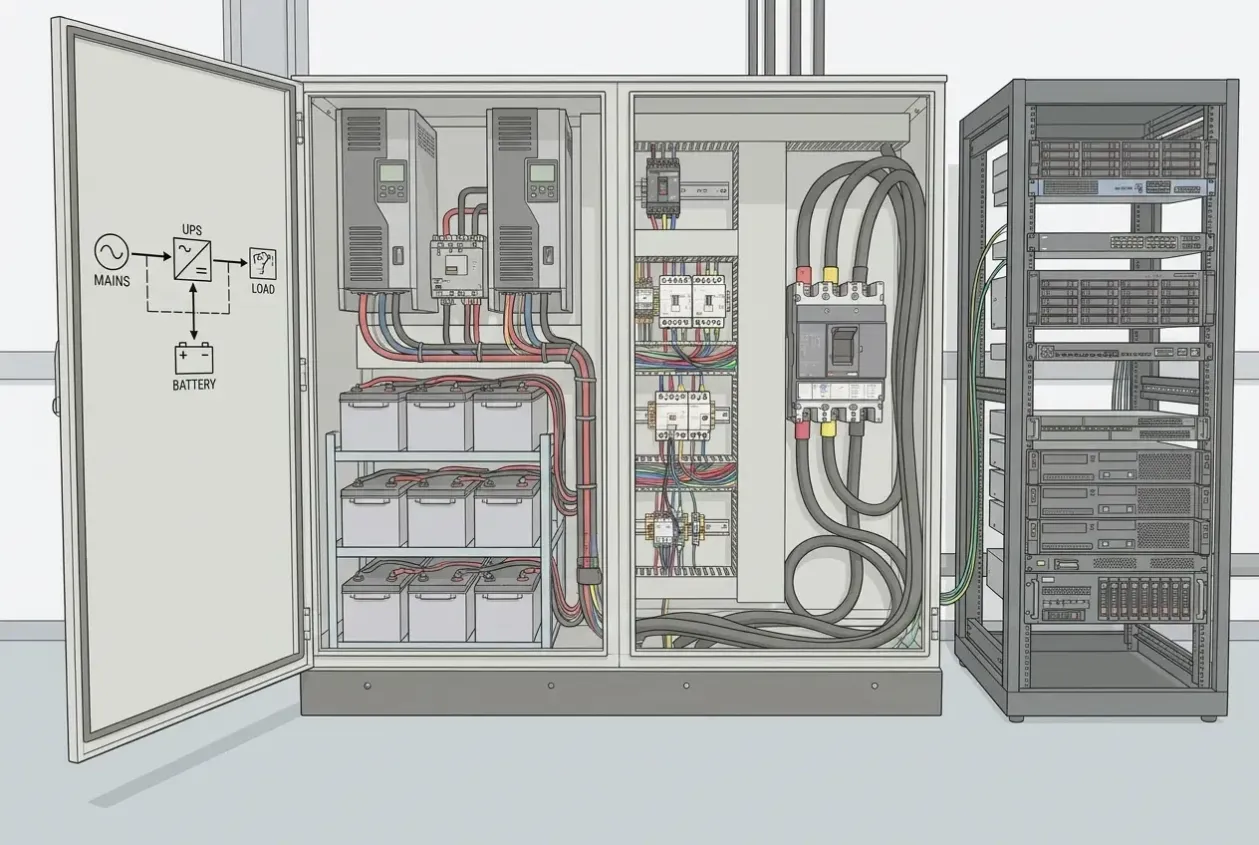
Top 10 Industrial UPS Manufacturers: A Buyer’s Comparison for Automation Projects
Industrial UPS manufacturers should not be compared only by brand size. For industrial automation projects, the real question is simple: what must the UPS protect, and what happens if it fails?
A UPS used for a PLC cabinet is different from a UPS used for an electrical room, a remote RTU station, a production line, or a plant-wide critical power system. Some buyers need three-phase backup for larger loads. Some only need a compact 24V DC UPS to keep the PLC, HMI, Ethernet switch, RTU, or communication gateway alive during a short power dip.
That is why there is no single “best” industrial UPS manufacturer. The best supplier depends on application fit, runtime, maintenance access, environment, and integration with the control system.
Top 10 Industrial UPS Manufacturers Comparison Table
Manufacturer | Best For | Buyer Note |
|---|---|---|
Plant-wide UPS and industrial power backup | Suitable when UPS selection is part of a wider electrical infrastructure project | |
Industrial facilities and power protection | Often considered when reliability, service, and facility-level backup matter | |
Heavy industry and process power protection | Practical for industrial environments where electrical system coordination is important | |
Siemens-based automation and 24V DC UPS systems | Strong fit when the plant already uses Siemens PLCs, power supplies, and control architecture | |
Critical infrastructure and larger UPS projects | Better suited for data, telecom, utility, and high-availability applications | |
Power quality and electrical continuity | Useful when power monitoring, switching, and continuity are key concerns | |
Cost-performance and three-phase UPS projects | Often reviewed when buyers need balanced performance and cost control | |
Utility, infrastructure, and large power systems | More relevant for larger power protection and infrastructure applications | |
Industrial backup and critical-load protection | Suitable for buyers comparing European UPS suppliers for industrial backup | |
Integrated automation panel UPS projects | Best fit when UPS must be supplied together with PLC panels, enclosures, wiring, FAT, and export documentation |
Why Buyers Choose Different Suppliers
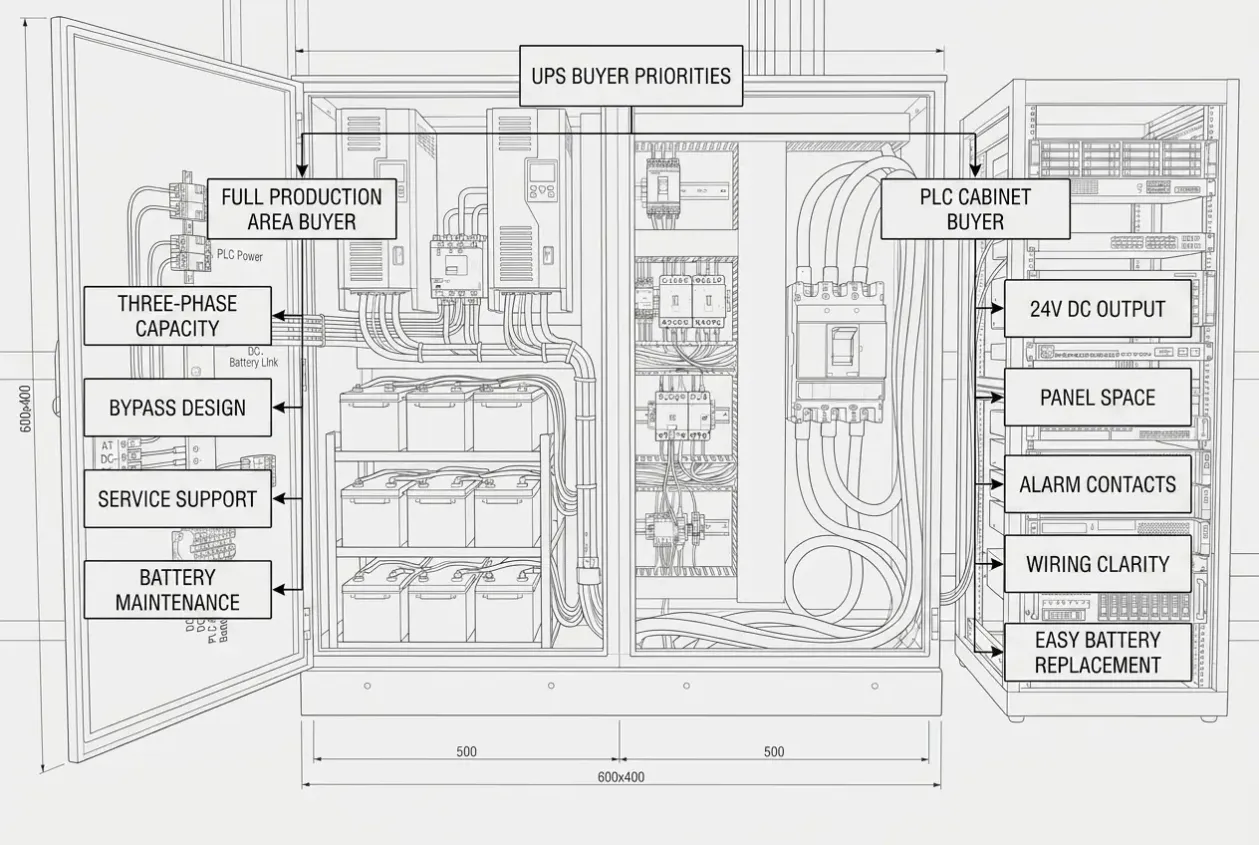
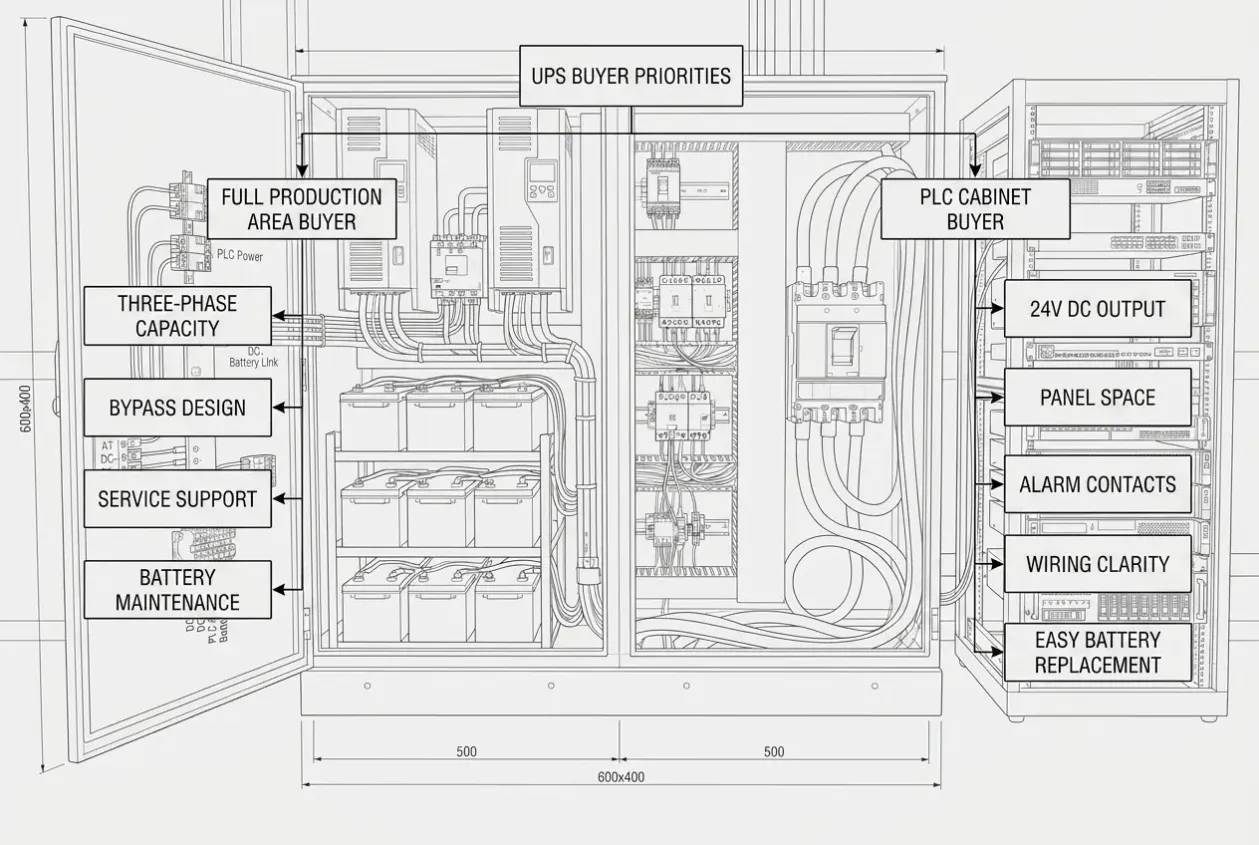
A buyer protecting a full production area will usually care about three-phase capacity, bypass design, service support, and battery maintenance. A buyer protecting a PLC cabinet will care more about 24V DC output, panel space, alarm contacts, wiring clarity, and how easily the maintenance team can replace the battery.
For remote stations, such as pump stations, RTU panels, or outdoor control cabinets, the UPS must also match temperature, enclosure rating, communication load, and backup time. In export projects, documentation, packing, FAT, and component availability may matter as much as the UPS brand.
Industrial UPS Selection Framework
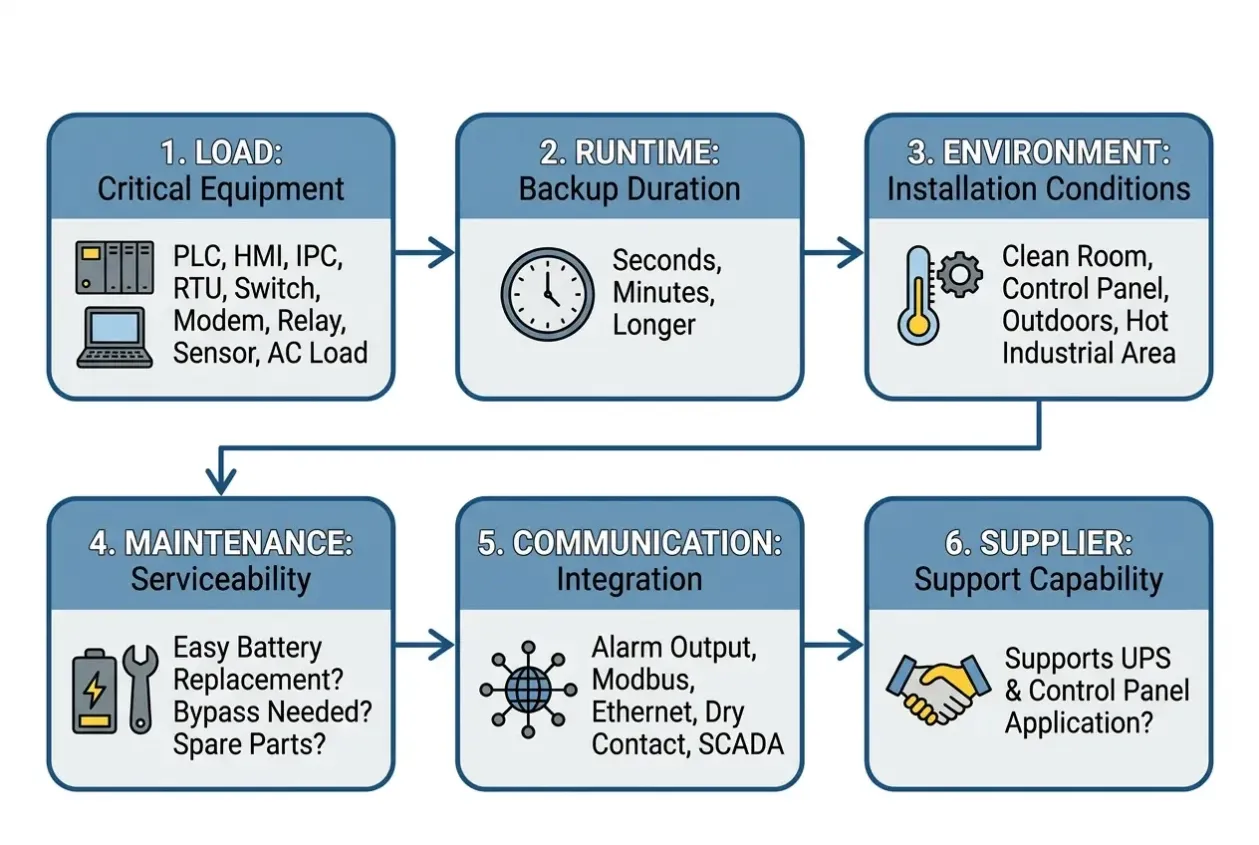
I usually review industrial UPS suppliers with this framework:
- Load: What equipment must stay powered? PLC, HMI, IPC, RTU, switch, modem, relay, sensor, or larger AC load?
- Runtime: Does the system need seconds, minutes, or longer backup time?
- Environment: Will the UPS be installed in a clean electrical room, inside a control panel, outdoors, or in a hot industrial area?
- Maintenance: Can batteries be replaced easily? Is bypass needed? Will spare parts be available later?
- Communication: Does the UPS need alarm output, Modbus, Ethernet, dry contact, or integration with SCADA?
- Supplier: Can the supplier support both the UPS and the control panel application?
Supplier Red Flags
Be careful if a supplier only asks about battery capacity, price, and lead time. That usually means they are quoting a UPS box, not reviewing the application.
A stronger supplier will ask about control load, input and output voltage, runtime target, ambient temperature, enclosure space, battery replacement access, bypass method, alarm output, communication needs, FAT, and maintenance path.
This difference is important. A cheap UPS can still create downtime if it is hard to maintain, poorly integrated into the control panel, or unable to support the actual control load during a power event.
Why UniRegal Can Be Shortlisted
Besides global UPS manufacturers, many industrial projects also need an integration partner. The UPS may need to be installed inside a control panel, connected to PLC power, wired to alarm terminals, tested during FAT, and shipped together with the enclosure and automation components.
This is where UniRegal fits. UniRegal is not positioned as a generic UPS brand. It is a project supplier for industrial automation panels, electrical enclosures, PLC systems, and control power backup packages.
Before requesting a quotation, send the load list, runtime target, input/output voltage, installation environment, panel layout, alarm needs, preferred brands, and delivery schedule. A serious supplier can then quote an industrial UPS solution, not just a battery backup product.
Related Guides: