
Aug 18, 2026Buying Guides
NEMA 4 vs NEMA 4X Enclosure: Which Rating Do You Need? | UniRegal
NEMA 4 and NEMA 4X both resist rain and splash, but 4X adds stainless or non-metallic corrosion resistance for outdoor, coastal and chemical sites. Compare ratings and source from Foshan.
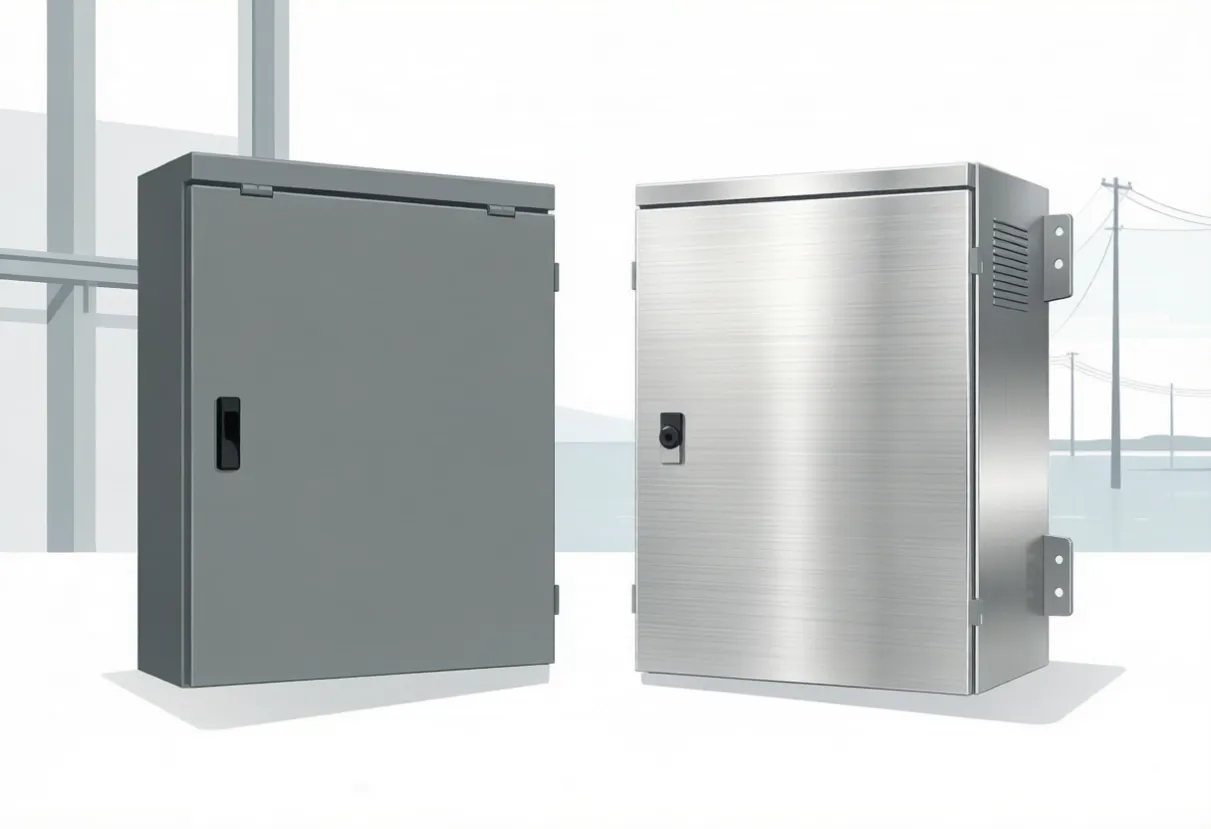
NEMA 4 vs NEMA 4X: What's the Difference for Industrial Enclosures?
Short answer: NEMA 4 and NEMA 4X both protect an electrical enclosure against rain, splashing water, and outside ice formation. The difference is corrosion: NEMA 4X is built from stainless steel or non-metallic materials that resist corrosion, while a standard NEMA 4 enclosure may use painted carbon steel that can rust in wet or chemical environments. If your site is outdoor, coastal, food-grade, or chemical-exposed, choose NEMA 4X.
Below, we break down what each rating actually protects against, how NEMA maps to IP codes, and how to decide which one your panel needs.
What NEMA ratings protect against
NEMA (National Electrical Manufacturers Association) ratings describe how well an enclosure protects its contents from the environment and accidental contact. They are common in North America; outside North America you will usually see the IP (Ingress Protection) system instead. If you want the exact test conditions, the authoritative source is the NEMA 250 standard published by the National Electrical Manufacturers Association.
A NEMA 4 enclosure is rated for:
- Indoor or outdoor use
- Rain, snow, and splashing water (hose-directed water from any direction)
- Windblown dust
- External ice formation
A NEMA 4X enclosure adds one thing on top of all of the above:
- Corrosion resistance — the enclosure is made from stainless steel or a non-metallic material (such as fiberglass-reinforced polyester) that will not corrode in wet, salty, or chemical atmospheres.
That single addition is why NEMA 4X is the default for food & beverage, pharmaceutical, wastewater, coastal, and outdoor solar sites.
NEMA 4 / 4X vs IP rating (quick map)
Buyers often ask "what is the IP equivalent of NEMA 4X?" There is no perfect 1:1 match, but the practical mapping most specifiers use is:
NEMA rating | Closest IP equivalent | Key difference |
|---|---|---|
NEMA 4 | IP66 | Both resist powerful water jets; NEMA 4 adds ice/foreign-object and hose-direction tests |
NEMA 4X | IP66 + corrosion-resistant material | IP66 does not specify material; 4X requires stainless/non-metallic |
NEMA 12 | IP52–IP54 | Indoor dust and drip only, no water jet |
Practical rule: If a customer in Europe or Asia specifies "IP66 stainless," a NEMA 4X stainless enclosure satisfies the intent. If they specify plain "IP66" on carbon steel, NEMA 4 is the closer match but will not resist corrosion like 4X.
NEMA 4 vs NEMA 4X: side-by-side
Factor | NEMA 4 | NEMA 4X |
|---|---|---|
Water / rain / splash | ✅ | ✅ |
Dust | ✅ | ✅ |
Ice formation | ✅ | ✅ |
Corrosion resistance | ❌ (carbon steel can rust) | ✅ (stainless / non-metallic) |
Typical material | Painted carbon steel | 304 / 316 stainless, FRP |
Outdoor coastal | ⚠️ risk of rust | ✅ |
Food / pharma wash-down | ⚠️ | ✅ |
Cost | Lower | Higher (material-driven) |
Which one do you need?
Choose NEMA 4X when any of these apply:
- The enclosure is outdoors and exposed to weather year-round
- The site is coastal or marine (salt air)
- There is wash-down (food, beverage, pharma, cleanroom)
- The atmosphere is chemical or corrosive (wastewater, pools, processing)
- You want maximum service life with minimal maintenance
Choose NEMA 4 (painted carbon steel) when:
- The enclosure is indoor or sheltered, dry most of the time
- Corrosion is not a concern
- You want the lowest cost and the rating is driven by a general "weatherproof" spec
Material matters more than the label
A NEMA 4X rating is only as good as the material behind it. For coastal and chemical sites we source 316 stainless (higher molybdenum, better pitting resistance than 304). For indoor clean areas, 304 stainless is usually enough and costs less. For highly corrosive or lightweight needs, fiberglass-reinforced polyester (FRP) is a strong non-metallic option.
Note: UniRegal is a Foshan-based sourcing and integration supplier, not a single factory. We match each enclosure spec to the right workshop in the local metal-enclosure cluster — including UL-listed workshops when UL certification is required — so you are not locked to one plant's limited range. For panels that must carry UL certification, the relevant rule is UL 508A for industrial control panels.
Lead time and MOQ (for distributors and OEMs)
If you are sourcing enclosures in volume:
- MOQ: from 5 units for standard custom bodies
- Lead time: ~15 days for typical custom enclosures; automation components (PLC / HMI / VFD) ship in 3–5 days
- One-stop option: enclosures can be sourced together with the PLC / HMI / VFD / UPS that go inside, consolidated into one shipment with one QC point
FAQ
Q: Is NEMA 4X the same as IP66?
A: Close, but not identical. NEMA 4X and IP66 both resist powerful water jets, but NEMA 4X additionally requires corrosion-resistant material (stainless or non-metallic) and covers ice formation. If you need "IP66 stainless," a NEMA 4X stainless enclosure meets the intent.
Q: Can I use a NEMA 4 enclosure outdoors?
A: Only if it is sheltered and corrosion is not a risk. A standard NEMA 4 carbon-steel box will eventually rust in open weather or coastal air. For truly outdoor or coastal sites, use NEMA 4X stainless.
Q: Do you supply UL-listed NEMA 4X enclosures?
A: We source from UL-listed workshops for NEMA 4X / IP66 builds when UL certification is required. Send your spec and we will match a qualified workshop rather than forcing one plant's catalog.
Q: What is the minimum order for custom NEMA 4X enclosures?
A: From 5 units for standard custom bodies, with ~15-day lead time. Larger batches get better unit pricing.
Get a quote
Send your environment (indoor/outdoor, coastal, wash-down), required rating (NEMA 4 or 4X), and dimensions or drawing. We will return a quote with material, rating, finish, and lead time — and can bundle the enclosure with the automation components that go inside.
Related guides
Sources
- NEMA 250 standard — National Electrical Manufacturers Association
- UL 508A for industrial control panels — UL Standards Catalog