
Sep 4, 2026Buying Guides
What to Send Your Control Panel Supplier Before Requesting a Quote
A control panel builder needs seven things from you before they can quote and build. Use this spec checklist to avoid revision rounds, lead-time surprises, and on-site startup failures.
Control Panel Build Spec: What to Send Your Panel Builder
You want a control panel built and shipped on schedule. Your panel builder wants the same thing. What kills the timeline, almost every time, is not the steel or the breakers—it is the missing information that turns a quote into a revision cycle.
This guide lists the seven specs a competent panel builder needs from you before they can commit to a fixed price and a fixed lead time. Send these in your first email, and you cut the typical quote-to-ship timeline from 8–12 weeks down to 4–6 weeks. Skip any of them and you will spend the next two weeks going back and forth on missing details, while your project deadline stays where it was.
The seven things your panel builder needs
1. Single-line diagram (or a hand sketch that says the same thing)
Your builder needs to see the incoming supply (voltage, phases, source), the main disconnect, the busbar arrangement, the downstream feeders, and which loads each feeder serves. It does not need to be a polished CAD file on the first email—a one-line diagram with breakers, contactors, and overload ratings written by hand is enough to start. What does not work is a photo of the old panel's door with no markings visible; we get those weekly, and they never start a quote.
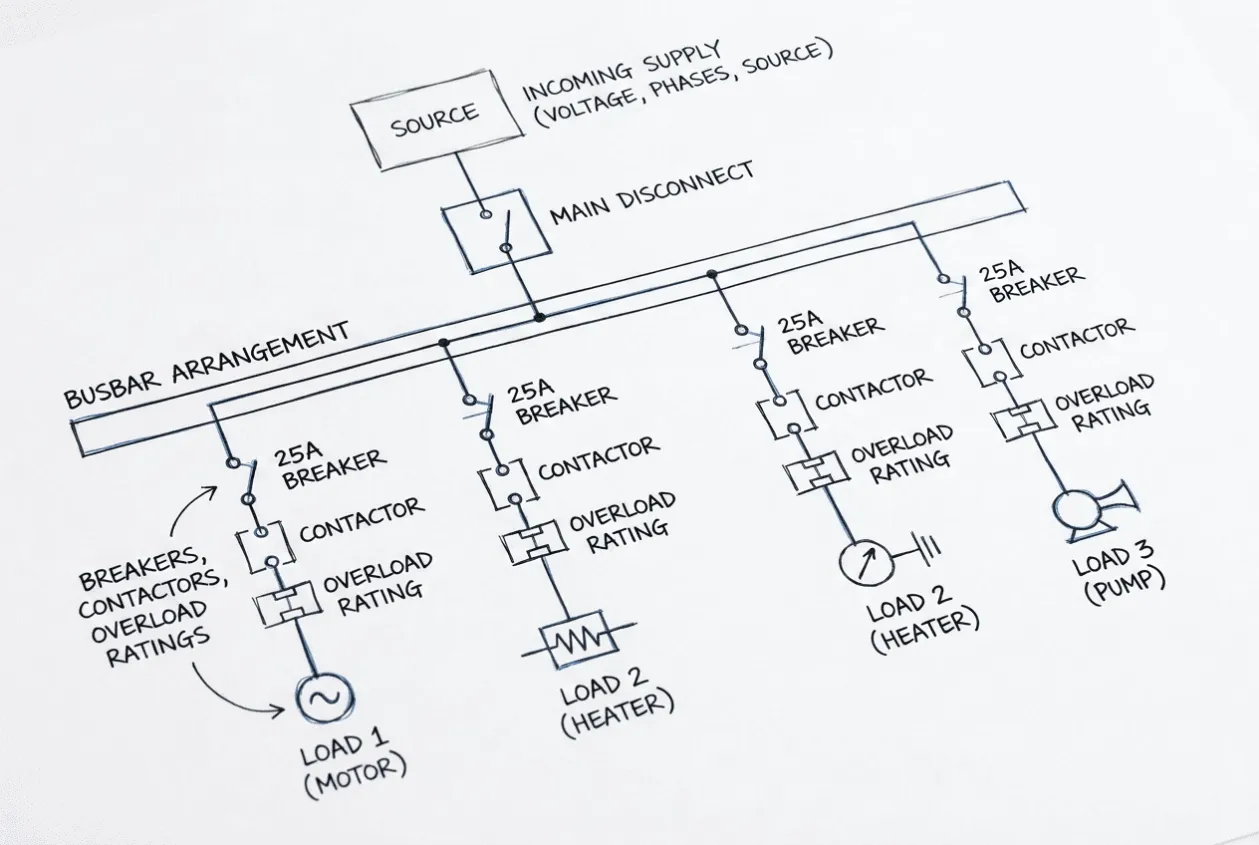
If you have an existing drawing in DWG or EPLAN format, attach it. If you do not, list the incoming feed and the loads sequentially. The goal is for the builder to see the topology: which breaker feeds which contactor, which contactor feeds which motor, and where the control circuit sits.
2. Load list—one row per downstream device
Every motor, heater, solenoid, or DC power supply inside the panel deserves one row. The minimum columns are
Field | Why the builder needs it |
|---|---|
Tag (e.g., M1, HEATER-2) | Cross-references the single-line diagram |
Rated power (kW or A) | Sizes the contactor and the breaker |
Full-load current (A) | Sizes the overload relay |
Starting method (DOL, star-delta, VFD, soft starter) | Decides contactor type and inrush handling |
Number of poles | Whether you need 1P, 2P, 3P, or 4P breakers |
Operating voltage | 24 V DC control vs. 230/400 V AC power |
Environment (IP rating, ambient temp) | Decides enclosure type and cooling |
This table is what separates a builder who sends you a quote in 48 hours from a builder who sends you a list of questions in 48 hours. We have shipped custom panels for OEMs in water treatment and HVAC customers where the entire load list fit on one A4 page—and the quote came back the same day.
3. Control logic—what triggers what
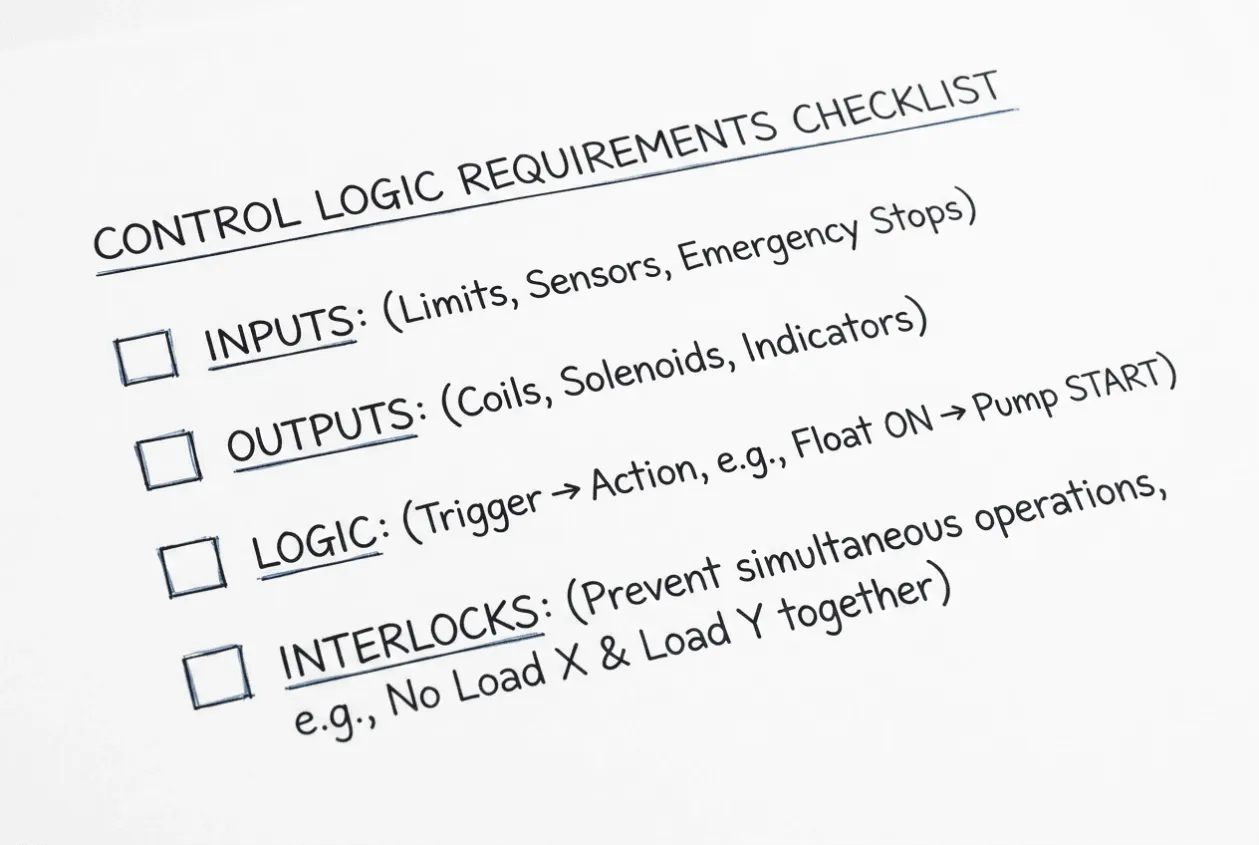
Even a simple panel has control logic: a float switch starts a pump, a thermostat cuts a heater, and a PLC output drives a contactor. Your builder needs to know:
- Inputs: which field signals come in (limits, sensors, emergency stops)
- Outputs: which coils, solenoids, or indicators the panel drives
- Logic: what triggers what (float switch on → pump start; 30 s later → valve open)
- Interlocks: which loads must never run at the same time
If you are using a PLC, share the I/O list. If you are using relays only, draw the logic on one page. If the logic is "the existing PLC over there handles everything—the panel is just power distribution," say so. That single sentence saves the builder a day of guessing.
4. Enclosure specs—physical and environmental
The enclosure is not a wrapper; it is half of the deliverable. Specify:
- Material: carbon steel, 304 vs 316 stainless steel, galvanized
- IP rating: IP65 vs IP66 is the most common split for outdoor projects
- Mounting: floor-standing, wall-mounted, or wall-mount vs floor enclosure — both options trade footprint for serviceability
- Dimensions (or a minimum internal volume and a maximum external footprint)
- Ambient conditions: outdoor? coastal? chemical exposure? dust?
- Cooling: natural convection, forced fan, air conditioner for outdoor cabinets, or heatsink
- Entry: top entry, bottom entry, or cable gland plate
Picture sending only "I need a panel for a pump skid" and getting back an 800 × 600 × 250 mm wall-mount panel in bare carbon steel—when your skid sits outdoors in a coastal refinery. The builder made a reasonable default choice; you already had a different one in mind. Specifying the enclosure up front closes that gap.
5. Certifications and standards you need stamped on the nameplate
Different projects need different stamps. Common ones we get asked for:
- UL 508A (US industrial control panels)
- CE + EN 61439 (EU low-voltage switchgear)
- CSA (Canada)
- GB/T (China domestic)
- IECEx / ATEX (hazardous areas)
- NEMA 4 / 4X (US enclosure rating, often confused with NEMA 4 vs 4X)
If you genuinely need UL, say so on the first email—UL-listed panels are built with UL-listed components, a UL-recognized shop, and a UL field label. That changes the cost and the lead time. If you do not need UL and your spec writer copy-pasted a UL requirement from a template, drop it. We have seen buyers pay 35% more for UL panels that were never going to be inspected.
For more on what certifications commonly cost and how they change the timeline, see our control panel FAQ on lead time, certification, and testing.
6. Project context—where the panel will live
A panel built for a frozen-food plant and a panel built for a coastal oil-and-gas skid have almost nothing in common, even if the load list is identical. Tell your builder:
- Industry: oil and gas, water treatment, HVAC, manufacturing, marine
- Site location: indoor controlled, outdoor covered, outdoor exposed, hazardous area
- Operating temperature range
- Humidity and condensation risk — see our guide to preventing condensation inside outdoor cabinets
- Vibration: skid-mounted, vessel-mounted, or stationary
- Altitude: derating applies above 1000 m
- Who installs and commissions it: your team, the builder's team, or a third-party integrator
This block answers three questions the builder would otherwise ask back: "Will this need extra cooling?", "Will it need anti-condensation heaters?", and "Will it need a marine-grade coating?"
7. Commercial and logistic constraints
The last block is not technical, but it is what makes a quote land:
- Quantity: one-off, batch of 5, or annual frame contract
- Target lead time: realistic, not aspirational (a typical custom control panel from a China sourcing partner is ~15 working days for the cabinet enclosure plus 3–5 days for the components—total 3–4 weeks from confirmed PO)
- Incoterms: FOB, CIF, DAP
- Delivery address: factory, jobsite, or port
- Packaging: export wooden crate, pallet, or container load
- Payment terms: T/T 30/70, L/C, others
How to package all of this in one email
Send a single email with three attachments:
- Single-line diagram (PDF or DWG—any format a builder can read)
- Load list (Excel, 1 row per load)
- Spec sheet (1 page: enclosure, certifications, project context, commercial terms)
In the body, paste a 4-line summary: industry, qty, target lead time, and port of delivery. That is enough for a builder to price the steel, the breakers, and the assembly hours in one pass—and to come back with a quote that does not carry a "subject to" clause the size of the panel itself.
If you want a builder that ships in 3–4 weeks and knows how to read a load list, you can submit your requirements here — we respond within one business day with either a quote or a single, focused clarifying question.
Common spec mistakes that cost you two weeks
- Sending only a photo of the existing panel's nameplate (no single-line, no load list)
- Listing motor kW but not the full-load current—your builder has to look it up and might pick the wrong frame
- Forgetting control voltage—a 24 V DC control circuit and a 230 V AC control circuit are not interchangeable
- Asking for "UL" without knowing whether your site actually requires UL inspection
- Leaving the enclosure to the builder's discretion and then rejecting the quote over the chosen material
- Not stating ambient conditions—a 40°C outdoor skid and a 25°C indoor plant ship in different panels
- Copy-pasting an old spec from a different project and not deleting the certifications you no longer need
Each of these is a 2–3 day round trip. Six of them is two weeks. Skip all six and you ship on time. For the longer version of why startup problems happen on site, see why control panel startup problems happen more often than buyers expect and the wiring-specific hidden wiring problems that delay OEM startups.
FAQ
What is the minimum information a panel builder needs to quote?
A single-line diagram, a load list (one row per downstream device), and a one-line spec covering enclosure, certifications, and commercial terms. With those three, most builders will quote within 48 hours.
Can I send a hand sketch instead of a CAD drawing?
Yes. A hand-drawn single-line diagram with breakers, contactors, and overload ratings written clearly is enough to start a quote. CAD drawings are needed for the build, not for the quote.
How long does a custom control panel take to build from a confirmed spec?
From a confirmed spec and confirmed PO, a typical custom control panel from a China sourcing partner ships in 3–4 weeks—roughly 15 working days for the cabinet enclosure plus 3–5 days for the components and assembly. Add 1–2 weeks if UL listing or a specific certification is required.
Do I need an UL listing if my project is outside the US?
Not always. UL is a US industrial standard. If your project ships to the EU, you need CE + EN 61439. If it ships to Canada, you need CSA. If it stays in China, GB/T. Many buyers ask for UL out of habit when their project never sees a US inspector—dropping that line item can cut 20–35% off the panel cost.
What happens if I forget to specify the enclosure material?
The builder will pick a default—usually bare carbon steel for indoor panels, 304 stainless for "outdoor" panels, or galvanized for cost-driven projects. If you needed 316 stainless for a coastal site, you will find out at the quote stage, when changing the material restarts the steel-sourcing clock.
Can I bundle multiple panels into one RFQ?
Yes—and we encourage it. Bundling 5–10 panels into one RFQ lets the builder commit to a single steel run, a single components order, and a single FAT. Lead time drops by a week, and unit cost drops by 10–15%.
What if my panel needs a PLC and I do not have the program yet?
Send the I/O list and a description of the process. The panel builder can wire, label, and pre-test the panel against the I/O list and ship it with the PLC programmed to your spec later.
How do I choose between DOL, star-delta, VFD, and soft starter for the motors on my load list?
The right starting method depends on motor size, mechanical load, and how often the motor starts per hour. A short buyer-side walkthrough is in our guide on how to choose the right motor starting method. For a broader view of how panel builders assemble starters into a finished cabinet, see our motor control panel sourcing overview.
Should the RFQ also include a request for quotations on the cabinet alone?
Often yes, especially if you are buying the cabinet and the components from different suppliers. A practical buyer-side RFQ that pulls enclosure, components, and commercial terms into one document is in our enclosure RFQ checklist guide. If you want a single partner that can quote the cabinet and the components together, see our page on sourcing enclosures and control panels as a China supplier.
What if the project also needs an industrial UPS on the same skid?
Add it to the same spec sheet. A control panel and a UPS sitting on the same skid share the same enclosure, the same cable entry, and the same ambient conditions — and the lead times for a UPS and a custom cabinet are different. A practical supplier shortlist is in our top 10 industrial UPS manufacturers guide.
What are the most common mistakes buyers make when sending a build spec?
The same six or seven mistakes come up on almost every rushed RFQ. The full list, with what each one costs in lead time, is in our guide on the top 10 mistakes when specifying outdoor electrical cabinets. Skim it before you press send on the first email.