
Sep 5, 2026Buying Guides
Best Materials for Outdoor Electrical Cabinets
The best material for an outdoor electrical cabinet depends on corrosion risk, budget, site exposure, and expected service life. Painted steel is cost
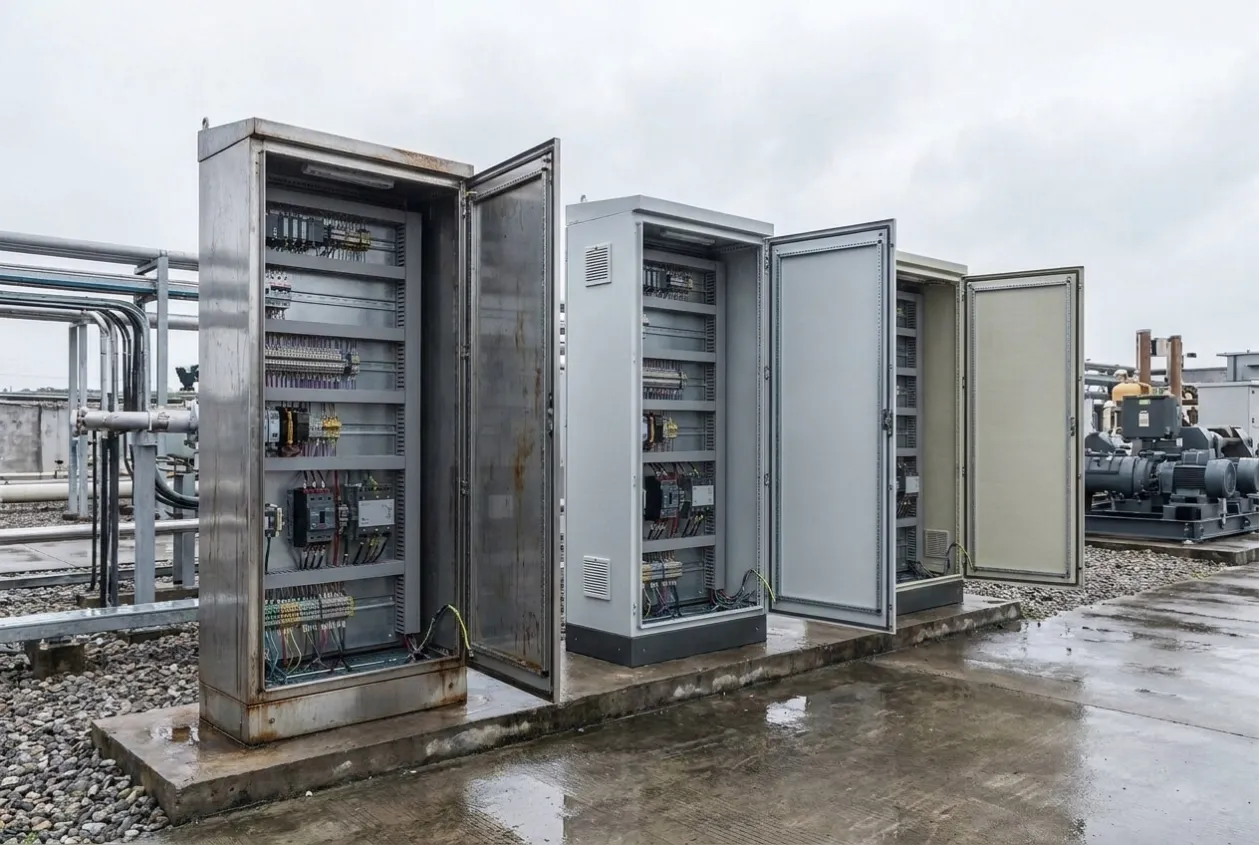
Best Materials for Outdoor Electrical Cabinets: Painted Steel, 304 Stainless Steel, or 316 Stainless Steel?
Choosing an outdoor electrical cabinet material is not simply a choice between “cheap steel” and “better stainless steel.”
The correct material depends on what the cabinet will actually face after installation: rain, humidity, salt, industrial chemicals, washdown, direct sunlight, temperature cycling, airborne contamination and the expected service life of the equipment inside.
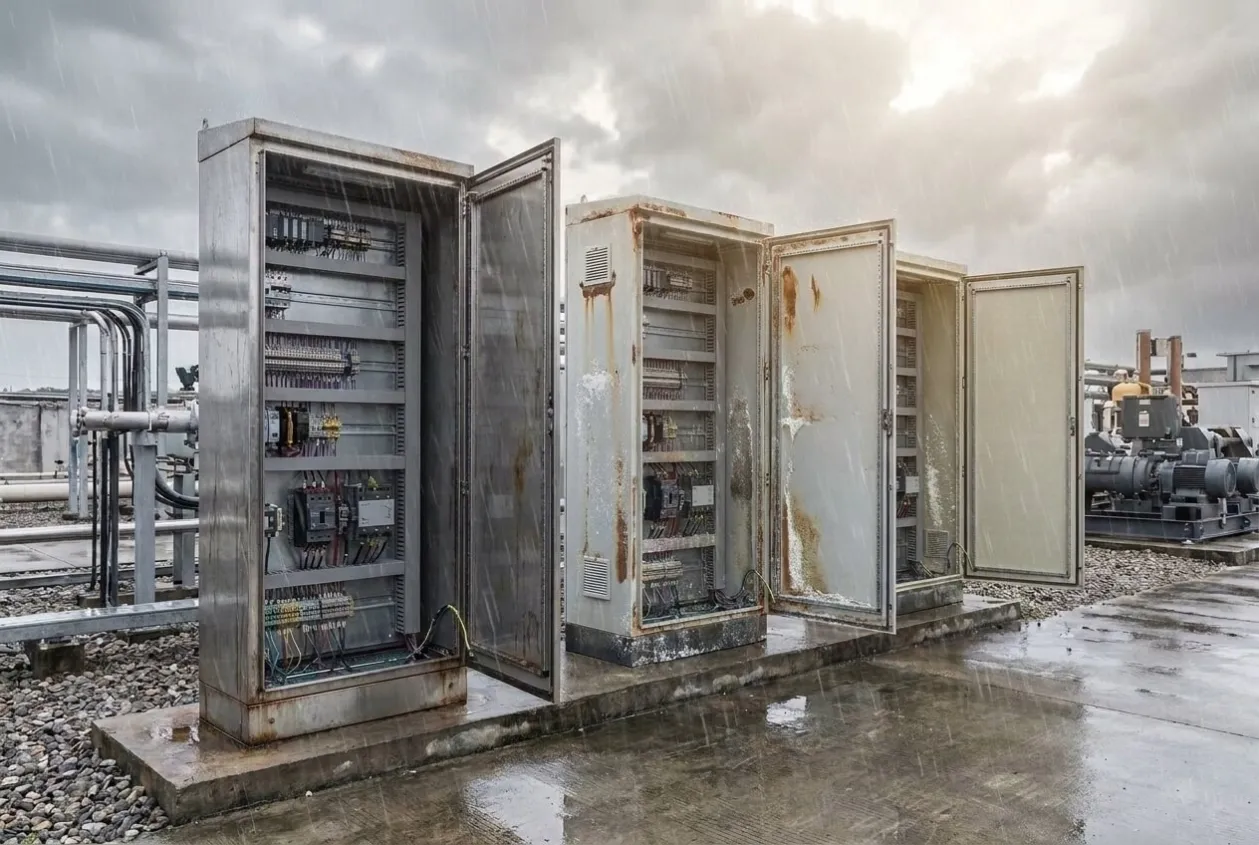
For many inland industrial sites, a properly prepared and coated carbon-steel cabinet can be completely appropriate. 304 stainless steel is a strong general-purpose choice where outdoor exposure and humidity are significant but chlorides remain limited. 316 or 316L stainless steel becomes more valuable when the cabinet is installed near the sea, around wastewater processes, in chemical plants or in environments where chloride-related corrosion is a realistic operating risk.
The buyer's decision should therefore not begin with:
Which material is the strongest?
It should begin with:
What will this cabinet actually be exposed to during the next 10 or 15 years?
That question usually leads to a much better specification.
Quick Selection Guide
For buyers who need a preliminary direction before reviewing the complete project conditions:
Installation Environment | Typical Starting Point | Main Reason |
|---|---|---|
Sheltered outdoor, dry inland site | Painted or powder-coated steel | Lower cost with adequate protection when coating remains intact |
General industrial outdoor installation | 304 stainless steel | Good overall atmospheric corrosion resistance |
High humidity without significant chloride exposure | 304 stainless steel | Reduces dependence on an external coating system |
Coastal or salt-air location | 316/316L stainless steel | Better resistance to chloride-induced pitting |
Wastewater treatment plant | 316/316L often preferred | Moisture, chemicals and corrosive gases may increase corrosion risk |
Chemical-processing area | Site-specific; often 316/316L | Material must match actual chemical exposure |
Food or beverage washdown | 304 or 316 depending on chemicals | Corrosion resistance plus cleanable surface |
Offshore or severe marine exposure | 316/316L or engineered alternative | High chloride exposure and difficult maintenance access |
This table should be treated as a starting point, not a material specification.
Exposure conditions, coating system, fabrication quality, gasket materials, fasteners, cooling method and enclosure rating still need to be reviewed before the cabinet is released for manufacture.
1. Start With the Environment, Not the Material Grade
A common RFQ says:
Outdoor electrical cabinet, IP66, stainless steel.
That still leaves several important engineering questions unanswered.
- What grade of stainless steel?
- Will the cabinet stand 500 metres from the sea or 100 kilometres inland?
- Will it be under a shelter?
- Will operators wash it with chemicals?
- Will chlorine, hydrogen sulfide or other corrosive substances be present?
- Will direct sunlight heat the cabinet every afternoon?
- Will condensation form inside overnight?
These conditions affect cabinet life more than the word “outdoor” alone.
A useful material review should consider at least five forms of exposure.
Atmospheric moisture
Rain and humidity increase corrosion risk, particularly where water can remain around hinges, seams, mounting brackets or damaged coatings.
Chlorides
Salt spray, coastal air, road salt and some process environments can accelerate localized corrosion, particularly pitting and crevice corrosion in stainless steels.
Industrial chemicals
Acids, alkalis, chlorine compounds, cleaning agents and process vapours can change which material is appropriate.
Mechanical damage
A coating system that performs well chemically may become vulnerable when scratched during transport, installation or maintenance.
Maintenance access
A cabinet located beside a workshop can be repaired or recoated relatively easily. A cabinet installed on an offshore structure, remote pumping station or operating wastewater plant may justify a higher initial material cost because future maintenance is much more difficult.
This is why material selection should be based on exposure and consequence, not simply initial purchase price.
2. Painted Steel: When Lower Cost Is Still Good Engineering
Painted or powder-coated carbon steel is sometimes dismissed too quickly for outdoor applications.
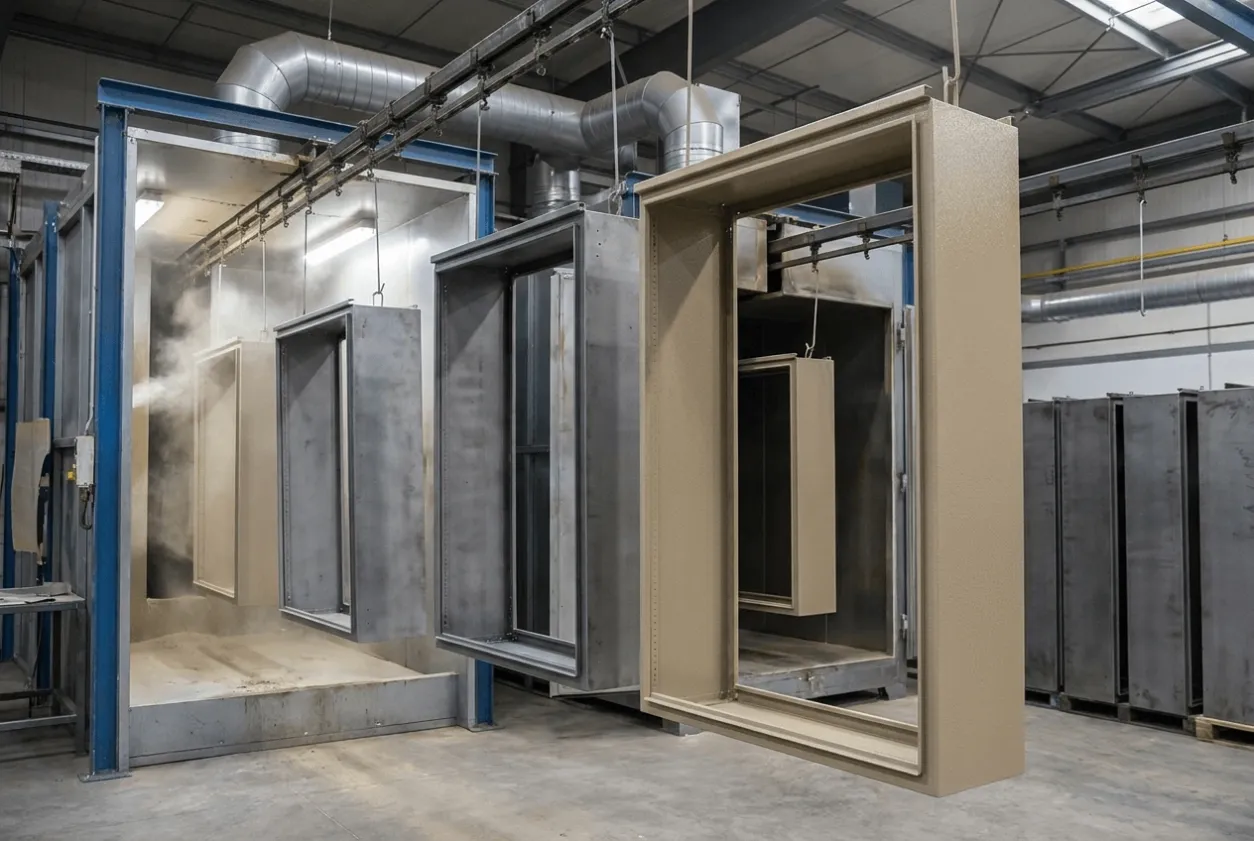
That is a mistake.
In the correct environment, coated steel provides good mechanical strength, easy fabrication and a significantly lower material cost than stainless steel.
The important point is that the corrosion resistance comes mainly from the surface-protection system, not from the carbon steel itself.
Where Painted Steel Makes Sense
It can be a reasonable choice for:
- Inland industrial sites
- Covered outdoor installations
- Utility areas with limited chemical exposure
- Cabinets protected from direct salt spray
- Projects where periodic maintenance is practical
- Cost-sensitive systems with moderate environmental severity
For these applications, the buyer should pay close attention to the coating specification.
“Powder-coated steel” is not enough information by itself.
The final performance depends on factors such as:
- Surface preparation
- Pretreatment
- Primer system
- Coating chemistry
- Dry-film thickness
- Edge coverage
- Weld preparation
- UV resistance
- Corrosion testing
- Repair method after fabrication damage
A strong coating system can provide years of service in an appropriate environment.
A poor one can begin failing around edges, fasteners or scratches surprisingly early.
Where Painted Steel Becomes Riskier
The main weakness appears when the protective layer is breached.
During shipping or installation, a cabinet can be scratched by lifting equipment, tools, conduit work or mounting hardware. Once bare carbon steel becomes exposed, corrosion can begin at that point and may spread underneath the surrounding coating.
That risk increases in:
- Coastal environments
- High-humidity locations
- Chemical plants
- Wastewater facilities
- Frequent washdown areas
- Sites where coating repair is unlikely to be maintained
This does not mean coated steel can never be used in these environments. It means the coating specification and maintenance strategy become much more important.
Buyer DecisionChoose painted steel because the site conditions justify it—not simply because it lowers the quotation.
3. 304 Stainless Steel: The General Outdoor Workhorse
304 stainless steel is widely used for outdoor industrial electrical cabinets because it provides a useful balance between corrosion resistance, fabrication availability, appearance and cost.
Unlike painted carbon steel, its corrosion resistance does not depend entirely on an applied coating. Stainless steel forms a passive oxide layer that helps protect the underlying metal.
For many ordinary outdoor industrial environments, this makes 304 a practical choice.
Where 304 Stainless Steel Usually Works Well
Typical applications include:
- General outdoor control cabinets
- Factory external equipment
- Water-treatment utility areas
- Commercial infrastructure
- Inland pumping stations
- Moderate-humidity locations
- Industrial sites without significant chloride exposure
For buyers who want longer-term outdoor corrosion resistance without moving immediately to the cost of 316, 304 is often the first stainless grade worth evaluating.
The Limitation Buyers Need to Understand
304 is stainless.
It is not corrosion-proof.
The most important limitation is usually chloride exposure.
Salt-containing environments can attack the passive surface layer and create localized pitting or crevice corrosion. This is why an enclosure that performs well at an inland factory may behave very differently at a coastal desalination project.
This distinction is especially important because the cabinet may still look satisfactory over most of its surface while corrosion begins locally around:
- Fasteners
- Door edges
- Welds
- Crevices
- Mounting brackets
- Drain locations
- Contaminated fabrication areas
So the question should not be:
Is 304 suitable outdoors?
The answer is often yes.
The better question is:
What is present in the outdoor environment?
That determines whether 304 remains the right choice.
4. 316 and 316L Stainless Steel: When Chloride Exposure Changes the Decision
316 stainless steel contains molybdenum, which improves resistance to chloride-related localized corrosion compared with 304.
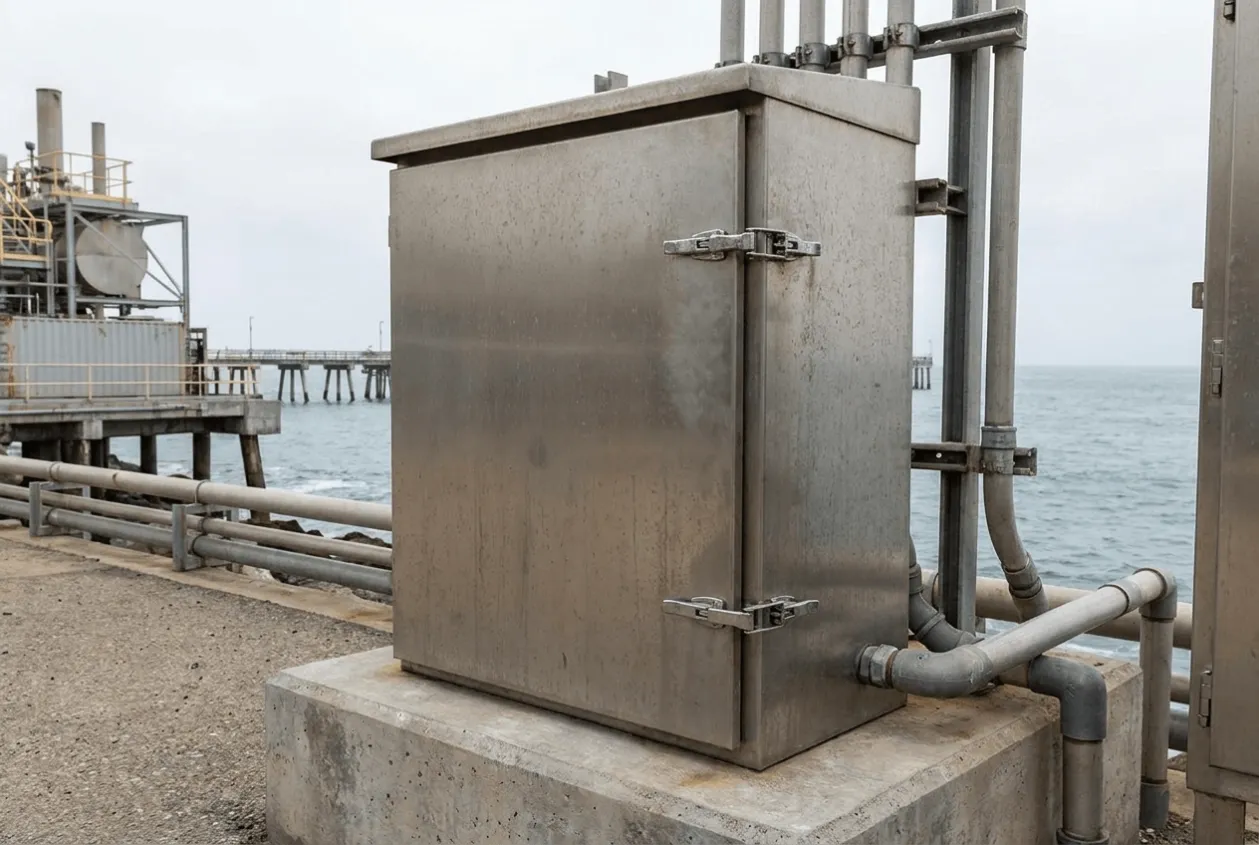
That difference becomes particularly important around salt air, process chemicals and other aggressive environments.
This is why 316 or 316L is commonly considered for:
- Coastal industrial projects
- Marine applications
- Ports
- Offshore installations
- Desalination facilities
- Wastewater treatment
- Chemical processing
- High-chloride washdown environments
- Sites with difficult maintenance access
For these conditions, the higher material cost may be small compared with replacing or repairing a badly corroded outdoor cabinet several years after commissioning.
Why 316L May Be Specified
Buyers may also see 316L rather than simply 316.
The “L” indicates a lower carbon content. It is commonly preferred for welded fabrication where reducing the risk of sensitization around weld areas is important.
This does not automatically mean every outdoor cabinet needs 316L.
It means the fabrication process matters as well as the nominal alloy.
A well-fabricated 304 cabinet installed in a suitable inland environment can outperform a poorly fabricated 316 cabinet whose welds, surface treatment or accessories have been handled badly.
Material grade is only one layer of enclosure durability.
5. 304 vs. 316: The Decision Is Usually About Chlorides
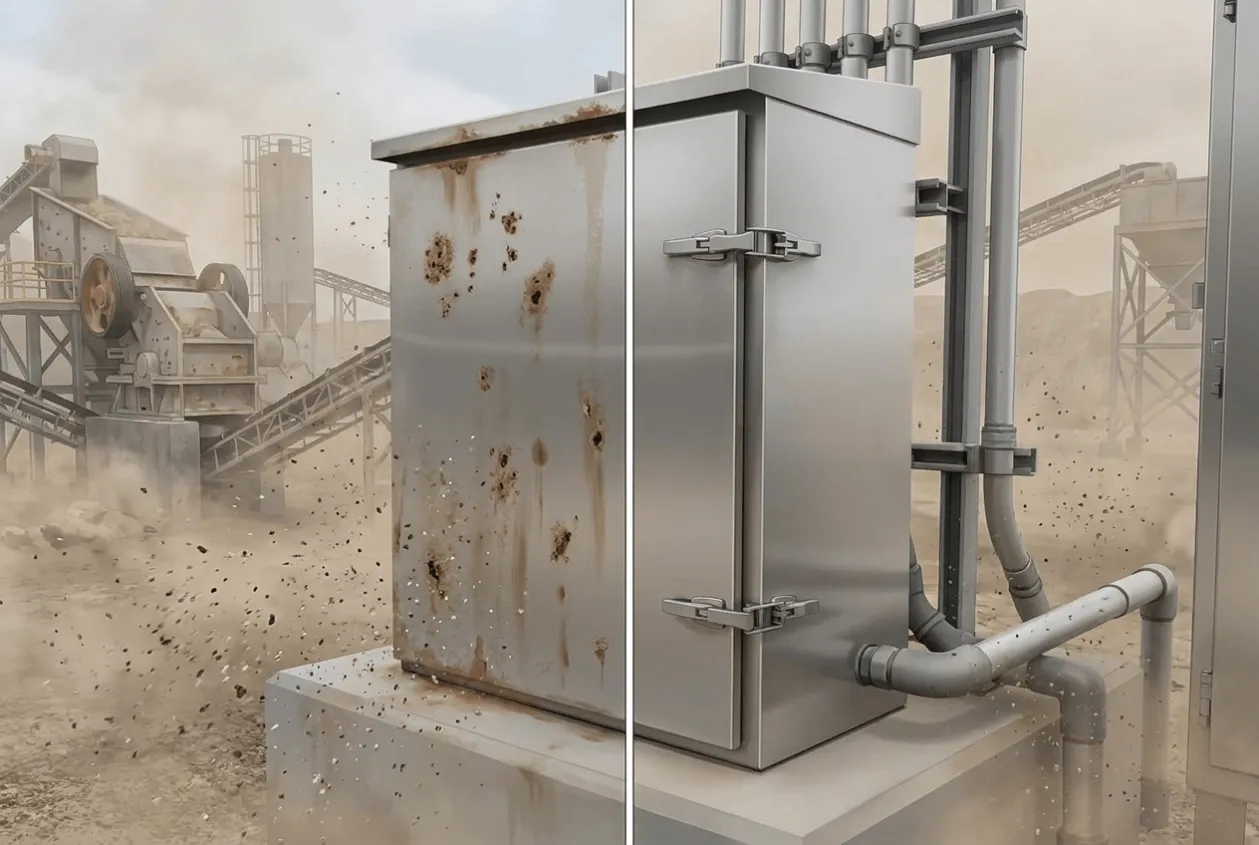
For many buyers, the hardest choice is not steel versus stainless steel.
It is:
Do we really need 316, or is 304 enough?
A practical comparison looks like this:
Decision Factor | 304 Stainless Steel | 316/316L Stainless Steel |
|---|---|---|
General atmospheric exposure | Very good | Very good |
Inland outdoor use | Usually suitable | Usually unnecessary unless another corrosive factor exists |
High humidity | Generally suitable | Suitable |
Coastal salt air | Increased risk | Preferred |
Chloride exposure | More vulnerable | Better resistance |
Marine environment | Often not preferred | Common choice |
Wastewater environment | Depends on location and chemistry | Often safer for exposed corrosive areas |
Chemical environment | Must be checked against chemistry | Often better but still requires compatibility review |
Initial cost | Lower | Higher |
Maintenance-risk reduction | Good in suitable environment | Better where corrosion severity is high |
The additional cost of 316 should therefore be evaluated against corrosion exposure and service consequence.
Installing 316 in every ordinary inland cabinet can waste budget.
Installing 304 beside the sea simply because it is technically “stainless steel” can create a much more expensive problem later.
6. Wastewater Plants Need More Care Than the Word “Outdoor” Suggests
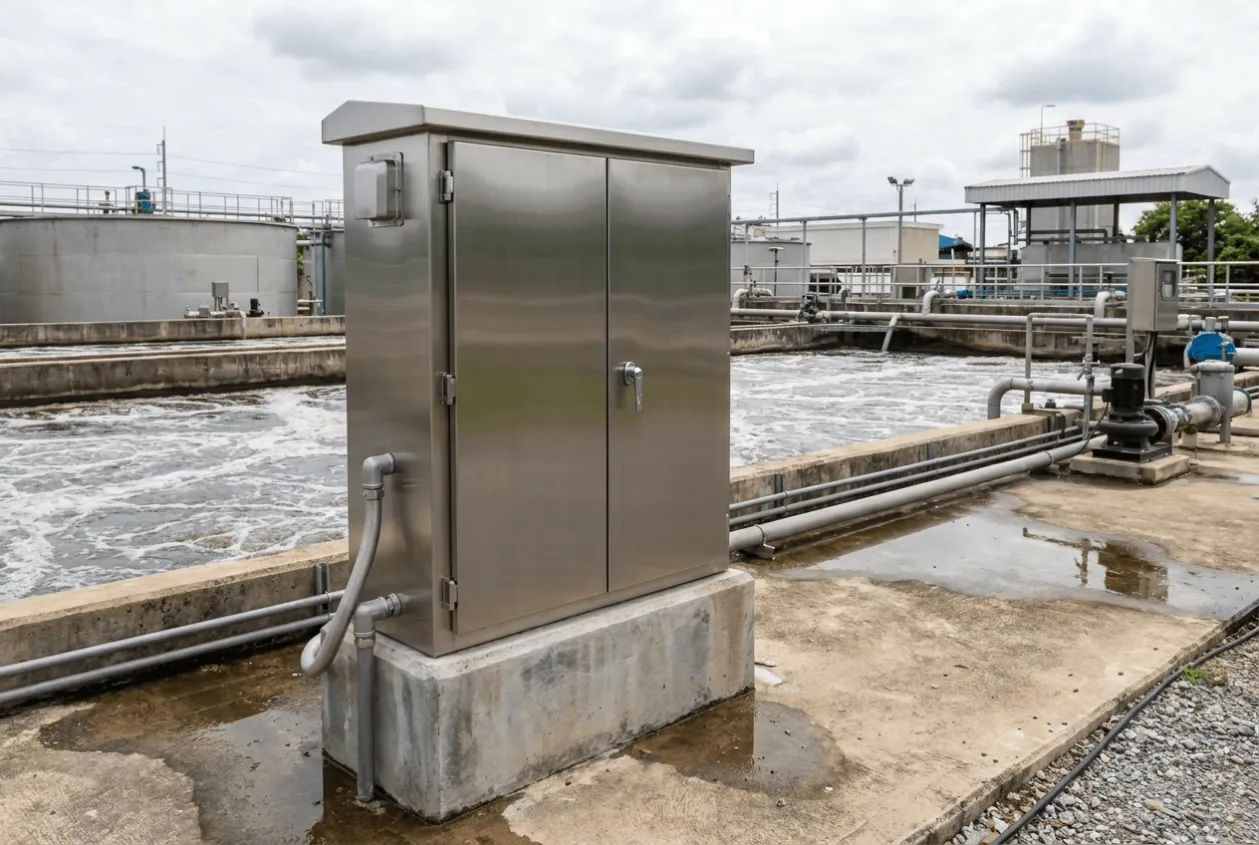
Wastewater treatment is a good example of why generic material selection can fail.
A buyer may specify an IP66 cabinet because the enclosure is located outside.
But rain may not be the most aggressive exposure.
Depending on the treatment process, the cabinet may also encounter:
- Constant humidity
- Chemical dosing areas
- Chlorine compounds
- Hydrogen sulfide
- Acid or alkali vapours
- Washdown
- Aerosols
- Condensation
A control cabinet next to a clean-water pump skid and another next to sludge treatment may therefore require different material strategies even though both are located at the same plant.
This is why “wastewater = 316” is useful as a caution but not a complete engineering rule.
The actual location within the plant should be reviewed.
7. Material Grade Alone Does Not Determine Cabinet Life
This is where many RFQs remain too simple.
A buyer may spend more for 316 stainless steel and still receive an enclosure whose long-term performance is weakened by poor fabrication choices.
Surface Finish
Surface condition affects appearance, cleanability and corrosion behaviour.
Buyers may specify:
- Brushed finish
- No. 4 finish
- Polished surfaces
- Bead-blasted finish
- Pickled and passivated finish
The appropriate finish depends on the environment and industry.
For corrosive applications, the fabrication and post-weld treatment should receive as much attention as cosmetic appearance.
Weld Treatment
Welding changes the local surface condition.
Heat tint and fabrication contamination should be addressed using suitable cleaning, pickling or passivation procedures where required.
Leaving poorly treated weld areas on an expensive stainless cabinet undermines part of the reason stainless steel was selected.
Carbon-Steel Contamination
Stainless surfaces can become contaminated during fabrication if they are processed using tools or work areas containing carbon-steel particles.
Later, buyers may see apparent “rust” appearing on a stainless enclosure and assume the entire material grade is wrong.
The issue may instead originate from fabrication contamination.
A stainless fabrication process should therefore control:
- Grinding tools
- Wire brushes
- Work surfaces
- Handling
- Storage
- Cleaning
This is a manufacturing-quality issue that rarely appears on a basic material datasheet.
8. Do Not Specify a Stainless Cabinet With the Wrong Accessories
Another common problem is specifying the enclosure body carefully while leaving the accessories undefined.
An outdoor enclosure is a system.
Its durability can be limited by the weakest exposed component.
The RFQ should therefore review:
- Hinges
- Door hardware
- Fasteners
- Locking system
- Mounting brackets
- Cable glands
- Drain fittings
- Ventilation components
- Rain hood
- Gland plates
- Nameplates
- Earthing hardware
If a 316 cabinet is installed with unsuitable external fasteners, corrosion may begin around the accessories long before it appears on the enclosure body.
Galvanic interaction between dissimilar metals should also be considered where different materials are in electrical contact and exposed to moisture.
Engineering NoteUpgrading the cabinet body from 304 to 316 while leaving external accessories at a lower corrosion resistance can reduce the value of the upgrade considerably.
9. IP66 and NEMA 4X Do Not Tell You the Same Thing as Material Grade
Material and enclosure rating are related decisions, but they are not interchangeable.
IEC 60529 defines the IP Code, which classifies degrees of protection provided by enclosures against access, solid objects and water.
NEMA 250 covers enclosure Types used for electrical equipment and includes outdoor classifications such as Types 3R, 4 and 4X. NEMA documentation distinguishes Type 4X by providing an additional degree of protection against corrosive atmospheric agents compared with Type 4.
That distinction matters.
An IP66 enclosure has demonstrated a defined level of dust and water protection. The IP code itself does not mean that the enclosure is made from 316 stainless steel or that it is automatically suitable for every corrosive atmosphere.
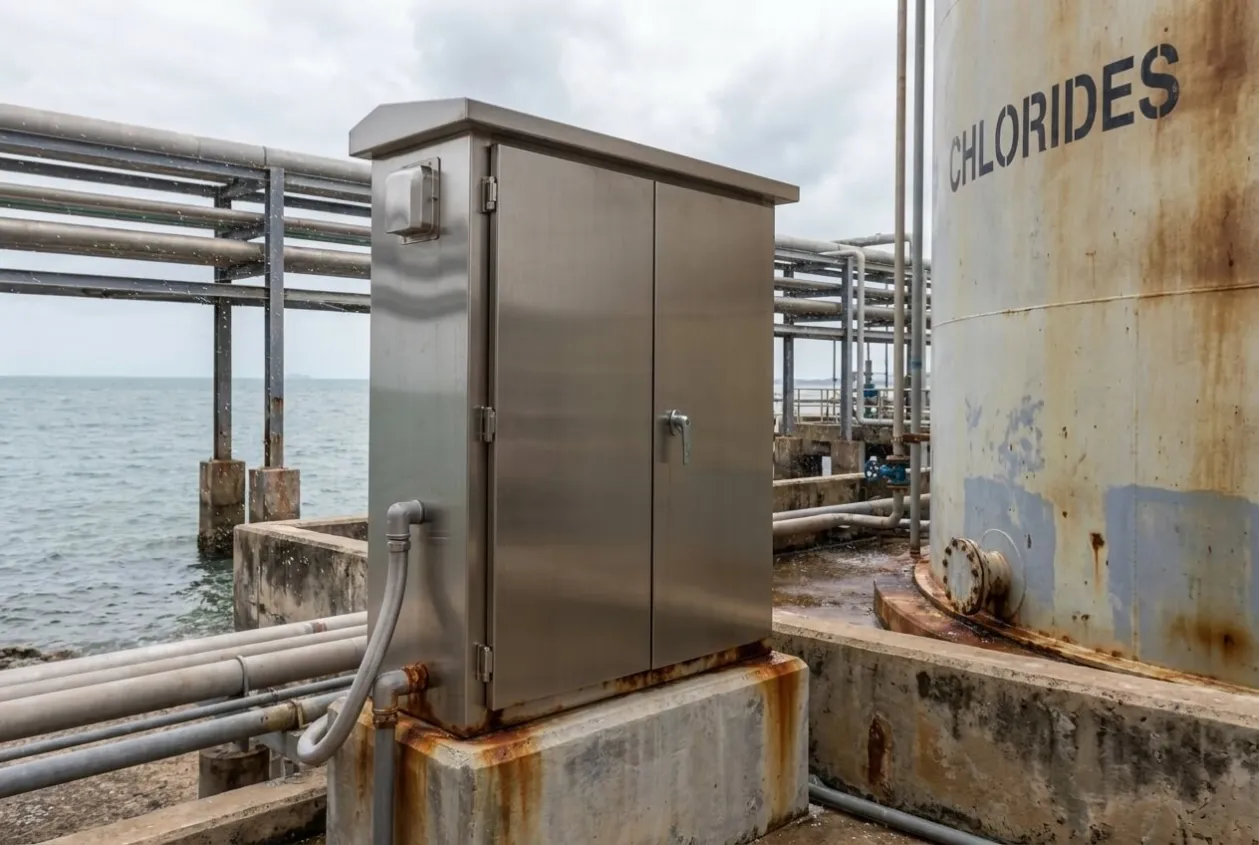
Likewise, specifying stainless steel does not automatically prove a particular IP or NEMA rating.
These requirements should therefore be written separately:
Enclosure material: 316L stainless steel Protection: IP66 NEMA requirement: Type 4X, where required by the project
The complete enclosure construction must be evaluated against the required standard.
NEMA also notes that the overall Type rating of an installed assembly can be limited by the lowest-rated component used with the enclosure, such as fittings added after manufacture.
This is important during site installation because an enclosure can leave the factory correctly designed and lose part of its intended environmental protection when unsuitable cable glands, conduit fittings or field openings are added.
10. The Material Does Not Solve Condensation
One of the most important outdoor-cabinet lessons is also one of the easiest to overlook:
Stainless steel cannot prevent condensation.
A beautifully manufactured 316L cabinet can still experience internal moisture when temperature changes cause humid air inside the enclosure to fall below the dew point.
Condensation may affect:
- PLCs
- VFDs
- Power supplies
- Terminals
- Relays
- Communication equipment
- Instrument interfaces
Material choice protects the enclosure structure from corrosion.
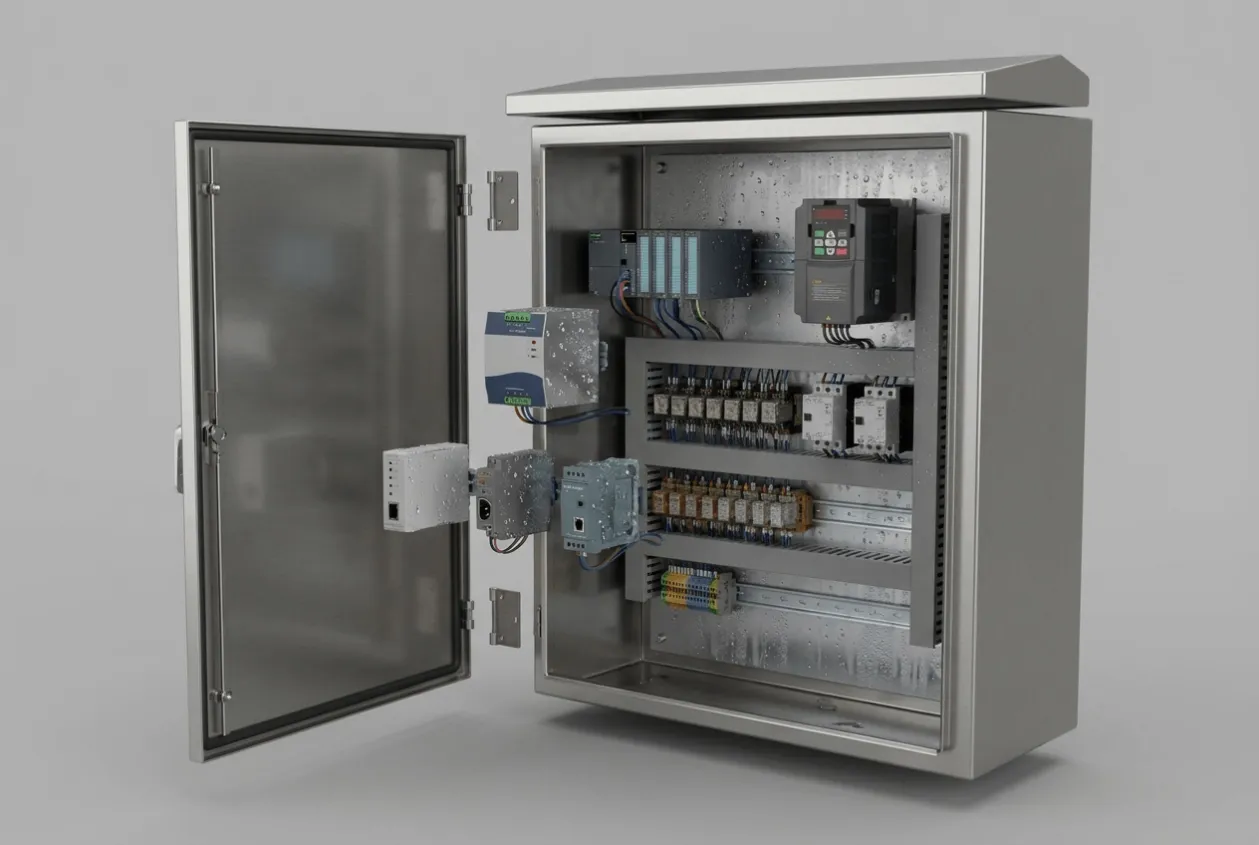
Condensation control protects the equipment inside.
Depending on the climate and internal heat load, the design may require:
- Anti-condensation heater
- Hygrostat
- Thermostat
- Controlled ventilation
- Heat exchanger
- Air conditioner
- Drain or breather
- Double-wall or sunshield design
- Internal insulation strategy
Outdoor enclosure design should therefore review material, sealing and thermal behaviour together.
11. Direct Sun Can Be a Bigger Problem Than Rain
Outdoor cabinets do not only face water.
Solar radiation can substantially increase the internal temperature of a sealed enclosure.
That matters when the cabinet contains:
- VFDs
- PLCs
- Power supplies
- UPS systems
- Industrial computers
- Communication switches
- Battery systems
A cabinet may satisfy its required ingress-protection rating and still experience equipment failures because the internal temperature exceeds component limits.
Buyers should therefore provide:
- Maximum ambient temperature
- Minimum ambient temperature
- Direct solar exposure
- Internal heat dissipation
- Required internal temperature
- Altitude
- Cabinet orientation
- Available auxiliary power
The supplier can then determine whether passive heat dissipation is sufficient or whether cooling, ventilation or a sunshield is required.
Again, selecting 316 instead of 304 does not solve this problem.
12. Painted Steel vs. 304 vs. 316: Lifecycle Thinking
The material decision becomes clearer when the buyer looks beyond purchase cost.
Suppose three cabinets perform the same electrical function.
The coated-steel version costs the least.
304 costs more.
316 costs more again.
Comparing only the quotation tells the buyer almost nothing about which represents the best value.
A lifecycle review should consider:
Cost or Risk | Painted Steel | 304 Stainless | 316/316L Stainless |
|---|---|---|---|
Initial purchase cost | Lowest | Medium | Highest |
Coating dependence | High | Low | Low |
Repair after scratches | More important | Usually limited | Usually limited |
General outdoor corrosion resistance | Depends heavily on coating | Good | Very good |
Chloride resistance | Limited if coating fails | Moderate | Better |
Appearance maintenance | Depends on coating condition | Good | Good |
Remote-site suitability | Depends on exposure | Good for moderate sites | Stronger for aggressive sites |
Coastal lifecycle risk | Higher | Higher than 316 | Lower when correctly fabricated |
The most economical material is the one whose corrosion resistance matches the actual environment without unnecessary over-specification.
13. What Buyers Should Put in an Outdoor Cabinet RFQ
Do not send:
Outdoor stainless steel cabinet, IP66.
That forces the supplier to make too many assumptions.
A more useful RFQ should define the following.
Installation Environment
- Indoor, covered outdoor or fully exposed outdoor
- Country and project location
- Distance from coast where relevant
- Industrial or chemical atmosphere
- Maximum and minimum ambient temperature
- Humidity
- Direct sunlight
- Dust exposure
- Washdown
- Chemical exposure
- Expected service life
Cabinet Material
Specify:
- Painted carbon steel, 304, 304L, 316 or 316L
- Sheet thickness
- Surface finish
- Coating system where applicable
- Post-weld treatment
- External hardware material
- Mounting-bracket material
- Gland-plate material
Environmental Protection
Specify:
- Required IP rating
- Required NEMA Type where applicable
- Indoor/outdoor certification requirements
- Rain hood or sunshield
- Drain and breather requirements
- Condensation-control requirements
IEC 60529 remains the international reference for IP classifications, while NEMA 250 is used for NEMA enclosure Types in North American projects.
Thermal Requirements
Provide:
- Ambient temperature
- Internal heat load
- Equipment loss data
- Maximum permitted internal temperature
- Ventilation restrictions
- Required heater or cooling system
Electrical and Control Requirements
Where the enclosure will become part of an assembled industrial control panel, the applicable panel standard should also be specified independently of the enclosure material. UL identifies UL 508A as the Standard for Industrial Control Panels and provides requirements covering components used in such assemblies.
14. Common Buying Mistakes
“Stainless Steel” Without a Grade
304 and 316 do not offer identical corrosion resistance.
Always identify the grade.
Choosing 316 for Every Outdoor Cabinet
This protects against under-specification but can unnecessarily increase cost on ordinary inland installations.
Better engineering matches the material to the exposure.
Using 304 Near the Sea Because It Is Stainless
The issue is not whether 304 can survive outdoors.
The issue is the chloride exposure over the required service life.
316 or 316L is usually the safer starting point for coastal applications.
Ignoring Welds and Fabrication Quality
An expensive stainless grade cannot compensate completely for poor fabrication, contaminated surfaces or untreated weld areas.
Ignoring External Fasteners
The cabinet body may survive while hinges, brackets, bolts or fittings begin corroding.
Assuming IP66 Means Corrosion Resistant
IP classification concerns ingress protection. It does not by itself define stainless grade or complete corrosion suitability.
Assuming NEMA 4X Means “316 Stainless”
NEMA 4X defines enclosure performance requirements rather than prescribing one universal material grade. Different compliant constructions may be possible.
Ignoring Condensation
Rain protection does not mean moisture cannot develop inside the cabinet.
Choosing Material Before Reviewing Heat Load
The enclosure may resist corrosion perfectly while the electronics inside fail from temperature.
15. A Practical Material Selection Path
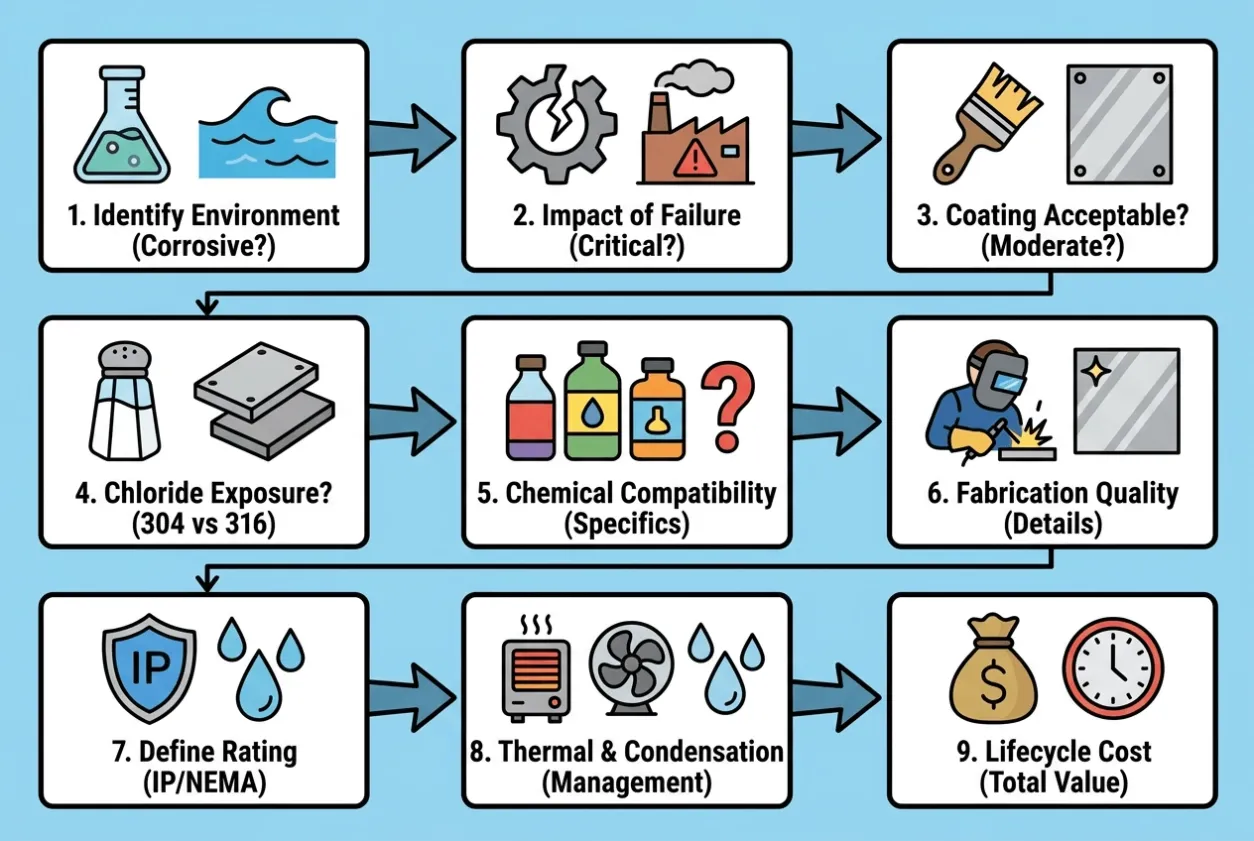
For most projects, buyers can make the decision in the following order.
Step 1: Identify the corrosive exposure
Is the site dry, humid, coastal, wastewater-related, chemical or marine?
Step 2: Identify the consequences of corrosion
Can the cabinet be repaired easily, or would failure shut down critical production?
Step 3: Decide whether coating dependence is acceptable
For moderate environments, coated steel may provide the right balance between cost and performance.
Step 4: Evaluate chloride exposure
Where chlorides are significant, compare 304 and 316/316L carefully.
Step 5: Review chemical compatibility
Do not assume 316 resists every industrial chemical.
The actual chemistry, concentration, temperature and cleaning method should be checked.
Step 6: Specify fabrication quality
Define surface treatment, weld finishing, fasteners and accessories.
Step 7: Define the enclosure rating separately
Select IP and/or NEMA requirements according to water, dust, washdown and corrosion exposure.
Step 8: Review condensation and thermal management
Confirm whether heaters, ventilation, cooling or solar protection are required.
Step 9: Compare lifecycle cost
Consider not only cabinet price but also recoating, repair, inspection, maintenance access and replacement risk.
Only after these decisions should the final material be approved.
16. Which Material Would We Choose?
If this were an inland factory with moderate humidity and the cabinet was protected from aggressive chemicals, we would first evaluate painted steel or 304 stainless steel rather than automatically specify 316.
If the cabinet were permanently exposed outdoors and the buyer wanted lower coating-maintenance dependence, 304 stainless steel would often be the stronger general-purpose option.
If the project were close to the sea, installed in a marine environment, exposed to significant chlorides or located in a particularly corrosive part of a wastewater or chemical facility, 316 or 316L would move much higher on the list.
The final choice would still depend on the enclosure fabrication, accessories, sealing, thermal design and maintenance conditions.
That is the key engineering point:
The material grade should solve a real environmental risk.
It should not be selected simply because one grade sounds more premium.
What Materials Are Best for Outdoor Electrical Cabinets?
If you are asking the question in this exact form, the short answer is: painted carbon steel or galvanized steel for general outdoor duty, 304 stainless for humid or washdown-adjacent sites, and 316 stainless wherever chlorides are present — coastal air, de-icing salt, brine, or chloride-based sanitisers. The rest of this section explains how to reach that answer for your specific site, rather than copying a material table.
Best Material for Coastal or Salt Spray Environments
Coastal environments change the enclosure decision significantly because airborne chlorides accelerate corrosion much faster than many buyers initially expect.
Near ports, offshore infrastructure, wastewater plants, and marine facilities, corrosion often becomes the dominant enclosure risk rather than mechanical damage.
This is why stainless steel, especially 316-grade stainless steel, is commonly preferred in harsh outdoor environments involving the following:
- Salt spray exposure
- Continuous humidity
- Chemical contamination
- Coastal wind exposure
The difference between stainless steel 304 and 316 matters here because 316 contains molybdenum, which improves resistance to chloride corrosion.
According to technical guidance from the Nickel Institute, 316 stainless steel generally provides stronger long-term performance in chloride-rich environments than 304.
Buyers sometimes hesitate because stainless steel cabinets carry a higher upfront cost. In practice, many coastal operators eventually discover that corrosion-related maintenance, repainting, and enclosure replacement cost far more over the lifecycle of the installation.
The operational question, therefore, becomes:
Is the project optimizing for purchase price or long-term reliability?
That distinction changes the enclosure decision entirely.
Best Material for Lightweight Outdoor Enclosures
In some projects, enclosure weight becomes an important engineering constraint.
This happens frequently in
- Pole-mounted systems
- Rooftop installations
- Renewable energy projects
- Transportation infrastructure
- Mobile equipment systems
Aluminum offers advantages in these applications because it reduces installation difficulty while still providing acceptable outdoor corrosion performance in many environments.
However, lightweight construction introduces tradeoffs that buyers sometimes overlook.
Compared to steel enclosures, aluminum may provide the following:
- Lower structural rigidity
- Different thermal behavior
- Increased sensitivity to mechanical impact
- Potential galvanic corrosion concerns
This does not make aluminum a poor choice. It simply means enclosure material should always be evaluated together with mounting conditions, environmental exposure, and equipment weight.
Best Material for Highly Corrosive Environments
Some industrial environments are aggressive enough that conventional metallic enclosures struggle to survive long-term exposure.
This includes:
- Chemical-processing facilities
- Wastewater treatment plants
- Fertilizer production
- Coastal chemical terminals
- Highly humid industrial zones
In these situations, FRP and fiberglass enclosures often become attractive because they eliminate many traditional corrosion mechanisms associated with steel.
Unlike metal cabinets, fiberglass does not rust. This can significantly reduce maintenance requirements in harsh environments where coating systems degrade continuously.
However, buyers should still evaluate:
- UV stability
- Mechanical strength
- Fire behavior
- Long-term aging
- Production quality consistency
FRP performance varies considerably between suppliers, especially in lower-cost products where resin quality and structural reinforcement may be inconsistent.
When Plastic Enclosures Make Sense
Plastic and polycarbonate enclosures are commonly used for smaller outdoor electrical applications because they offer corrosion resistance, low weight, and lower cost.
They are often suitable for:
- Communication boxes
- Small junction systems
- Light-duty controls
- Sensor housings
However, outdoor plastic performance depends heavily on UV resistance and long-term weathering behavior.
This is one area where procurement decisions sometimes become overly price-driven.
A low-cost plastic enclosure may initially appear acceptable but gradually become brittle, discolored, or structurally weakened after years of direct sunlight exposure.
This is especially problematic in hotter climates where thermal cycling accelerates material aging.
Stainless Steel vs Galvanized Steel
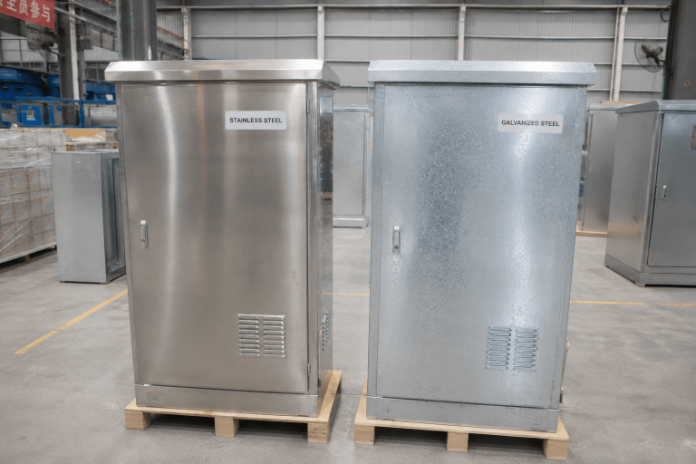
Cost and Lifecycle Value
The purchase price difference between galvanized steel and stainless steel is often substantial, which is why procurement teams frequently prefer galvanized steel initially.
However, life cycle economics often tell a different story.
When evaluating enclosure value, buyers should consider the following:
Cost Factor | Long-Term Impact |
|---|---|
Corrosion maintenance | Increased labor cost |
Repainting or coating repair | Additional downtime |
Premature enclosure replacement | Higher capital expense |
Water ingress after corrosion | Equipment failure risk |
Outdoor maintenance access | Service difficulty |
In projects involving remote locations, production-critical automation systems, or difficult maintenance access, lifecycle cost often outweighs initial purchase savings.
This is one reason experienced industrial operators frequently standardize stainless steel for outdoor automation infrastructure despite higher upfront pricing.
Which One to Choose
For standard outdoor applications with moderate exposure and manageable maintenance access, galvanized steel often remains a practical and economical choice.
For corrosive, coastal, or high-humidity environments where long-term reliability matters more than upfront cost, stainless steel generally provides stronger operational value over time.
The better material is usually the one that minimizes long-term operational risk rather than simply reducing purchase cost.
Why NEMA and IP Ratings Matter
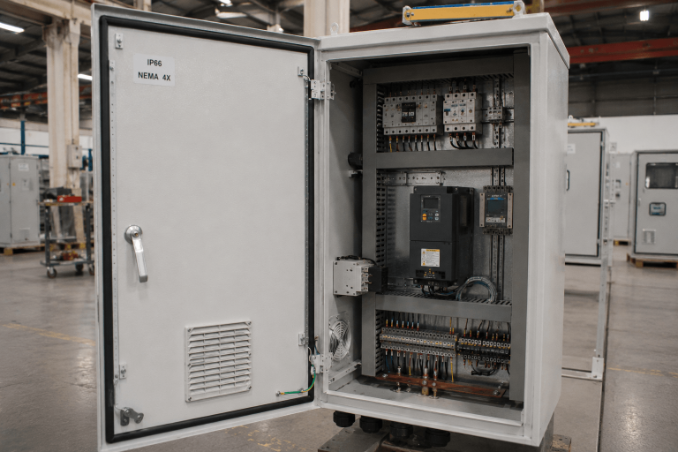
Protection Rating Comes First
Many buyers begin enclosure discussions by focusing on material selection before clearly defining environmental protection requirements.
In practice, the enclosure rating should usually be determined first because it defines what the cabinet must survive operationally.
IP ratings focus primarily on ingress protection against solids and water. NEMA ratings also consider environmental factors such as corrosion, ice formation, and outdoor exposure.
This distinction matters because the enclosure material must support the protection rating consistently over years of real-world use rather than only during initial installation.
According to NEMA enclosure standards, environmental conditions should always be evaluated together with enclosure type and intended operating environment.
Engineering Note — our supply programme. We source in carbon steel, galvanized steel, 304 stainless and 316 stainless. Aluminium is not part of our standard programme; where a specification calls for it, that is a separate sourcing conversation and usually a longer lead time. If weight is your binding constraint, tell us early and we will design around a galvanized or stainless alternative where possible.
FAQ
Is 316 stainless steel always the best material for an outdoor electrical cabinet?
No.
316 or 316L provides stronger resistance to chloride-related corrosion and is particularly useful for coastal, marine and other aggressive environments. For an ordinary inland site, 304 or properly coated steel may provide a better cost-to-performance balance.
Is painted steel acceptable for outdoor electrical enclosures?
Yes.
A correctly prepared and coated steel cabinet can perform well in moderate outdoor environments. The coating specification and risk of mechanical damage become particularly important because exposed carbon steel can begin corroding after the protective coating is breached.
Should I use 304 or 316 stainless steel near the sea?
316 or 316L is generally the safer starting point where the enclosure will experience significant salt-air or chloride exposure because it offers better resistance to chloride-induced localized corrosion than 304.
Is 304 stainless steel waterproof?
The material grade does not determine whether an enclosure is waterproof.
Water ingress protection depends on the complete enclosure design, including seams, door construction, gaskets, cable entries and tested enclosure rating.
Does an IP66 cabinet need to be stainless steel?
No.
IP66 is an ingress-protection classification under IEC 60529. It does not prescribe one particular enclosure material.
Is NEMA 4X the same as IP66?
No.
NEMA and IEC ratings come from different standards and contain different requirements. They should not be treated as automatically interchangeable. NEMA Type 4X additionally addresses corrosion-related enclosure performance beyond the basic outdoor and hose-directed-water protection associated with Type 4.
Engineering Takeaway
There is no single “best” outdoor electrical cabinet material.
There is only a material that is correctly matched—or incorrectly matched—to its environment.
Painted steel can be the most economical solution where atmospheric corrosion is moderate and the coating can be maintained.
304 stainless steel is a strong general-purpose outdoor material for many industrial environments.
316 or 316L stainless steel becomes worth the additional cost when chloride exposure, marine conditions, wastewater processes or other aggressive environments materially increase corrosion risk.
But material is only one part of enclosure reliability.
A buyer should review:
Environment → Material → Fabrication → Accessories → IP/NEMA Rating → Condensation → Thermal Design → Lifecycle Cost
in that order.
A more expensive alloy cannot correct a poor enclosure design, and an expensive IP-rated cabinet cannot protect its internal electronics from heat or condensation if those conditions were never considered.
Specifying an Outdoor Electrical Cabinet?
Do not send us only a cabinet size and the words “stainless steel, IP66.”
Send us the installation conditions.
Tell us:
- Where the cabinet will be installed
- Whether it is coastal or inland
- Maximum and minimum ambient temperature
- Chemical or wastewater exposure
- Required IP/NEMA rating
- Internal electrical equipment
- Expected heat load
- Mounting method
- Required service life
UniRegal can review the material, enclosure protection, condensation control, thermal design and control-panel construction together before the cabinet specification is finalized.
For projects requiring complete industrial control panels, we can also integrate the enclosure with PLC, HMI, VFD, power distribution, environmental control and project-specific panel requirements, including UL 508A where applicable. UL describes UL 508A as the Standard for Industrial Control Panels.
Send Us Your Outdoor Cabinet Specification for an Engineering Review
We will help determine whether painted steel, 304 stainless steel or 316/316L is appropriate before you pay for either too little protection—or more material than the site actually needs.