
Sep 15, 2026Engineering Toolkit
Electrical Enclosure RFQ Checklist: What to Send
The nine items that make enclosure quotes comparable: size, material, rating, machining, accessories, certification, scope, quantity, delivery.
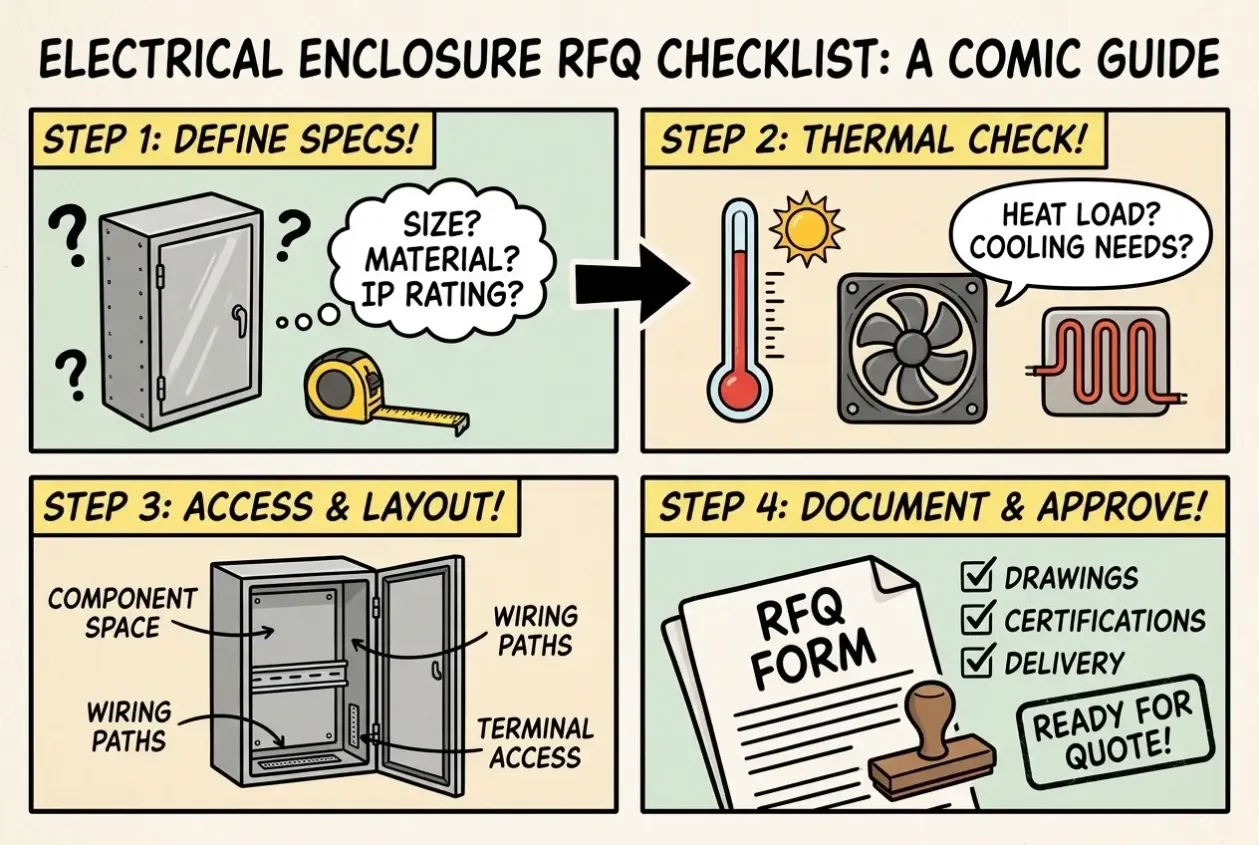
Electrical Enclosure RFQ Checklist: An Engineering Review Before Requesting Quotes
I once reviewed an enclosure RFQ that said only this:
“Outdoor electrical enclosure, 800 × 600 × 300 mm, stainless steel, IP66.”Buyer Decision Facts
When you request an enclosure quotation: empty enclosures start from 5 units and run 15 to 20 days; complete wired panels start from 1 unit and run 35 to 40 days. Customer-supplied core components are accepted, and FAT records, photographs and an as-built wiring diagram ship with the panel. We build to the standard your destination market requires. IP ratings such as IP65 (IEC 60529) are tested ratings, not certificates.
Not sure what to send for a quotation? The six items we need are listed at /resources/what-to-send-for-a-control-panel-quote . If you are supplying your own components, see /resources/customer-supplied-components-control-panels .
It looked simple.
Too simple.
The first supplier quoted a basic stainless box. The second added a mounting plate and gland plate. The third refused to give a final price until they knew the component list, cable entry direction, HMI cutout, site temperature, and certification requirement.
At first, the third supplier looked slow.
They were not slow. They were reviewing the real job.
That is the point.
Missing information never disappears.
It simply moves downstream.
Before You Send the RFQ
Before requesting an electrical enclosure quote, I want the supplier to know what the enclosure must protect, where it will be installed, how it will be mounted, what must be modified, and what documents the buyer needs before approval.
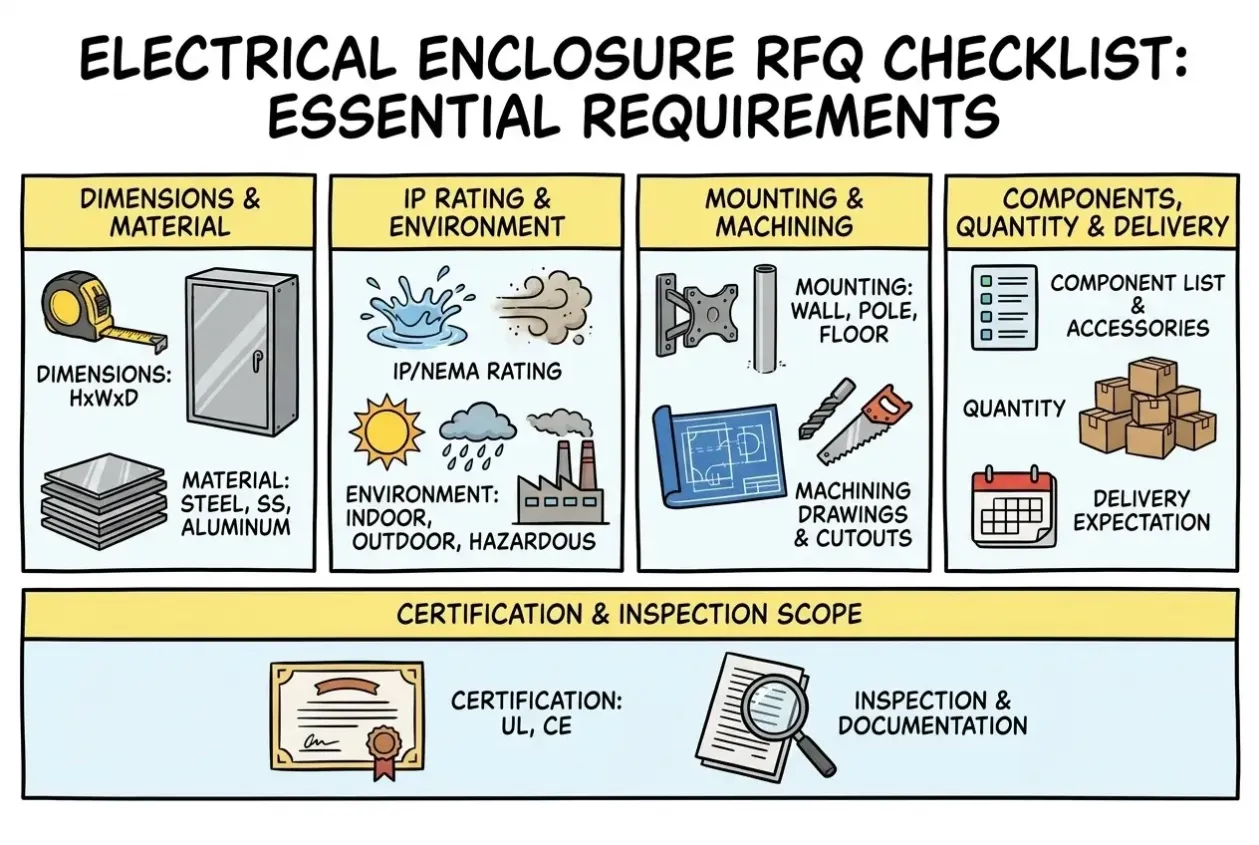
At minimum, the RFQ should include:
- Dimensions
- Material
- IP or NEMA rating
- Installation environment
- Mounting method
- Accessories
- Machining drawings
- Component list
- Certification requirement
- Quantity
- Delivery expectation
- Inspection or documentation scope
This is not about making the RFQ longer.
It is about making the first quotation useful.
Here Is Where Most Quote Comparisons Go Wrong
Quote | First Impression | What Was Actually Included |
|---|---|---|
Quote A | Lowest price | Bare enclosure body, no machining, no glands, no documents |
Quote B | Reasonable price | Mounting plate, gland plate, basic accessories, unclear certification |
Quote C | Highest price | Machining review, IP-rated accessories, packing, inspection photos, approval drawings |
Quote A may look attractive in the purchasing spreadsheet. But sometimes the lowest price is not cheaper. It is unfinished.
Before comparing price, compare scope.
That one habit saves many uncomfortable meetings later.
The Engineering Review Behind a Good RFQ
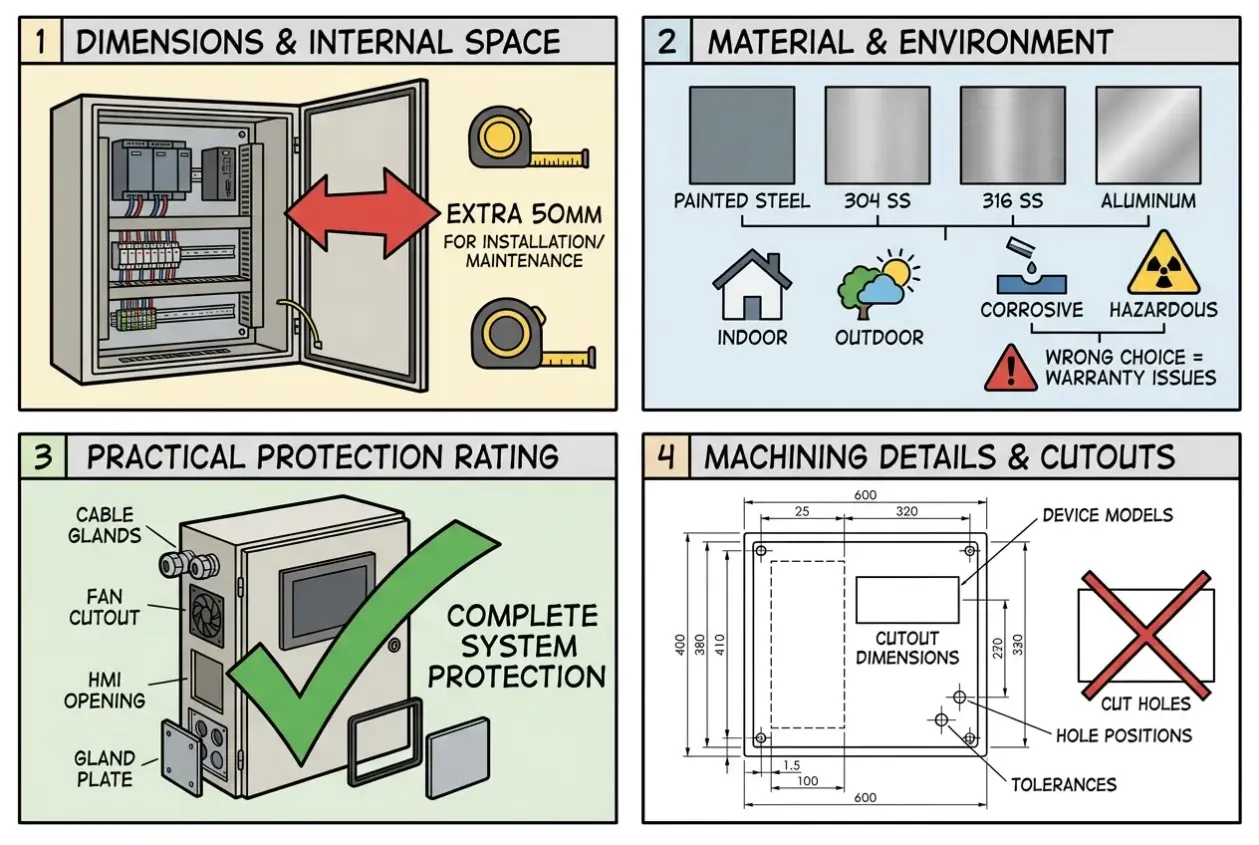
Size is not only height, width, and depth. I check whether there is enough internal space for wiring ducts, terminals, cable bending, and maintenance. One extra 50 mm inside the cabinet can save hours during installation.
Material should follow the environment. Painted steel, 304 stainless steel, 316 stainless steel, and aluminum can all be correct in different conditions. The wrong material choice usually becomes visible after the warranty conversation has already become awkward.
Protection rating is important, but I do not stop after seeing “IP66.” What about the cable glands? What about the fan cutout? What about the HMI opening? What about the gland plate? An enclosure can lose its practical protection through one poorly selected accessory.
Machining details also matter. “Cut holes for buttons and HMI” is not a production instruction. The supplier needs device models, cutout dimensions, hole positions, and tolerances where necessary.
A screenshot with arrows can start a conversation.
It should not start production.
Standards Help. They Do Not Design the Enclosure for You.
IEC 60529 defines the IP Code for degrees of protection provided by enclosures against access, solid objects, dust, and water. NEMA 250 is commonly used for enclosure-type requirements such as NEMA 4 and NEMA 4X.
Those standards give buyers and suppliers a common language. They do not answer every site question.
NEMA 250 notes that enclosure type requirements do not cover every condition, including condensation, thermal damage, corrosion, icing, or contamination that may enter through conduit or unsealed openings. Buyers should therefore review the complete NEMA enclosure guidance together with the actual installation environment rather than relying only on the enclosure rating.
If the enclosure becomes part of an industrial control panel, UL 508A may also be relevant. UL’s Industrial Control Panel Shop Program requires panel shop staff to understand and maintain knowledge of UL 508A requirements.
So the buyer should not only ask, “Is it IP66?”
A better question is, "Is the complete enclosure still suitable after machining, accessories, wiring, installation, and inspection?”
I Would Reject This RFQ
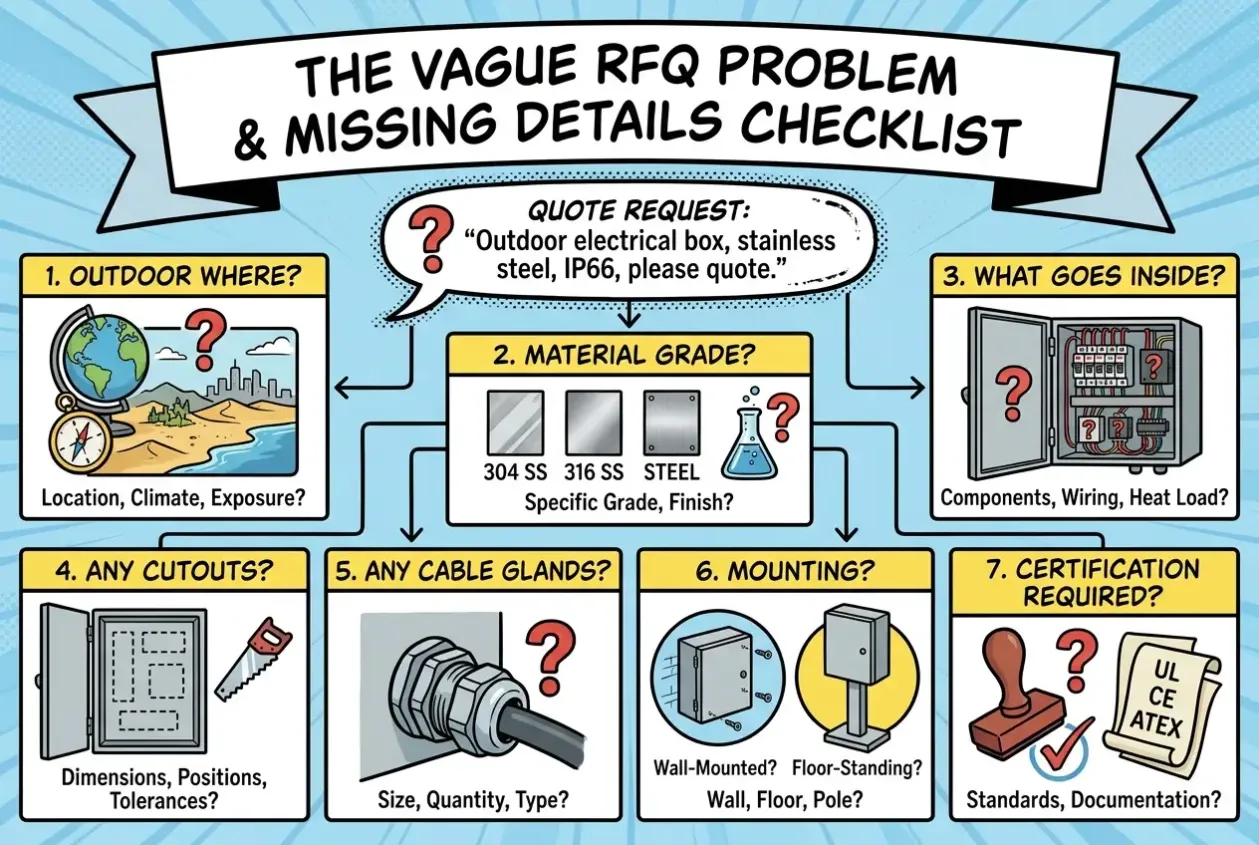
“Outdoor electrical box, stainless steel, IP66, please quote.”
There is not enough information here.
- Outdoor where?
- What material grade?
- What goes inside?
- Any cutouts?
- Any cable glands?
- Wall-mounted or floor-standing? Is certification required?
This RFQ invites assumptions.
Assumptions are not free. They just invoice later.
I Would Send This RFQ Back for Clarification
“Please quote 10 stainless enclosures with HMI cutouts.”
This is closer, but still not enough. The supplier needs the HMI model, cutout size, door position, material grade, surface finish, gland entry, packing requirement, and whether the same design will repeat after the first batch.
One wrong HMI cutout on one enclosure is a problem.
The same wrong cutout on 10 stainless enclosures is a purchasing lesson.
UniRegal Engineering Note
At UniRegal, we usually review the RFQ before preparing the quotation. We check size, material, rating, machining, cable entry, accessories, thermal condition, certification, packing, and inspection scope together.
A quotation should never be the first engineering review.
That review should happen before the buyer approves the price.
Before You Request a Quote
Before sending your enclosure RFQ, prepare the cabinet dimensions, material requirement, installation environment, IP or NEMA rating, component list, machining drawings, cable entry direction, mounting method, certification needs, quantity, and delivery target.
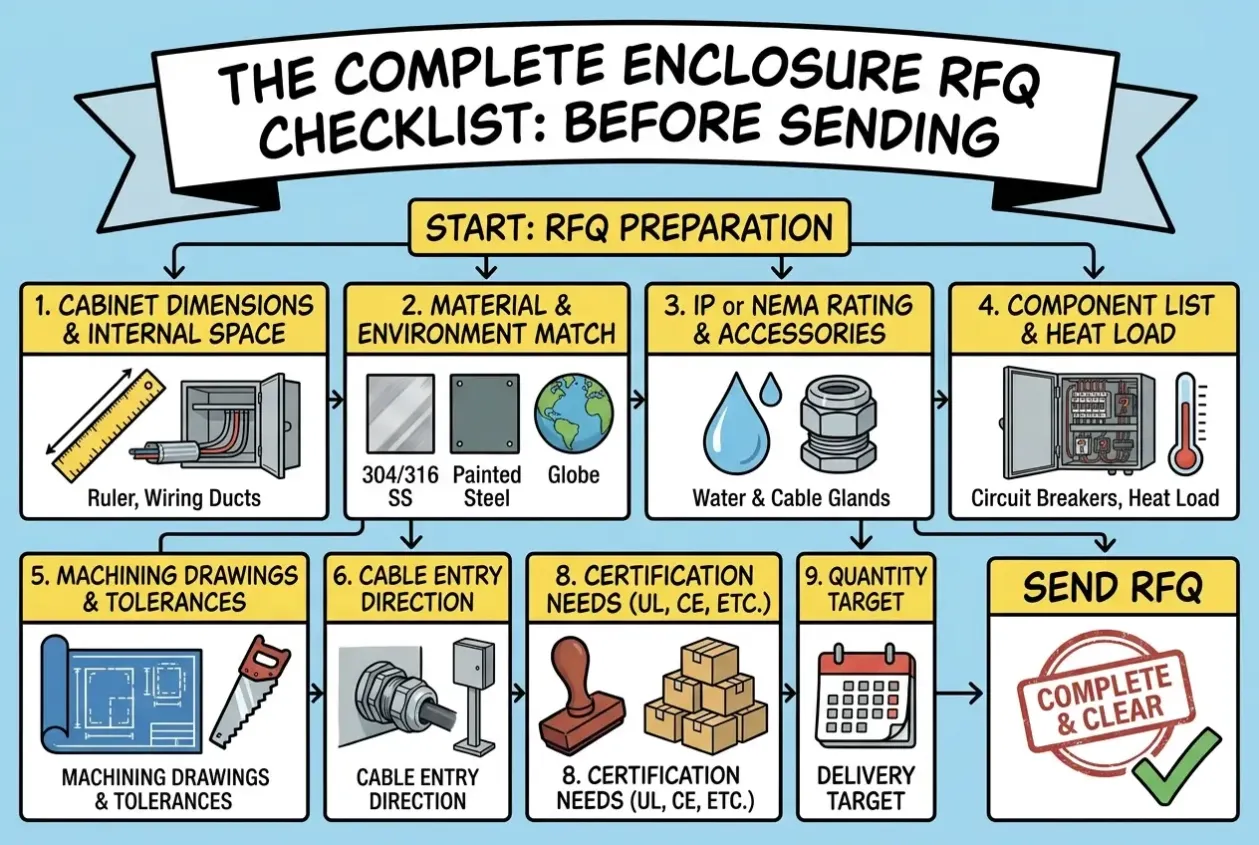
If your RFQ only says “outdoor electrical enclosure,” there is still not enough information to quote the real product.
At UniRegal, we can review your enclosure requirement before quotation and help check whether the size, material, protection rating, machining, accessories, packing, and documentation scope are clear enough for production.
A useful quotation should not only give you a price.
It should help you avoid the wrong enclosure before the purchase order is approved.
Send your electrical enclosure RFQ to UniRegal for an engineering review and project quotation.
FAQ
Do I need drawings before requesting an enclosure quote?
Not always. For a standard enclosure, dimensions, material, rating, quantity, and delivery target may be enough. If there are cutouts, holes, glands, vents, or custom mounting, drawings are strongly recommended.
Should I send the internal component list?
Yes, if space, heat, or layout matters. PLCs, VFDs, power supplies, HMIs, breakers, and terminals all affect enclosure size and thermal review.
How should I compare enclosure quotations?
Compare scope before price. Check material, thickness, accessories, machining, certification, packing, inspection documents, and delivery terms. Otherwise, you may be comparing a finished enclosure with an empty shell.
Final Recommendation
An electrical enclosure RFQ is not paperwork. It is the first filter that decides whether the quotation will be useful or misleading.
Before requesting a price, explain the job clearly.
- What must fit inside?
- Where will it work?
- How will cables enter?
- What must be cut, installed, tested, packed, and documented?
A supplier who understands the job can quote the enclosure you actually need, not the enclosure they had to imagine.
Related Guides