
Aug 10, 2026Buying Guides
How to Choose the Right Motor Starting Method
This guide compares DOL, star-delta, soft starters, and VFDs to help engineers select the right solution for pumps, fans, conveyors and industrial machinery.
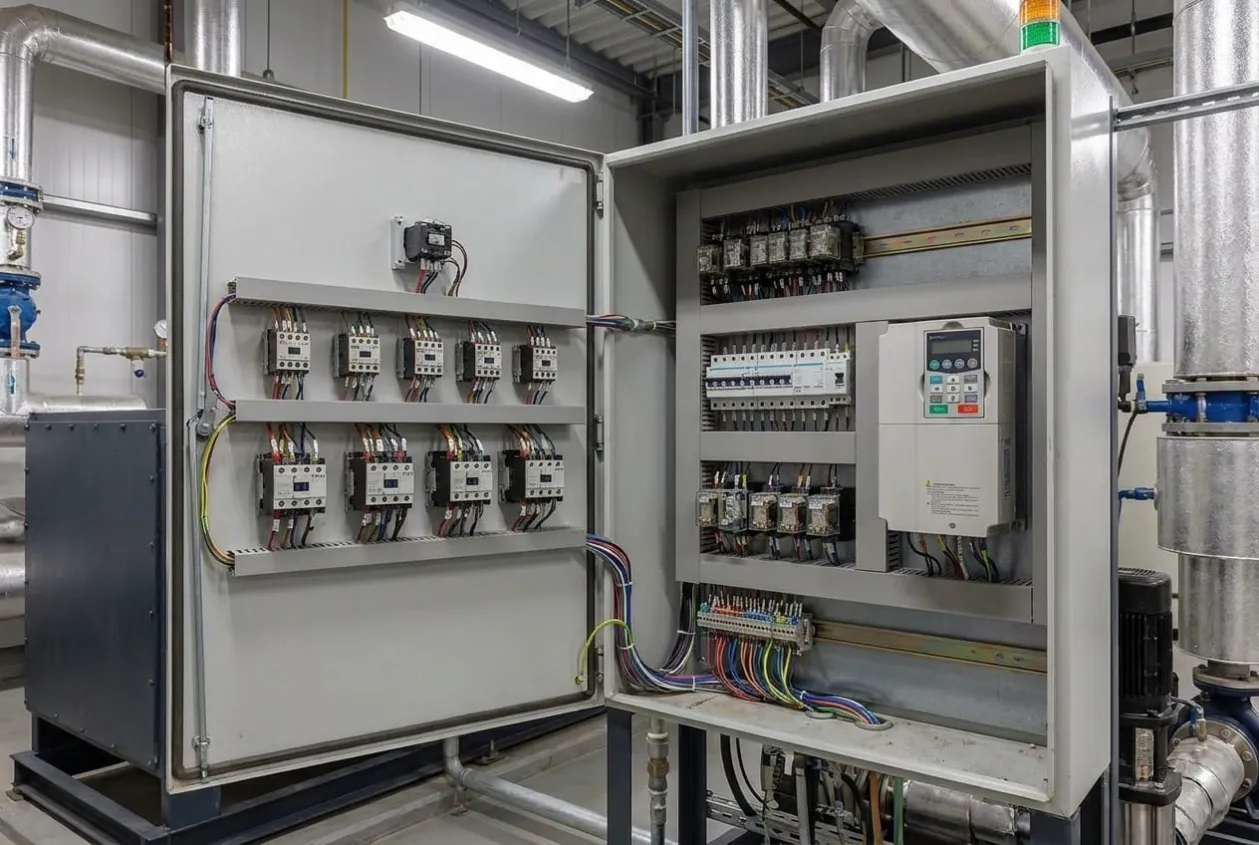
DOL vs Star-Delta vs Soft Starter vs VFD: How to Choose the Right Motor Starting Method
DOL, star-delta, soft starter, and VFD are four common motor starting methods. Choose DOL for small motors, star-delta for simple reduced-voltage starting, soft starters for smooth acceleration, and VFDs when speed control, energy savings, or process optimization matter. The right choice depends on load type, starting current, torque, and budget.
What is a DOL Starter?
A DOL starter, or Direct-On-Line starter, connects the motor directly to the full supply voltage during startup. It is the simplest and lowest-cost motor starting method, but it creates high motor starting current and high starting torque, making it best for small motors or rugged loads.
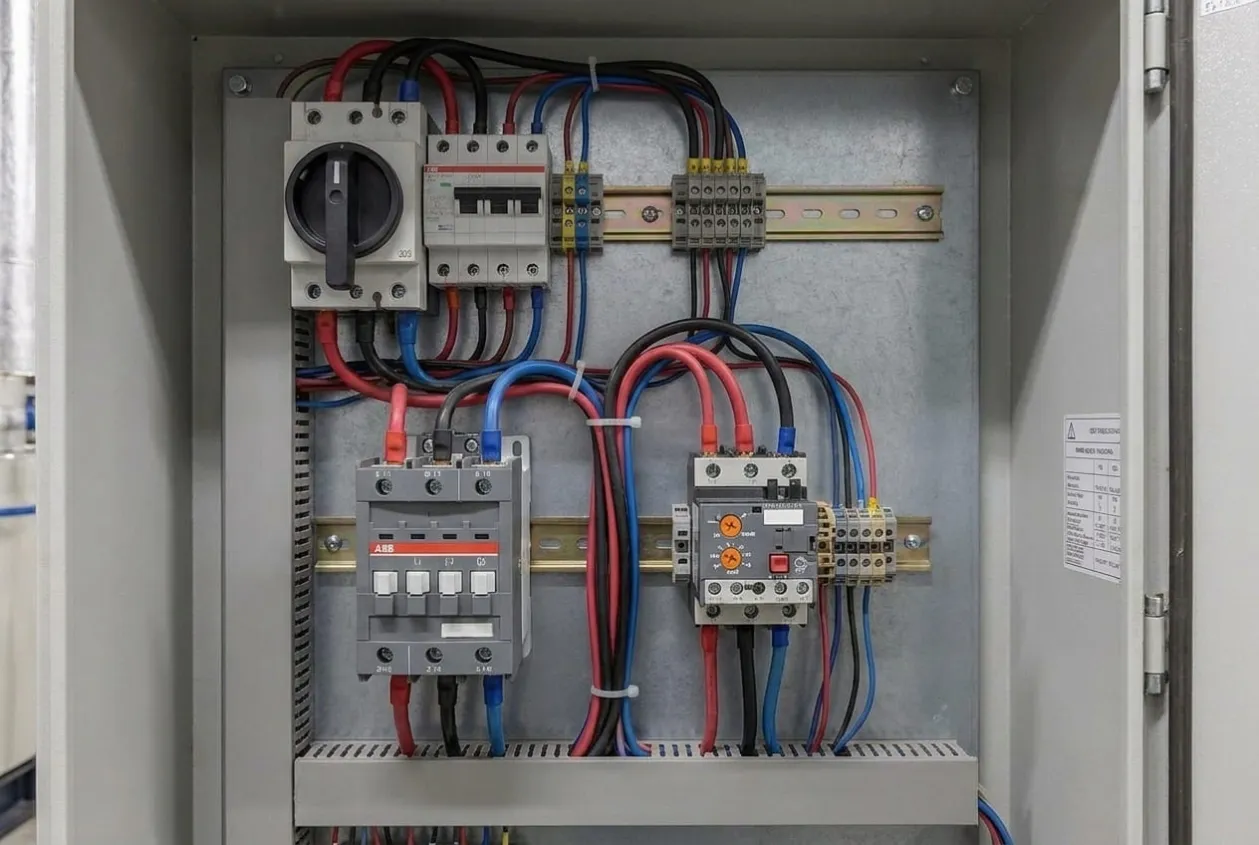
Core Technology: A DOL starter uses a contactor, overload relay, and protection devices to apply full line voltage directly to the motor terminals.
Motor Starting Current: Typically 6–8 times the motor’s full-load current, which can cause voltage dips in weak electrical networks.
Motor Starting Torque: High starting torque, often useful for loads that need strong breakaway force.
When to Use a DOL Starter: Use DOL for small pumps, compressors, fans, and machines where the supply network can tolerate inrush current.
What is a Star-Delta Starter?
A star-delta starter reduces motor starting current by first connecting the motor windings in star configuration, then switching to delta after the motor accelerates. It is a traditional reduced-voltage starting method for medium-sized motors, but it also reduces motor starting torque during startup.
Core Technology: The starter uses three contactors, a timer, overload protection, and a star-to-delta transition sequence.
Motor Starting Current: Usually reduced to about one-third of DOL starting current, depending on motor and supply conditions.
Motor Starting Torque: Also reduced to about one-third of DOL torque, so it is not ideal for heavy starting loads.
Star-Delta Starter Applications: Common in centrifugal pumps, fans, blowers, and lightly loaded machines that do not require high breakaway torque.
What is a Soft Starter?
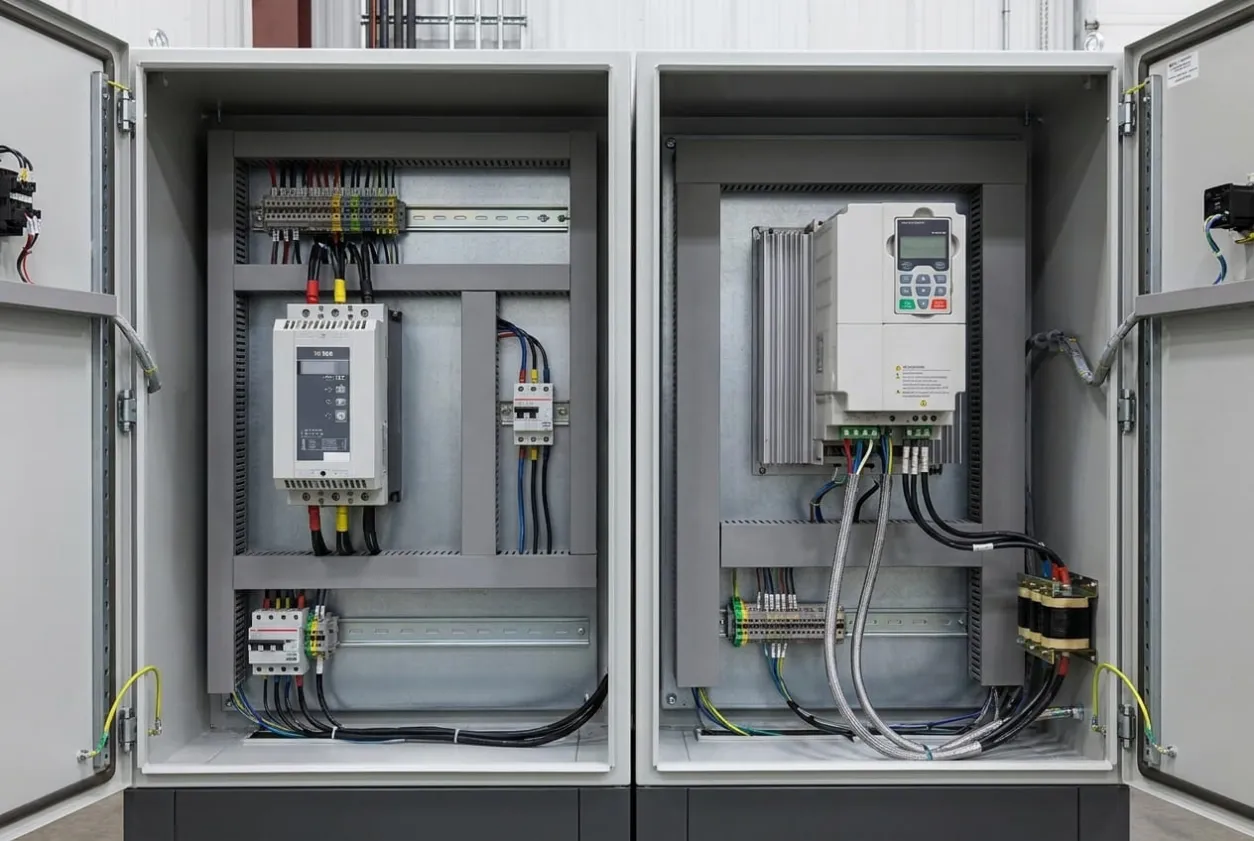
A soft starter gradually increases voltage to the motor using power electronics, allowing smoother acceleration and reduced mechanical stress. It is ideal when the goal is to limit motor starting current and avoid shock loading, but it does not provide continuous speed control like a VFD.
Core Technology: Soft starters typically use thyristors or SCRs to ramp voltage during startup and sometimes during stopping.
Motor Starting Current: Lower than DOL, often adjustable, but usually higher than a properly configured VFD during controlled acceleration.
Motor Starting Torque: Torque increases gradually as voltage ramps up, making it suitable for pumps, conveyors, and fans with moderate starting demands.
Best Use Case: Soft starters are excellent when only smooth start and stop are required, not variable speed operation.
What is a VFD?
A VFD, or Variable Frequency Drive, controls both voltage and frequency to start, stop, and run a motor at variable speeds. It provides the most advanced control among motor starting methods and is best when speed regulation, energy savings, soft acceleration, or process control are required.
Core Technology: A VFD converts incoming AC power to DC, then inverts it back to variable-frequency AC for precise motor control.
Motor Starting Current: Usually close to or below full-load current during ramp-up, making it the best option for limiting electrical stress.
Motor Starting Torque: Can provide controlled torque and strong low-speed performance depending on the drive type and configuration.
Best Use Case: VFDs are preferred for pumps, fans, conveyors, mixers, and any application needing adjustable speed or energy optimization.
Key Differences: DOL vs Star-Delta vs Soft Starter vs VFD
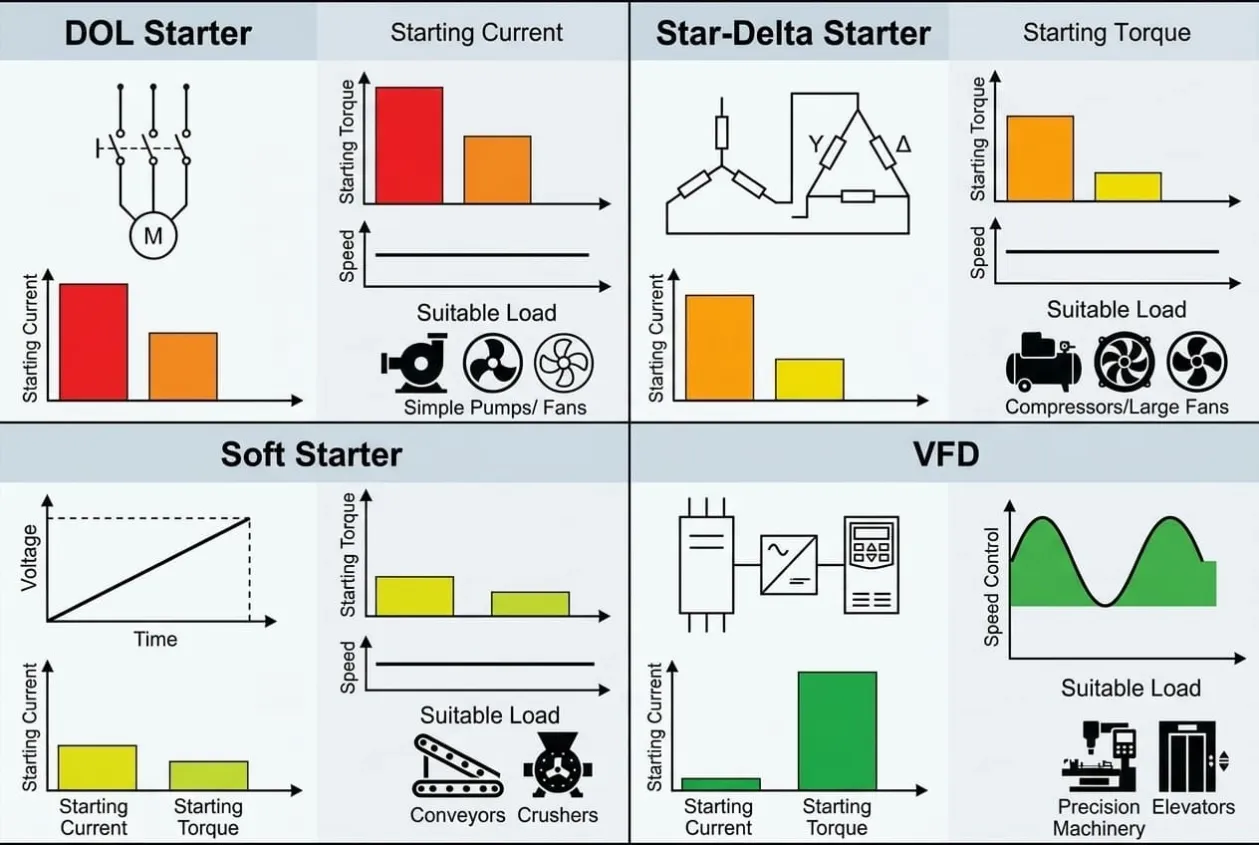
The main difference in DOL vs star-delta vs soft starter vs VFD selection is how each method handles voltage, current, torque, and speed. DOL is simple but harsh, star-delta reduces current but weakens torque, soft starters provide smooth ramping, and VFDs provide full speed and torque control.
Comparison Factor | DOL Starter | Star-Delta Starter | Soft Starter | VFD |
|---|---|---|---|---|
Starting Method | Full voltage applied instantly | Starts in star, runs in delta | Gradual voltage ramp | Variable voltage and frequency control |
Motor Starting Current | Very high, about 6–8x FLC | Medium, about 2–3x FLC | Adjustable and reduced | Very low and controlled |
Motor Starting Torque | High | Low during start | Smooth and adjustable | Controlled, strong if configured properly |
Speed Control | No | No | No continuous speed control | Yes |
Mechanical Stress | High | Medium | Low | Very low |
Cost | Lowest | Low to medium | Medium | Highest |
Energy Savings | No | No | Minimal | High, especially for pumps and fans |
Best Applications | Small motors, simple loads | Light-start medium motors | Pumps, conveyors, fans | Pumps, fans, conveyors, process control |
Maintenance Complexity | Low | Medium | Low to medium | Medium to high |
Best Keyword Match | when to use a DOL starter | star-delta starter applications | soft starter vs VFD | VFD vs soft starter for pumps |
ClearFilter Pro Tip: We recommend choosing the starter based on the load curve, not just motor size. Our rule is simple: if the load needs speed control or energy savings, choose a VFD; if it only needs smooth starting, choose a soft starter; if it is small and rugged, DOL may be enough.
Pros & Cons Comparison
Feature | DOL Starter | Star-Delta Starter | Soft Starter | VFD |
|---|---|---|---|---|
Main Advantage | Cheapest and simplest | Reduces starting current compared with DOL | Smooth acceleration and reduced shock | Best control, speed regulation, and energy savings |
Main Disadvantage | High inrush current and mechanical stress | Low starting torque and transition shock | No continuous speed control | Higher cost and more setup complexity |
Best Load Type | Small motors, direct loads | Light-load pumps and fans | Pumps, fans, conveyors | Variable-speed pumps, fans, conveyors |
Motor Starting Current | Highest | Reduced | Controlled | Lowest and most controlled |
Motor Starting Torque | High | Reduced | Adjustable but voltage-dependent | Highly controllable |
Electrical Network Impact | High voltage dip risk | Moderate voltage dip risk | Low to moderate | Lowest |
Mechanical Impact | Harsh start | Moderate | Smooth | Smoothest |
Motor Starting Method for Conveyor | Only for simple, rugged conveyors | Not ideal for loaded conveyors | Good for smooth start conveyors | Best for variable-speed conveyors |
Motor Starting Method for Fan | Acceptable for small fans | Common for medium fans | Good for smooth fan startup | Best for airflow control and energy savings |
VFD vs Soft Starter for Pumps | Not applicable | Basic reduced-current option | Best for pressure control and energy savings |
How to Choose the Right Motor Starting Method
For motor starting method selection, first identify the load type, required starting torque, electrical supply strength, and whether speed control is needed. The best choice is not always the most advanced option; it is the method that safely starts the motor while meeting process and budget requirements.
Application Requirement | Recommended Starting Method | Reason |
|---|---|---|
Lowest cost for small motor | DOL starter | Simple, reliable, and inexpensive |
Reduced current for light-start motor | Star-delta starter | Lower current than DOL with basic control |
Smooth start and stop only | Soft starter | Reduces mechanical shock without full VFD cost |
Variable speed required | VFD | Controls speed, torque, and acceleration |
Pump with water hammer risk | Soft starter or VFD | Both can reduce hydraulic shock |
Pump needing pressure control | VFD | Best for variable flow and energy savings |
Fan needing airflow control | VFD | Reduces speed instead of throttling airflow |
Conveyor with loaded start | Soft starter or VFD | Provides smoother acceleration |
Conveyor needing speed adjustment | VFD | Allows process speed control |
Weak electrical supply | Soft starter or VFD | Reduces voltage dip and inrush current |
Conclusion
DOL is best for simple, small-motor applications where high inrush current is acceptable. Star-delta is suitable for medium motors with light starting loads. Soft starters are ideal for smooth acceleration and reduced mechanical stress. VFDs are the best choice when variable speed, low motor starting current, torque control, or energy savings are important.
FAQ
1. What is the main difference between DOL starter vs star-delta starter?
A DOL starter applies full voltage directly to the motor, while a star-delta starter starts the motor at reduced voltage in star connection before switching to delta. DOL gives high starting torque and high current, while star-delta reduces both current and torque.
2. When to use a DOL starter?
Use a DOL starter for small motors, simple machines, strong electrical networks, and applications where high starting current will not cause voltage problems.
3. What are common star-delta starter applications?
Star-delta starters are commonly used for centrifugal pumps, fans, blowers, and lightly loaded motors that can accelerate with reduced starting torque.
4. Soft starter vs VFD: which is better?
A soft starter is better when you only need smooth start and stop. A VFD is better when you need speed control, energy savings, process control, or better torque management.
5. Which is better for pumps: VFD vs soft starter?
For pumps, a soft starter is good for reducing water hammer during startup and stopping. A VFD is better when you need pressure control, flow control, or energy savings.
6. What is the best motor starting method for conveyor systems?
For a simple unloaded conveyor, DOL may work. For loaded conveyors, soft starters or VFDs are better. If conveyor speed must change during operation, a VFD is the best option.
7. What is the best motor starting method for fan applications?
For small fans, DOL may be acceptable. For medium fans, star-delta or soft starters can work. For fans needing airflow control and energy savings, a VFD is usually the best choice.
8. Which motor starting method has the lowest motor starting current?
A VFD usually has the lowest and most controlled motor starting current because it ramps both frequency and voltage instead of simply reducing voltage.
9. Which motor starting method gives the highest motor starting torque?
DOL provides high starting torque because it applies full voltage immediately. However, a properly selected VFD can provide controlled high torque with less electrical and mechanical stress.
10. How do I choose between DOL vs star-delta vs soft starter vs VFD?
Choose DOL for low-cost simple starts, star-delta for reduced-current light-load starts, soft starter for smooth acceleration, and VFD for variable speed, energy savings, and advanced motor control.
Related Products: