
Aug 14, 2026Buying Guides
Water Treatment Enclosure: Spec an IP66 / NEMA 4X Corrosion-Proof Box | UniRegal
Water and wastewater plants are corrosive: specify 316 stainless or FRP enclosures with IP66 (NEMA 4X) rating, sealed cable glands, and UL listing where required. Here is the spec for pump and control
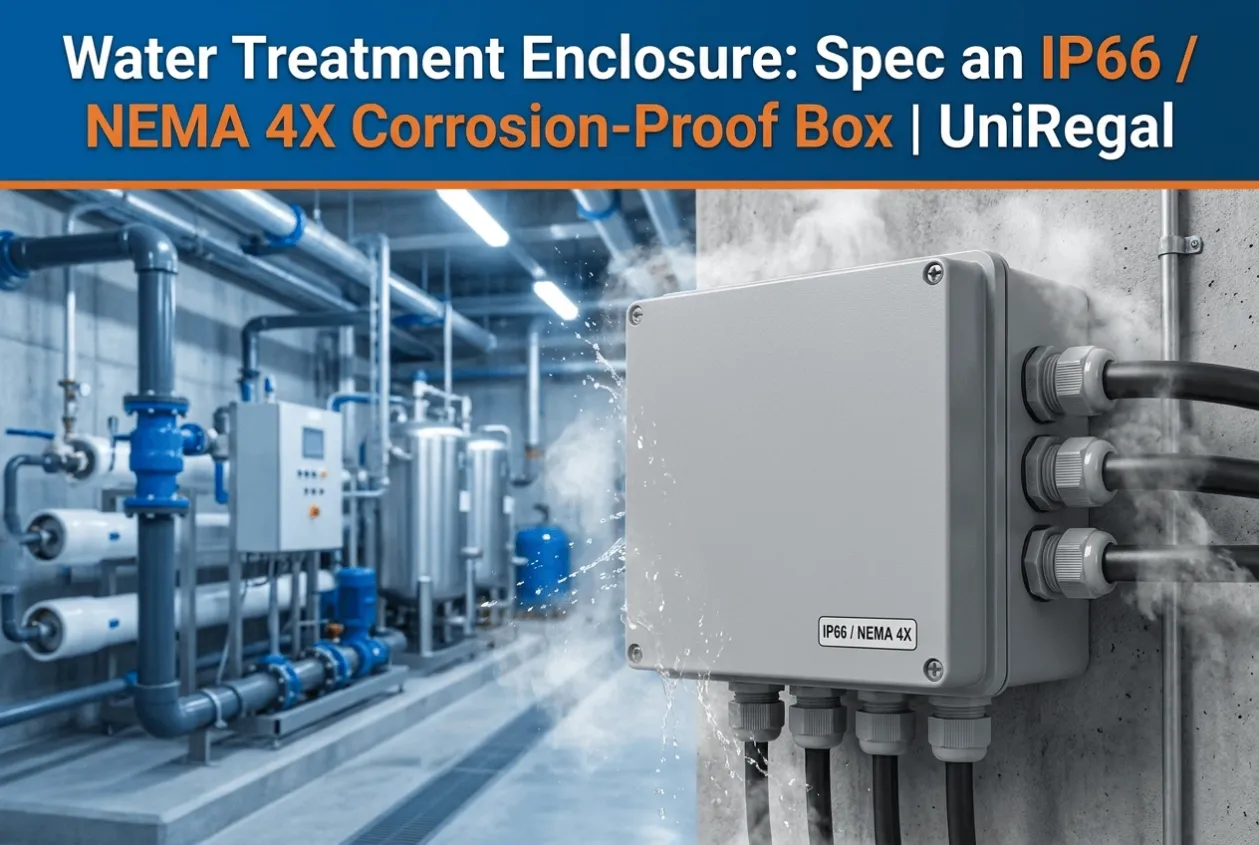
Water Treatment Enclosure: How to Spec a Box That Survives the Plant
A water treatment enclosure should be selected according to what it will actually be exposed to after installation.
That sounds obvious, but many RFQs still arrive with little more than:
Outdoor electrical enclosure, stainless steel, IP66.
For a dry electrical room, that may be enough to begin a discussion. For a wastewater plant, chlorine room, chemical dosing area or outdoor pump station, it leaves too many important questions unanswered.
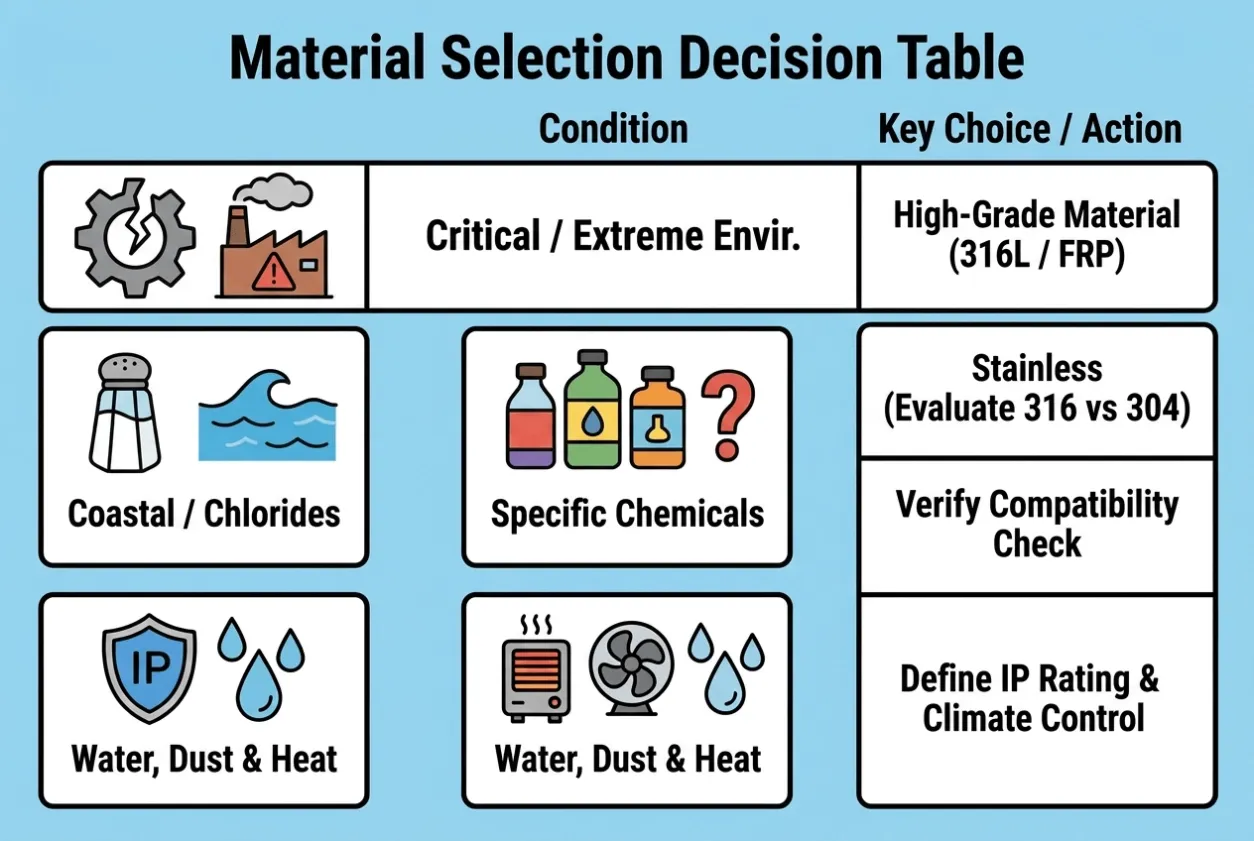
The enclosure may be exposed to continuous humidity, washdown, chemical vapour, hydrogen sulfide, salt air, condensation and large temperature changes. Under those conditions, choosing the cabinet body is only the first part of the specification.
The practical question is:
Which enclosure material and protection strategy will remain reliable in this particular part of the plant?
For many moderate indoor locations, painted steel or 304 stainless steel can work well. For wastewater, coastal or chemically aggressive areas, 316/316L stainless steel or FRP often becomes the safer choice.
Start With the Installation Zone
A water treatment plant is not one corrosion environment.
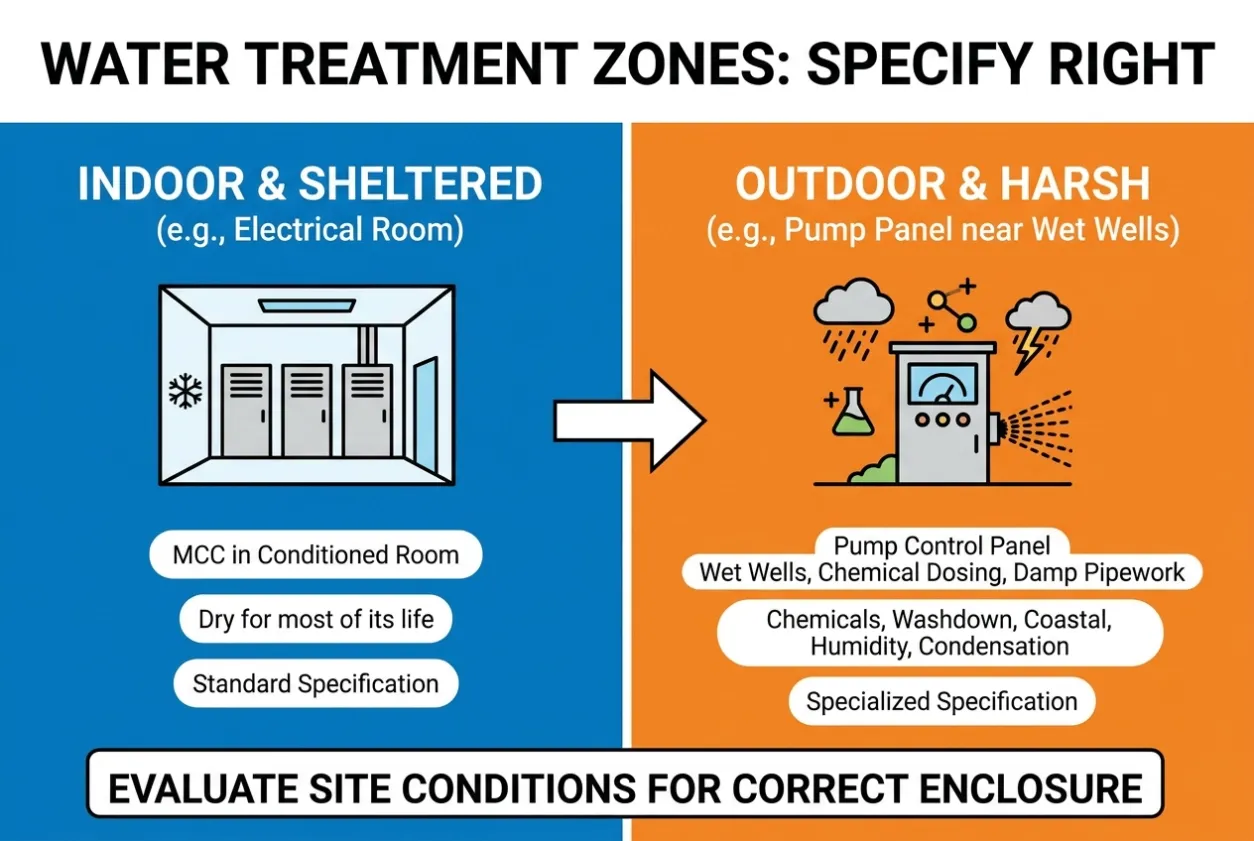
The MCC inside a conditioned electrical room may stay dry for most of its life, while a pump control panel only 100 metres away may sit outside beside wet wells, chemical dosing equipment and constantly damp pipework.
Those two cabinets should not automatically receive the same specification.
Before selecting the enclosure, identify:
- Whether the cabinet is indoors, sheltered or fully outdoors
- Whether chlorine, hydrogen sulfide or other chemicals are present
- Whether the cabinet will be washed down
- Whether the site is coastal
- Maximum humidity and temperature
- Whether condensation is likely
- How difficult future maintenance will be
This simple review usually tells us more about the correct material than the words “water treatment plant.”
Water Treatment Enclosure Decision Matrix
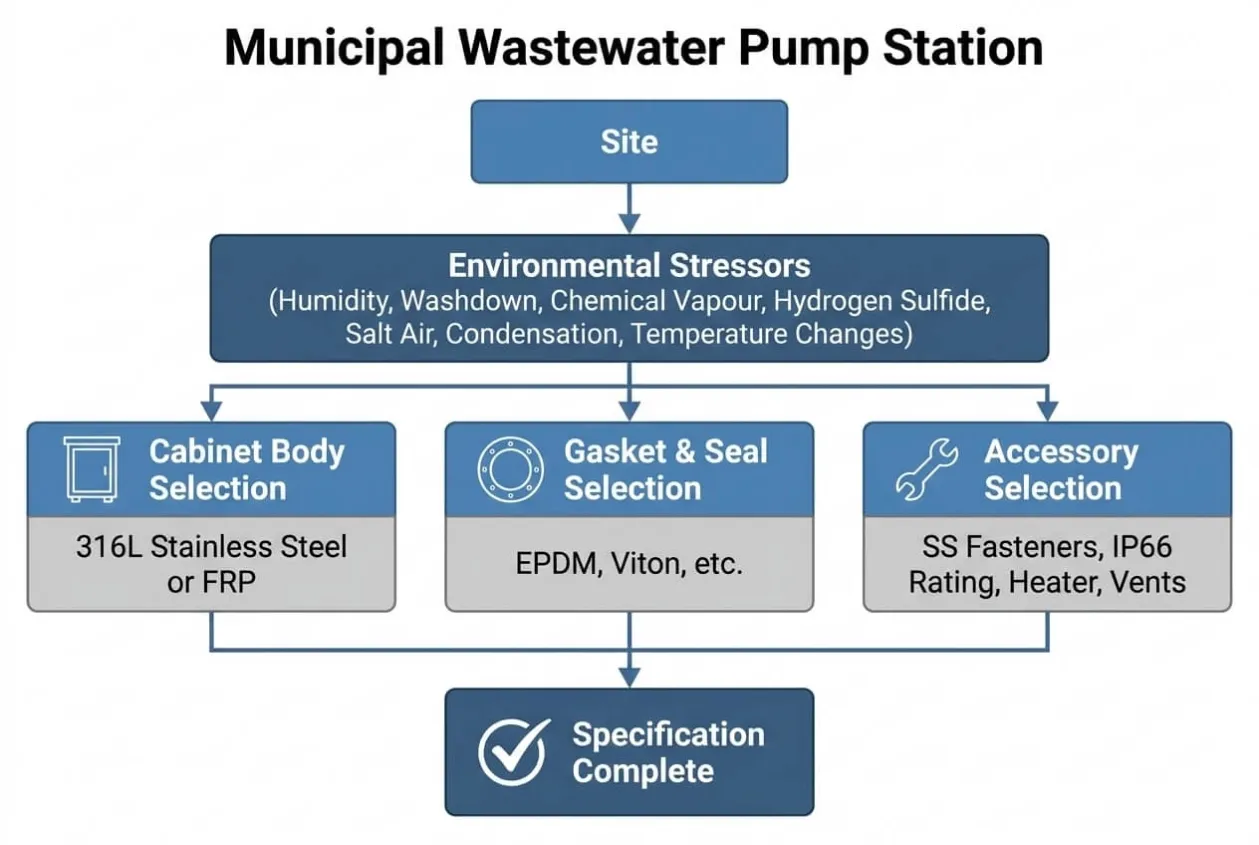
For preliminary specification, the following matrix gives buyers a useful starting point.
Site Condition | Recommended Material | Why |
|---|---|---|
Indoor, dry electrical room | Painted steel | Lowest cost where corrosion exposure is limited |
Indoor humid process area | 304 stainless steel | Good general resistance without relying on coating |
Outdoor inland location | 304 stainless steel | Suitable for many normal outdoor industrial environments |
Wastewater process area | 316/316L stainless steel | Better resistance where moisture, wastewater gases and chemicals are present |
Coastal installation | 316/316L stainless steel | Better resistance to chloride-related corrosion |
Chlorine or chemical dosing area | 316/316L or FRP | Material should be matched to actual chemical exposure |
Small outdoor instrumentation box | FRP or 316 stainless steel | FRP works well where low weight and corrosion resistance are important |
Dry indoor control panel with low corrosion risk | Painted steel or 304 stainless steel | 316 usually adds little value here |
This is not intended to replace a site-specific material review.
It is a way to prevent two common mistakes: paying for 316 stainless steel where it adds little practical value, or specifying 304 simply because it is “stainless steel” when the installation actually has significant chloride or chemical exposure.
When 304 Stainless Steel Is Enough
304 stainless steel is a practical material for many water treatment applications.
For an inland plant where the cabinet is outdoors but away from aggressive chemicals, 304 often provides a reasonable balance between corrosion resistance, availability and cost.
It is commonly suitable for:
- General outdoor control cabinets
- Clean-water treatment areas
- Indoor humid environments
- Pump rooms
- Utility areas without significant chloride exposure
The important limitation is chloride.
304 can still suffer localized corrosion when it is exposed repeatedly to salt, chlorine-containing environments or other chloride sources. The risk becomes more relevant where moisture remains around welds, hinges, mounting brackets and crevices.
That is why we would not select material simply by asking whether the enclosure is outdoors.
We would ask what is in the air around it.
When 316 or 316L Becomes Worth the Cost
316 stainless steel contains molybdenum, which improves resistance to chloride-related pitting compared with 304.
For many buyers, that difference only becomes valuable when the site actually creates the corresponding corrosion risk.
Typical examples include:
- Wastewater treatment areas
- Coastal pumping stations
- Desalination plants
- Chlorinated process areas
- Chemical dosing stations
- Marine installations
- Locations where replacing a corroded enclosure later would be difficult
316L may also be preferred for welded enclosure fabrication because of its lower carbon content.
This does not mean a 316L cabinet is automatically a good cabinet.
Poor weld finishing, unsuitable external hardware or contaminated stainless surfaces can still reduce its service life. The fabrication quality needs to match the material being purchased.
Where FRP Makes More Sense
FRP is sometimes overlooked because many industrial buyers automatically think in terms of stainless steel.
For smaller boxes, instrumentation enclosures and highly corrosive locations, FRP can be a very practical alternative.
It offers good corrosion resistance and electrical insulation while keeping the enclosure relatively light.
We would consider FRP where:
- Chemical exposure is the main concern
- Cabinet weight matters
- The internal equipment load is moderate
- A non-metallic enclosure is preferred
- The enclosure will not carry very heavy switchgear or large thermal loads
Outdoor FRP should be specified with suitable UV resistance.
For large VFDs, transformers or heavy power equipment, stainless steel may still be preferable because mechanical strength, heat dissipation and mounting load become more important.
IP66 and NEMA 4X Should Not Be Treated as Material Grades
A common specification says:
316 stainless steel, IP66 / NEMA 4X.
That may be a perfectly reasonable requirement, but the three terms describe different things.
316 stainless steel describes the enclosure material.
IP66 describes a level of protection against dust and water ingress.
NEMA Type 4X is an enclosure performance classification commonly used on North American projects and includes corrosion-related requirements in addition to outdoor and water protection.
They should therefore be specified independently.
A better RFQ might read:
316L stainless-steel outdoor control enclosure, IP66, NEMA Type 4X where required by the project, installed beside a municipal wastewater wet well.
Now the supplier understands both the enclosure construction and the environment it needs to survive.
Cable Entries Are Often Where Good Enclosures Fail
The cabinet body can be manufactured correctly and still develop water-ingress problems after installation.
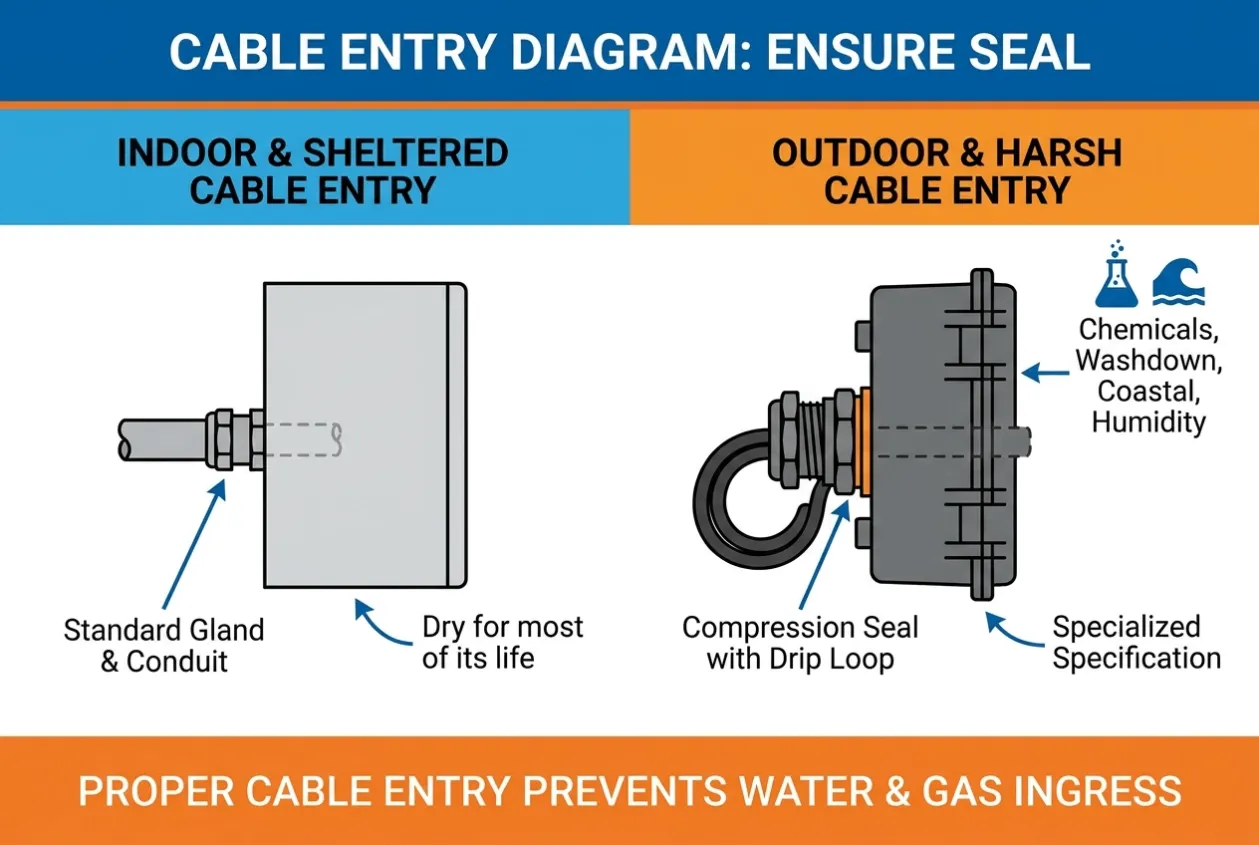
Cable entries are one of the most common weak points.
For wet or outdoor water-treatment locations, we normally review:
- Cable-gland ingress rating
- Gland material
- Gland-plate material
- Sealing of unused openings
- Cable routing
- Drip loops
- Field-drilled holes
- Conduit fittings
IP68-rated cable glands can be appropriate where the installation requires that level of sealing, but they should not simply be added as a marketing specification.
The gland, cable diameter, installation method and enclosure opening all need to work together.
A well-sealed IP66 cabinet can lose much of its environmental protection through one poorly installed cable gland.
A Stainless Cabinet Can Still Fail From Condensation
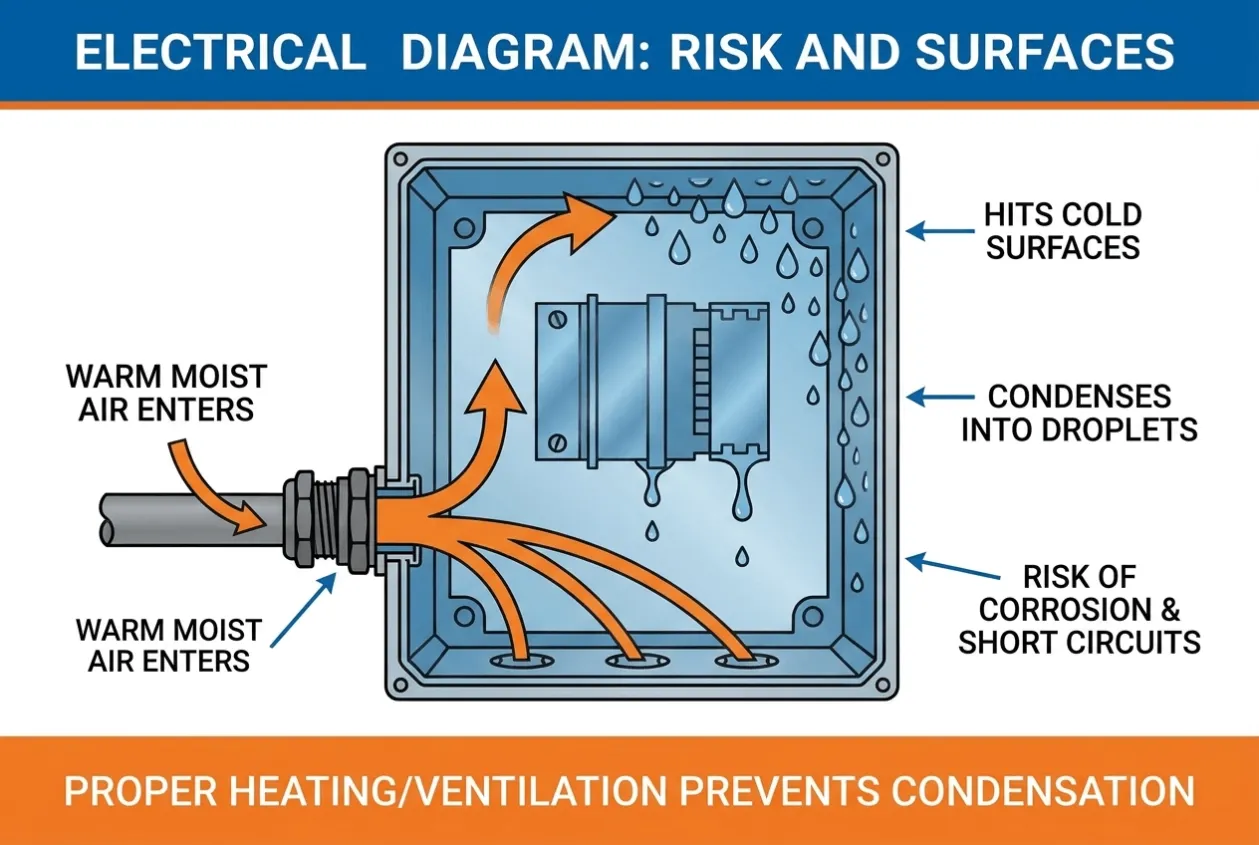
Another common mistake is assuming that corrosion-resistant material solves moisture problems.
It does not.
An outdoor 316L stainless enclosure may look perfectly intact externally while moisture repeatedly forms inside when warm humid air cools overnight.
That condensation can affect:
- PLC terminals
- Relays
- Power supplies
- VFD electronics
- Communication equipment
- Field wiring
For outdoor pump and control panels, we therefore review condensation control separately from enclosure material.
Depending on the site, that may mean using an anti-condensation heater controlled by a hygrostat, providing a suitable breather or drain, or reviewing the cabinet's thermal management as part of the complete design.
For cabinets containing VFDs or other significant heat sources, cooling requirements should also be calculated rather than assumed.
Example: Municipal Wastewater Pump Station
Consider a municipal wastewater pump station with a control panel installed outdoors beside the wet well.
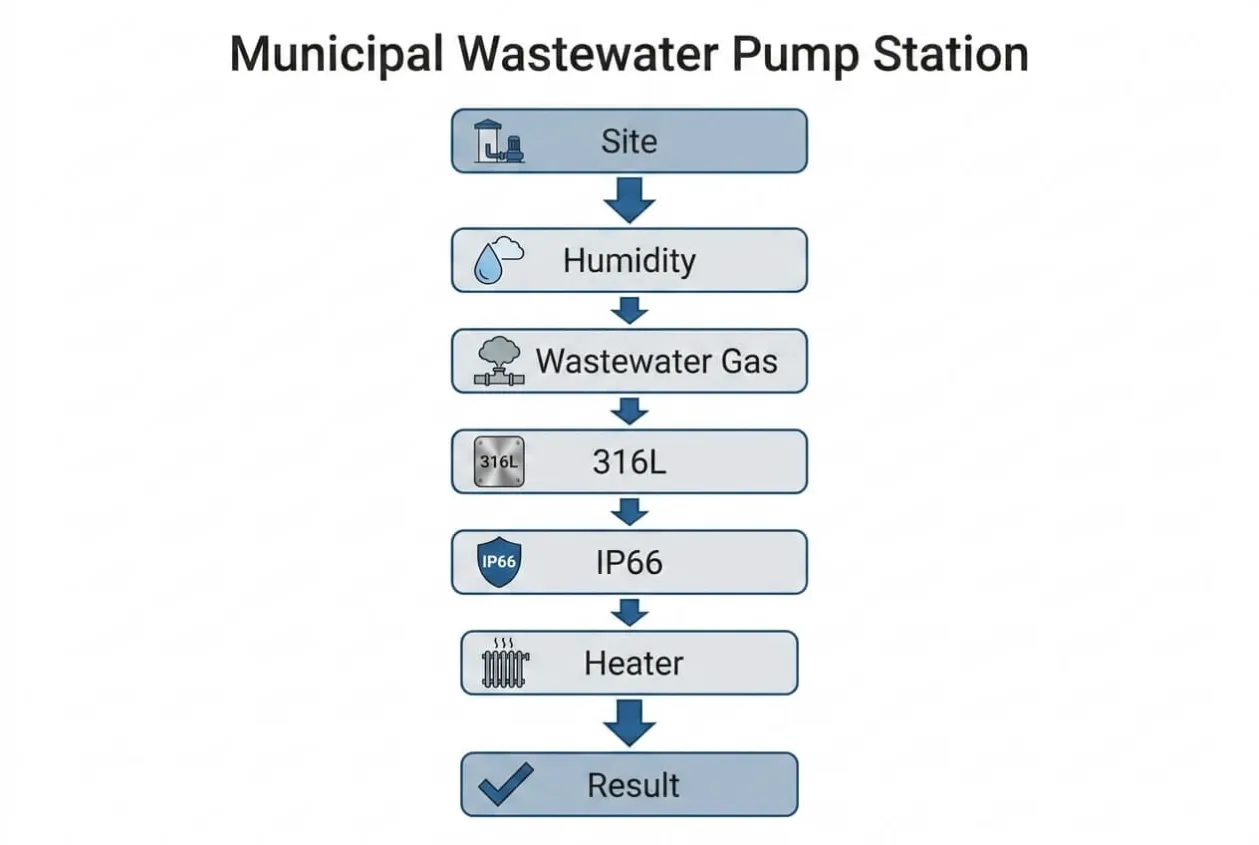
The original specification might simply say:
Outdoor pump panel, stainless steel, IP66.
That still leaves the supplier to make several decisions.
At this site, the cabinet would be exposed to high humidity, wastewater gases, rain and daily temperature cycling. Maintenance crews would also need to open the enclosure periodically for pump and instrumentation work.
For that environment, our starting specification would be closer to:
Item | Engineering Decision |
|---|---|
Enclosure body | 316L stainless steel |
Protection | IP66 |
NEMA requirement | Type 4X if required by project specification |
Cable entries | Corrosion-resistant sealed glands matched to required ingress protection |
External hardware | Corrosion-resistant hinges, fasteners and mounting hardware |
Condensation control | Anti-condensation heater with humidity control |
Thermal review | Based on PLC, power supply, contactors and any VFD heat load |
Mounting | Raised sufficiently to reduce direct splash and standing-water exposure |
The reason for choosing 316L would not simply be that wastewater plants “should use 316.”
It would be the combination of moisture, wastewater atmosphere and expected service life.
The heater would address an entirely different risk. Stainless steel protects the enclosure from external corrosion, while the heater helps protect the electronics from condensation inside.
That distinction matters because simply upgrading the cabinet body from 304 to 316 would not solve the complete reliability problem.
What Buyers Should Put in the RFQ
For most water-treatment enclosure projects, the supplier needs more than dimensions.
A useful RFQ should include:
- Water or wastewater application
- Exact installation area
- Indoor, sheltered or outdoor location
- Coastal or inland location
- Chlorine, H₂S or chemical exposure
- Required material
- Cabinet dimensions
- IP rating
- NEMA Type where required
- Internal equipment list
- Approximate heat load
- Ambient temperature
- Humidity
- Cable-entry direction
- Condensation-control requirement
- UL 508A requirement for the complete control panel, if applicable
These details allow the enclosure to be designed around its environment rather than selected from a generic catalogue.
Engineering Takeaway
There is no single enclosure specification that is right for every water treatment plant.
A painted-steel cabinet may be completely appropriate inside a dry electrical room. A 304 stainless cabinet can perform well at an inland outdoor site. At a wastewater wet well, coastal pumping station or aggressive chemical area, 316/316L or FRP may be the more sensible lifecycle choice.
The important point is to select the enclosure as a complete environmental protection system.
Material determines how the cabinet handles corrosion. The enclosure rating deals with ingress. Cable glands protect the penetrations. Condensation and thermal controls protect the electrical equipment inside.
If one of those parts is ignored, specifying a more expensive stainless-steel grade will not necessarily make the panel more reliable.
Need to Specify a Water Treatment Enclosure?
Send us the installation location, environmental conditions, enclosure dimensions, IP/NEMA requirement and internal equipment list.
UniRegal can review whether your application is better suited to painted steel, 304 stainless, 316/316L or FRP, and whether the enclosure also needs condensation control, thermal management or project-specific control-panel requirements.
If you are sourcing a complete pump or process control panel, we can review the enclosure together with the PLC, HMI, VFD, protection devices and UL 508A requirements where applicable.
Send Your Water Treatment Enclosure Specification for Engineering Review
Related guides
Sources
- NEMA 250 standard — National Electrical Manufacturers Association
- UL 508A for industrial control panels — UL Standards Catalog