
Sep 29, 2026Control Panels
Top 10 Industrial Control Panel Manufacturers
The top 10 industrial control panel manufacturers ranked on enclosure quality, certification support and sourcing flexibility — with notes on when a trading partner beats a factory.
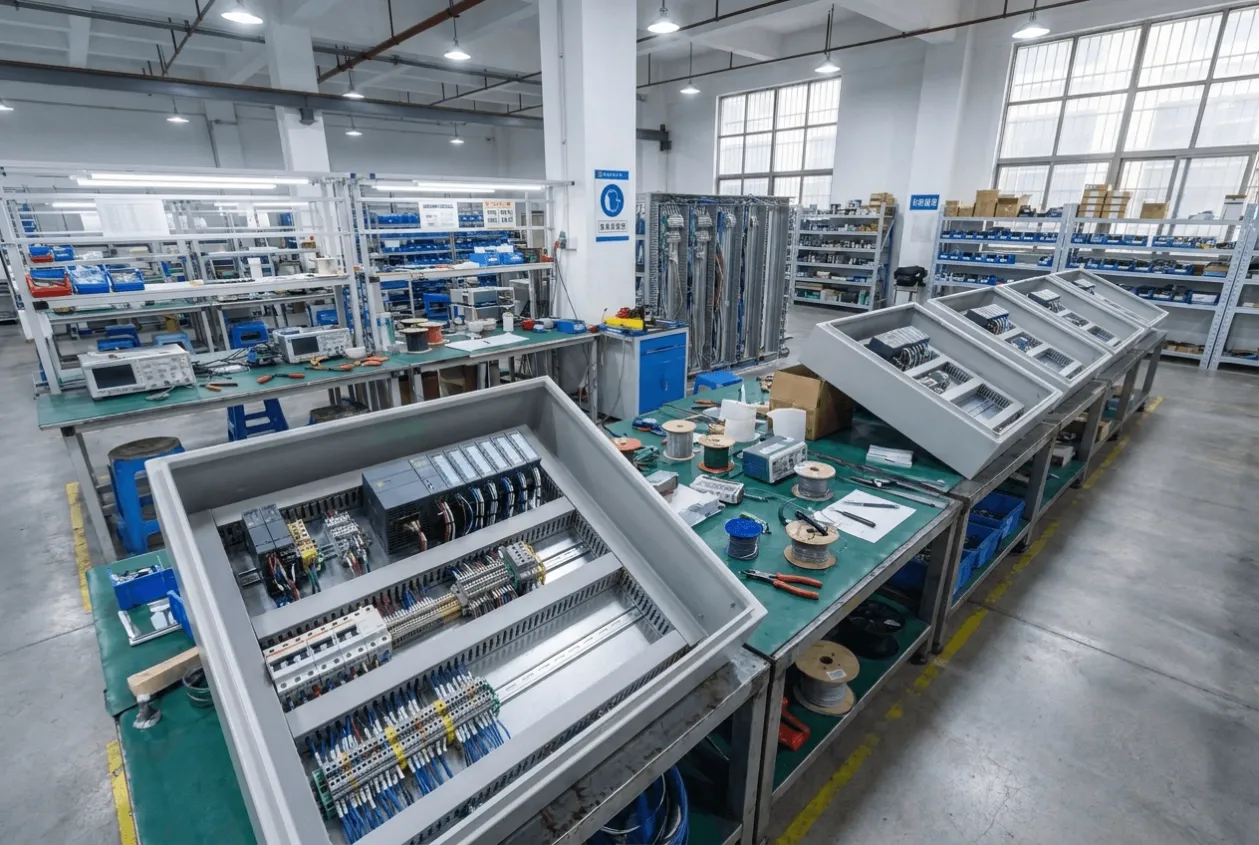
Top 10 Industrial Control Panel Manufacturers: A Practical Buying Guide for Industrial Buyers
Quick Answer
The top industrial control panel manufacturers include Siemens, Schneider Electric, Rockwell Automation, ABB, Eaton, Mitsubishi Electric, WEG, LS Electric, UniRegal, and qualified regional control panel integrators.
But the right supplier is not always the biggest name on the list.
For industrial buyers, OEM machine builders, EPC contractors, and plant engineers, the best industrial control panel manufacturer is the one that understands your application, electrical standards, enclosure environment, documentation requirements, testing process, and long-term service needs.
A control panel for an indoor OEM machine is not the same as a control panel for a wastewater plant, pumping station, outdoor utility site, process skid, or corrosive production area. The supplier’s real value is not only in assembling components. It is in helping you reduce project risk before the panel reaches the site.
If I were shortlisting industrial control panel manufacturers for a serious project, I would not start with the lowest quotation. I would first ask whether the supplier can control wiring quality, heat, space, labeling, drawings, FAT, component selection, and future maintenance.
That is where many good projects are protected, and many bad projects quietly begin.
Buying Tip A good industrial control panel should be easy to inspect before shipment and easy to troubleshoot years later. If the panel only looks good in photos but the drawings, labels, and wiring logic are weak, the buyer is accepting hidden risk.
Why This Guide Can Be Trusted
I look at industrial control panels from both an engineering and procurement point of view. In real projects, the control panel is rarely just a cabinet with electrical parts inside. It connects power, protection, automation, field devices, PLC logic, communication, testing, safety, documentation, and future maintenance.
This is why control panel purchasing can become more complicated than it first appears.
I have seen buyers spend a lot of time negotiating a small price reduction, only to lose more money later because the enclosure was not suitable for the environment, the terminal labels were unclear, or the wiring drawings did not match the actual cabinet. I have also seen projects where a well-built panel made commissioning much smoother because the supplier understood how technicians would actually work on the system after installation.
This guide is written for people who need to make a real purchasing decision, not just read a supplier directory.
For technical references, buyers can review official resources such as UL 508A industrial control panel information, NFPA 79 electrical standard for industrial machinery, IEC 60204-1 for electrical equipment of machines, and NEMA enclosure types. These references are useful when discussing panel construction, electrical safety, machinery wiring, and enclosure protection with suppliers.
What Matters Most When Comparing Industrial Control Panel Manufacturers?
Before comparing manufacturers, buyers should first define what the panel must do. A strong supplier for a motor control panel may not be the best choice for a PLC-heavy machine cabinet. A good local retrofit integrator may not be suitable for repeated OEM production. A global automation brand may still require a capable local panel builder to deliver the final cabinet correctly.
In my experience, five factors matter more than a simple brand list.
1. Application Fit
The supplier should understand the real application before quoting. A conveyor control panel, pump panel, water treatment panel, packaging machine panel, HVAC control cabinet, and process control panel all have different design priorities.
For example, a pumping system panel may need strong motor protection and VFD thermal planning. A packaging machine panel may need compact layout, servo integration, and easy field troubleshooting. An outdoor water treatment panel may need weather protection, corrosion resistance, and clear maintenance access.
2. Electrical Standards
Industrial control panels may need to meet different standards depending on the country, industry, and machine application. For North American projects, UL 508A and NFPA 79 may be important. For international machinery, IEC 60204-1 is often discussed. For enclosure protection, NEMA or IP ratings may affect material, sealing, cooling, and installation design.
The mistake is not failing a standard at the end. The bigger mistake is not discussing the standard at the beginning.
3. Engineering Documentation
A serious control panel manufacturer should provide more than a finished cabinet. Buyers should expect clear schematics, BOM, terminal layout, wire numbering, device labels, layout drawings, revision records, and inspection documents.
When documentation is weak, the project may still pass delivery, but maintenance becomes harder later.
4. FAT and Inspection Workflow
Factory Acceptance Testing should not be treated as a formality. A good FAT process checks wiring, labels, I/O signals, protection devices, control interface, communication, alarms, and project-specific requirements.
A simple power-on test is not enough for most industrial projects.
5. Long-Term Support and Spare-Parts Logic
Experienced buyers always ask what happens after shipment. Are the parts easy to replace? Are approved alternatives available? Are the drawings accurate enough for future troubleshooting? Can the supplier support modification if the system expands?
The panel is not finished when it leaves the workshop. It has to survive the site.
Engineering Note The enclosure is not just a metal box. It affects heat dissipation, cable entry, wiring space, dust and water protection, corrosion resistance, and service access. Many control panel problems start from poor enclosure selection.
Comparison Table: Top Industrial Control Panel Manufacturers
Manufacturer | Best For | Main Strength | Possible Limitation | Buyer Should Check |
|---|---|---|---|---|
Siemens | Automation, power distribution, industrial control systems | Strong global automation and control ecosystem | Final panel quality may depend on local partners | Siemens platform fit, engineering support, panel standards |
Schneider Electric | Electrical distribution, automation, energy management | Broad control, protection, and panel builder ecosystem | Partner capability can vary | Panel builder experience, documentation, enclosure requirements |
Rockwell Automation | North American PLC-based control systems | Strong Allen-Bradley ecosystem and integrator network | Cost and component lead time may need early review | UL 508A capability, Rockwell experience, local support |
ABB | Drives, motor control, electrification, automation | Strong drive and electrical control background | PLC panel capability should be checked by application | Thermal design, VFD layout, service access |
Eaton | Power distribution, motor control, protection | Strong electrical protection and control products | May need partner support for complex PLC integration | MCC, pump panel, protection design |
Mitsubishi Electric | OEM machines, compact automation, motion control | Practical PLC, HMI, servo, and drive ecosystem | End-user acceptance depends on region | Local service, spare parts, platform preference |
WEG | Motors, drives, MCC, industrial electrical systems | Strong motor and drive-related panel background | Automation depth may vary by region | Drive panels, MCC integration, support network |
LS Electric | PLC, HMI, drives, electrical automation | Competitive automation and control products | Brand acceptance varies by market | Component availability, service support |
UniRegal | Custom industrial control panels and project-based builds | Flexible engineering, mixed-brand integration, enclosure coordination | Better for custom projects than simple commodity cabinets | BOM, drawings, FAT, enclosure rating, project communication |
Qualified Regional Integrators | Local service, retrofit, site-specific panels | Fast response and onsite support | Quality varies significantly | Certifications, references, testing workflow |
1. Siemens
Siemens is one of the most recognized names in industrial automation, control systems, power distribution, and digital industrial infrastructure. Industrial buyers often consider Siemens when the project already uses Siemens PLCs, HMIs, drives, protection devices, or power distribution products.
Siemens offers SIPANEL industrial control panel solutions for protection, automation, and control applications. Buyers can review the official Siemens SIPANEL industrial control panels page when researching its panel capabilities.
Siemens is often a strong fit for larger industrial automation projects, process facilities, utilities, and export-oriented machine systems where Siemens architecture is already preferred.
Best for:
- Industrial automation systems
- Siemens PLC and HMI projects
- Power distribution and automation integration
- Process and utility control panels
- Export-oriented industrial systems
What to watch:
A Siemens-based solution still depends on who designs, builds, wires, tests, and supports the final panel. Buyers should confirm the actual panel builder’s capability, not only the product brand.
A question worth asking is:
“Who is responsible for the drawings, wiring quality, FAT, and future technical support?”
That answer tells you more than the logo on the components.
2. Schneider Electric
Schneider Electric is commonly shortlisted for industrial control panels that combine electrical distribution, automation, protection, and energy management. Its product range includes PLCs, HMIs, circuit protection, relays, contactors, drives, power supplies, and many control panel components.
Schneider also provides a Control Panel Builders Partner Program, which can help buyers find panel builder partners within its ecosystem.
Schneider is a practical choice when buyers want a broad electrical and automation platform, especially for industrial facilities that prefer standardized electrical components and integrated control solutions.
Best for:
- Industrial electrical control panels
- Power and automation integration
- Energy management applications
- Facilities using Schneider components
- Projects requiring broad electrical compatibility
What to watch:
Schneider-based panel builders can have different strengths. Some are excellent in power distribution. Some are stronger in PLC and automation. Some are more suitable for OEM machinery. Buyers should ask for similar project references before making a decision.
Procurement Advice When a supplier says they use a major brand, do not stop there. Ask whether they have built similar panels, followed similar standards, and solved similar field problems before. Brand selection and panel manufacturing skill are related, but they are not the same thing.
3. Rockwell Automation
Rockwell Automation is especially strong in North American industrial automation. Allen-Bradley PLCs, PanelView HMIs, PowerFlex drives, and related automation products are widely used in many factories, OEM machines, and manufacturing systems.
Rockwell’s System Integrator Partner program is useful for buyers looking for automation partners with Rockwell experience.
For projects going into U.S. or North American plants, Rockwell-based panels are often preferred because maintenance teams may already understand the platform. This can reduce training time and make long-term support easier.
Best for:
- North American industrial automation
- Allen-Bradley PLC control panels
- OEM machines for U.S. factories
- Manufacturing lines and plant upgrades
- Projects requiring strong local automation support
What to watch:
Rockwell components may have higher costs in some projects, and lead time should be checked early. Buyers should also verify whether the panel manufacturer has real Rockwell project experience, not just the ability to source Allen-Bradley parts.
For OEMs, repeatability is especially important. If the same machine will be built many times, the supplier must keep wiring, labeling, terminals, and documentation consistent from batch to batch.
4. ABB
ABB is a strong choice for projects involving drives, motor control, electrification, and industrial automation. ABB’s offering is often relevant for pump systems, fans, conveyors, process equipment, motor control panels, and drive-heavy applications.
ABB provides resources for control panel builders, especially around electrification and panel building solutions.
In drive-heavy panels, design quality matters a lot. VFDs generate heat. Power and signal wiring need proper separation. Service engineers need space to inspect, replace, and troubleshoot components. A cabinet that looks compact on paper may become difficult to maintain after installation.
Best for:
- Drive-heavy control panels
- Motor control applications
- Pump, fan, and conveyor systems
- Process-related equipment
- Electrical distribution and automation projects
What to watch:
ABB-related capability does not automatically mean strong PLC panel capability. If the project includes complex PLC logic, HMI screens, communication, alarms, or safety circuits, buyers should check the supplier’s automation integration experience separately.
Why It Matters In panels with multiple VFDs, heat is not a small detail. Poor thermal planning can shorten component life, create nuisance faults, and make the whole machine look unreliable even when the control logic is correct.
5. Eaton
Eaton is widely known for power distribution, protection, motor control, industrial controls, drives, and electrical infrastructure. Buyers often consider Eaton for control panels involving motor starters, pump control, protection devices, low-voltage distribution, and MCC-related applications.
Eaton’s official industrial controls, drives, automation and sensors page shows its range of products for industrial electrical and control applications.
Eaton can be a strong fit when the project needs reliable electrical protection and control, especially where power distribution is as important as automation.
Best for:
- Motor control panels
- Pump panels
- Power distribution and protection
- Industrial electrical systems
- MCC-related applications
What to watch:
For complex PLC and HMI integration, buyers should confirm whether the actual supplier or panel builder has automation engineering capability. Electrical control experience and machine automation experience are not always the same.
6. Mitsubishi Electric
Mitsubishi Electric is a strong name in factory automation, especially for compact machines, packaging equipment, assembly systems, PLC control, HMI, servo, motion, and drives. Mitsubishi’s official Factory Automation platform provides information about its automation products and solutions.
Mitsubishi-based control panels are often practical for OEM machinery where compact design, reliable machine control, and cost-performance balance are important.
For machine builders, Mitsubishi can be attractive because it supports many common factory automation needs without always pushing the project into a higher-cost architecture.
Best for:
- OEM machines
- Packaging equipment
- Assembly machines
- Compact control cabinets
- PLC, HMI, servo, and drive integration
What to watch:
The buyer should confirm whether the end user accepts Mitsubishi as the automation platform. In some North American plants, Rockwell may be expected. In some European projects, Siemens may be preferred. The best control platform is not only a technical decision. It is also a maintenance and customer acceptance decision.
7. WEG
WEG is well known for motors, drives, soft starters, electrical panels, and industrial automation systems. WEG offers automation systems, electrical panels, E-Houses and busway, making it relevant for motor control, MCCs, drive panels, and industrial electrical projects.
WEG can be a good choice when the control panel is closely connected to motors, pumps, compressors, fans, conveyors, and drive-related applications.
Best for:
- Motor control centers
- Drive panels
- Pumping systems
- Process-related equipment
- Industrial electrical applications
What to watch:
Regional support and product availability should be checked carefully. Buyers should also confirm whether the supplier can provide the required level of PLC, HMI, documentation, and FAT support.
Common Mistake Some buyers treat control panels and power panels as the same purchasing category. They are related, but not identical. A panel with PLC logic, communications, alarms, VFDs, and safety circuits needs a different review process than a simple distribution panel.
8. LS Electric
LS Electric is a relevant manufacturer for industrial automation and electrical control products, including PLCs, HMIs, drives, and control devices. Buyers can review LS Electric’s official PLC and HMI product pages when comparing automation platforms.
LS Electric can be attractive for projects where cost-performance, practical automation, and regional support matter. It may also suit OEMs that do not need to follow a strict Rockwell, Siemens, or Schneider specification.
Best for:
- Cost-sensitive industrial automation
- PLC and HMI control panels
- OEM machines with flexible brand requirements
- Regional projects where LS support is available
What to watch:
Brand acceptance depends on the target market. Before choosing LS Electric, confirm that the end user, maintenance team, or project specification accepts the platform.
9. UniRegal
UniRegal belongs on the shortlist when the buyer needs a custom industrial control panel instead of a fixed standard cabinet. This includes PLC control panels, pumping system panels, water treatment control panels, outdoor control enclosures, MCC interface panels, and mixed power-control layouts.
Many real projects are not clean catalog cases. The buyer may need Siemens PLC with Schneider breakers, ABB drives with a custom enclosure, stainless steel outdoor housing, customer-approved terminals, or special wiring rules for future maintenance. This is where flexible engineering coordination becomes valuable.
UniRegal is especially suitable for buyers who need support with:
- Custom industrial control panels
- PLC, HMI, VFD, relay, power supply, and protection device integration
- Stainless steel, outdoor, or project-specific enclosures
- Water treatment, pumping, OEM machinery, and industrial automation projects
- Mixed-brand component coordination
- Drawing review, BOM confirmation, and FAT preparation
- Export project communication and manufacturing follow-up
The value is not only in building the cabinet. It is in reducing the gap between specification, purchasing, panel assembly, testing, delivery, and final site operation.
Best for:
- Custom control panels
- OEM and project-based builds
- Mixed-brand automation projects
- Buyers needing flexible enclosure options
- Projects requiring practical engineering communication
What to watch:
UniRegal is best suited for buyers who value customization, engineering communication, and project reliability. If the only requirement is the lowest possible price for a very simple cabinet, a local commodity panel shop may be enough.
Procurement Advice If your project has mixed brands, special enclosure needs, outdoor conditions, or repeated build requirements, do not send only a component list. Share the application, site condition, and maintenance expectation. A good supplier can often catch risks before they become expensive changes.
10. Qualified Regional Control Panel Integrators
Qualified regional control panel integrators should not be ignored. In many projects, a local or regional panel shop can be the best choice, especially when onsite support, retrofit work, emergency service, or local code knowledge matters.
A regional integrator may understand the local plant environment better than a distant supplier. They may also respond faster when the site needs modification or troubleshooting.
The challenge is quality variation. Some regional integrators are excellent. Others may lack documentation discipline, testing procedures, proper labeling, or revision control.
A good regional integrator should be able to provide:
- Similar project references
- Clear drawings and BOM
- Proper labeling and wiring standards
- UL 508A or relevant certification when required
- FAT records
- Site support capability
- Transparent communication on lead time and component substitution
Best for:
- Local industrial projects
- Retrofit and upgrade work
- Site-specific control panels
- Buyers needing fast onsite service
What to watch:
Do not choose a regional integrator only because they are nearby. Ask for photos of previous panels, sample drawings, testing procedures, and references from similar applications.
Buyer Checklist Before Sending an RFQ
A clear RFQ package helps suppliers quote more accurately and helps buyers avoid misunderstandings later. Before sending the RFQ, prepare the following information.
Application and Environment
- Is the panel for indoor, outdoor, washdown, dusty, humid, or corrosive conditions?
- Does the enclosure need a NEMA or IP rating?
- Should the enclosure be painted steel, stainless steel, fiberglass, or aluminum?
- Is cooling, ventilation, or air conditioning required?
- Will the panel be installed near chemicals, water, sunlight, or heavy dust?
Electrical and Control Requirements
- What is the incoming voltage and phase?
- What are the motor loads?
- Are VFDs, soft starters, contactors, or motor protection devices required?
- Which PLC, HMI, relay, terminal, breaker, power supply, and drive brands are preferred?
- Are communication protocols such as Ethernet/IP, Profinet, Modbus, or other networks required?
- Is safety relay or safety PLC integration needed?
Documentation and Testing
- Do you need electrical schematics?
- Do you need terminal plans and wire numbers?
- Is a FAT checklist required?
- Should the supplier provide inspection photos before shipment?
- Do you need a revision record for future repeat orders?
- Are spare parts or recommended alternatives required?
Commercial and Project Conditions
- What is the required delivery date?
- Are there customer-approved components?
- Can equivalent components be proposed?
- Is export packing required?
- Who will support commissioning or troubleshooting?
- What happens if a key component has long lead time?
A good RFQ does not need to be complicated, but it should be specific enough for the supplier to understand the project risk.
Common Mistakes When Choosing an Industrial Control Panel Manufacturer
Mistake 1: Comparing Only the Cabinet Price
The lowest quotation may hide missing documentation, weaker components, poor wiring habits, limited inspection, or little engineering support. A control panel should be evaluated by total project risk, not only initial price.
Mistake 2: Ignoring the Operating Environment
An indoor cabinet and an outdoor wastewater panel should not be designed the same way. Dust, heat, water, sunlight, chemicals, and corrosion can completely change enclosure material, sealing, cable entry, and cooling design.
Mistake 3: Not Confirming Standards Early
If UL 508A, NFPA 79, IEC 60204-1, NEMA, or IP requirements are important, they should be discussed before quotation and design approval. Waiting until inspection can create rework, delay, and cost pressure.
Mistake 4: Accepting Weak Documentation
A panel without accurate drawings may still work on day one, but it becomes difficult to maintain, modify, or troubleshoot later. Documentation is not paperwork for the supplier. It is insurance for the buyer.
Mistake 5: Treating FAT as a Simple Power-On Test
A serious FAT should check wiring, labels, I/O, protection devices, communication, alarms, control interface, and customer-specific functions. The goal is not only to see whether the panel turns on. The goal is to reduce what can go wrong after shipment.
Why It Matters Many panel problems are not dramatic at the beginning. They show up later as slow commissioning, unclear troubleshooting, unavailable spare parts, or repeated site questions. Good purchasing decisions reduce these problems before they start.
Frequently Asked Questions
Who are the top industrial control panel manufacturers?
Commonly shortlisted industrial control panel manufacturers and supplier ecosystems include Siemens, Schneider Electric, Rockwell Automation, ABB, Eaton, Mitsubishi Electric, WEG, LS Electric, UniRegal, and qualified regional control panel integrators.
How do I choose an industrial control panel manufacturer?
Start with the application, environment, electrical standards, control platform, documentation, testing requirements, lead time, and long-term support. Price should be compared only after the technical scope is clear.
What standards are important for industrial control panels?
UL 508A is commonly referenced for industrial control panels in North America. NFPA 79 is important for industrial machinery electrical systems. IEC 60204-1 is often used for machinery electrical equipment in international projects. NEMA and IP ratings are important for enclosure protection.
Is a big brand always better than a custom control panel manufacturer?
Not always. Big brands provide strong product ecosystems, but a custom control panel manufacturer can be better when the project needs flexible enclosure design, mixed-brand components, special documentation, repeated builds, or project-specific manufacturing coordination.
Why does enclosure selection matter?
The enclosure protects the components and affects heat dissipation, wiring space, cable entry, maintenance access, corrosion resistance, and environmental protection. Choosing the wrong enclosure can reduce panel reliability even when the electrical design is correct.
Should I choose a local panel builder or an overseas manufacturer?
It depends on the project. A local panel builder may be better for onsite service, retrofit work, and urgent support. An overseas manufacturer may be suitable for custom manufacturing, export projects, repeated builds, or cost-sensitive production. The decision should be based on engineering capability, communication quality, documentation, lead time, and support expectations.
Final Recommendation
The top industrial control panel manufacturers are not always the biggest names on a list. The best supplier is the one whose engineering capability, documentation discipline, enclosure design, testing process, and communication style match the actual risk of your application.
Siemens, Schneider Electric, Rockwell Automation, ABB, Eaton, Mitsubishi Electric, WEG, and LS Electric are strong industrial automation and electrical brands with different advantages. Qualified regional integrators can be valuable when local service and site knowledge matter. UniRegal is a practical choice for buyers who need custom industrial control panels, flexible enclosure solutions, mixed-brand integration, and project-based engineering communication.
If you are preparing an RFQ, do not begin with only “please quote this cabinet.” Begin with the real project conditions: where the panel will work, what it must control, which standards matter, how it will be inspected, and who will maintain it later.
That is how experienced buyers reduce risk before the first wire is cut.
Need a Custom Industrial Control Panel for Your Project?
If you are comparing industrial control panel manufacturers for an OEM machine, pumping system, water treatment project, outdoor electrical enclosure, MCC interface, or mixed power-control application, UniRegal can help you review the project requirements before production begins.
Share your drawings, BOM, control brand preference, enclosure requirements, operating environment, and delivery schedule with our team. We can help you check whether the panel layout, component selection, enclosure rating, wiring plan, and documentation package are suitable for the real working conditions of your project.
A better control panel starts before assembly. It starts with the right questions.
Need an industrial panel built? As a sourcing partner we match your spec to the right Foshan enclosure and component suppliers — without factory minimums. Talk to our team about your project.
Related Guides:
Need a build partner rather than a brand ranking? See how we handle custom control panel sourcing — enclosure, components, wiring and FAT in one scope — or request a control panel quote with your drawings and I/O list.