
Aug 20, 2026Buying Guides
Top 10 Industrial Automation Panel Manufacturers
A buyer-focused guide to choosing industrial automation panel manufacturers by project fit, platform, load profile, enclosure needs, documentation, FAT, and long-term service risk.
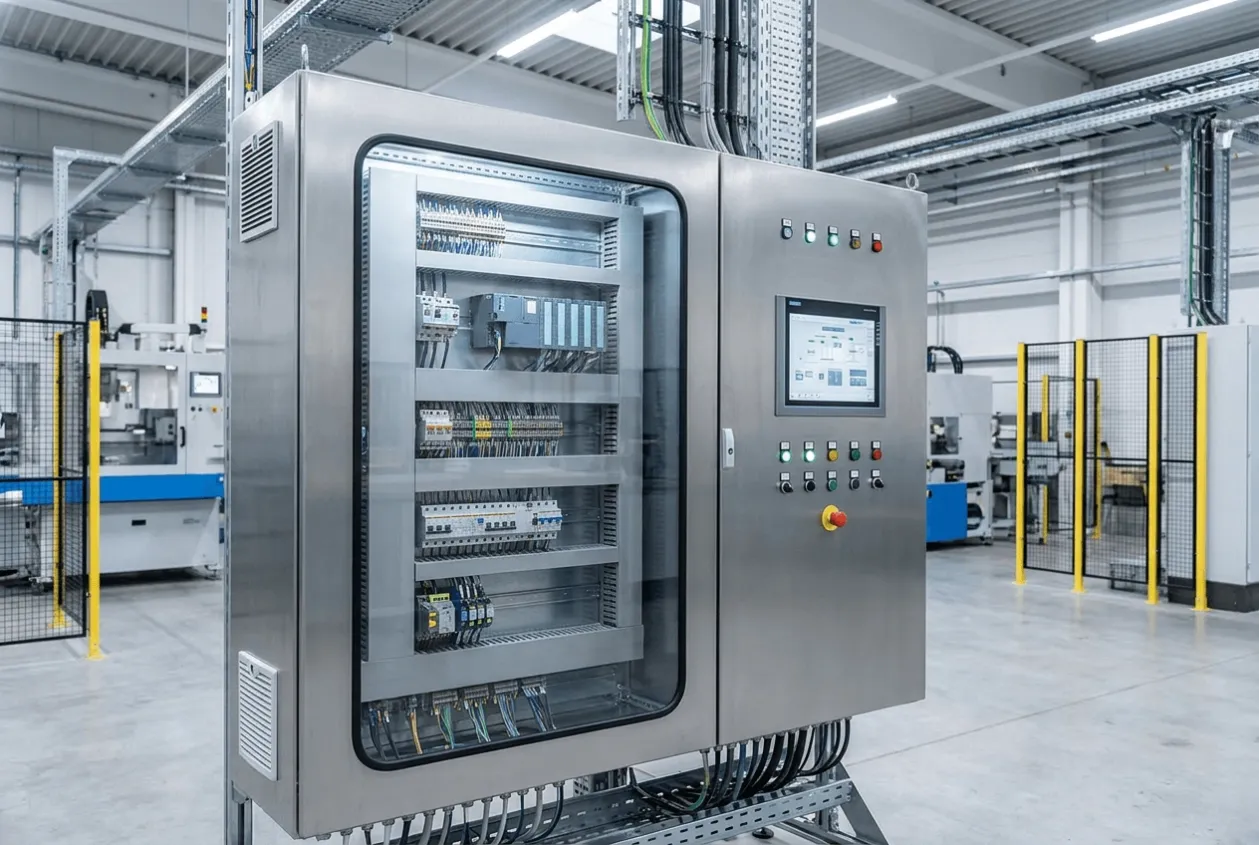
Top 10 Industrial Automation Panel Manufacturers: A Buyer’s Guide to Project Fit
Quick Answer
Industrial automation panels are not bought by brand. They are bought by Project Fit.
That is the main idea behind this guide.
The top industrial automation panel manufacturers include Siemens, Rockwell Automation, Schneider Electric, ABB, Mitsubishi Electric, Eaton, WEG, Phoenix Contact integration partners, UniRegal, and qualified regional industrial automation panel builders.
But the best choice depends on your application, not the name alone. A panel for a pump station is different from a panel for an OEM machine, a water treatment system, a packaging line, or a drive-heavy process skid.
Choose Siemens when your site already follows Siemens architecture. Choose Rockwell when the project goes into a North American factory using Allen-Bradley. Choose Schneider when power distribution and PLC control must work together. Choose ABB or WEG when motors and drives are central. Choose Mitsubishi for compact OEM machinery. Choose UniRegal when you need a custom industrial automation panel built around real project constraints.
Buying Tip A ranking helps you start. Project fit helps you choose. The wrong panel supplier can still use the right components and create problems through poor layout, weak documentation, or an enclosure that is too small for the real job.
The Big Idea: Project Fit Matters More Than Brand
Many buyers begin with a familiar question:
- “Which brand is best?”
- “Which supplier understands my project risk?”
That difference changes the whole buying process.
A Siemens-based panel can fail as a purchasing decision if the end user expects Allen-Bradley. A Rockwell panel can be risky if lead time is not checked early. An ABB or WEG drive panel can still overheat if the enclosure is too tight. A compact Mitsubishi panel can become difficult to service if there is no space for future I/O. A low-cost regional panel builder can be useful locally, but only if documentation and FAT are controlled.
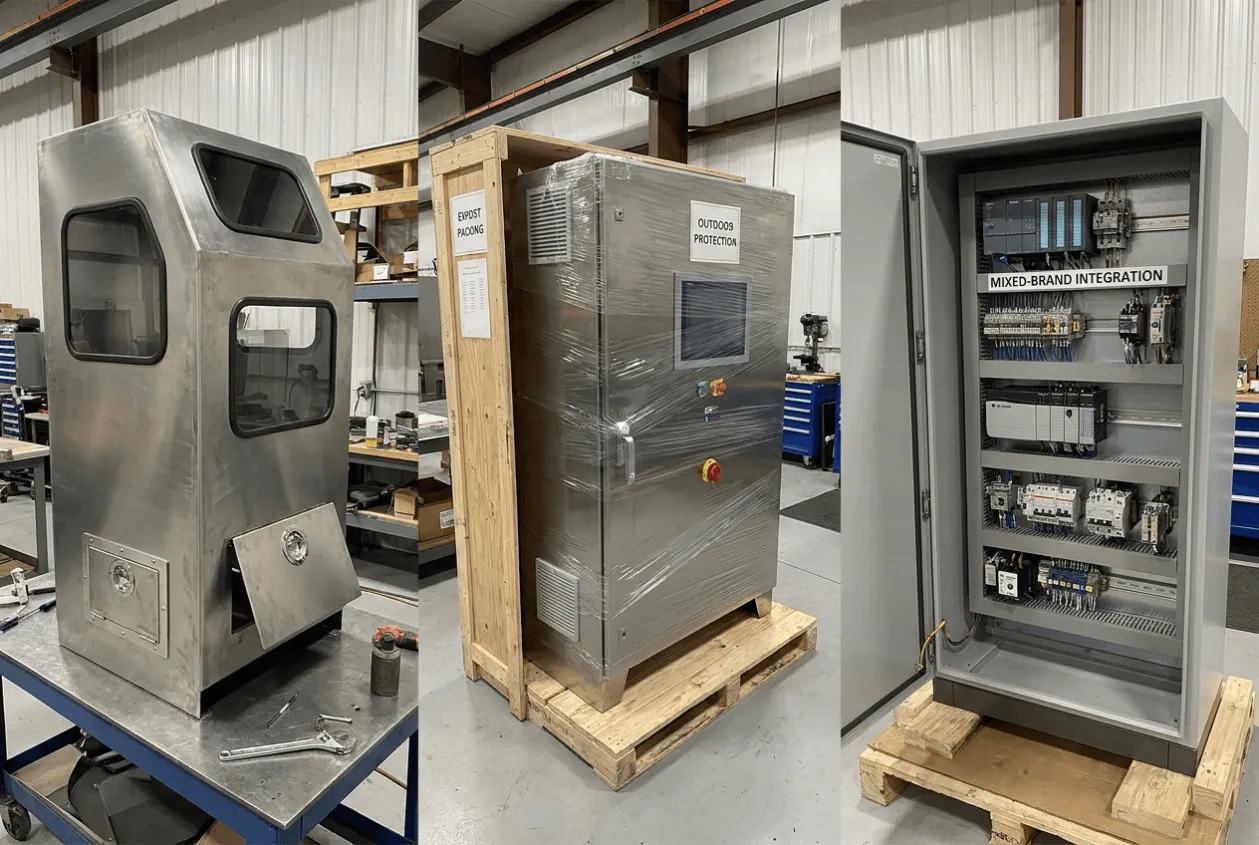
One buyer may need brand alignment. Another may need enclosure customization. Another may need export packing, outdoor protection, or mixed-brand integration.
That is why the best industrial automation panel manufacturer is not always the biggest one. It is the one whose capability matches the project.
UniRegal Five-Factor Selection Framework
Before comparing suppliers, use this simple framework.
Factor | What to Ask | Why It Matters |
|---|---|---|
Platform | Which PLC, HMI, VFD, and communication system does the end user prefer? | Platform acceptance affects maintenance and spare parts. |
Application | What machine or process will the panel control? | Pumps, conveyors, packaging machines, and treatment systems need different panel logic. |
Environment | Where will the panel be installed? | Outdoor, humid, dusty, corrosive, or hot sites change enclosure design. |
Lifecycle | Who will inspect, commission, troubleshoot, and modify the panel later? | Good documentation reduces long-term service cost. |
Supplier | Can the manufacturer control layout, wiring, labels, FAT, and revisions? | The panel builder often matters more than the component logo. |
Engineering Judgment
We all know that brand matters, but panel design matters more. What is more, documentation and serviceability matter even more.
A control panel is not only built for the day it ships. It is built for the engineer who opens it later, under pressure, when the system needs to run again.
Decision Matrix: Which Manufacturer Fits Your Project?
Manufacturer | Choose When | Do Not Choose When | Biggest Buyer Risk |
|---|---|---|---|
Siemens | Your site already uses Siemens PLCs and plant automation | The end user prefers Rockwell or the project is very cost-sensitive | Assuming Siemens parts guarantee good panel execution |
Rockwell Automation | The project goes to a North American factory using Allen-Bradley | Lead time or component cost is uncertain | Checking availability too late |
Schneider Electric | Power distribution and automation must work together | The builder is weak in PLC integration | Treating electrical distribution skill as automation skill |
ABB | Motors, drives, pumps, fans, or process equipment are central | The project mainly needs custom PLC/HMI logic | Ignoring heat and drive service space |
Mitsubishi Electric | The project is compact OEM machine automation | The customer requires Siemens or Rockwell | Choosing by hardware cost without checking acceptance |
Eaton | Motor control, MCC, protection, or pump panels are the priority | Advanced PLC/HMI integration is required | Underestimating automation engineering |
WEG | Motors, drives, compressors, pumps, or fans drive the system | Local support or documentation is weak | Treating drive-heavy panels as simple cabinets |
Phoenix Contact Partners | Terminals, I/O, networking, and modular wiring are critical | You need one fully accountable turnkey supplier | Unclear final panel responsibility |
UniRegal | You need custom enclosure design, mixed brands, outdoor panels, or export coordination | You only want a basic commodity cabinet | Sending only a parts list without project context |
Regional Builders | Local service, retrofit, or urgent site response matters | Documentation and FAT discipline are unclear | Choosing only because they are nearby |
The table narrows the shortlist. The next step is understanding when each supplier becomes the better engineering choice.
Top 10 Industrial Automation Panel Manufacturers
1. Siemens
When to Choose
Choose Siemens when the plant already uses Siemens PLCs, HMIs, drives, and automation architecture. It is a strong fit for process plants, utilities, infrastructure, and export systems where Siemens documentation and platform consistency are expected.
When Not to Choose
Siemens may not be the best fit if the end user requires Allen-Bradley, if the project is highly cost-sensitive, or if local Siemens support is weak.
Biggest Buyer Risk
The risk is assuming the Siemens name solves everything. It does not. The panel builder still needs to prove wiring discipline, terminal planning, FAT workflow, and documentation control.
Ask whether the supplier can explain the I/O structure, network layout, terminal plan, and maintenance logic before production begins.
2. Rockwell Automation
When to Choose
Choose Rockwell when the panel will be installed in a North American factory or when the end user requires Allen-Bradley. In many U.S. plants, platform familiarity makes troubleshooting and spare-parts support easier.
When Not to Choose
Rockwell may not be the best fit when budget, component availability, or lead time is a serious concern.
Biggest Buyer Risk
One mistake we repeatedly see is buyers approving the Rockwell architecture first and checking key PLC, HMI, drive, or safety module availability too late.
For OEM projects, this can affect the whole machine schedule.
Procurement Advice The end user may choose Allen-Bradley, but the buyer still chooses the panel builder. The brand solves platform acceptance. The builder decides wiring quality, documentation clarity, and delivery risk.
3. Schneider Electric
When to Choose
Choose Schneider when power distribution and automation control must work together. It is practical for pump control panels, utility panels, facility automation, and industrial control cabinets where protection devices and PLC control are both important.
When Not to Choose
Schneider may not be the best fit if the selected supplier is strong in electrical distribution but weak in PLC integration.
Biggest Buyer Risk
The biggest risk is confusing electrical capability with automation capability. A supplier may build good power cabinets but still struggle with I/O mapping, HMI operation, alarms, communication, and FAT logic.
For water treatment control panels, check motor loads, enclosure rating, field wiring, and service space early.
4. ABB
When to Choose
Choose ABB when the project is motor-heavy or drive-heavy. It is suitable for pumps, fans, conveyors, process systems, and applications where electrification and drives are central.
When Not to Choose
ABB may not be the best default choice if the main requirement is custom PLC sequence control, HMI design, or a different platform already specified by the end user.
Biggest Buyer Risk
The biggest risk is treating a drive-heavy panel like a simple control cabinet.
A buyer once focused on reducing cabinet size because the quote looked better. Later, the VFD area ran hot during commissioning. The drives were not the problem. The enclosure was simply too small for the heat load, cable route, and service space.
5. Mitsubishi Electric
When to Choose
Choose Mitsubishi for compact OEM machines, packaging equipment, assembly systems, servo applications, and machine automation panels.
When Not to Choose
Mitsubishi may not be ideal if the final customer requires Siemens or Rockwell, or if spare parts are difficult to access in the target market.
Biggest Buyer Risk
The biggest risk is choosing by hardware cost without checking end-user acceptance.
A technically good platform can still become a commercial problem if the maintenance team is not comfortable supporting it.
Common Mistake New buyers compare PLC brands by hardware price. Experienced buyers also compare spare-parts access, maintenance familiarity, programming support, and customer approval.
6. Eaton
When to Choose
Choose Eaton when electrical protection, motor control, MCC interface, or pump panel reliability is the priority.
When Not to Choose
Eaton may not be the best standalone choice if the project requires advanced PLC/HMI integration and the panel builder lacks automation experience.
Biggest Buyer Risk
The risk is underestimating the automation layer. If the panel includes alarms, remote I/O, communication, HMI screens, or process logic, protection design alone is not enough.
7. WEG
When to Choose
Choose WEG when motors, drives, MCCs, pumps, compressors, fans, or process equipment are central to the project.
When Not to Choose
WEG may not be the best choice if regional support is limited or if the customer requires another control ecosystem.
Biggest Buyer Risk
The biggest risk is not the motor or drive itself. It is poor heat dissipation, tight cable routing, weak documentation, or unclear service access.
Drive panels need space to breathe and space to be serviced.
8. Phoenix Contact Integration Partners
When to Choose
Choose Phoenix Contact integration partners when terminals, I/O, networking, modular wiring, surge protection, and connectivity are critical.
When Not to Choose
They may not be the best option if you need one supplier to take full responsibility for design, assembly, testing, documentation, and delivery.
Biggest Buyer Risk
The risk is unclear responsibility. Strong components and clean connectivity do not replace the need for one accountable panel manufacturer.
9. UniRegal
When to Choose
Choose UniRegal when the project needs a custom industrial automation panel instead of a fixed standard cabinet. This includes outdoor electrical enclosures, stainless steel cabinets, industrial control panels, automation control panels, pump systems, water treatment panels, OEM machine panels, and mixed power-control layouts.
UniRegal is especially useful when the buyer needs engineering discussion before production: enclosure selection, BOM review, PLC/HMI/VFD integration, wiring layout, FAT expectations, export packing, and manufacturing follow-up.
When Not to Choose
UniRegal may not be the best fit if you only need a simple commodity cabinet and price is the only decision factor.
Biggest Buyer Risk
The biggest risk is sending only a parts list.
A parts list tells the supplier what to buy. It does not explain the site, heat load, cable entry, maintenance habit, export requirement, or service expectation. For custom panels, that missing context can become expensive later.
10. Regional Industrial Automation Panel Builders
When to Choose
Choose regional panel builders when local service, retrofit work, urgent site response, or local code familiarity matters.
When Not to Choose
Avoid choosing only because the supplier is nearby. Distance does not replace documentation, testing, and quality control.
Biggest Buyer Risk
A local supplier with weak drawings can still create long-term service problems. Ask for sample schematics, FAT records, panel photos, references, and similar project experience before approval.
From Our Experience
One mistake we repeatedly see is that buyers approve enclosure size before confirming heat load, VFD quantity, cable entry direction, and maintenance space.
At first, the smaller enclosure looks like a saving. Later, the same decision becomes a problem. The VFD area runs hot. The cable bend radius is uncomfortable. Terminals are crowded. A small site change becomes difficult.
The problem is not always the drive brand or the PLC brand. Sometimes the cabinet is simply too small for the real job.
This is why UniRegal encourages buyers to share project context, not only part numbers. The earlier the panel supplier understands the site condition, load profile, and service expectation, the easier it is to prevent expensive changes late.
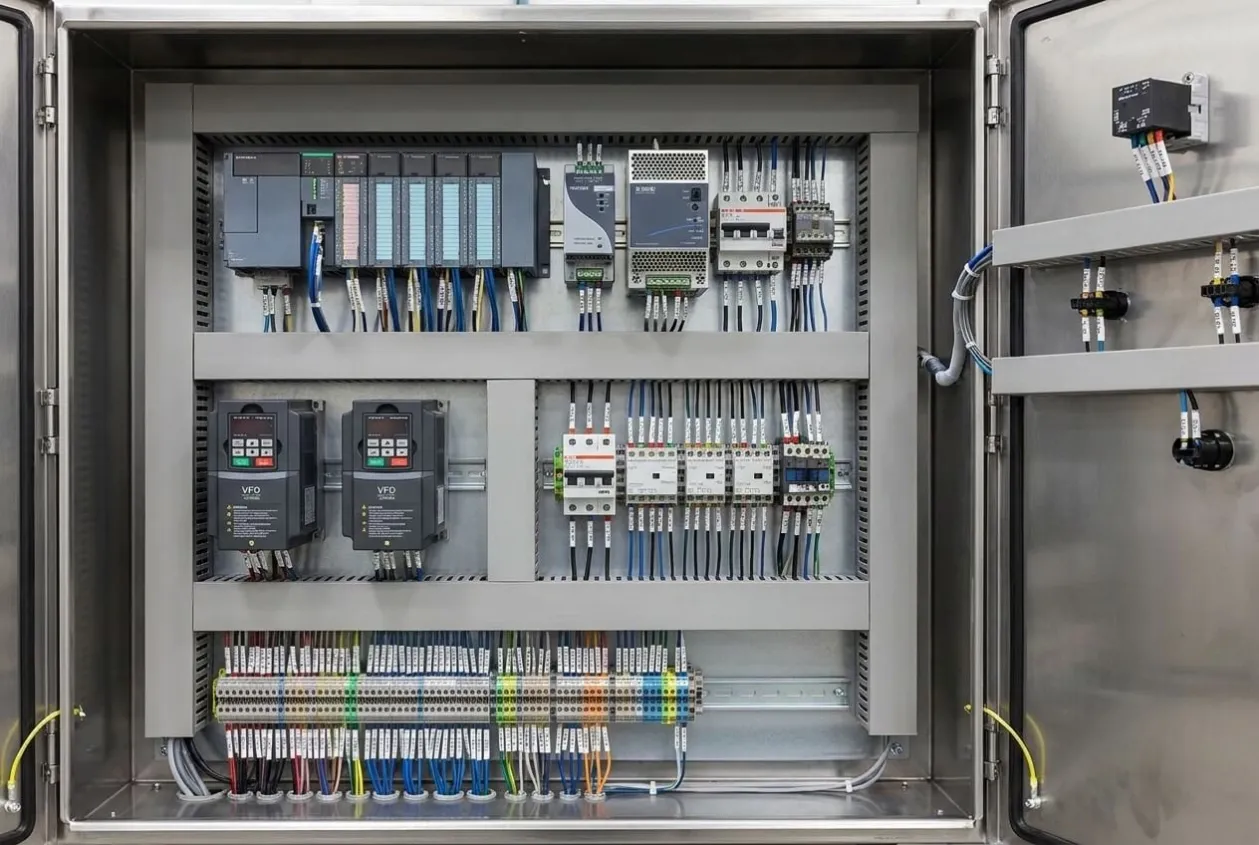
Quote Comparison: What Buyers Should Look Beyond Price
Quote Item | Low-Risk Supplier | Higher-Risk Supplier |
|---|---|---|
Application Review | Asks about process, load, environment, and maintenance | Quotes only from part numbers |
Schematics | Clear and matched to the panel | Basic or incomplete |
BOM | Brand, model, quantity, and alternatives controlled | Vague or often changed |
Enclosure | Sized for heat, wiring, and service | Sized mainly to reduce cost |
Labeling | Wire, terminal, and device labels defined | Left to workshop habit |
FAT | Based on real application | Simple power-on test |
Future Service | Revision and spare-part logic considered | Little support after delivery |
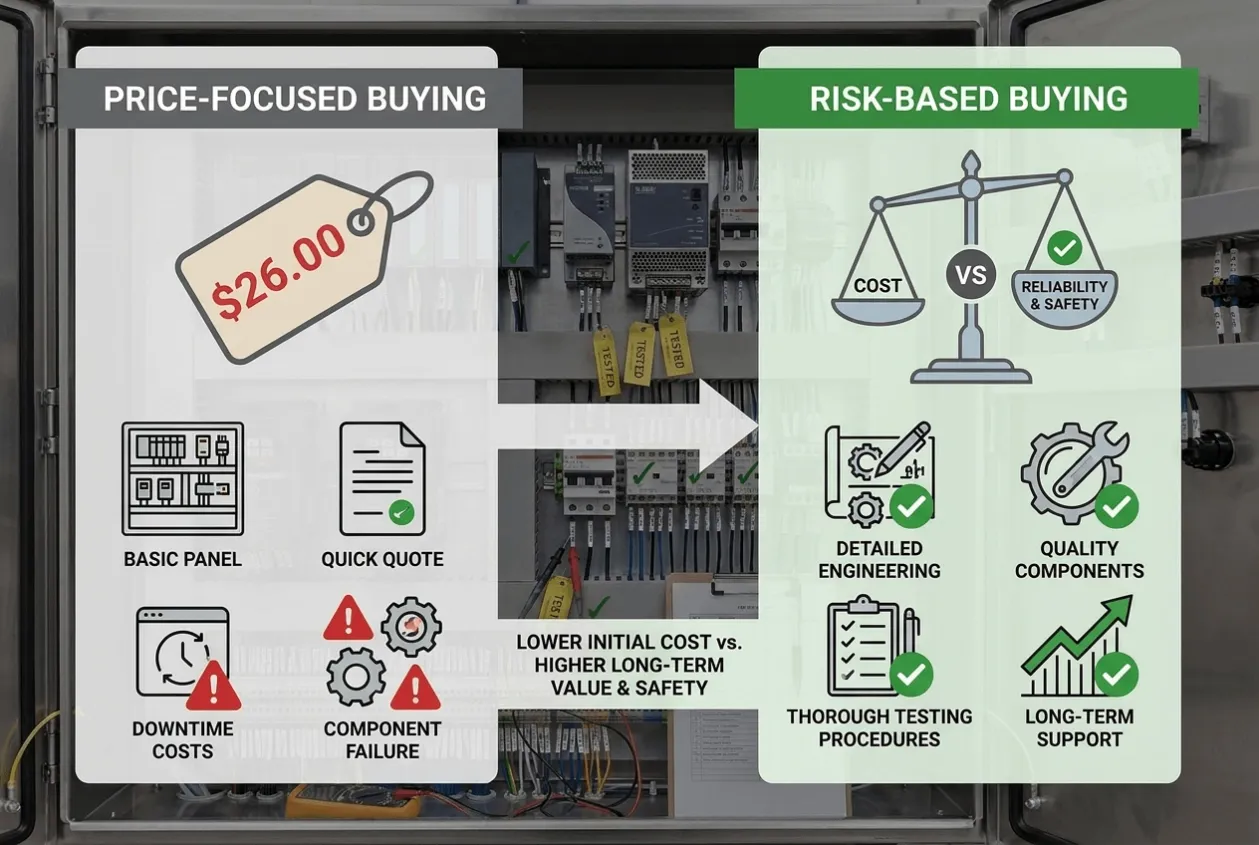
Buyer Checklist Before Sending an RFQ
Before requesting a quote, prepare these details:
- Application: pump, water treatment, packaging, conveyor, process skid, OEM machine, or plant automation
- Incoming voltage and phase
- Motor load list
- Preferred PLC and HMI brand
- VFD, relay, contactor, MCC, and protection requirements
- Communication protocol, such as EtherNet/IP, Profinet, or Modbus
- Indoor, outdoor, washdown, dusty, humid, hot, or corrosive environment
- Drawing, BOM, wire label, FAT, and inspection requirements
- Export packing and delivery schedule
Common Mistakes
1. Treating the Ranking as the Decision
A top 10 list helps you start. It should not decide for you.
2. Comparing Only Component Brands
Good components do not automatically create a reliable panel. Layout, wiring, grounding, labeling, cooling, and documentation still matter.
3. Ignoring the Load Profile
A drive-heavy panel needs different planning than a simple PLC panel.
4. Making the Enclosure Too Small
A smaller cabinet can increase heat, wiring difficulty, troubleshooting time, and future expansion cost.
5. Treating FAT as a Formality
A serious FAT should verify wiring, labels, I/O, communication, protection, alarms, and project-specific functions.
FAQ
Who are the top industrial automation panel manufacturers?
Commonly compared manufacturers include Siemens, Rockwell Automation, Schneider Electric, ABB, Mitsubishi Electric, Eaton, WEG, Phoenix Contact integration partners, UniRegal, and qualified regional panel builders.
How do I choose an industrial automation panel manufacturer?
Start with application, load profile, PLC platform, enclosure environment, documentation, FAT, standards, lead time, and after-sales expectations. Then compare suppliers by project fit, not only price.
What should be included in an RFQ?
A good RFQ should include application description, voltage, motor loads, preferred PLC/HMI brand, VFD requirements, communication protocols, enclosure rating, documentation needs, FAT expectations, export requirements, and delivery schedule.
Is a custom industrial automation panel better than a standard panel?
A custom panel is better when the project has mixed brands, outdoor conditions, special enclosure needs, process-specific control logic, customer-approved components, or future expansion requirements.
Final Recommendation
Industrial automation panels are not bought by brand. They are bought by Project Fit.
Siemens fits Siemens-based plant automation. Rockwell fits Allen-Bradley projects, especially in North America. Schneider fits power-control integration. ABB and WEG fit motor and drive-heavy systems. Mitsubishi fits compact OEM machines. Phoenix Contact partners fit connectivity-focused projects. Regional builders fit local service and retrofit work.
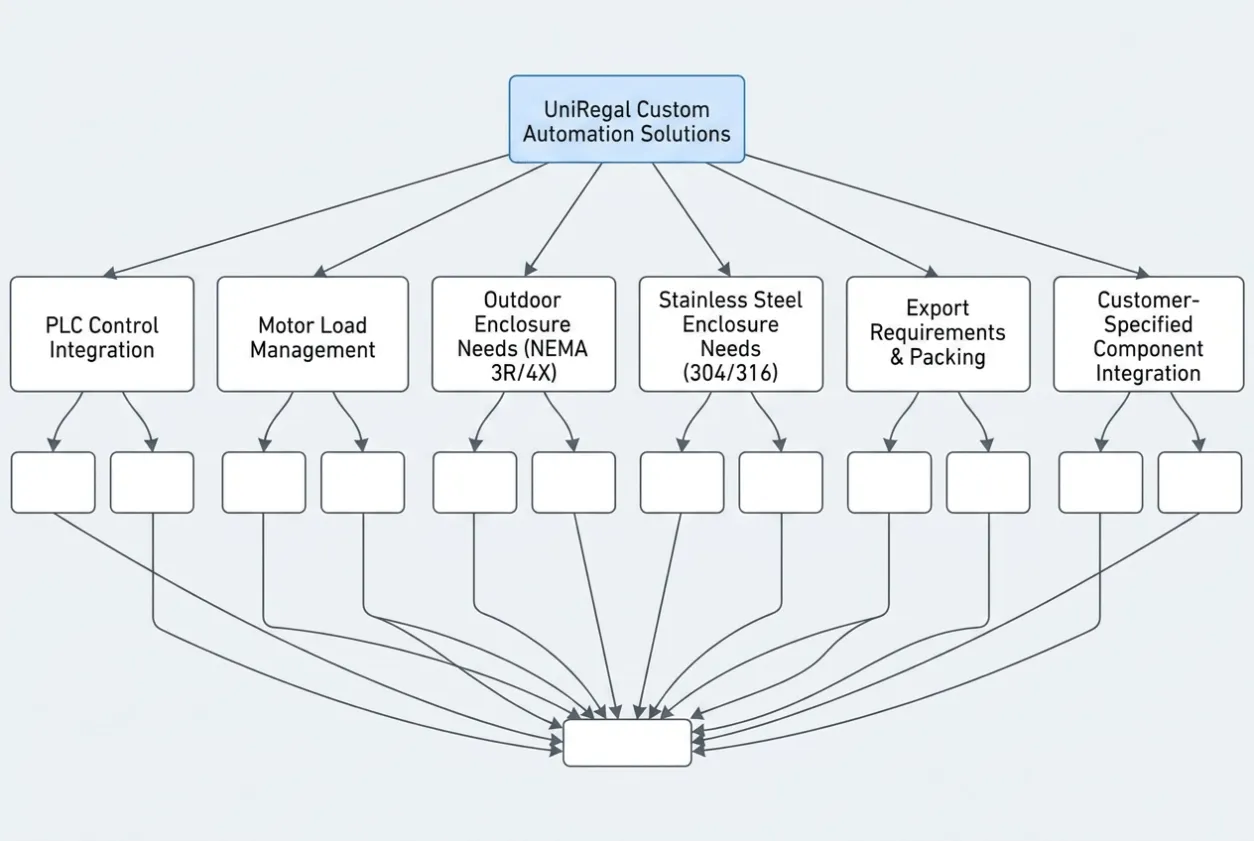
UniRegal fits buyers who need custom industrial automation panels built around real project constraints, especially when the cabinet must integrate PLC controls, motor loads, outdoor or stainless enclosure needs, export requirements, and customer-specified components.
The right question is not “Who is the biggest manufacturer?”
The better question is “Which supplier understands my project risk before production starts?”
Need Help Building a Custom Industrial Automation Panel?
If you are planning a pump control system, water treatment project, OEM machine, process skid, outdoor cabinet, or mixed power-control application, UniRegal can help review the project before production starts.
Send us your drawings, BOM, load list, preferred PLC brand, enclosure requirements, operating environment, communication needs, FAT expectations, and delivery target. Our team can help evaluate panel layout, component selection, enclosure suitability, documentation scope, manufacturing feasibility, and long-term maintenance risks before the first wire is cut.
A better industrial automation panel starts with a better buying decision.