
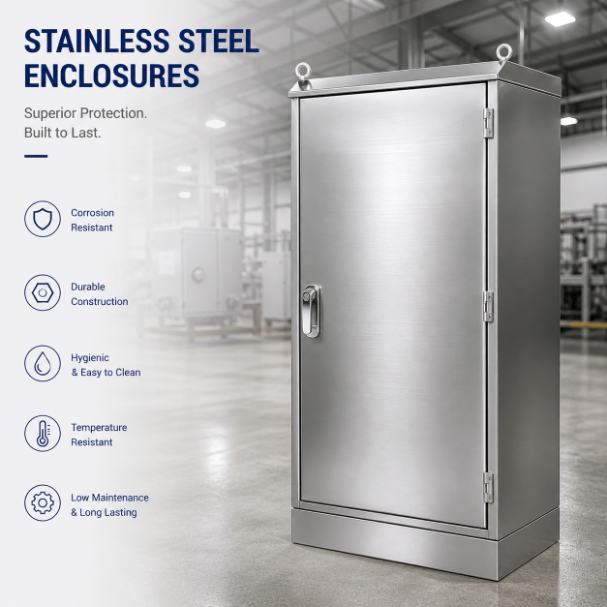
Stainless Steel Enclosures
Stainless Steel Electrical Enclosure Supplier
Custom 304 and 316 stainless steel enclosures for control panels: washdown, outdoor, food, water treatment and chemical applications.
Specifications
- Material
- Carbon Steel / Stainless Steel
- Protection Rating
- IP54 / IP65 / IP66 Optional
- Mounting Type
- Wall Mount / Floor Standing
- Surface Finish
- Powder Coated
- Application
- Industrial Use
- Customization
- Available
Quick Answer
Operating in washdown, coastal or chemical environments where carbon steel rusts? UniRegal supplies 304 and 316 stainless steel enclosures with smooth welded seams and IP66 sealing for food, pharma and outdoor use. We size and finish to your drawing and source certified grades and gaskets from multiple brands. Fabrication lead time is ~15 days; UL 508A is available.
304 and 316 Stainless Steel Electrical Enclosures
UniRegal supplies custom stainless steel electrical enclosures for control panels, junction boxes, automation equipment, water treatment, food processing, chemical plants, outdoor installations and corrosive environments.
304 stainless steel is common for many industrial and washdown applications, while 316 stainless steel is often considered for stronger corrosion, coastal or chemical exposure.
304 or 316: the decision that decides the service life
The difference that matters is molybdenum. Grade 316 contains it, 304 does not, and that is what gives 316 its resistance to chloride pitting — the rust-coloured spotting that appears on stainless steel near the sea, on roads treated with de-icing salt, and in plants that wash down with chlorinated water.
Grade 304 is the right economical choice for most industrial and food-grade washdown duties where exposure is fresh water, mild detergents and normal humidity. Grade 316 earns its premium on coastlines, in chemical and fertiliser plants, in wastewater and desalination, and wherever chlorides are part of the process. Specifying it the other way round costs money twice: 304 that starts staining within two years at a coastal site, or 316 bought for a dry inland electrical room where nothing will ever test it.
The grade comparison, including what each one costs and where each one is justified, is set out in 304 vs 316 stainless steel enclosures.
Finish and weld quality matter as much as the grade
Two enclosures made from the same grade perform differently depending on how they are finished. A smooth, consistent surface sheds water and cleans down quickly; a rough or poorly blended weld holds moisture and product residue, and corrosion almost always starts there rather than on the flat panel.
For washdown, food and pharmaceutical applications, specify ground and blended seams, radiused internal corners where the design allows, and no ledges or crevices where liquid can sit. Common finishes are 2B mill finish for general industrial use, a brushed No. 4 finish where appearance and cleanability both matter, and a polished finish for food contact and pharmaceutical areas. Tell us which one the application needs — it changes both the fabrication steps and the price.
Where stainless pays for itself, and where it does not
It pays for itself in washdown areas, coastal and offshore sites, chemical and fertiliser plants, wastewater and desalination, food and beverage, and pharmaceutical production — anywhere a cleaning regime or a corrosive atmosphere would shorten the life of painted carbon steel.
It is difficult to justify in a dry, controlled indoor electrical room with no corrosive atmosphere, where painted carbon steel will last just as long for a fraction of the cost. We set that comparison out in stainless steel vs carbon steel electrical cabinets.
What moves the price of a stainless steel enclosure
Nine variables, roughly in the order they matter: overall dimensions, grade, sheet thickness, surface finish, required ingress protection, the number and complexity of cutouts, backplate and gland plate requirements, hinges, locks and any viewing window, and finally quantity.
Of these, cutout complexity and finish are the two most commonly underestimated. A single rectangular HMI cutout is inexpensive; a cluster of circular cutouts held to tight tolerances, deburred and blended, is not. The cost drivers are broken down in what drives a stainless steel enclosure quotation.
Information to Send Before Quotation
- drawing, sketch, sample photo or required dimensions;
- 304 or 316 stainless steel requirement and surface finish;
- IP rating, installation environment and corrosion exposure;
- backplate, gland plate, hinges, locks, window and cutout needs;
What UniRegal Can Deliver
UniRegal can support stainless steel enclosure fabrication, cutting, bending, welding, polishing or brushing, backplate fitting, cutouts, labels, packing and agreed quality checks.
FAQ
What information is needed for quotation?
Send drawings or sketches, dimensions, material, IP rating, mounting style, cable-entry direction, accessory requirements, quantity and installation environment.
Can UniRegal build from customer drawings?
Yes. Build-to-print enclosure orders are practical when drawings, material, finish, tolerances and inspection points are agreed before production.
Can custom cutouts and labels be included?
Yes. HMI, push button, meter, lock, hinge, gland, ventilation and label requirements can be produced according to approved drawings.
Can UniRegal support repeat OEM orders?
Yes. Repeat batches can be produced from approved drawings so dimensions, mounting holes and accessories remain consistent.
How should material be selected?
Carbon steel is common for indoor industrial use. Stainless steel is preferred for corrosion, washdown, coastal, food, chemical or outdoor environments.
Request a Quote
Send drawings, dimensions, material and IP rating requirements for an enclosure quotation.