
Oct 4, 2026Buying Guides
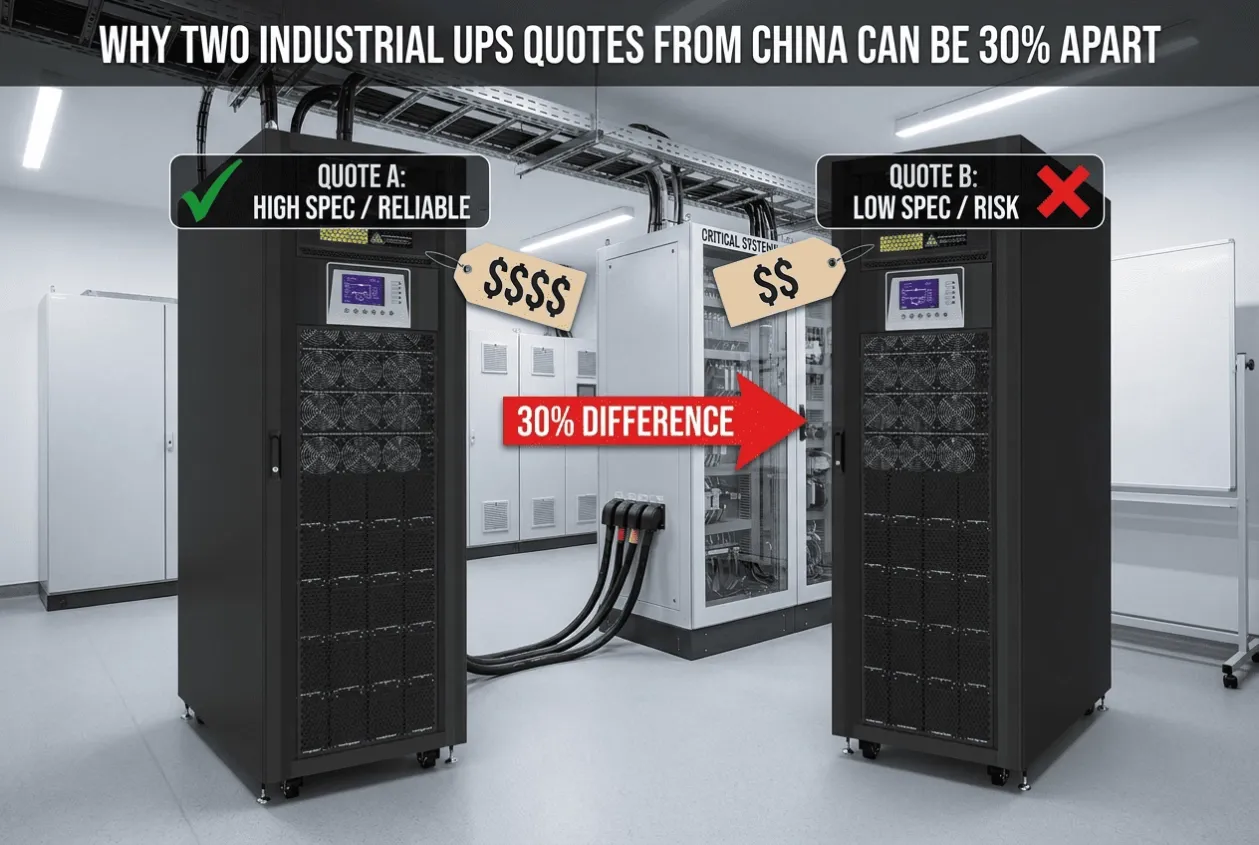
Why Two Industrial UPS Quotes from China Can Be 30% Apart
Industrial UPS quotes from China vary by scope. Buyers should confirm load, runtime, batteries, bypass, certificates, inspection, and packing before comparing prices.
Why Industrial UPS Quotes from China Vary So Much—and What Buyers Should Send First
A buyer once asked me, “Can you quote a 10 kVA industrial UPS from China? Just give me a price first.”
I understand that request. Purchasing teams need numbers before they can compare suppliers, discuss budgets, or push a project forward. The problem is that a UPS price without scope tells me almost nothing. Without the scope, I cannot tell whether I am comparing suppliers or comparing assumptions.
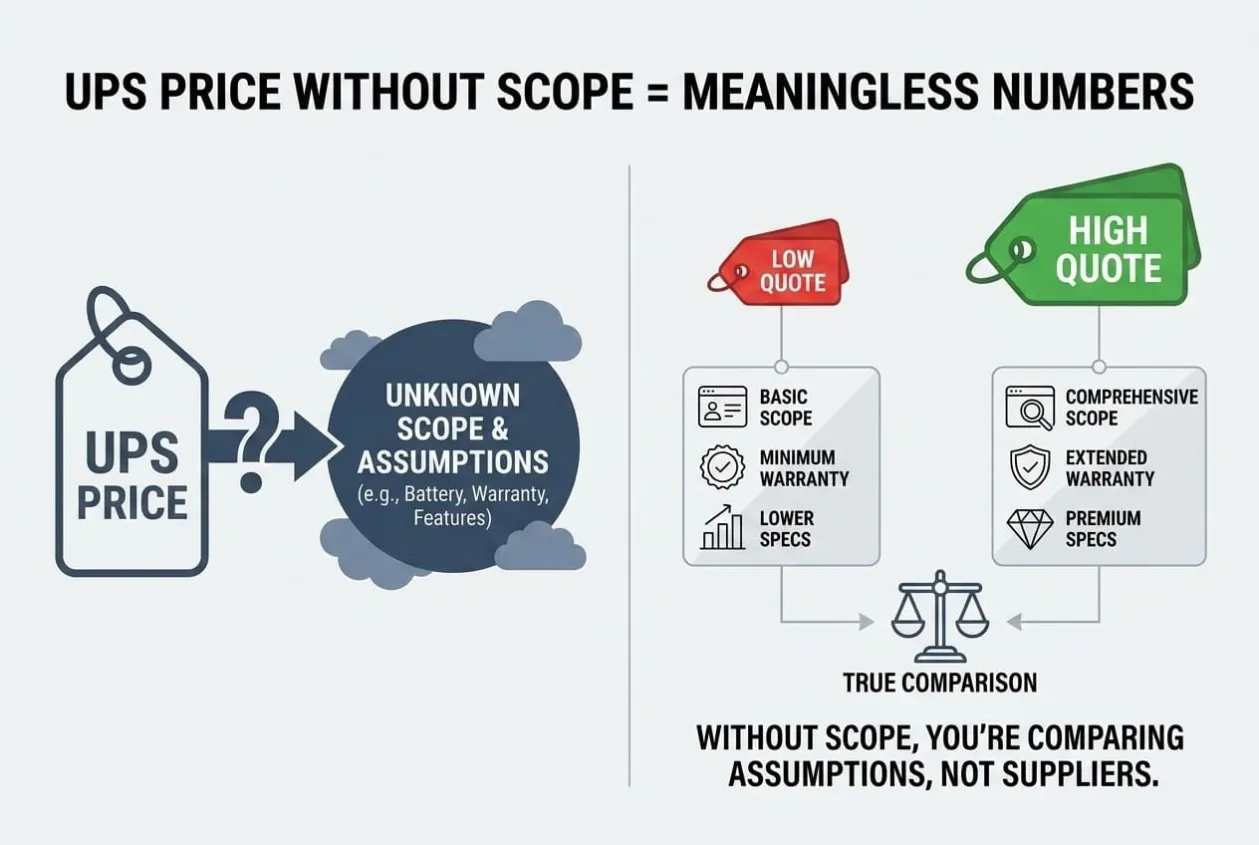
One Chinese supplier may quote only the UPS body. Another may include batteries, bypass, cabinet, export packing, inspection, and certificates. Both quotations may say 10 kVA, but one is a product price and the other is closer to a project price.
The sourcing notes for this topic make the same point: an industrial UPS should be compared by load, runtime, topology, environment, battery package, and compliance documents, not only by catalog rating.
Why Two 10 kVA UPS Quotes Can Be 30% Apart
When buyers see a large price difference, they often ask, “Is this supplier too expensive?” Sometimes yes. But very often, the better question is, “Are these suppliers quoting the same scope?”
Supplier A | Supplier B |
|---|---|
UPS unit only | UPS + battery package |
5-minute runtime | 30-minute runtime |
No maintenance bypass | Bypass included |
Basic packing | Export packing included |
Certificate “available” | Exact model documents listed |
No FAT detail | Tests and inspection included |
EXW price | FOB or delivered terms discussed |
Same 10 kVA.
Different scope.
This is why I do not like approving an industrial UPS supplier only by unit price. A low price may be a good deal, or it may simply be the quote with the most missing pieces.
The China Supplier Comparison I Actually Care About
When I compare industrial UPS suppliers in China, I do not start by asking who has the best brochure. I want to know whether the supplier can support the buying decision.
- Can they explain what battery runtime is included? Can they provide the battery calculation?
- Can they confirm whether the UPS is line-interactive or online double-conversion?
- Can they provide certificates for the exact model?
- Can they support low-quantity orders?
- Can they inspect and pack properly for export?
- Can they integrate the UPS into a control panel or enclosure if the project needs it?
That is the difference between a seller and a sourcing partner.
A factory may be strong at production but weak at project communication. A trading company may be fast but not technical enough. A sourcing partner should sit in the middle and make the scope clear before asking anyone for the final price.
A Small Sourcing Case
One customer received two prices for an industrial UPS used for a PLC control cabinet. The lower quote looked 22% cheaper, so purchasing almost approved it.
Then we checked the details.
- No external battery cabinet.
- No bypass. No runtime calculation.
- No inspection report.
- No export packing.
After adding those items back, the “cheaper” quote was no longer cheaper. It was just incomplete.
That is the difference between shopping and sourcing.
Before I Ask Chinese Suppliers to Quote
Before I send an industrial UPS inquiry to suppliers, I want a short list of buying facts. It does not need to be perfect, but it should be clear enough to prevent five suppliers from making five different assumptions.
What to Send | Why It Helps Compare Suppliers |
|---|---|
Protected load list | Shows what must stay powered |
Runtime target | Decides battery size and cabinet cost |
Installation environment | Affects temperature, enclosure, and battery life |
Destination market | Decides certificate and document requirements |
Quantity and delivery terms | Changes MOQ, packing, freight, and lead time |
Integration need | Confirms standalone UPS or panel-mounted solution |
Sometimes the buyer only has cabinet photos and a rough load list. That is enough to start. A good sourcing partner can review the photos, ask what must stay alive, and help turn a rough inquiry into something suppliers can quote properly.
What Makes Me Nervous
Three things make me slow down when reviewing industrial UPS quotes from China.
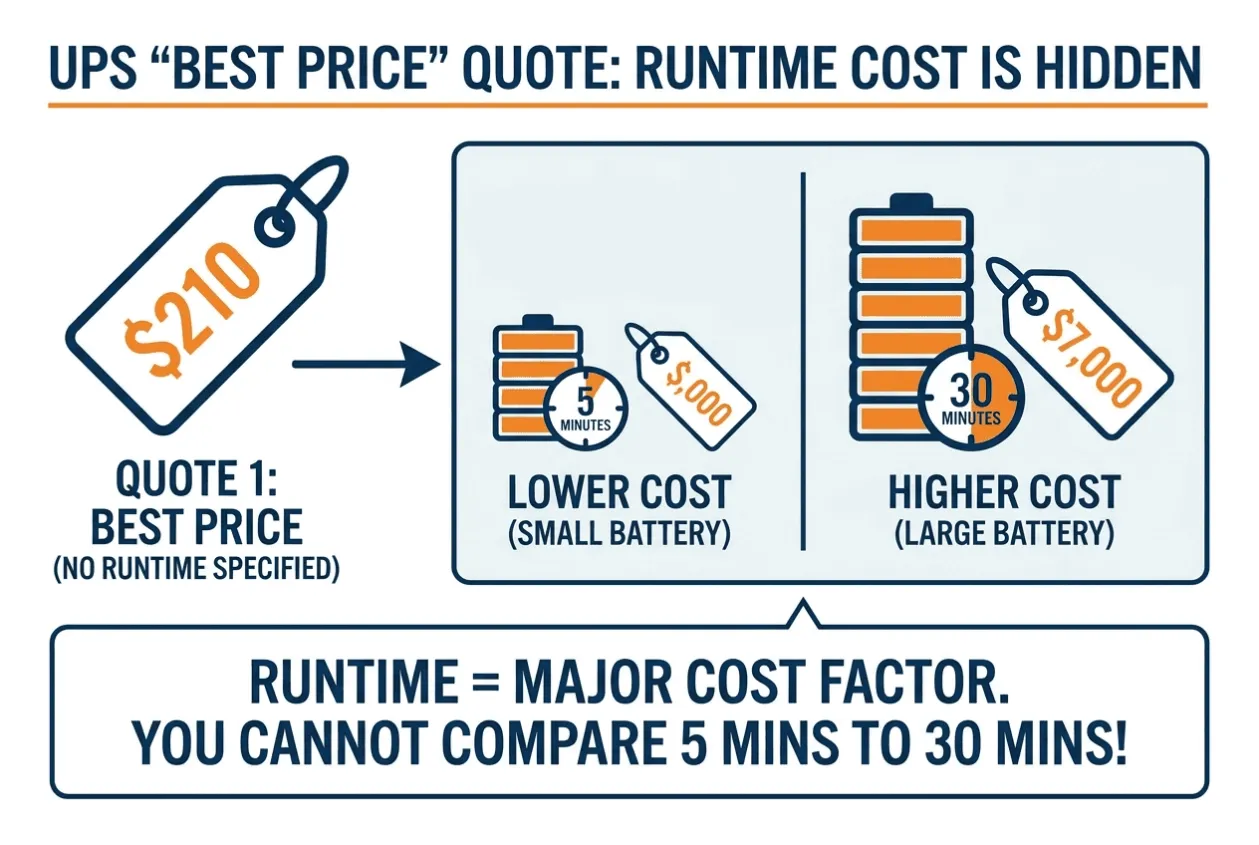
The first is “best price” with no runtime. Runtime is where a lot of cost hides. Five minutes and thirty minutes are not the same battery package.
The second is “certificates available” without the exact model number. For regulated projects, the document must match the unit being supplied, not just the brand family.
The third is no inspection before shipment. I do not like discovering power equipment problems after the goods have crossed an ocean. That is not quality control; that is gambling with freight cost.
How We Usually Support Buyers
When UniRegal helps buyers source industrial UPS systems, we review missing information before asking factories to quote. That usually includes the load list, runtime, battery type, topology, certificates, packing, inspection, and whether the UPS should be supplied alone or integrated into a control panel.
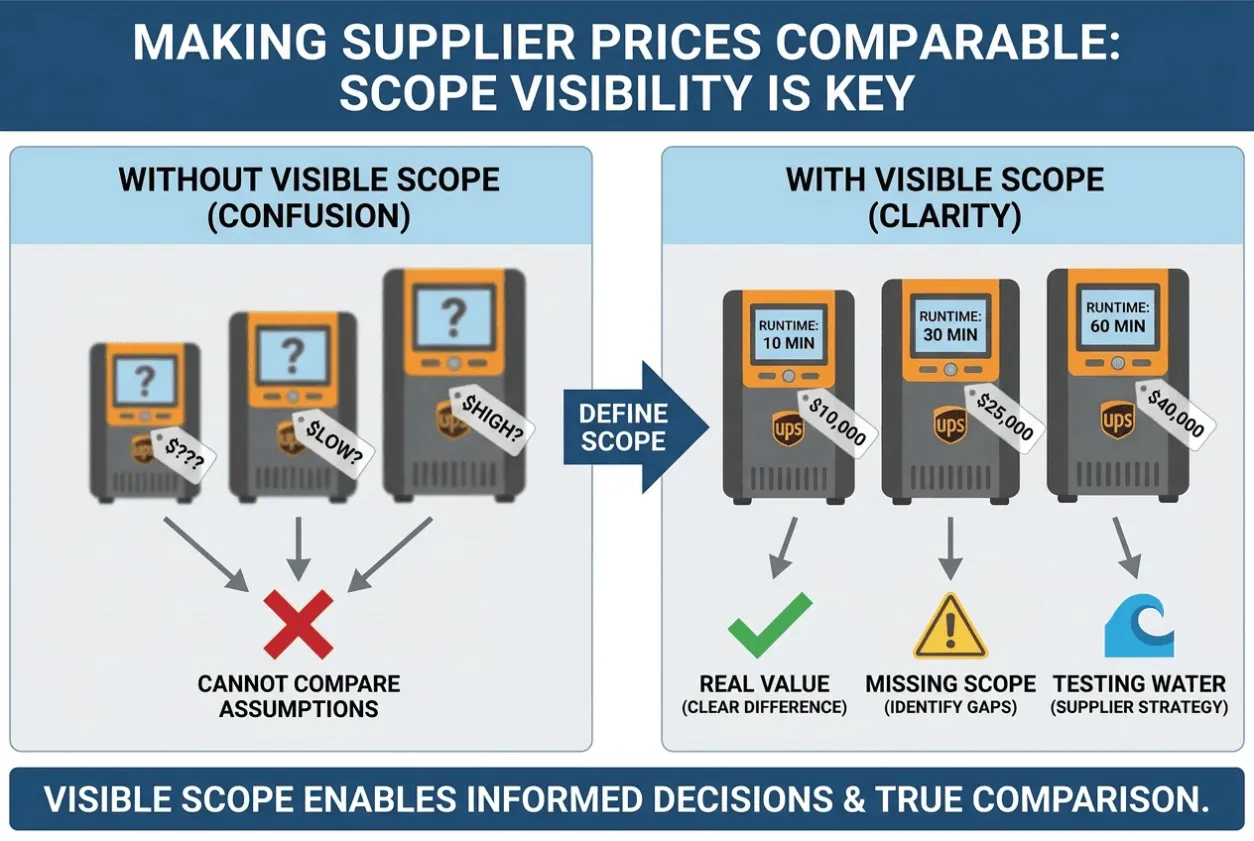
We are not trying to make the buyer’s inquiry longer for fun. We are trying to make supplier prices comparable. Once the scope is visible, the buyer can see whether the price difference is real value, missing scope, or just a supplier testing the water.
Send us the load list, runtime target, destination country, and any cabinet drawings or photos you already have. If the information is rough, that is fine. Rough information is still better than asking five suppliers to guess in five different ways.
FAQ
Why do industrial UPS prices from China vary so much?
Because the quoted scope may be different. One supplier may quote only the UPS unit, while another includes batteries, bypass, runtime calculation, certificates, packing, inspection, and documentation.
What should I send before asking for a UPS price?
Send the protected load list, runtime target, installation environment, destination country, certificate requirement, quantity, and whether the UPS must be integrated into a control panel.
Is the cheapest China UPS supplier always risky?
Not always. A low price can be valid if the scope is clear. The risk starts when the quotation does not explain batteries, runtime, bypass, certificates, inspection, or delivery terms.
Final Thought
A cheap industrial UPS quote is useful only when you know what it includes.
Good sourcing is not finding the lowest UPS price. It is making sure every supplier is quoting the same job.
About UniRegal
The UniRegal sourcing team supports system integrators and OEMs with industrial UPS sizing, battery-string calculation, and control-panel power integration — matching critical loads to double-conversion systems and building inspected, export-ready shipments from a Foshan sourcing base.
Related Guides:
Related Solutions: