
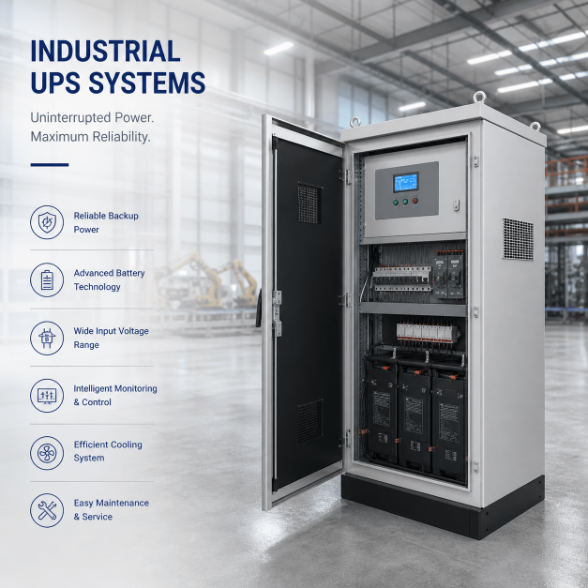
Industrial UPS
Industrial UPS Supplier
UniRegal supplies industrial UPS systems for PLC panels, SCADA, process control, utilities and critical automation loads. Configure UPS capacity, runtime, battery, bypass, monitoring and enclosure requirements.
Specifications
- UPS Type
- Online Double Conversion
- Capacity
- Customizable
- Input Voltage
- Multiple Options Available
- Output Voltage
- Multiple Options Available
- Battery Type
- VRLA / Lithium
- Communication
- Modbus / SNMP
- Operating Temperature
- Industrial Grade
Quick Answer
A momentary power loss can crash your PLC, HMI and VFD - halting production, scrapping a batch or dropping a safety system. UniRegal supplies industrial UPS systems (online double-conversion) sized to your critical load, with VRLA or lithium batteries, generator tie-in and Modbus/Profibus monitoring. We build the cabinet to spec on a ~15-day lead time; FAT and documentation are provided before shipment.
Industrial UPS Systems for Automation, Process Control, and Critical Loads
Industrial UPS systems provide uninterrupted and conditioned power for PLCs, HMIs, SCADA systems, control panels, industrial computers, communication equipment, and other loads that cannot tolerate unstable power.
UniRegal supplies project-specific industrial UPS solutions for manufacturing plants, process facilities, water-treatment systems, infrastructure projects, remote installations, and automation environments where a short power disturbance can interrupt production or delay a restart.
The correct UPS is selected from the actual load, required backup time, starting current, power quality, ambient conditions, battery type, bypass arrangement, and communication requirements.
[Discuss Your Industrial UPS Project]
Quick Answer: What Is an Industrial UPS System?
An industrial UPS system is a power-protection system that keeps critical electrical loads operating when the utility supply becomes unstable or unavailable.
Depending on the selected topology, it may provide:
- Battery backup during a power interruption
- Voltage and frequency regulation
- Protection from sags, surges, and short disturbances
- A controlled transfer to bypass or generator power
- Communication with PLC, SCADA, BMS, or remote monitoring systems
- Defined runtime for an orderly shutdown or generator transfer
An industrial UPS should be sized for the equipment’s real operating conditions. The nameplate wattage alone is not enough to determine the correct system.
When Does an Industrial Facility Need a UPS?
An industrial UPS system is usually considered when a power interruption can cause more than a temporary loss of lighting.
Typical warning signs include:
- PLCs restarting after short voltage dips
- HMI or SCADA communication dropping during generator transfer
- Servo drives losing control references
- Production batches being interrupted
- Instrumentation losing recorded data
- Remote stations becoming unavailable
- Control panels requiring manual reset after a power event
- Critical equipment needing time for a controlled shutdown
The first step is to identify which loads must remain powered. Not every load in a plant needs UPS protection. Separating critical control loads from non-critical loads usually produces a more practical and cost-controlled design.
Industrial UPS Systems for Different Applications
Application | Typical protected loads | Suitable UPS direction |
|---|---|---|
PLC control cabinets | PLC, HMI, remote I/O, network switches, instrumentation | DIN-rail DC UPS or compact AC UPS |
Process control | DCS, PLC, SCADA, analyzers, control servers | Online double-conversion UPS |
Manufacturing automation | PLC, motion controllers, industrial PCs, communication equipment | Online UPS with defined bypass and runtime |
Water and wastewater plants | Pump controls, telemetry, dosing controls, PLC and SCADA | Industrial AC or DC UPS according to the control architecture |
Industrial IT and edge systems | Servers, switches, gateways, data acquisition equipment | Rackmount or tower UPS |
Remote and outdoor installations | RTU, telemetry, communication and instrumentation | Enclosed industrial or outdoor-rated UPS |
Large industrial plants | Distributed control loads and critical process systems | Modular three-phase UPS with redundancy planning |
Select the Right Industrial UPS Architecture
DIN-Rail DC UPS
A DIN-rail UPS is designed for control cabinets that use 24 VDC or another defined DC control voltage.
It is commonly used for:
- PLC and remote I/O backup
- HMI and instrumentation
- Industrial network equipment
- Small control systems
- Compact machine panels
The design must confirm the DC load current, battery capacity, charging method, cabinet temperature, and required hold-up time.
Online Double-Conversion UPS
An online double-conversion UPS continuously converts incoming AC power to DC and then regenerates the output AC supply through an inverter.
This topology is commonly selected for sensitive automation, process-control, communication, and industrial IT loads because the load is supplied through a controlled inverter output rather than waiting for a utility failure before correction begins.
Important selection points include:
- Input and output voltage
- Single-phase or three-phase arrangement
- Rated kVA and kW
- Output power factor
- Overload capability
- Bypass transfer arrangement
- Battery runtime
- Generator compatibility
- Harmonic performance
- Required communication interface
Rackmount Industrial UPS
Rackmount UPS systems are suitable for industrial servers, network switches, edge-computing equipment, and communication cabinets.
The buyer should confirm rack height, depth, ventilation clearance, battery expansion, input connector, output receptacles, and remote monitoring requirements before selecting a model.
Modular Industrial UPS
A modular UPS can be considered when the project requires capacity expansion or N+1 redundancy.
The design should define:
- Initial load and future load
- Number of active modules
- Redundant module capacity
- Static bypass rating
- Battery arrangement
- Maintenance bypass
- Module replacement procedure
- Available cabinet space
Outdoor or Harsh-Environment UPS
Remote and outdoor projects may require additional protection against temperature, dust, moisture, vibration, condensation, and unauthorized access.
The UPS itself is only one part of the solution. The enclosure, ventilation, heater, air conditioner, cable entry, battery temperature, and maintenance access must also be reviewed.
How to Size an Industrial UPS System
1. Define the Critical Load
Prepare a load list showing each device that must remain powered during an interruption.
Include:
- PLC and remote I/O
- HMI and industrial computers
- SCADA servers and network switches
- Instrumentation
- Control relays and contactors
- Communication equipment
- Valves and actuators
- Security or telemetry equipment
Do not include large motors or heating loads unless the UPS is specifically designed for them.
2. Confirm kVA and kW
UPS capacity is affected by both apparent power and real power.
The calculation should consider:
- Continuous load
- Peak load
- Load power factor
- Future expansion
- Non-linear loads
- Inrush current
- Overload duration
A UPS selected only from the connected wattage may trip when several devices start at the same time.
3. Define the Required Runtime
Runtime should be based on the purpose of the UPS:
- Ride through a short disturbance
- Allow generator start and transfer
- Keep control systems online during a planned shutdown
- Complete a process sequence
- Save data and shut down industrial computers
- Maintain remote communication until field support arrives
The required runtime determines the battery capacity and cabinet size.
4. Check Inrush and Startup Conditions
Switch-mode power supplies, industrial PCs, contactors, drives, and instrumentation can create short-duration startup peaks.
The UPS must be checked for:
- Inrush current
- Crest factor
- Overload response
- DC bus behavior
- Simultaneous startup
- Generator interaction
5. Review the Installation Environment
Confirm:
- Ambient temperature
- Humidity and condensation
- Dust or corrosive atmosphere
- Vibration
- Altitude
- Ventilation
- Cabinet heat dissipation
- Battery location
- Service access
VRLA or Lithium-Ion Battery?
Battery selection affects installation space, maintenance planning, replacement cost, and operating temperature.
Battery option | Common reason for selection | Points to review |
|---|---|---|
VRLA lead-acid | Familiar technology and lower initial cost for many standard installations | Temperature control, ventilation, replacement planning, and available floor space |
Lithium-ion / LiFePO₄ | Lower weight, smaller footprint, and longer service planning in suitable applications | Battery management system, protection, compatibility, fire strategy, and project approval |
External battery cabinet | Required when longer runtime is needed | Cable length, protection, ventilation, battery isolation, and maintenance access |
Distributed DC battery system | Suitable for multiple control cabinets | DC load balance, charging coordination, and cabinet-level protection |
The final battery choice should be based on the operating environment, runtime, maintenance policy, project specification, and total cost of ownership.
Generator and Bypass Compatibility
An industrial UPS may operate alongside a standby generator, but compatibility must be checked during design.
The review should include:
- Generator frequency stability
- Generator sizing
- UPS input power factor
- Input harmonic current
- Rectifier behavior
- Bypass source quality
- Transfer sequence
- Battery recharge current
- Maintenance bypass arrangement
A bypass circuit should be designed so that authorized maintenance can be carried out without unintentionally removing power from the protected load.
Remote Monitoring and Industrial Communication
Industrial UPS systems can be integrated with existing monitoring platforms through the appropriate interface.
Possible options include:
- Modbus RTU
- Modbus TCP
- SNMP
- Dry contacts
- Ethernet communication
- PLC alarm inputs
- SCADA status monitoring
- Battery temperature monitoring
- Battery fault and replacement alarms
- Input, output, bypass, and battery status
The communication method should be agreed before purchasing the UPS so that the required card, gateway, software, and wiring are included in the quotation.
What UniRegal Provides
For each industrial UPS project, UniRegal can support the following engineering and procurement requirements:
- Load and runtime review
- UPS topology selection
- kVA and kW verification
- Battery sizing
- Bypass and protection planning
- Cabinet and installation arrangement
- Generator compatibility review
- PLC and SCADA communication planning
- Component and battery selection
- Technical quotation
- Wiring and connection documentation
- Factory inspection coordination
- Delivery and replacement planning
The final supply scope depends on the approved specification, selected UPS manufacturer, battery configuration, enclosure arrangement, and testing requirements.
Industrial UPS System Price: What Affects the Cost?
The price of an industrial UPS system depends on more than its kVA rating.
Main cost factors include:
- UPS topology
- Rated kVA and kW
- Single-phase or three-phase output
- Required battery runtime
- VRLA or lithium battery selection
- Internal or external battery cabinet
- Static and maintenance bypass
- Input and output protection
- Harmonic filtering
- Communication cards
- Enclosure and environmental protection
- Redundancy or modular architecture
- Factory testing and documentation
- Delivery and installation requirements
For an accurate quotation, provide the load list, voltage, frequency, required runtime, installation environment, battery preference, and communication requirements.
Industrial UPS System Suppliers and Sourcing Partners
When comparing industrial UPS system manufacturers or suppliers, check whether the quotation clearly identifies:
- Actual UPS topology
- Continuous kVA and kW rating
- Battery model and quantity
- Runtime test condition
- Bypass arrangement
- Operating temperature
- Communication interface
- Warranty scope
- Replacement battery availability
- Factory testing
- Technical documentation
- Local service responsibility
A quotation that only shows “UPS capacity and price” does not provide enough information for a reliable technical comparison.
UniRegal can coordinate the UPS, battery system, enclosure, protection, communication requirements, and project documentation as one industrial power-protection package.
Factory Testing and Project Documentation
The agreed inspection scope may include:
- Input and output voltage verification
- Bypass operation
- Battery charging and discharge checks
- Alarm and indication verification
- Communication test
- Protection and interlock checks
- Runtime calculation review
- Wiring and terminal inspection
- Insulation and continuity tests
- Nameplate and label inspection
- Approved drawing review
- Factory acceptance testing where specified
The buyer should confirm the required documentation before the order is placed.
Frequently Asked Questions
1. What is an industrial UPS system used for?
It protects critical industrial loads from power interruptions and unstable supply conditions. Typical loads include PLCs, HMIs, SCADA systems, instrumentation, control panels, network equipment, and industrial computers.
2. What is the difference between an industrial UPS and an office UPS?
An industrial UPS is selected around the site load, runtime, environmental conditions, generator behavior, bypass arrangement, communication system, and maintenance requirements. An office UPS is usually designed for a more controlled environment and a simpler load profile.
3. How do I calculate the correct industrial UPS size?
Start with the critical-load list, then confirm continuous kW, apparent power in kVA, power factor, peak current, inrush, required runtime, and future expansion. The final UPS size should also consider battery and bypass requirements.
4. How long should an industrial UPS provide backup power?
There is no universal runtime. The requirement may be several minutes for generator transfer, longer for an orderly shutdown, or extended operation for remote equipment. Runtime must be defined from the process and emergency operating strategy.
5. Is online double-conversion necessary for PLC and SCADA systems?
It is often selected when the load is sensitive to voltage variation, frequency instability, generator transfer, or poor power quality. A smaller DC UPS may be sufficient for a limited 24 VDC control circuit.
6. Should I choose VRLA or lithium batteries?
VRLA may suit standard installations where initial cost and established maintenance practices are important. Lithium batteries may suit projects where space, weight, temperature, and long-term maintenance are major concerns. Compatibility and safety requirements must be checked first.
7. Can an industrial UPS communicate with a PLC or SCADA system?
Yes, depending on the UPS interface. Modbus, SNMP, Ethernet, and dry contacts are common options. The required communication protocol should be specified before purchase.
8. What information is needed for an industrial UPS system price?
Send the voltage, phase arrangement, load list, kVA or kW, present power factor, required runtime, battery preference, installation environment, bypass requirement, communication protocol, and project standard.
Request an Industrial UPS Proposal
Send UniRegal any available project information:
- Load list or power schedule
- Single-line diagram
- Input and output voltage
- Single-phase or three-phase requirement
- Required backup time
- Generator information
- Battery preference
- Installation temperature and environment
- PLC, SCADA, or BMS communication protocol
- Required standard and inspection scope
UniRegal will review the application and recommend an industrial UPS system that matches the protected load, runtime objective, installation conditions, and project requirements.
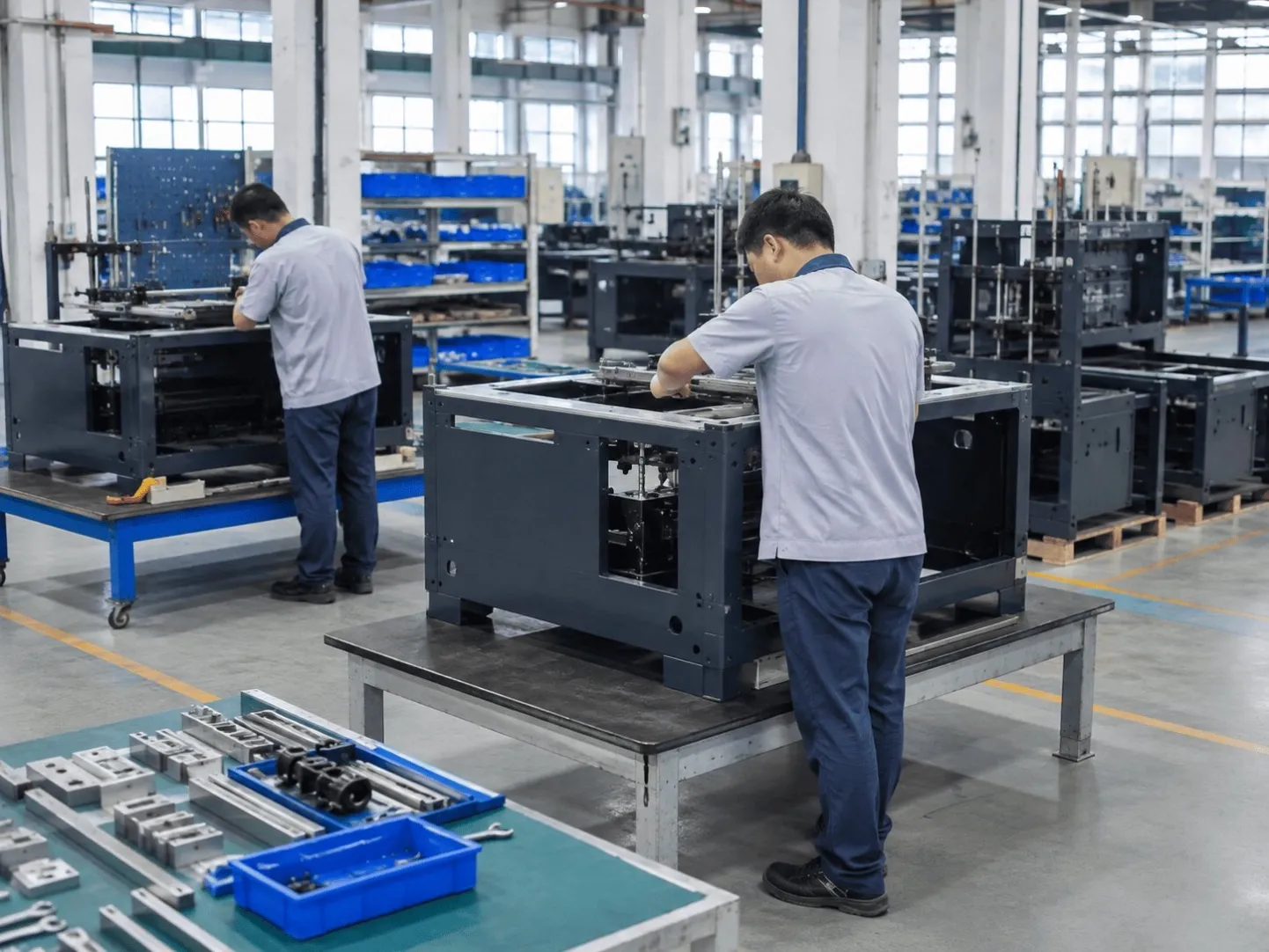
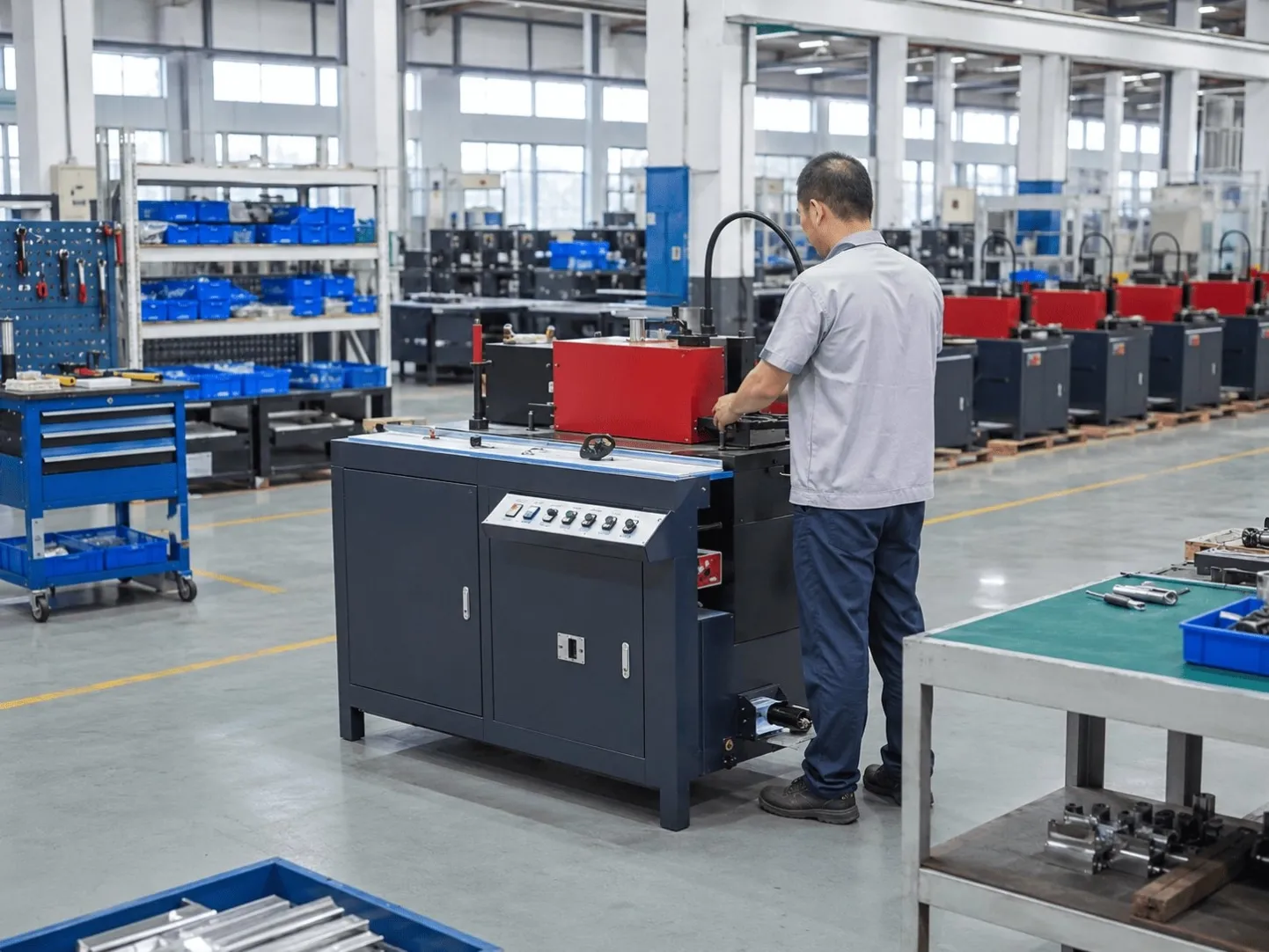
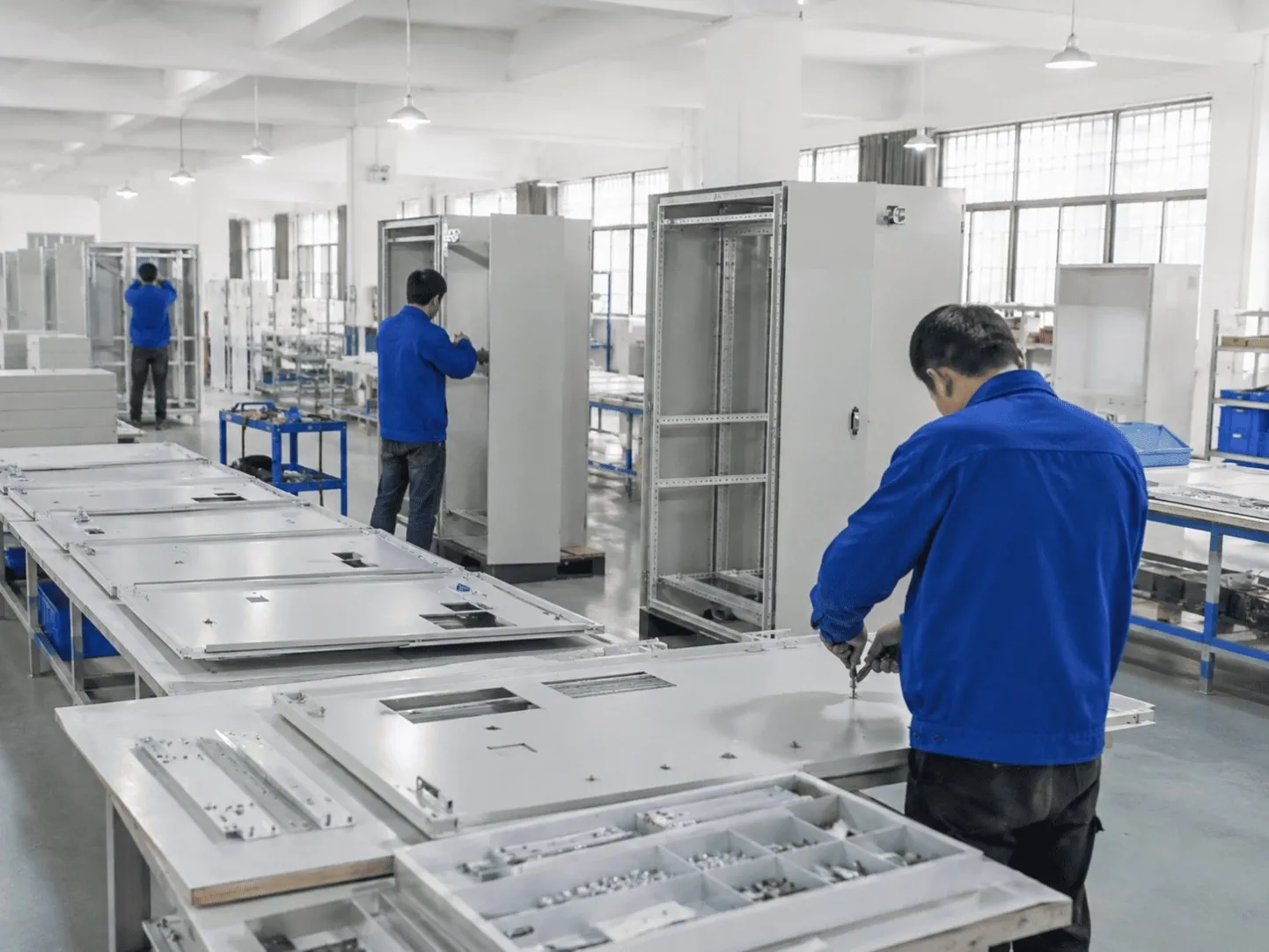
From our Foshan supplier network — these photos show typical enclosure fabrication and panel-assembly steps carried out by our inspected production partners.
Recent Projects (Anonymous)
Real deliveries through our Foshan sourcing network. Client names withheld by request.
Project Example — Modular UPS for a Small Data Room, 2026
- Scope: 1× N+1 modular UPS for a 10 kVA critical load in a small data room.
- Panel: 19" rack-style modular UPS, hot-swappable power modules, external battery bank, BMS.
- Country: Southeast Asia.
Engineering Review Example
- Customer Requirement: A 10 kVA load that could not go down, but the room had no space for a big standalone UPS.
- Our Suggestion: A modular UPS with N+1 power modules — same footprint as a single module, but one module can fail and the load stays up.
- Final Design: Modular UPS with 2× power modules (10 kVA N+1), external battery bank sized for 15 min; FAT was a battery-discharge and module-failover test before shipment.
Why Choose UniRegal for Industrial UPS
- Foshan multi-supplier sourcing — UPS + battery + enclosure sourced together, build-to-print.
- Prototype & project orders from 1 unit; lead time confirmed after drawing & BOM review; modules / batteries ship in 3–5 days.
- N+1 redundancy — modular builds let one module fail without dropping the load.
- Battery runtime sized to need — we size minutes, not just kVA.
- FAT before shipment — discharge + failover test, photos on request.
Lead Time & FAT
- UPS cabinet / enclosure: ~15 days
- Modules / batteries: 3–5 days
- FAT + inspection: before shipment, photos available
FAT checklist: power-up test / I/O point check / protection settings / label verification / photo before packing.Prototype & project orders from 1 unit; lead time confirmed after drawing & BOM review
FAQ — Industrial UPS
Q: N+1 or single module?
A: Critical load that can’t drop → N+1 modular. The extra module covers a failure with zero interruption.
Q: How long should the battery last?
A: We size minutes to your transfer / generator plan — typically 5–15 min for a graceful handover. Tell us the load and the plan.
Q: Do you FAT the UPS?
A: Yes — battery discharge and module failover are tested before shipment, record provided.
Applicable Industries
Data centers, industrial facilities, medical, telecom, process control, critical infrastructure.
Request Engineering Review
Have a load list or runtime need? Upload it → we return an engineering review + quotation in 1–2 working days.