
Oct 4, 2026Buying Guides
Why Your Control Panel Needs UPS Backup Power
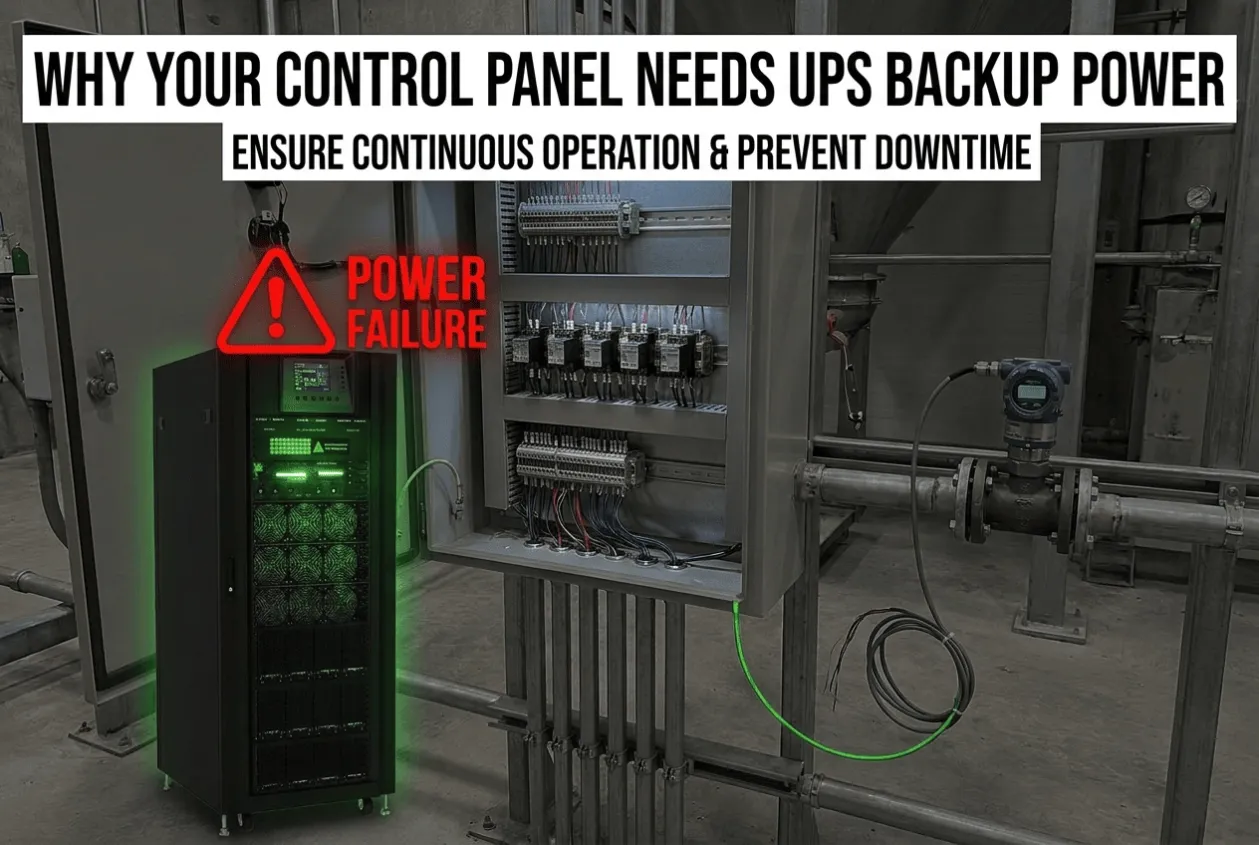
A UPS in a control panel is not for “extra backup.” It keeps the PLC, HMI, communication, and process state alive during short power dips, helping buyers avoid long restarts and lost production.
Why Your Control Panel Needs UPS Backup Power
I asked one engineer during a control panel review whether he always recommended adding a UPS.
He thought about it for a moment and said no.
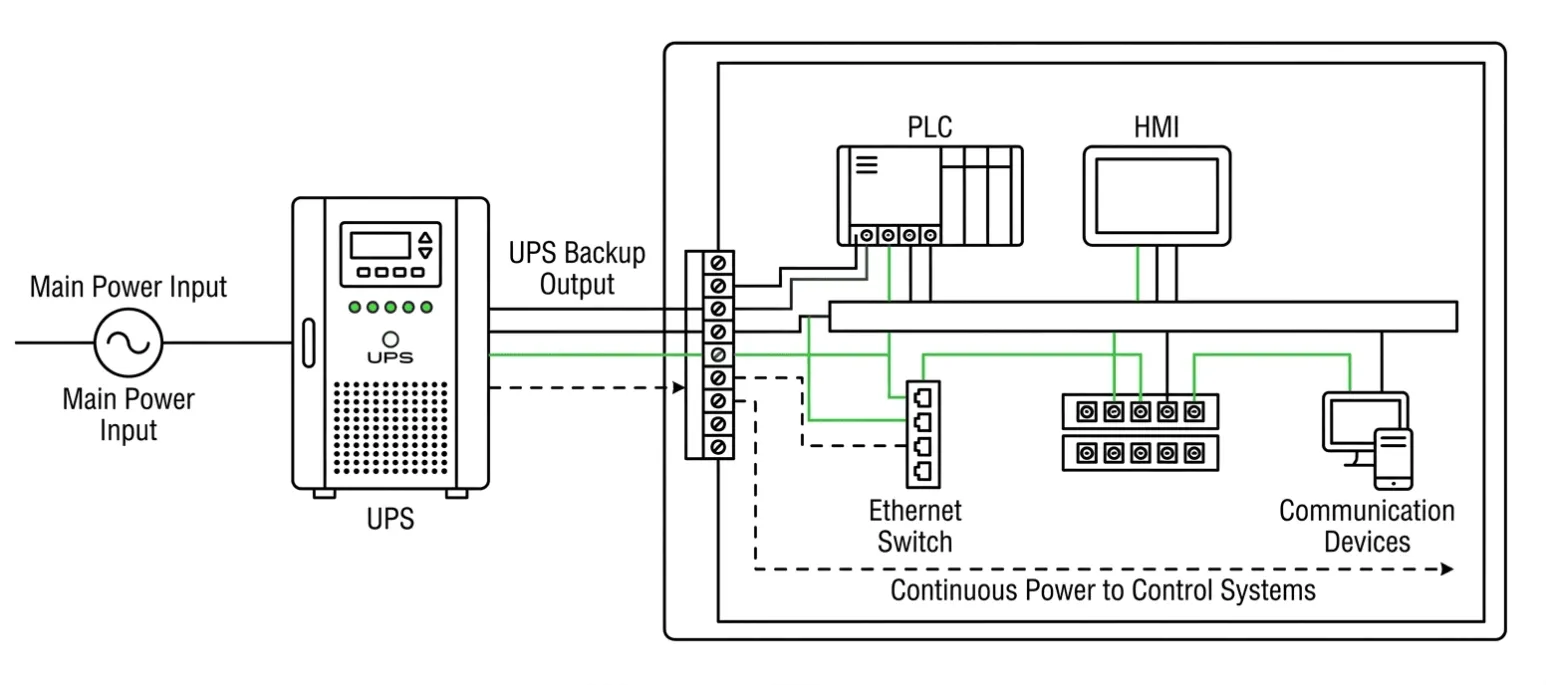
That answer surprised the buyer in the room. It probably would have surprised me years ago too, because once a panel includes a PLC, HMI, Ethernet switch, and communication devices, UPS backup sounds like an obvious upgrade.
Then he looked at the drawing again and added something more useful.
“Wrong question. Not every panel needs backup power. Every process needs a backup strategy.”
I still think that is the right way to look at it. A UPS should not be added because there is empty space left in the cabinet. It should stop a short power event from turning into a long and messy restart.
The Problem Is Usually Not a Long Blackout
Most buyers imagine a blackout. The whole factory goes dark, operators know something has happened, and the generator becomes the center of the conversation.
Reality is usually less dramatic.
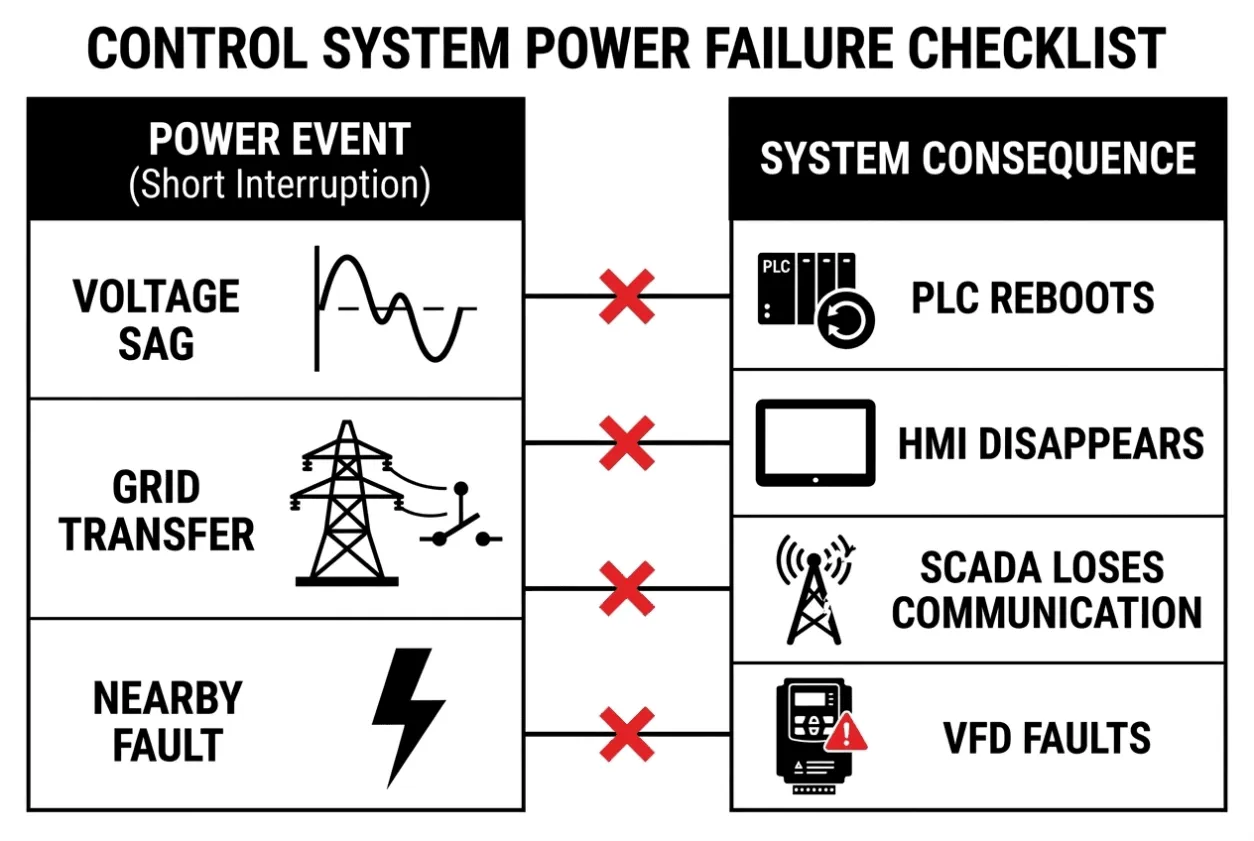
A voltage sag, a grid transfer, or a nearby fault may interrupt power for only a few seconds. That is enough for the PLC to reboot, the HMI to disappear, SCADA to lose communication, and the VFD to fault.
Nothing looks broken.
Yet the process is no longer where it was.
That is what makes these events so deceptive. The panel powers up again, the lights come back on, and everyone can see voltage on the meter. What they cannot always recover immediately is the operating state, alarm sequence, communication history, or product already sitting in the line.
In one food-line project I supported, a short power dip caused three interlocked panels to restart out of sequence. The actual power event lasted only a few seconds, but the operators spent close to 40 minutes clearing alarms, checking product, and restarting the line. The outage was short; the recovery was not.
Buyer: “But We Already Have a Generator”
This is a reasonable question, and I hear it often. A generator is valuable for longer outages, but it does not usually come online instantly. If the generator takes 10 to 30 seconds to start and stabilize, the control panel still experiences a gap unless something bridges it.
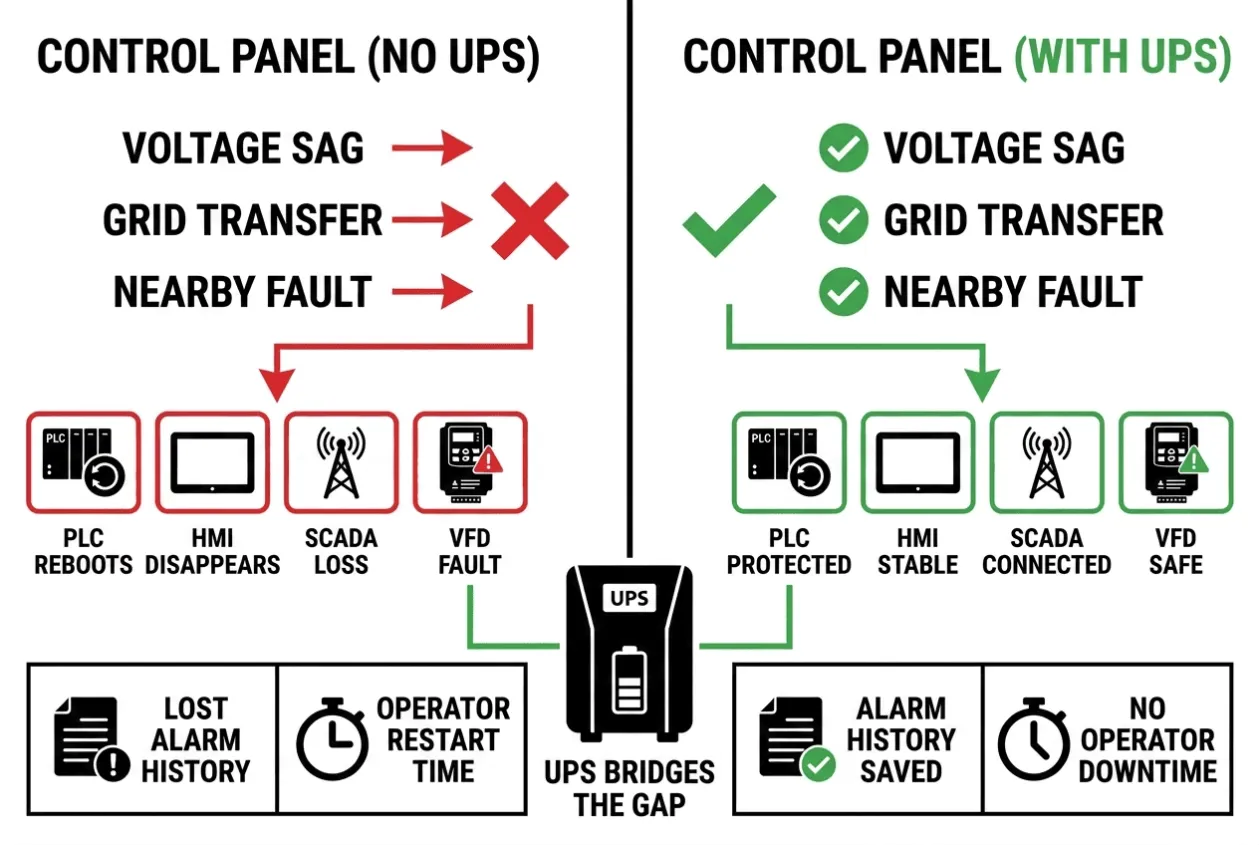
This is where a small UPS can be more useful than it looks on the quotation. It does not need to run the entire machine, and it certainly does not need to support motor loads. Its job is to keep the control side alive long enough for mains power to return, the generator to take over, or the PLC to perform a controlled shutdown.
The battery is not really about protecting the PLC as a device. It is about protecting the restart, the operating state, the alarm history, and the time your operators would otherwise spend putting the process back together.
Before You Buy a UPS, Ask Yourself
Before approving a UPS, I usually ask:
✓ What absolutely cannot lose power?
✓ How long before backup power arrives?
✓ Who restarts the process?
✓ What does one restart cost?
✓ What happens if nobody is on site?
This is the part many quotations skip. They include a UPS model, but they do not clearly explain what the UPS is protecting. Buying a UPS without deciding what it should protect is like buying insurance without knowing what you own.
What Type of UPS Fits a Control Panel?
For many PLC-based control panels, a 24V DC UPS is the cleanest option because the PLC, HMI, sensors, Ethernet switch, and remote I/O may already be on a 24V control bus. It avoids unnecessary conversion and usually fits neatly inside the cabinet.
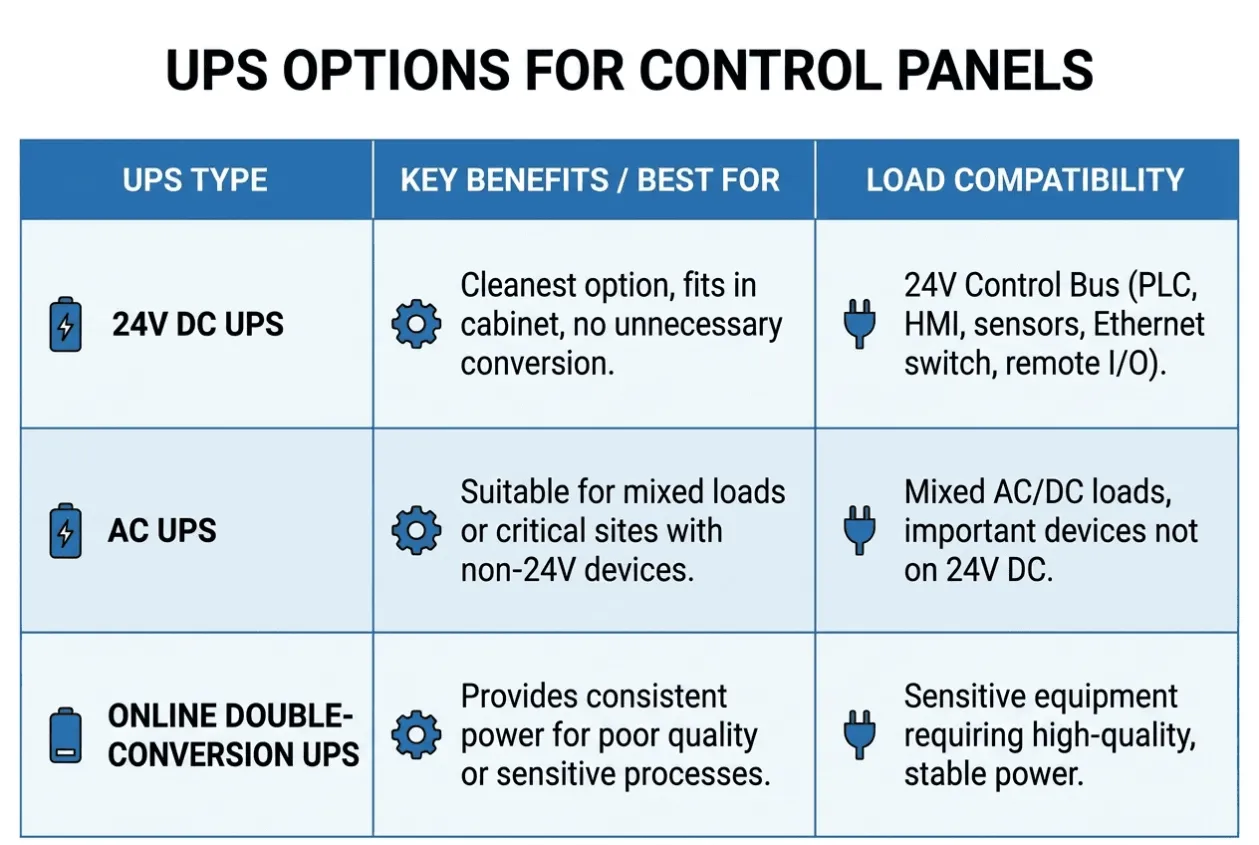
For mixed loads or critical sites, an AC UPS may be more suitable, especially when important devices cannot be moved to 24V DC. In applications where the power quality is poor or the process is sensitive, an online double-conversion UPS may be worth discussing because it gives the load more consistent power than a simple backup unit.
I do not like using desktop office UPS units inside industrial cabinets. They may pass a quick bench test, but control panels are warmer, tighter, and less forgiving than an office corner. Heat is hard on batteries, and a UPS that looked cheap at purchasing can become expensive if it fails quietly inside a cabinet nobody checks.
A practical buyer should ask for the UPS type, the load list, the expected backup time, the battery replacement plan, the alarm output, and whether the PLC receives a shutdown signal. That is not overengineering; it is simply making sure the UPS is part of the control design rather than a loose accessory.
How I Usually Size It
I do not size a panel UPS from the cabinet size or the motor power, because the UPS usually does not feed the motor. It feeds the control system.
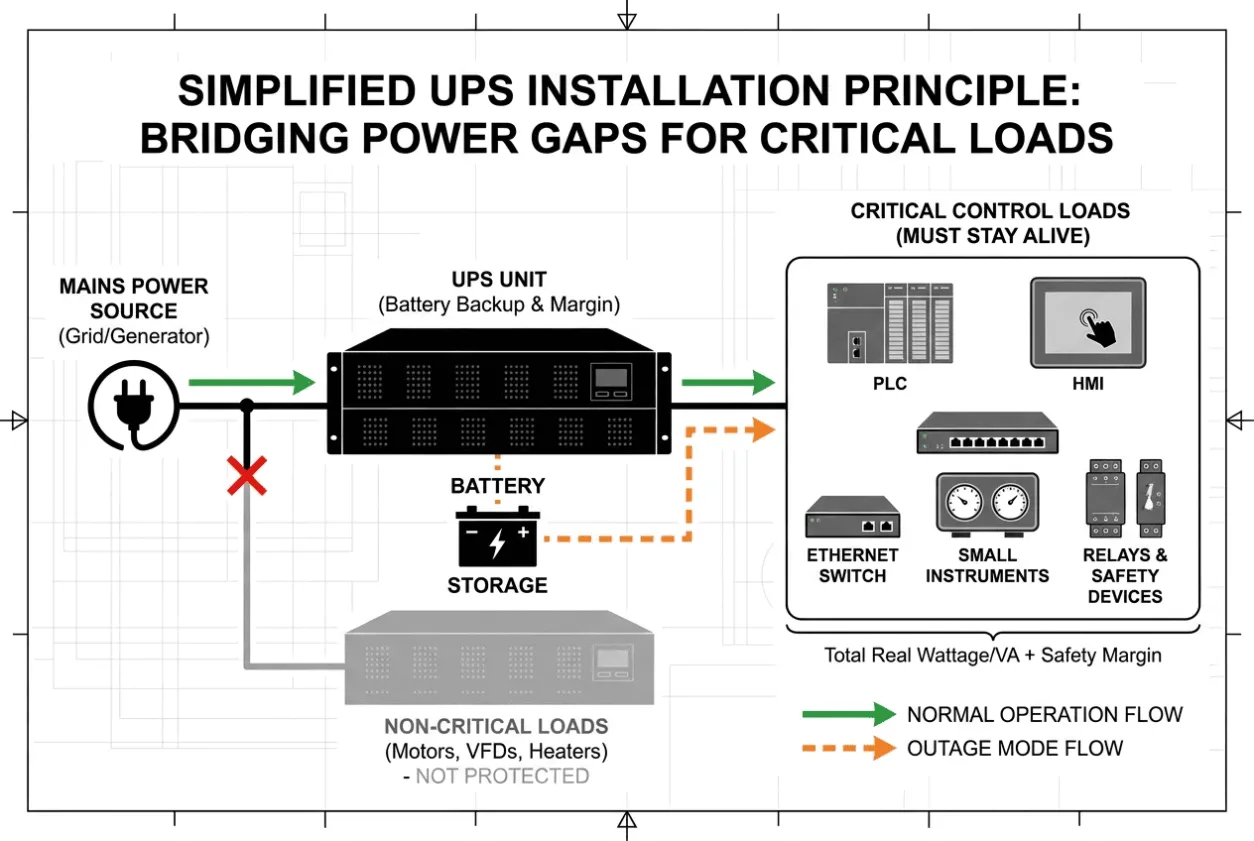
Start with the actual loads that must stay alive: PLC, HMI, Ethernet switch, communication gateway, small instruments, relays, and any device needed for safe monitoring or controlled shutdown. Add their real wattage or VA, then leave margin because batteries age and cabinet temperatures are often higher than people expect.
In many normal panels, 1.5 to 2 times the actual control load is a sensible starting point. The backup time depends on the project. Some plants only need enough time to bridge a generator start, while others need several minutes for operator response or a clean shutdown sequence.
The useful question is not simply how big the UPS should be. It is how long the process needs to remain under control after power becomes unstable.
Where UniRegal Usually Helps
When we review a control panel at UniRegal, we normally begin with the process rather than the UPS model itself. Only after we understand what must stay alive do we decide how the backup should work.
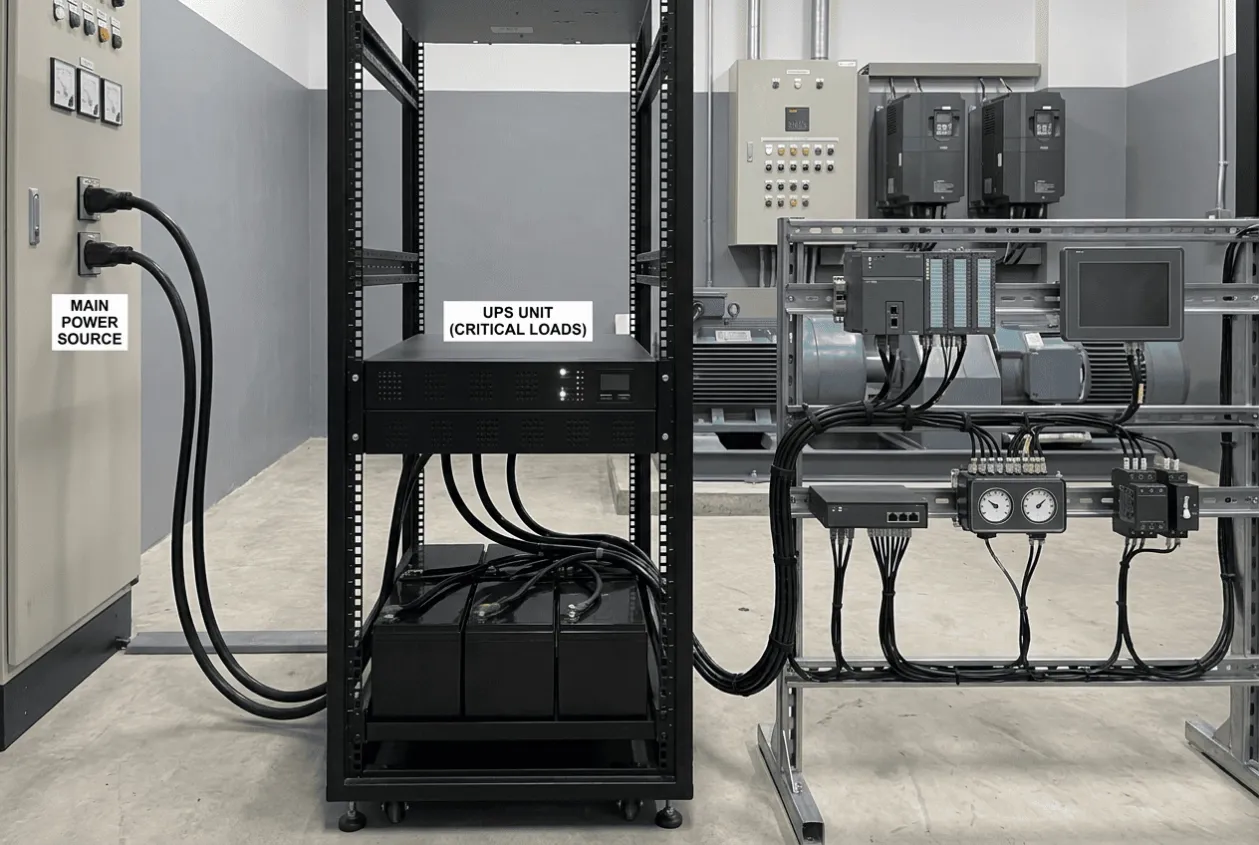
That review usually includes the load list, enclosure space, battery heat, breaker arrangement, alarm contact, PLC shutdown signal, wiring, and FAT test before the panel is built. A UPS added at the last minute often becomes an awkward box with unclear responsibility. When it is designed into the panel from the beginning, it becomes part of the control strategy rather than something someone remembered after the drawing was nearly finished.
FAQ
Does every control panel need a UPS?
No. A simple starter panel may not need backup power. A PLC panel with HMI, Ethernet communication, SCADA connection, interlocked equipment, or production data should at least be reviewed for UPS backup.
Is a generator enough?
A generator helps with long outages, but it may take 10 to 30 seconds to start and stabilize. A UPS bridges that gap so the control system does not reboot before the generator takes over.
Should I choose a 24V DC UPS or an AC UPS?
For panels where the critical loads are mostly PLC, HMI, sensors, and Ethernet devices, a 24V DC UPS is often cleaner. If important AC loads must remain powered, an AC UPS may be more suitable.
How long should the UPS run?
For many projects, the answer is not hours. It may be enough to bridge a generator start, allow operator response, or give the PLC time to perform a controlled shutdown.
What should I send before requesting a quote?
Send the critical load list, voltage, wattage or VA, required backup time, generator start time, enclosure temperature, available panel space, and whether the PLC needs a shutdown signal.
Final Thought
Nobody buys a UPS because they enjoy buying batteries. They buy it because restarting a process is often far more expensive than preventing the restart in the first place.
Related Guides & Solution Centers
About UniRegal
This guide is written by the application team at Uni Regal, a Foshan-based sourcing partner for control panels, electrical enclosures, and industrial UPS systems—not a factory. We consolidate enclosures, PLC/HMI/VFD, protection, and FAT through vetted local workshops so buyers get one quote and one accountable party.
The UniRegal control-panel team has 8+ years of experience specifying panels for water treatment, food, oil & gas, and OEM integrators across North America, the Middle East, and Southeast Asia. Questions about your spec? Contact our team.