
Oct 6, 2026Control Panels
Industrial UPS Topology for Control Panels: Online Double-Conversion vs Line-Interactive
Industrial UPS topology helps control panels survive voltage sags by reducing PLC restarts, VFD faults, cabinet heat mistakes, and costly downtime.
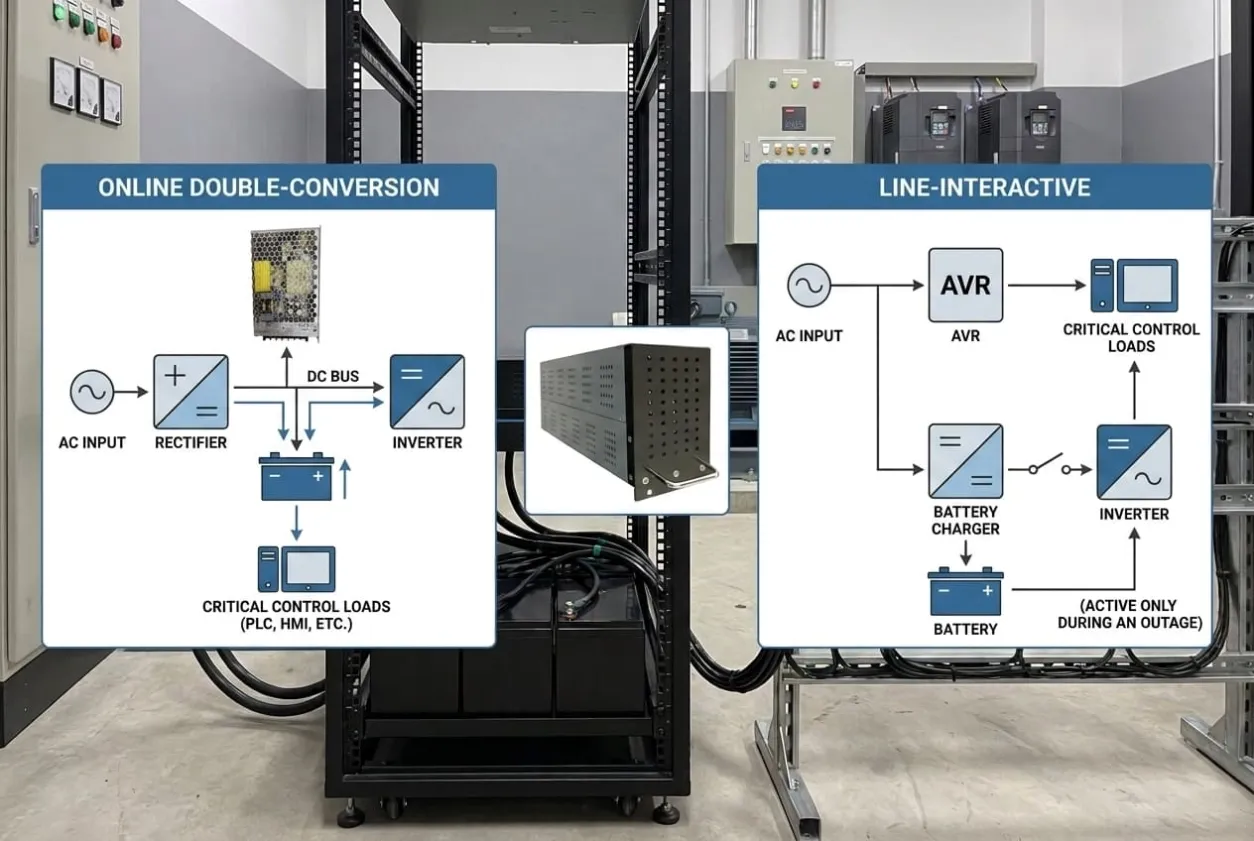
Industrial UPS Topology for Control Panels: Online Double-Conversion vs. Line-Interactive
When Should Buyers Choose Online Double-Conversion Instead of Line-Interactive?
A plant manager once told me, “The lights only blinked, but the production line stopped.”
That sentence immediately ruled out one possible UPS topology.
The site did not suffer a long blackout. Nobody found burnt wiring, failed PLC hardware, or damaged drives inside the cabinet. The voltage dipped for only a moment, but the PLC restarted, one VFD faulted, and the operator had to bring the line back manually. By the time production was stable again, nearly 40 minutes had disappeared.
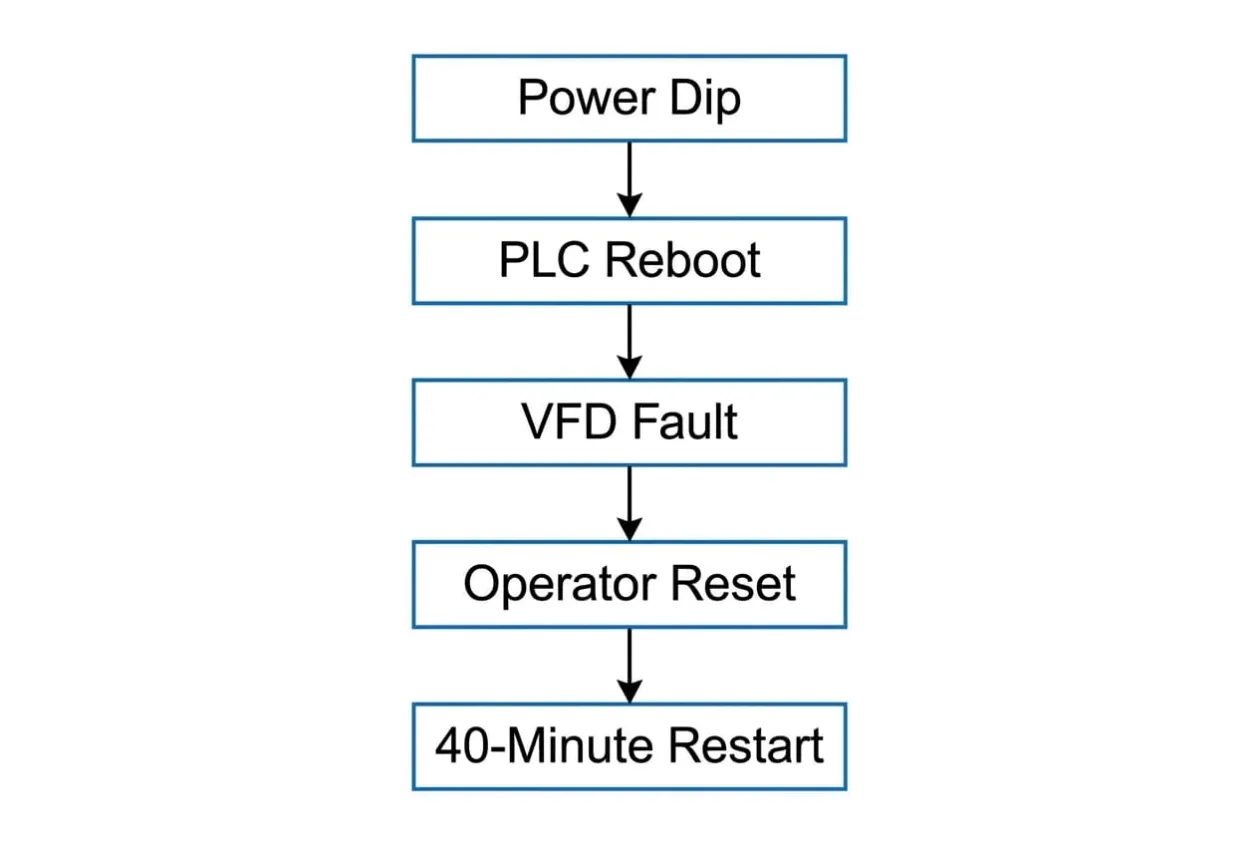
That is why UPS topology matters. A UPS is not just a battery added to a control panel. It decides how the panel behaves when incoming power becomes unstable for a few seconds.
Why UPS Topology Matters
Choosing a UPS is easy. Choosing the wrong UPS is expensive.
Many buyers compare UPS models by kVA, backup time, price, and delivery. Those numbers are necessary, but they do not tell the whole story. In a control panel, the more useful question is whether the PLC, HMI, communication devices, instruments, or drives can ride through a voltage sag without creating a restart problem.
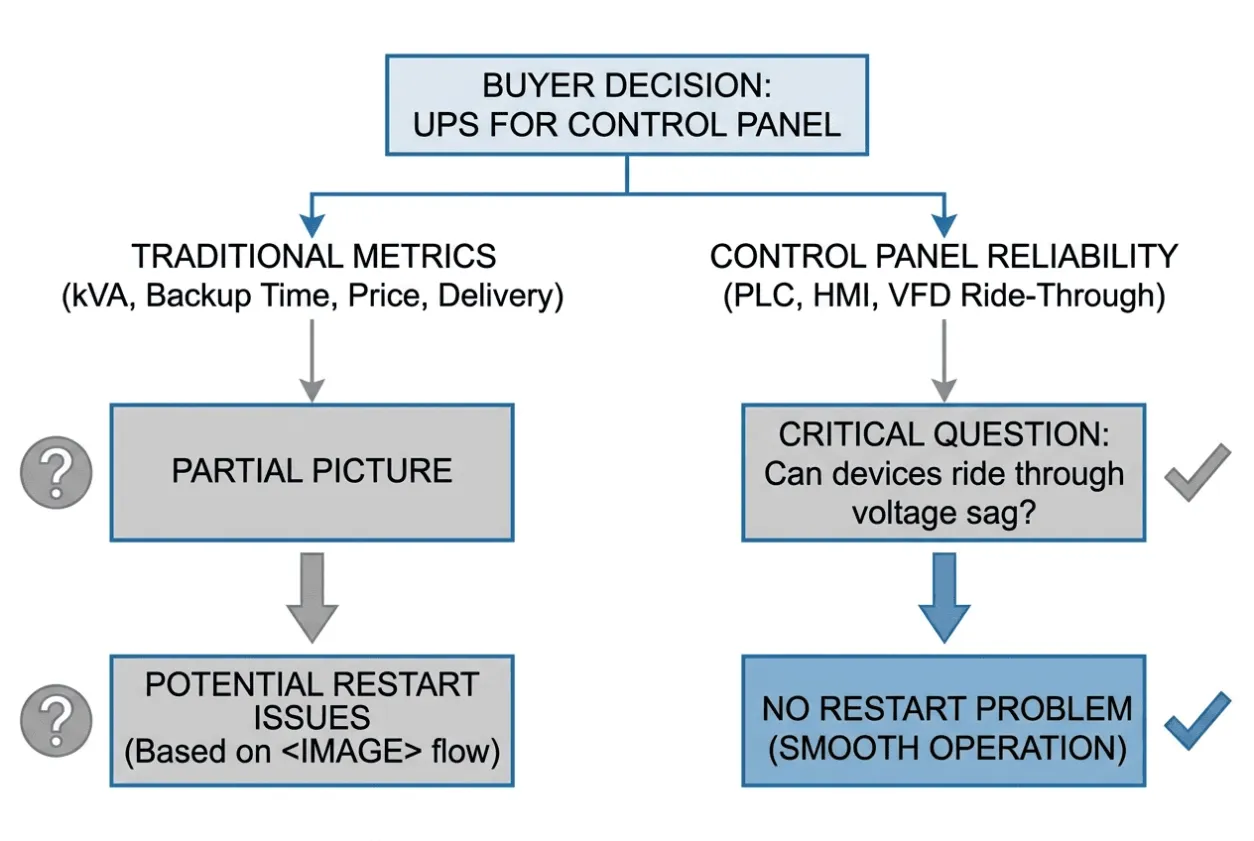
Engineering Insight Buyers usually compare kVA. Engineers usually compare what happens during a voltage sag.
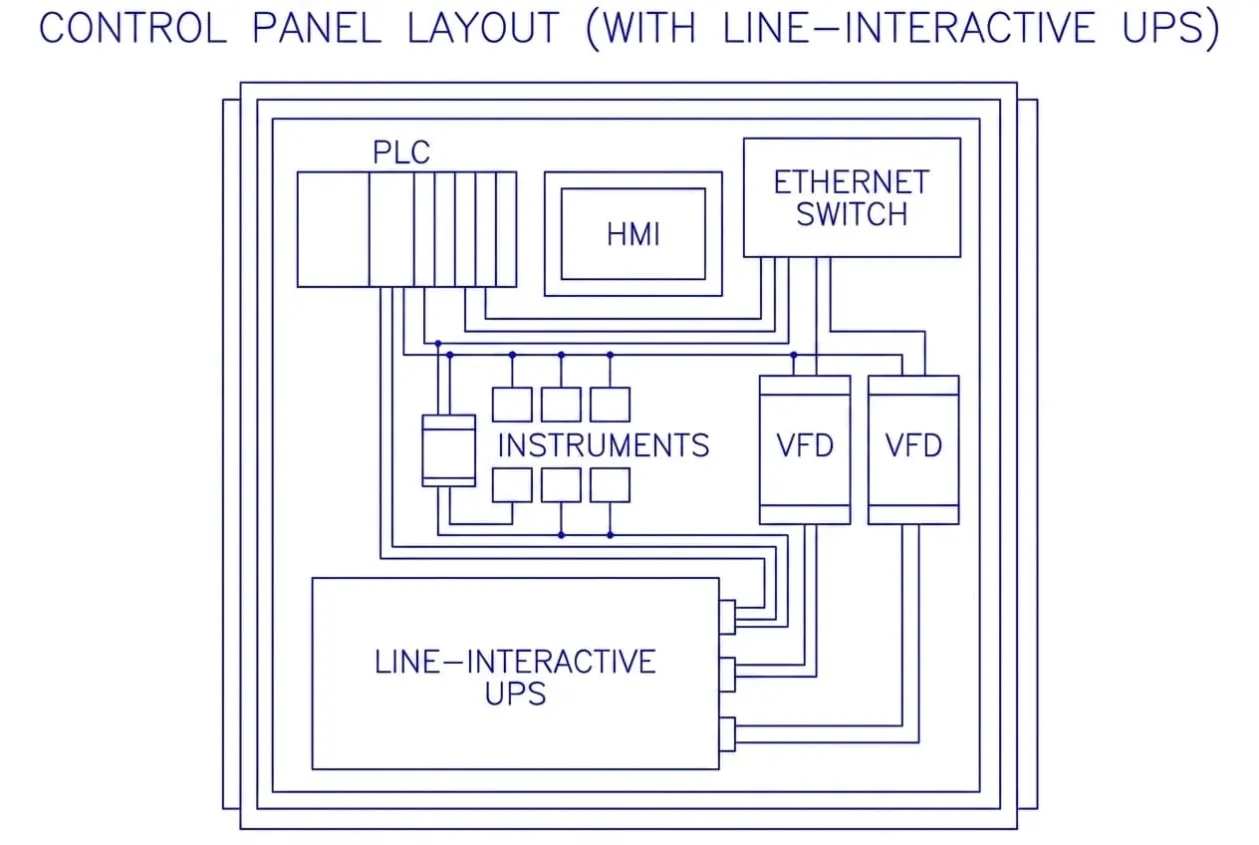
A line-interactive UPS can be a practical choice when the utility supply is stable and the panel mainly supports PLC, HMI, Ethernet switch, and small control loads. It is efficient, compact, and usually easier to manage inside a cabinet.
An online double-conversion UPS is selected for a different reason. The load is continuously supplied through the inverter, so short sags, frequency instability, and transfer gaps are less likely to reach the control system. That matters when the panel includes VFDs, sensitive instruments, remote operation, or equipment where one restart creates real production loss.
Real Case Review
The panel in that project controlled a small automated production section with one PLC, one HMI, an Ethernet switch, several instruments, and two small VFDs. The first supplier recommended a line-interactive UPS because it was cheaper, cooler, and available faster. Looking only at the quotation, the recommendation was not unreasonable.
Then the engineer asked the question that changed the review.
The Question That Changed Everything
“Have these VFDs ever tripped during a voltage sag?”
The plant manager admitted they had. Not every week, but often enough that the operators had given the fault a nickname.
When operators give a fault a nickname, it has already happened too many times.
From that point, the discussion was no longer about whether the UPS could support the calculated load. The issue was whether the UPS topology could prevent the same annoying stoppage from happening again. The line-interactive UPS was not a bad product. It was simply the wrong answer for that process.
Lessons from This Project
✓ The UPS load was not the main problem.
✓ The topology did not match the failure mode.
✓ The restart cost more than the UPS upgrade would have cost.
Line-Interactive vs. Online Double-Conversion
Buyer Question | Line-Interactive UPS | Online Double-Conversion UPS |
|---|---|---|
Will the PLC usually ride through? | Usually, on stable power | More reliably |
Can VFDs still trip during ugly sags? | Possibly | Less likely |
Does the cabinet get hotter? | Slightly | Yes, plan for it |
Is the price lower? | Usually | No |
Is maintenance simpler? | Generally easier | More heat and battery planning |
Best buying situation | Stable utility, PLC/HMI loads | Poor utility, VFDs, remote sites, costly restarts |
My rule is simple enough for most quotation reviews: if a restart costs a few minutes and the utility supply is stable, I normally review line-interactive first. If a restart costs production, product loss, or a midnight site visit, online double-conversion deserves serious attention.
Something Buyers Often Forget
Online double-conversion solves the power-quality problem, but it brings heat into the cabinet. That part is easy to miss because the UPS is usually discussed as an electrical item, not as a thermal load.
A unit running around 90–95% efficiency will turn the remaining loss into heat. On a 10 kVA online UPS, that can mean roughly 500–1,000 W of additional heat inside or around the enclosure, depending on the installation. In a sealed outdoor cabinet, that is not a small detail.
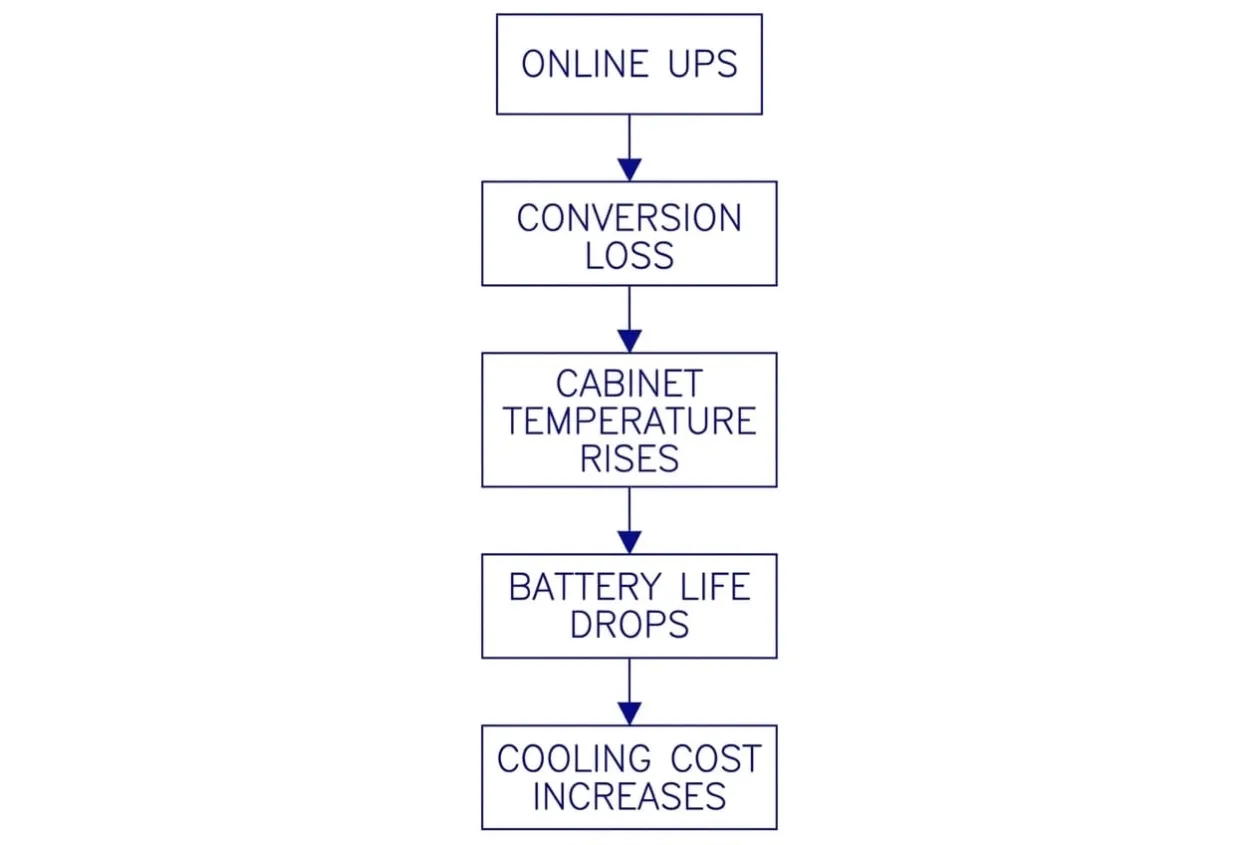
Many buyers remember the UPS. Fewer remember the heat it creates.
That is why I always want the UPS topology reviewed together with enclosure size, cooling method, ambient temperature, battery type, and service access. A technically correct UPS can still become a poor decision if it quietly cooks the cabinet.
Buyer Decision Tree
Use this as a quick starting point, not as a replacement for sizing.
Site Condition | Starting Point |
|---|---|
Stable utility power, PLC/HMI only, low restart cost | Review line-interactive UPS first. |
Generator present, short bridge time needed, no sensitive drives | Line-interactive may be enough. |
Poor utility power, repeated voltage sags, multiple VFDs | Review online double-conversion. |
Remote or unattended site, restart requires service visit | Online double conversion is usually safer. |
Sensitive instruments or process data must stay stable. | Online double-conversion deserves review. |
Sealed outdoor cabinet with limited cooling | Check heat before approving online UPS. |
Engineering Insight A UPS does not prevent power failures. It prevents long recoveries.
Buyer Checklist Before Approval
Before approving a UPS for a control panel, I usually want these points confirmed:
✓ Site power quality and history of voltage dips
✓ Generator start delay, if a generator is used
✓ PLC, HMI, switch, instrument, and VFD load list
✓ Whether VFDs have tripped during previous sags
✓ Required backup time or shutdown time
✓ Cabinet temperature and cooling method
✓ UPS topology and kVA rating
✓ Battery type and replacement plan
✓ Alarm output to PLC or HMI
✓ ECO mode setting and whether it is allowed during operation
✓ FAT test method for power-loss simulation
This checklist does not make the quotation more complicated. It makes the buying decision harder to misunderstand.
Where UniRegal Helps
At UniRegal, we normally review UPS selection after understanding three things: what must stay alive, how long it must stay alive, and what happens if it does not.
Once those answers are clear, the UPS model usually becomes much easier to choose. For PLC-only panels, line-interactive may be the practical solution. For VFD-heavy, remote, or restart-sensitive panels, online double-conversion may justify the extra cost and heat planning.
We can source industrial UPS units from vetted suppliers, integrate them into the cabinet, check wiring and alarm contacts, and include UPS behavior in the FAT before shipment.
Final Thought
The worst time to evaluate a UPS topology is during a power failure. By then, the buying decision has already been made.
Related guides
Talk to a sourcing partner before you overspec
Tell us your load list, runtime target, and site conditions, and we will route the UPS topology, rating, and enclosure to matched Foshan suppliers and own the integration as your sourcing partner. Send your panel spec through our requirements form — we will confirm topology, kVA, and lead time before you commit a purchase order.
Need help specifying or sourcing this for your project? Request a quote - we reply within 1-2 working days with a technical review.