
Sep 4, 2026Buying Guides
Why Custom Control Cabinet Enclosure Quotes Vary So Much
A custom control cabinet enclosure is more than a painted box. Cut-out placement, paint system, and a factory acceptance test (FAT) decide whether the panel ships right the first time.
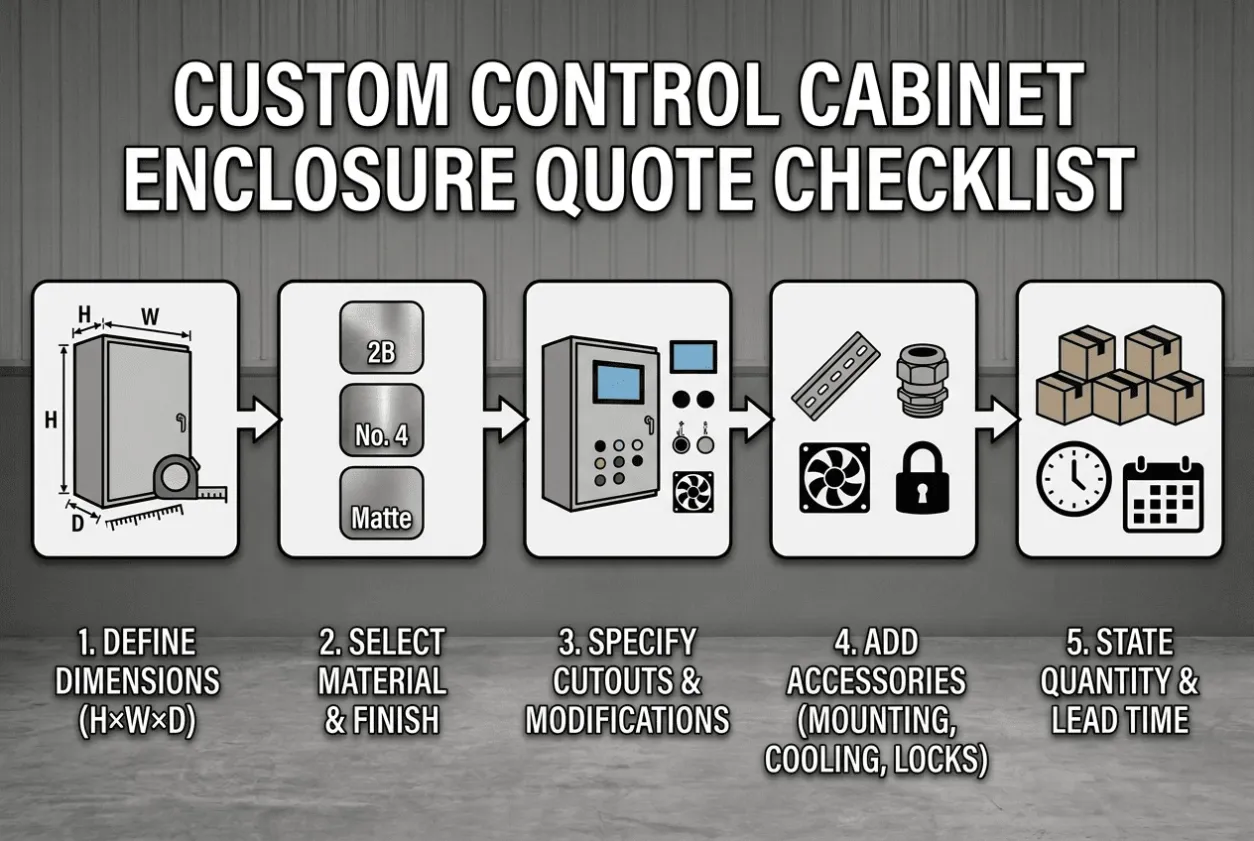
Custom Control Cabinet Enclosure: Cut-outs, Paint & FAT Explained
When you order a custom control cabinet enclosure, you are not buying a box—you are buying a housing that has to accept your breakers, your HMI, your cable glands, and your cooling unit without a single field modification. The three things that decide whether it arrives right are where the cut-outs are, what paint system protects it, and whether anyone actually tested it before it left the shop.
This guide covers all three, written for the buyer who needs to specify the enclosure and verify it on arrival—not for the panel builder who already knows the trade. If you are also sourcing the control panel that goes inside, our control panel build spec checklist lists the seven things your panel builder needs from you first.
Cut-outs—position them before the steel is bent
A cut-out is any hole or window cut into the enclosure wall or door: HMI windows, push-button holes, conduit entries, cooling-unit cut-outs, and vent slots. Each one is cut after the panel is formed but before it is painted, and each one has a tolerance.
Specify every cut-out with:
- Position measured from two adjacent edges (not ""centered"—centered drifts)
- Shape and size—rectangular cut-out for an HMI, round hole for a gland, NEMA-rated window cut-out for a viewing panel
- Which wall—door, left side, right side, top, or bottom (top entry and bottom entry change the gasket design)
- Tolerance—±0.5 mm is standard for a CNC-plasma or laser cut; ±1 mm for punched
The most common field failure: the HMI cut-out is 3 mm too low, so the HMI bezel does not cover the raw edge, and the gasket gap lets water track in. Specify the cut-out from the HMI drawing, not from memory. If you are unsure how the motor loads affect door layout, our guide to choosing a motor starting method shows why VFD vs DOL changes how much wall space the drive needs.
A clean way to avoid cut-out surprises: send the enclosure supplier the same panel layout drawing you send the panel builder. When both shops work from one drawing, the cut-outs line up with the devices.
Paint system—what the coating actually protects
Most stainless enclosures ship unpainted (304 and 316 are corrosion-resistant as-is). Carbon steel enclosures need a paint system, and the system—not just the color—decides the service life.
Paint system | Typical life (outdoor, mild) | Best for |
|---|---|---|
Powder coat, single layer | 5–8 years | Indoor, dry, non-corrosive |
Powder coat, zinc-rich primer + topcoat | 8–12 years | Outdoor, covered, low UV |
Epoxy primer + polyurethane topcoat | 10–15 years | Outdoor, coastal, chemical wash-down |
Stainless (no paint) | 15–25 years | Anywhere stainless is specified |
Two things buyers miss:
- The primer matters more than the topcoat. A pretty topcoat over a weak primer fails at the scratch. Ask for zinc-rich or epoxy primer on any enclosure going outdoors.
- Color is a line item. If you need a specific RAL color to match plant branding, say so in the RFQ. Adding color after the fact means repainting the whole batch.
If your site is coastal or chemical, skip carbon steel entirely and go stainless—the paint system on carbon steel is fighting a losing battle against salt. Our 304 vs 316 stainless guide covers which grade you need, and our stainless enclosure quotation guide breaks down what the grade and finish cost.
Cooling cut-outs—don't forget the heat load.
If the panel holds a VFD, a UPS, or a PLC rack, it makes heat. That heat needs a way out, and the way out is usually a cut-out for a fan, a filter, or an air conditioner.
- Filtered fan + exhaust: cheapest, fine when ambient stays under 40°C and the panel is not in direct sun
- Vortex cooler: no moving parts, good for hazardous areas, expensive per watt removed
- Enclosure air conditioner: needed when the ambient is consistently high or the panel sits in the sun on a dark surface
Specify the cooling cut-out from the cooling unit's template, not from a guess. A cut-out of 5 mm off means the air conditioner does not seat, and you ship it back. Our outdoor cabinet air-conditioner guide compares the three options with numbers.
If the panel will lose power and the load cannot tolerate a blip, add a UPS to the spec — see our guide to sizing an industrial UPS for a control panel for what to size.
FAT—the factory acceptance test that catches errors before shipping
FAT (Factory Acceptance Test) is the step most buyers skip and most regret skipping. It is a documented test, done at the builder's shop before crating, that proves the panel does what the drawing says.
A proper FAT covers:
- Continuity/earthing test—every exposed conductive part bonds to the earthing stud
- Insulation resistance—megger test between live parts and earth (typical pass: >1 MΩ at 500 V)
- Functional test—each input triggers its output (float switch → pump start, E-stop → contactor drop)
- Visual inspection—cut-outs line up, labels present, torque values recorded
- Documentation—a signed FAT report you keep with the panel
At Uni Regal we run FAT on every panel before crating, and we share the report with the buyer. The pre-shipment control panel checklist is the exact list we walk through, and our FAT guide explains why a 2-hour test saves a 2-week startup delay. Panels that skip FAT are the ones that show up with a reversed interlock or a missing gland plate—problems that cost 10× more to fix on-site than in the shop.
How to verify the enclosure on arrival
When the enclosure reaches your site, before you mount it:
- Check cut-outs against the drawing—every hole where it should be, within tolerance
- Check the paint—no bare spots, no runs, and primer visible at edges if specified
- Check the gasket—continuous, no gaps at corners
- Check the documentation—FAT report, nameplate ratings, certification stamps
- Check the accessories—lifting yes, plinth, spare gasket (order spares with the enclosure; they are the highest-wear item)
If any of these is wrong, reject it before mounting. A wrong cut-out found after the panel is built inside is a rebuild; one found before is one phone call.
How we handle custom control cabinet enclosures at Uni Regal
We are a China sourcing partner based in Foshan, not a factory. When you order a custom control cabinet enclosure through us:
- We confirm the cut-out list against your panel layout drawing, and we flag any cut-out that conflicts with another (two cut-outs too close, a cut-out too near a bend).
- We specify the paint system by environment, not by default—zinc-rich primer + polyurethane topcoat for outdoor carbon steel, no paint for stainless.
- We require a FAT report from the shop before we pay them, and we forward it to you.
- We bundle the enclosure with the control panel components (breakers, PLC, HMI, VFD) when you are sourcing the whole panel, so the cut-outs, the paint, and the cooling all match one build. Our control panel build spec is the single document that drives the whole order.
Typical lead time for a custom stainless or painted enclosure is 15 days; the panel build adds another 5–10 days if we source the components. MOQ is 5 units per size for cabinet-grade builds.
Send your enclosure drawing and panel layout to natalie@uniregal.com, and you will get a comparable quote within 48 hours.
Frequently asked questions
Can I supply my own HMI and have the cut-out made to fit?
Yes. Send the HMI's cut-out template (most brands publish a DXF or PDF with the exact window dimensions and corner radius). The shop cuts to that template. Do not send "make it fit a 10-inch HMI"—every 10-inch HMI has a different bezel, and the cut-out that fits one will not fit another.
What paint color can I specify?
Any RAL code. State it in the RFQ as a line item. If you do not specify, you get the shop's standard light grey (usually RAL 7035). Color is not free—it adds a repaint cycle—but it is far cheaper to specify up front than to repaint a batch after delivery.
Do I need a FAT if the panel is simple?
Yes, even for a simple panel. The FAT that catches the most expensive errors is the functional test—a reversed interlock or a miswired sensor shows up in 10 minutes on the bench and takes 2 days to find on-site. For a panel with no control logic (power distribution only), the continuity and insulation tests still matter.
Should the enclosure be stainless or painted carbon steel?
If the environment is dry and indoor, painted carbon steel is the cheaper correct answer. If it is outdoor, coastal, or chemical, stainless (304 or 316) outlasts any paint system. The material selection guide walks through the trade-off with a decision table.
Can I order just the enclosure, or must I source the whole panel?
Either. We supply bare enclosures to panel builders who want to do their own assembly, and we supply complete panels to buyers who want one responsible party. Sourcing the enclosure alone is fine; sourcing it with the panel is usually 8–15% cheaper because the cut-outs and cooling are specified once.