
Sep 28, 2026Buying Guides
NEMA 4X Enclosure Sourcing from China: A Buyer's Reality Check (2026)
Most NEMA 4X enclosures sourced from China are sold on a label, not a spec. Here is what export buyers actually need to verify — IP66 vs NEMA 4X, 304 vs 316, gasket choice, UL 50E listing, and when a
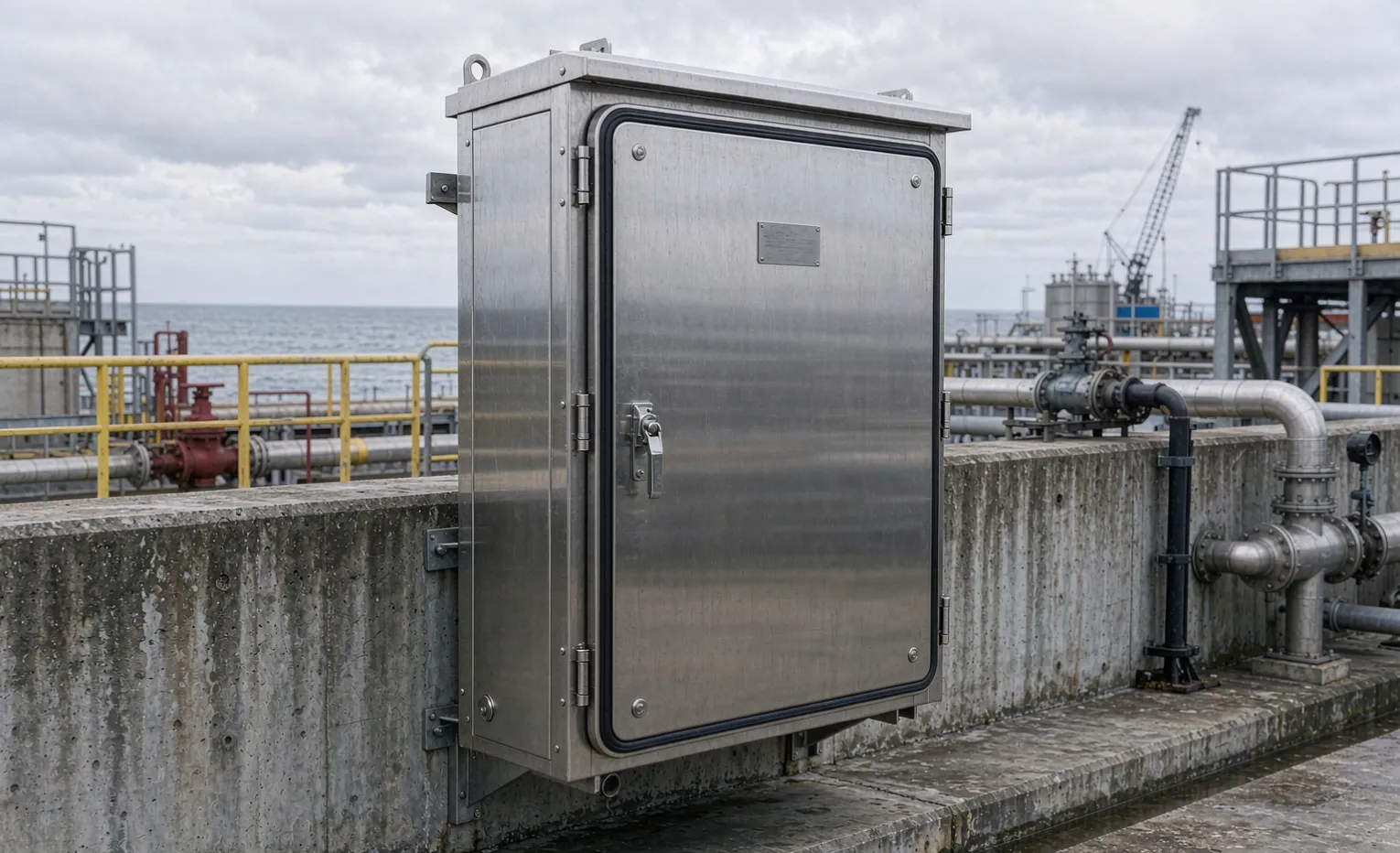
A "NEMA 4X" stamp on a box means almost nothing by itself. The rating only holds if the enclosure was actually built, gasketed, and finished to survive the duty you're putting it in — coastal air, hose-down, chemical splash, freeze-thaw. Most of the enclosures exported from China are sold on the label, and the buyer finds out the label lied two years later when the door seam rusts through.
This guide is the version most supplier shortlists skip. We walk through the seven questions export buyers really ask, point out where the common advice ("just pick a listed shop") quietly breaks down, and show how to verify a build before you pay. UniRegal is a sourcing partner, not a manufacturer: for NEMA 4X we match your drawings to vetted Foshan fabricators and handle spec review, build-to-print manufacturing, inspection, and export packing. That model shapes the advice below — but the verification steps apply no matter who builds your enclosure.
For the cabinet and cooling side of the same project, see our Electrical Enclosure Sourcing Guide (China). When you need a finished enclosure built to spec, our Electrical Enclosures team handles build-to-print from 304/316 stainless.
1. "NEMA 4X" on the box vs NEMA 4X in the spec
The first trap is assuming the words on the nameplate and the rating in your specification are the same thing. They aren't.
NEMA 4X is a performance rating set by NEMA. A 4X enclosure has to keep out falling dirt, rain, sleet, snow, hose-directed water, splashing, and — this is the part people forget — it has to resist corrosion and survive external ice formation without breaking the seal. A supplier can stamp "NEMA 4X" on a stainless box they've never tested to that standard, and the stamp survives the ocean freight just fine.
Buyer Decision: Ask for the test basis, not the label. If a supplier can't tell you which NEMA document their build was verified against (and what was actually tested — the whole enclosure or just a similar one), you don't have a 4X enclosure. You have a stainless box with a bold claim.
Where the cheap boxes cut corners is almost always the same three places: the gasket, the weld finish on the door seam, and the material grade. We'll get to each. The point here is that the rating is a contract between you and the environment, and a self-declared stamp is not a contract anyone can enforce.
2. IP66 vs NEMA 4X: the swap that fails inspections
This is the single most common way a China-sourced enclosure gets rejected at the jobsite. A supplier quotes you an "IP66 / NEMA 4X" box as if those are the same rating. They are not, and an AHJ or an OEM quality engineer who knows the difference will catch it.
IP66 proves the enclosure can survive a powerful water jet and stay dust-tight. It says nothing about corrosion resistance and nothing about ice formation. NEMA 4X covers both of those on top of the water protection. So an IP66 polycarbonate box is genuinely IP66 — and genuinely not NEMA 4X, because polycarbonate doesn't meet the corrosion requirement and there's no ice test behind it.
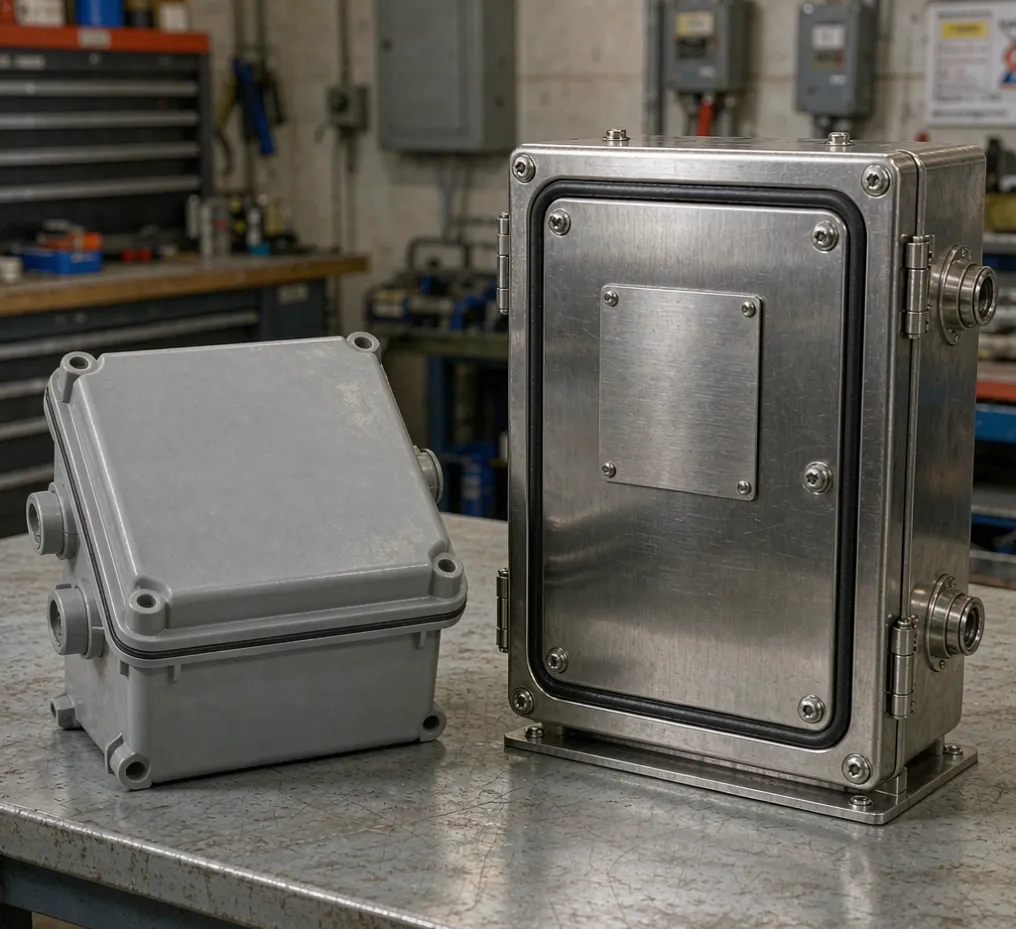
Engineering Note: If your spec says NEMA 4X and you accept an IP66 box, you've accepted a substitution that fails the corrosion clause. In a coastal or wastewater environment that's not a paperwork problem — that's the box rotting out in three seasons.
There are plenty of cases where IP66 is the right call and NEMA 4X is overkill: indoor washdown-rated panels, non-corrosive indoor duty, anything that never sees weather or chemicals. The mistake isn't using IP66. The mistake is letting a supplier swap IP66 for a NEMA 4X requirement without telling you.
Our take on the rating difference is longer than this section allows — read NEMA vs IP ratings: what's the difference and NEMA 4 vs NEMA 4X before you write the spec.
3. 304 or 316 stainless? (and the 201 problem nobody mentions)
For a stainless NEMA 4X enclosure, the material grade is the difference between an enclosure that outlives the equipment inside it and one that pits within a year. The grades you'll actually be quoted are 304 and 316. Both are real, both weld cleanly, both pass a magnet test loosely (316 is less magnetic, but don't rely on that).
The grade nobody puts in the quotation but shows up in the box is 201 stainless. It's cheaper, it looks identical in a photo, and it rusts in coastal or humid duty because its nickel content is low. A fabricator quoting you "stainless" at a price that seems too good is often quoting 201 and hoping you never ask for the mill certificate.
Buyer Decision: Require a mill test certificate (MTC) naming 304 or 316 by ASTM grade, not a line that says "stainless steel." For most inland and mild-duty outdoor sites, 304 is enough and cheaper. Step up to 316 when the enclosure faces saltwater, wastewater, or chemical splash — the molybdenum in 316 is what stops pitting in those environments.
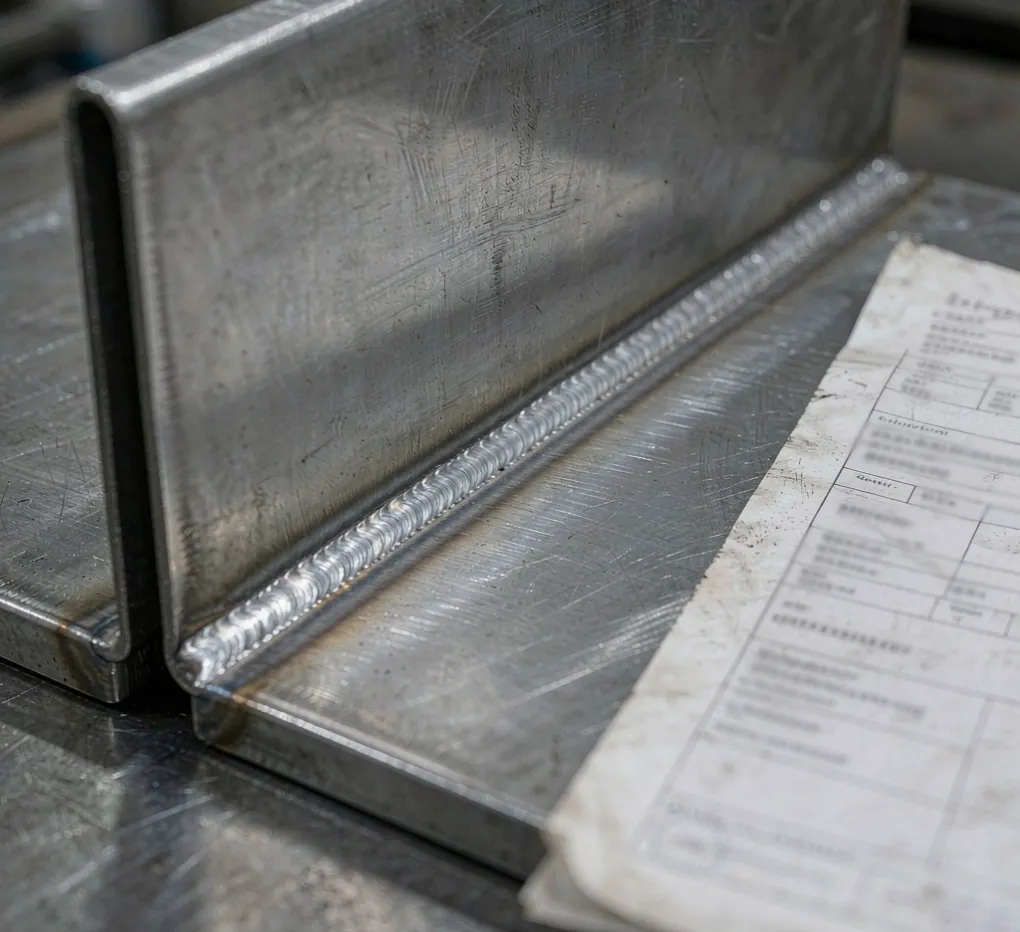
We source 304 and 316 from Foshan fabricators and do not work in aluminum for NEMA 4X duty — aluminum doesn't hold up to the hose-down and corrosion clauses the way stainless does, and most export specs that call 4X won't accept it anyway.
4. The gasket nobody checks until it leaks
The door seal is where most NEMA 4X enclosures actually fail, and it's the last thing buyers spec. Two decisions matter: the gasket material and how it's fitted.
Silicone and EPDM are the two you'll be offered. Silicone holds up better across temperature swings and resists more chemicals; EPDM is cheaper and fine for mild duty but goes hard and cracks in cold or in oil/chemical exposure. For coastal or outdoor 4X duty, silicone is the safer default.
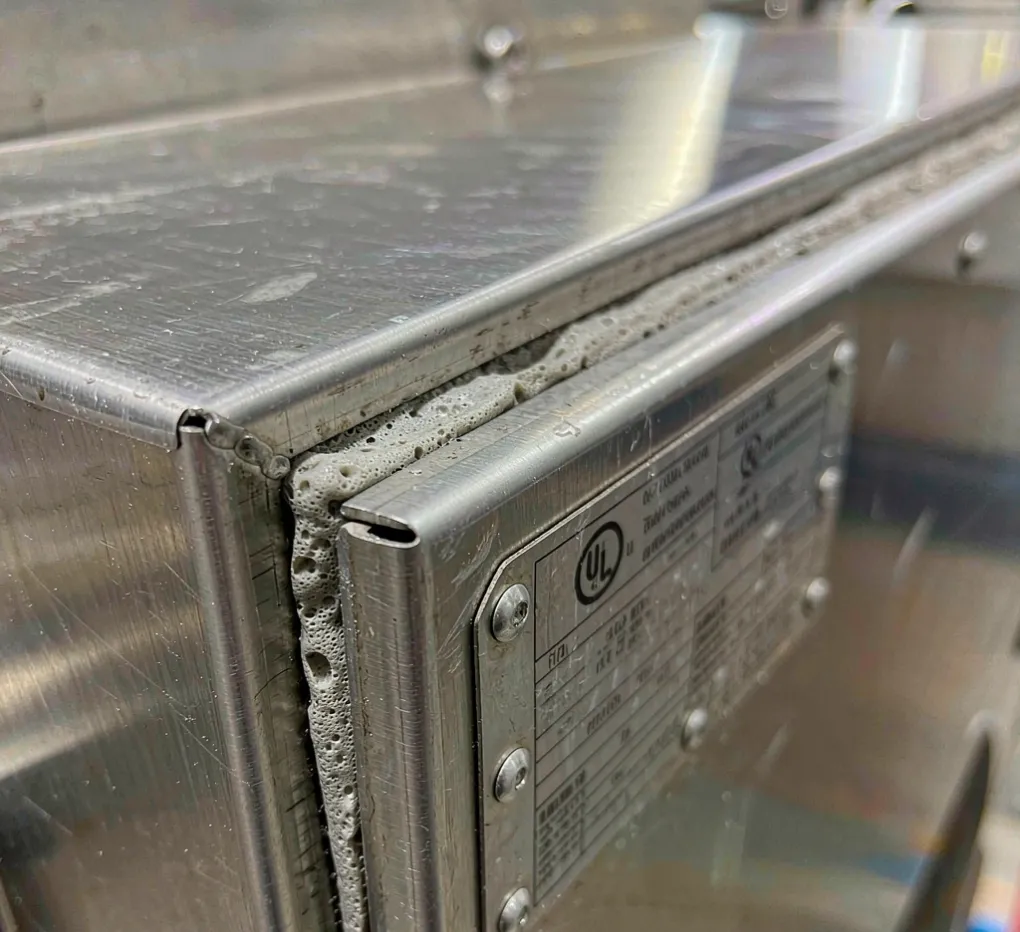
The bigger mistake is the type of gasket. A strip gasket pressed into a channel can lift at the corners over time. A foamed-in-place (PU or silicone) gasket bonds to the door and keeps a continuous seal — that's what you want on a real 4X enclosure. Ask which one you're getting; a supplier who can't answer is using whatever was cheapest.
5. Self-declared NEMA 4X vs UL 50E listed — what survives an AHJ
For North America, the question that ends arguments is simple: does the enclosure carry a UL 50E listing (or cUL), or is the supplier just calling it NEMA 4X?
A UL 50E listing means a third party tested the enclosure type to the standard and the shop is under follow-up surveillance. That's what an AHJ and an insurer accept without a fight. A self-declared "NEMA 4X" enclosure has no such backing — if it's challenged, the burden is on you to prove it, usually after the panel is already built and late.
Engineering Note: If your enclosure goes into a UL 508A panel or a site under ANSI/NEC enforcement, get the 50E listing number and verify it on UL's database. For a one-off or a non-listed assembly, you can arrange a UL-listed build per project — that's a different (and valid) path, but it has to be specified up front, not after the fact.
We don't own a line, so for UL 50E we match your drawings to a listed fabricator and manage the build, inspection, and packing. The verification steps are the same whether you go direct or through a partner. See UL-listed electrical enclosures from China: the sourcing path for the per-project route.
6. Guangdong vs Zhejiang: which cluster fits your order
China's NEMA 4X value chain splits roughly into two clusters, and the right one depends on your order shape.
Guangdong — Foshan, Shenzhen, Dongguan — leads on volume and export logistics. Foshan in particular is dense with sheet-metal fabricators who do stainless enclosures and complete panel assembly under one roof, which is why most export buyers land here. Lead times are shorter and the freight handoff to a Shenzhen or Guangzhou port is straightforward.
Zhejiang — Ningbo, Wenzhou — leads on precision finish and material traceability. The welding and surface quality out of that cluster is strong for mid-to-high-end enclosures, but if you're south-China based the logistics add a day or two and a bit of cost.
Buyer Decision: Standard and semi-custom enclosures at low MOQ with fast export? Guangdong. Heavily engineered, finish-critical builds where material certs are the priority? Zhejiang is worth the extra logistics. Mixed or repeating programs across both? That's where a partner with feet in both clusters earns its margin.
7. One shop or a sourcing partner?
The structural question behind every shortlist: do you contact one fabricator directly, or work through a sourcing partner who runs the comparison and the inspection for you?
If you have one enclosure, drawings locked, volume steady, and you've already vetted the shop — going direct is fine. The model breaks when any of those isn't true: low MOQ across several projects, mixed materials, a shop whose capacity is full that week, or a build you can't physically inspect before it ships.
A sourcing partner gives you one accountable contact, compares multiple Foshan and Zhejiang shops on price and lead time, and inspects before shipment. The trade-off is real and we'll state it plainly: a partner coordinates suppliers rather than owning the line, so you're buying coordination and verification, not a single factory's brand. For buyers who need MOQ from 5 units, about a 15-day lead, and one throat to choke when something's wrong, that trade is usually worth it.
Factory-direct vs sourcing partner — which fits your order
Your situation | Better path | Why |
|---|---|---|
One enclosure, drawings final, shop already vetted | Factory-direct | No coordination overhead; you already trust the build |
MOQ 5–20 across several projects | Sourcing partner | One shop won't flex; partner spreads the risk |
Mixed 304 / 316 / carbon in one program | Sourcing partner | Different shops are better at different materials |
UL 50E required, tight timeline | Sourcing partner (listed shop) | Partner finds a listed fabricator and manages the paperwork |
High-volume repeat, single spec | Factory-direct | Volume justifies owning the supplier relationship |
Can't inspect at the factory | Sourcing partner | Inspection and FAT happen before your money leaves |
The 5-step verification checklist (do this before PO)
- Pull the UL 50E / cUL listing number and verify it on UL's database — confirm it's current and covers your enclosure type.
- Get the material mill certificate naming 304 or 316 by ASTM grade. "Stainless" in the quote is not evidence.
- Pin the gasket spec in writing — silicone vs EPDM, and foamed-in-place vs strip. Match it to your environment.
- Ask for a salt-spray test report (ASTM B117) if the duty is coastal, chemical, or wastewater. No report, no coastal order.
- Request a photo or sample of a similar build before full PO. A shop confident in its finish will send one without hesitation.
For the full document set we send with every enclosure RFQ, see our Enclosure RFQ checklist and the gasket selection guide.
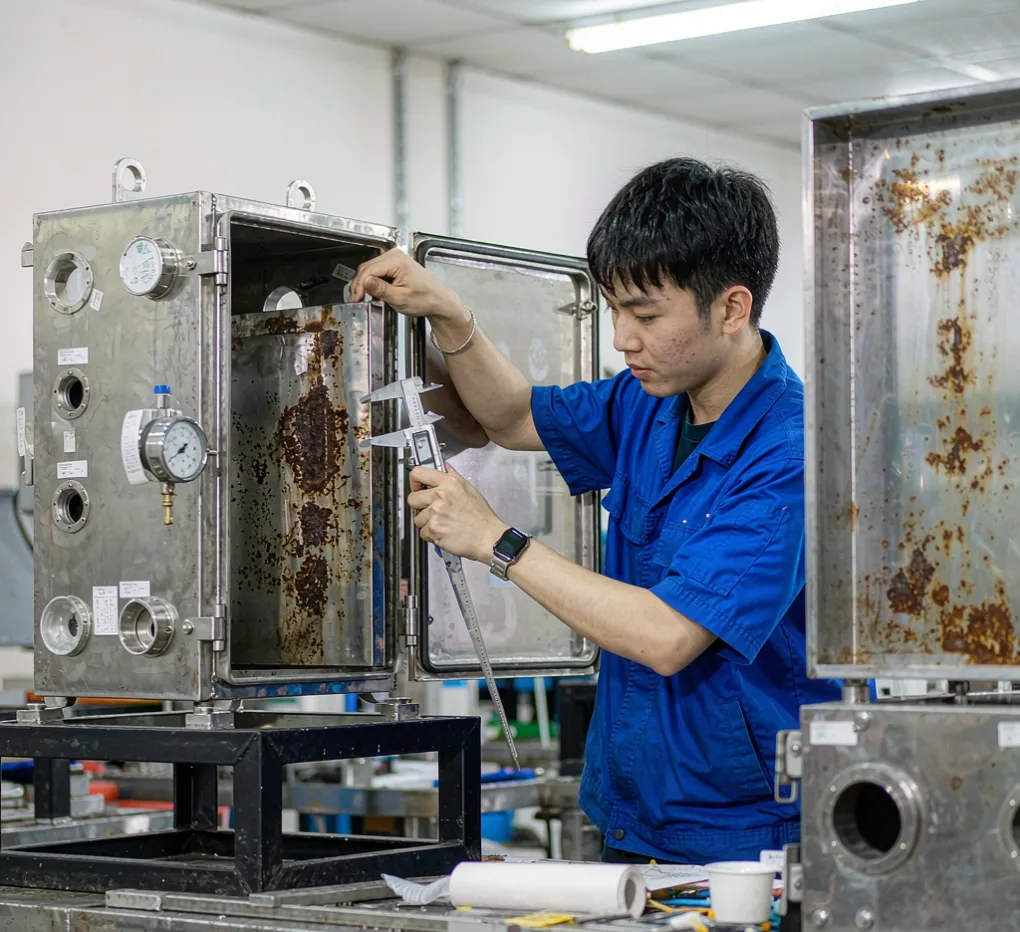
A real build we stopped at FAT
Here's what this checklist catches in practice. Last quarter a buyer sent us drawings for twelve 4X enclosures for a coastal wastewater retrofit. The first quote came back roughly 30% below the others. On paper it ticked every box: 316 stainless, NEMA 4X, full documentation.
At FAT — before a single unit shipped — three things were wrong. The mill certificate covered the sheet stock but not the door panels. The gasket was a strip EPDM glued into the channel, with visible gaps at both top corners. And the hinge screws were plain carbon steel, which would have bled rust streaks down a "316" door within one season.
None of that shows up in a price comparison. All of it shows up in year one. We moved the build to a second fabricator with a foamed-in-place silicone gasket and a cert pack that covered every panel, and the shipment left six days behind the original schedule — which is still cheaper than discovering any of this after installation, on a site that's a flight away.
Buyer Decision: The 30%-cheaper quote is where the risk usually hides, because the savings come from somewhere: material grade, gasket, or the inspection step itself. If a quote can't explain its own price, the checklist above is how you find out.
The full pre-shipment routine we run on every outdoor enclosure is written up in what we check before delivering an outdoor electrical enclosure.
Frequently Asked Questions
Where are most NEMA 4X enclosures made in China? Guangdong (Foshan, Shenzhen, Dongguan) leads on volume and export logistics; Zhejiang (Ningbo, Wenzhou) leads on precision finish and material traceability. Together they cover most export supply.
Is it safe to source NEMA 4X enclosures from China for North America? Yes, if the shop holds UL 50E / cUL or you arrange a UL-listed build per project, and you verify material certs and gasket rating. Many export enclosures are built to UL 50E and IEC 60529 side by side.
IP66 or NEMA 4X — which do I actually need? If the spec says NEMA 4X (common under NEC/ANSI enforcement, coastal, or chemical duty), IP66 alone won't satisfy it — IP66 has no corrosion or ice test. If the environment is indoor and non-corrosive, IP66 may be all you need. Match the rating to the duty, not the price.
304 or 316 stainless for my enclosure? 304 for most inland and mild outdoor duty. 316 when the enclosure faces saltwater, wastewater, or chemical splash — the molybdenum stops pitting. Always require the mill cert; don't accept "stainless" as the grade.
What is a realistic MOQ and lead time? Standard boxes can start at 1–5 units; custom build-to-print typically runs MOQ 5+ with about 15–25 days after drawings are confirmed. Component-only shipments from our distribution side move in 3–5 days, but that's a different line.
Why use a sourcing partner instead of contacting a factory directly? One accountable contact, multi-shop price and lead-time comparison, and inspection before shipment — useful when you need low MOQ, mixed materials, or several enclosures across projects. You're buying coordination and verification, not a single shop's brand.
How do I stop a supplier swapping 201 for 304 stainless? Require the mill test certificate naming the ASTM grade and cross-check the heat number. A supplier who won't provide it is telling you what they're shipping.
Does UniRegal manufacture NEMA 4X enclosures? No. We're a sourcing partner: we match your drawings to vetted Foshan and Zhejiang fabricators, then manage spec review, build-to-print manufacturing, inspection, and export packing. The verification steps above are exactly what we run before your panel ships.
Engineering Takeaway
NEMA 4X is a spec, not a stamp. The enclosures that survive a coastal site and an AHJ inspection are the ones built to the rating — 304/316 with a mill cert, a silicone foamed-in-place gasket, and a UL 50E listing where North America requires it — not the ones with "NEMA 4X" silk-screened on the door. Verify the four things that fail (material grade, gasket, listing, salt-spray), and decide factory-direct vs partner on your actual order shape, not on which shortlist looked longest.
Send us your drawings, I/O list, or BOM. Our engineers review it against these checks before quotation and respond within 24 hours — submit your requirements.
Related guides
- NEMA vs IP ratings: what's the difference — the rating swap that fails inspections, explained.
- NEMA 4 vs NEMA 4X: what the X buys you — corrosion, hose-down, and ice, line by line.
- 304 vs 316 stainless for outdoor enclosures — when 316 actually pays for itself.
- Enclosure gasket selection (silicone vs EPDM) — the seal that decides whether your 4X box stays 4X.
- UL-listed electrical enclosures from China: the sourcing path — the per-project listed-build route.
- Top 10 electrical enclosure types — which form factor fits which duty.