
Oct 6, 2026Buying Guides
Top 10 Electrical Enclosure Types: How to Choose the Right Cabinet for Your Application
Ten enclosure types compared for buyers: wall-mount, floor-standing, bayed lineups, consoles, washdown stainless, outdoor kiosks, pole-mount and RTU enclosures — with a decision matrix, material pairi
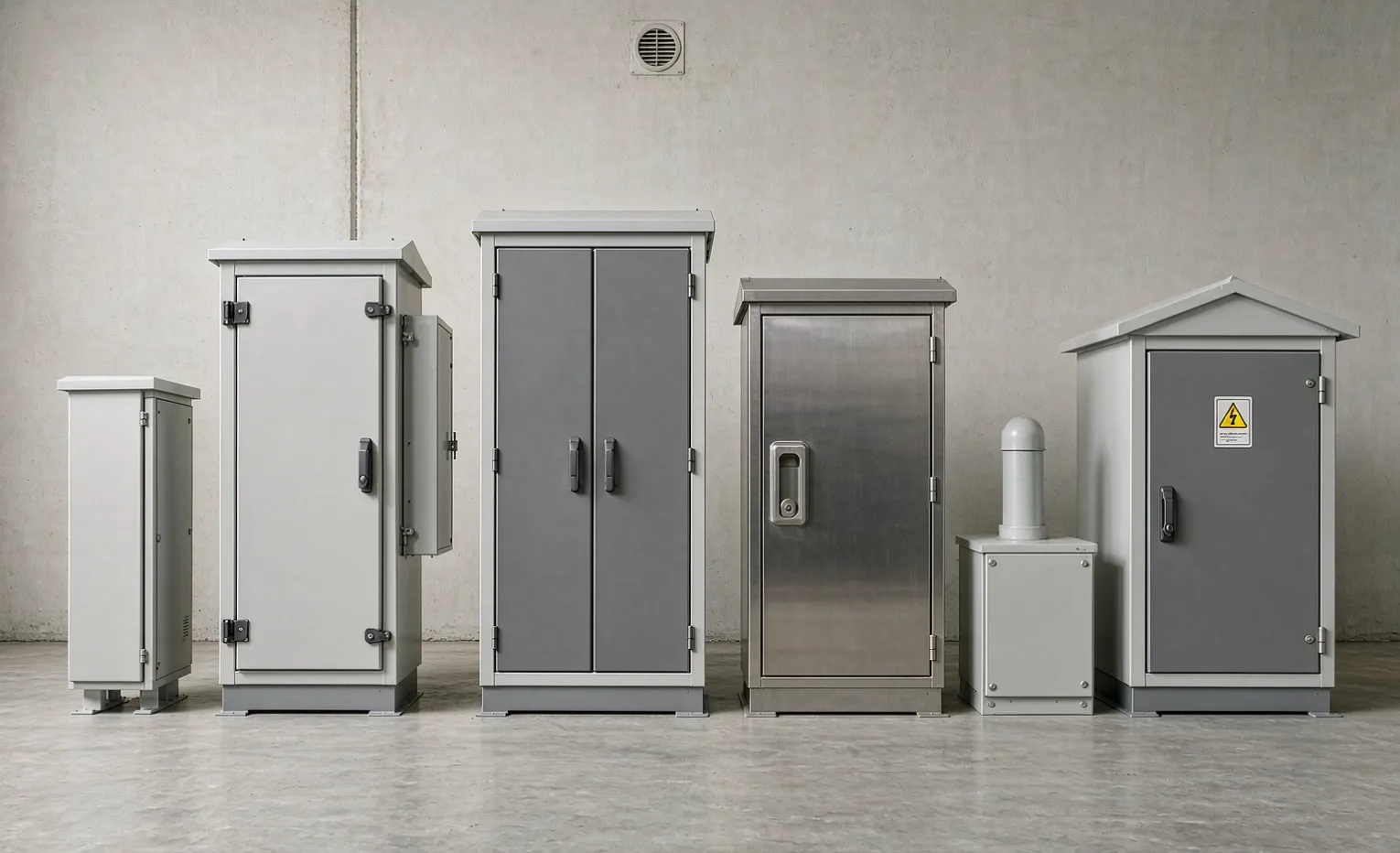
Electrical Enclosure Engineering Series (1): Choosing the enclosure type
You are standing in front of a wall with a drawing in your hand, and the specification just says "electrical enclosure, IP65, 800×600." That line has cost more projects more money than almost any other sentence in an electrical schedule. Because "IP65, 800×600" describes a box — it does not describe the job.
The enclosure type you pick determines whether a technician can terminate a cable without contorting, whether the back plate fits the drives you actually bought, whether the door still seals after two summers, and whether the whole thing can be replaced without shutting down the line. Get the type wrong and every downstream cost — installation labour, heat management, spare parts, downtime — goes up.
This guide walks through the ten enclosure types that cover the overwhelming majority of industrial and infrastructure projects, with the decision logic behind each. It is written for the person who has to sign the purchase order: system integrators, MRO buyers, panel builders and project procurement teams.
Who is writing this, and why the comparison is useful to you
We are Uni Regal, a China-based industrial automation supplier and sourcing partner. We are not the brand on the enclosure door — and that is precisely why this comparison is worth reading. Because we source enclosures, panels and components across several production partners around Foshan, we see how these designs behave after delivery: which gasket compounds take a set and leak, which door hardware loosens after a year of vibration, which finishes chalk in coastal sun, which mounting plates flex when you load them with drives.
Read this as an engineering comparison, not a catalogue. Where a type is a poor fit for a specific environment, we say so.
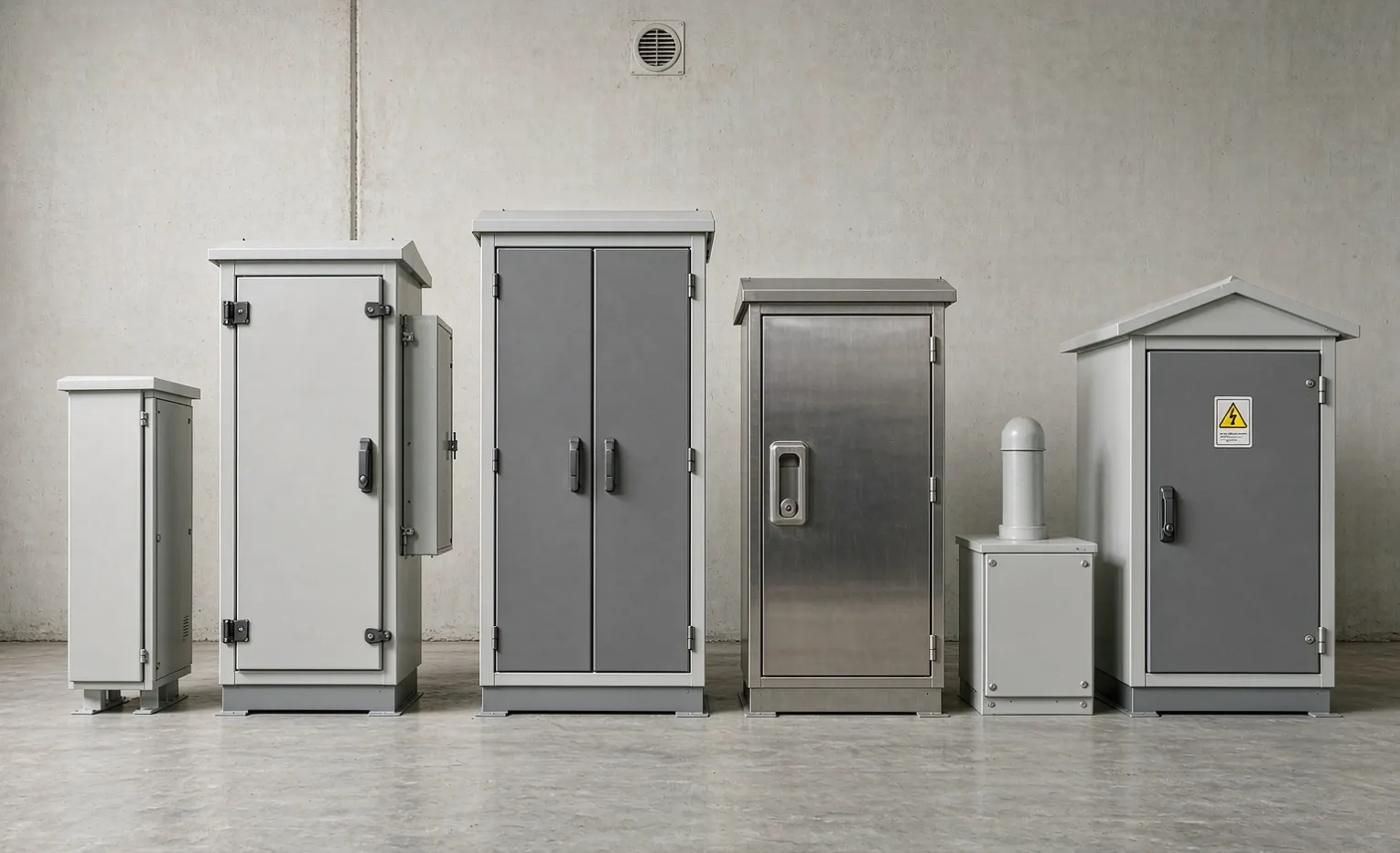
Start with four questions, not with a catalogue
1. Where does it physically live?
Indoor, dry and climate-controlled is the easy case. Everything else changes the specification:
- Outdoor, exposed: rain, direct sun, dust, and — most underestimated — solar heat load and condensation cycling.
- Outdoor, sheltered: under a canopy or eaves. You can often drop a rating grade, but not the drainage and ventilation thinking.
- Washdown: food, beverage, pharmaceutical. Daily high-pressure, high-temperature, caustic cleaning. This is a different design discipline, not a higher IP number.
- Coastal / chemical: salt-laden or chemically aggressive air. Material choice dominates, not ingress rating.
2. What goes inside it?
Heat is the number one reason an enclosure specification fails in the field. A cabinet full of VFDs and power supplies is a heater; a cabinet with four terminal blocks and a small PLC is not. If the internal dissipation is more than a few hundred watts, the enclosure type you choose must have physical room for thermal management, and you should decide that before you order, not after the first thermal trip.
3. How will it be mounted and serviced?
- Is there a structural wall, or only a concrete pad?
- Can a technician open the door fully and stand in front of it, or is it in a corridor?
- Does the equipment need front access only, or rear access for cabling?
- Will it ever need to move?
4. What must survive around it?
Ingress rating (IP per IEC 60529, NEMA 250 per nema.org), impact resistance, UV exposure, corrosion class, and — if the end client demands it — a listing mark such as UL 50E for the enclosure itself or UL 508A for the assembled panel.
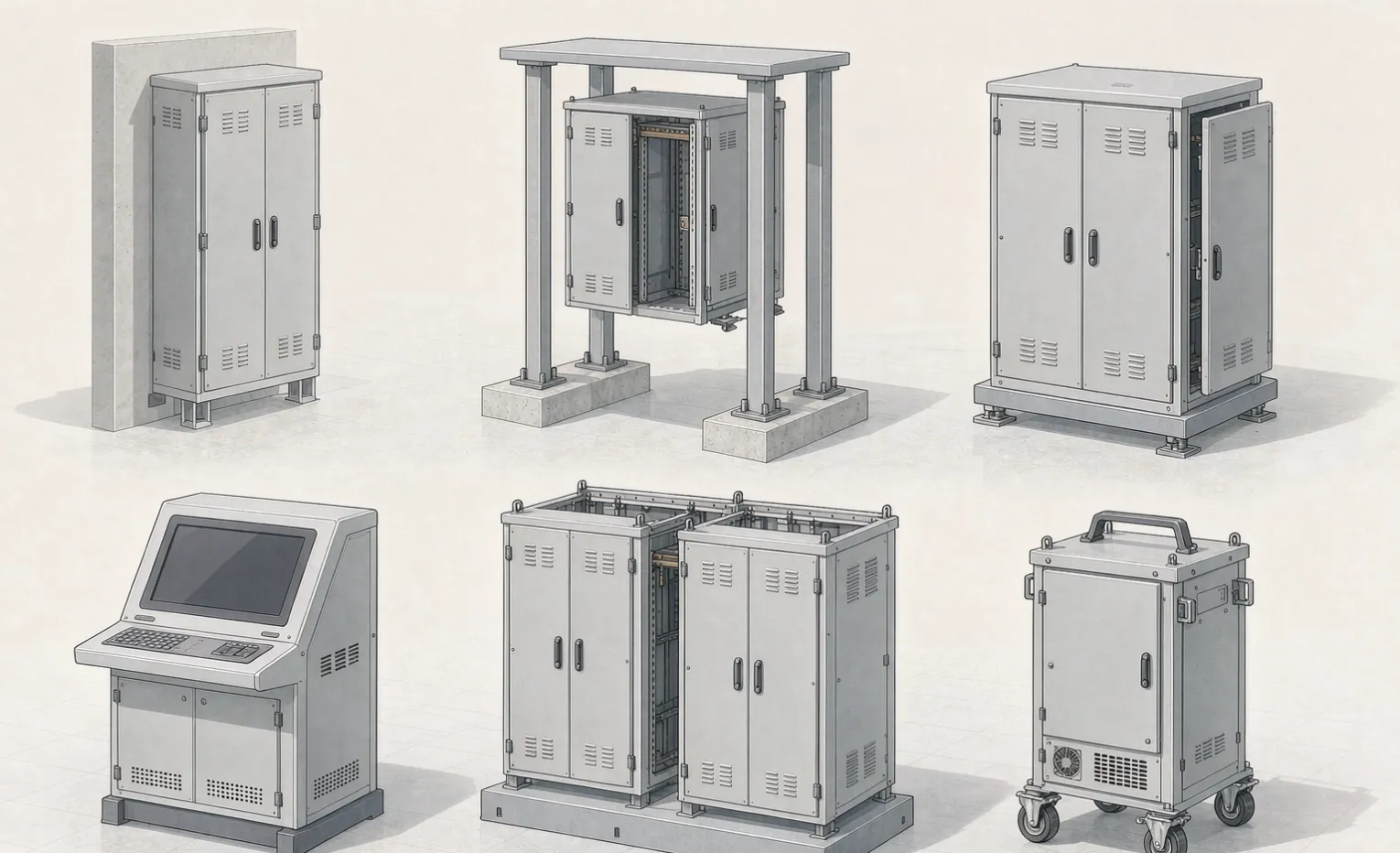
The decision matrix
Use this table to shortlist. Then read the detailed section for the two or three types that survive.
# | Enclosure type | Best environment | Typical rating | Typical material | Common size range | Choose it when | Watch out for |
|---|---|---|---|---|---|---|---|
1 | Wall-mount, single door | Indoor / sheltered outdoor | IP65 / NEMA 4 | Carbon steel, powder coated; 304 | 300×300 to 800×600 mm | Space is tight, load is light (PLC, relays, small drives) | Depth. A 250 mm deep box fits the PLC but not the cable bend radius |
2 | Wall-mount, double door | Indoor, wide back plates | IP65 / NEMA 4 | Carbon steel, powder coated | 800×600 to 1200×800 mm | You need a wide mounting plate but cannot give up floor space | Wall structure. A loaded 1200 mm cabinet is heavy; verify fixing points |
3 | Junction / terminal box | Indoor or outdoor | IP66 / IP67 / NEMA 4X | ABS, polycarbonate, 304/316 | 100×100 to 400×400 mm | Termination, marshalling, instrument heads, small field I/O | UV on plastic. Unstabilised ABS chalks outdoors in two years |
4 | Floor-standing, single door | Indoor / plant room | IP54–IP65 / NEMA 12–4 | Carbon steel, powder coated | 1600×600 to 2000×800 mm | Large component count, single lineup, front access | Shipping and rigging. A 2 m cabinet does not fit every lift |
5 | Bayable floor-standing lineup | Indoor, MCC and distribution | IP54–IP65 | Carbon steel, powder coated | 600–1200 mm bays, combined | Multiple functional sections, future expansion, busbar systems | Bay-to-bay sealing and busbar rating coordination |
6 | Operator console | Indoor, operator areas | IP54 / NEMA 12 | Carbon steel or 304 | Custom | HMI and controls at working height, sloped top | Ergonomics and cable entry from below |
7 | Stainless washdown | Food, beverage, pharma | IP66 / IP69K / NEMA 4X | 316 stainless (304 in mild areas) | 400×400 to 1200×800 mm | Daily high-pressure caustic cleaning | Gasket and gland material. The box survives; the seals often do not |
8 | Outdoor environmental kiosk | Exposed outdoor | IP65 / NEMA 4X, sometimes NEMA 3R | 304/316, galvanized, double-wall | Custom, often 1200 mm+ | Sun, rain, dust, and heat load at remote sites | Solar load, condensation, and thermal management volume |
9 | Pole-mount / pedestal | Roadside, telecom, remote | IP65 / NEMA 4X | Galvanized, 304, aluminium elsewhere | 400×600 to 800×1000 mm | No wall, no pad; traffic, telemetry, small RTU | Vibration, tamper resistance, pole clamp compatibility |
10 | Instrument & RTU enclosure | Remote well sites, pipelines | IP65 / NEMA 4X, solar-ready | 304/316, galvanized | 600×600 to 1200×800 mm | Low-power instrumentation, battery/solar, telemetry | Power budget, sun shield, sealing after repeated field access |
The ten types in detail
1. Wall-mount, single door — the default, and the most overspecified
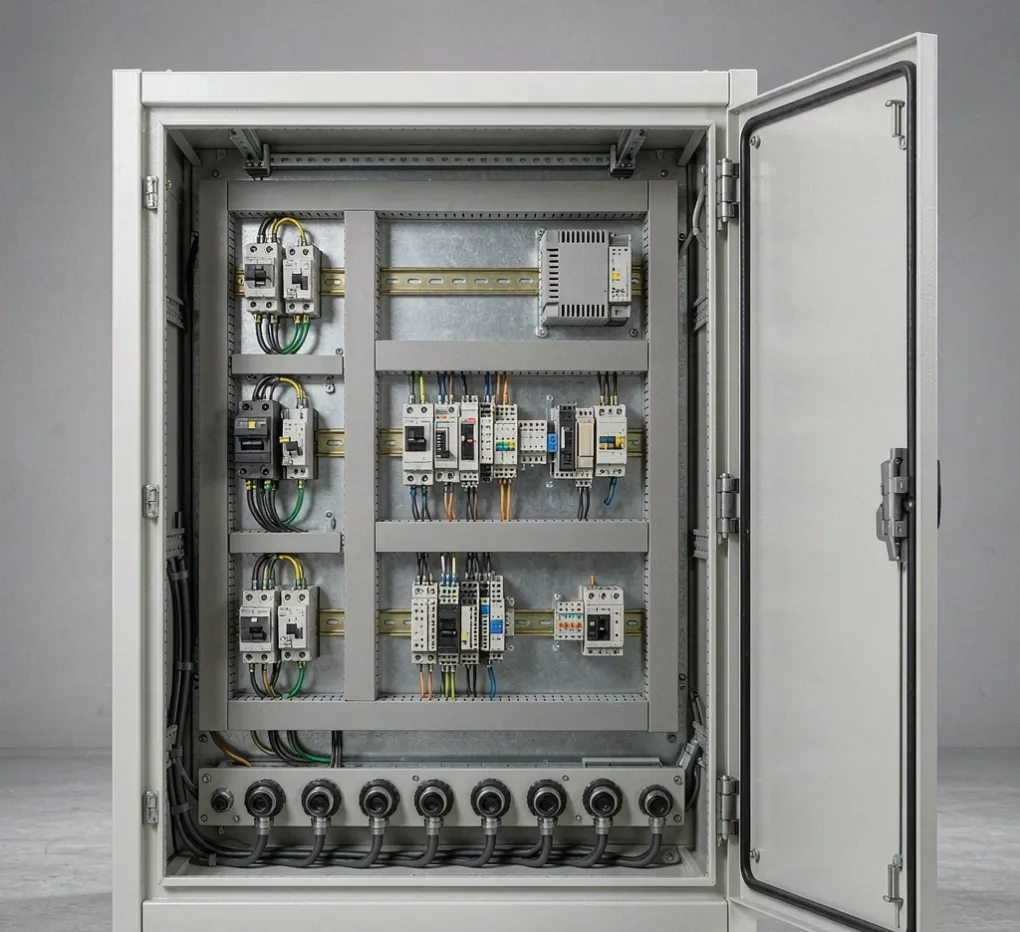
The workhorse. Single door, hinged on the left or right, mounting plate or DIN rails inside, cable entry usually through the bottom via gland plates.
Choose it when your component count fits comfortably and you have a structural wall. It is the cheapest installed option and the fastest to source.
The two specification traps:
- Depth, not height, is what kills you. Buyers specify width × height and forget depth. Then the VFD needs 200 mm of clearance, the cable bend radius needs another 150 mm, and the door will not close. Always spec the deepest component plus bending space, then add 50 mm.
- Weight on the wall. A 800×600×250 cabinet loaded with contactors and a transformer can exceed 80 kg. Check the wall is structural, not partition board.
Buyer Decision — if your heat dissipation exceeds roughly 150 W in a wall-mount box, you are already shopping for a filter fan or a small enclosure air conditioner. Price that in at specification stage, not after commissioning.
2. Wall-mount, double door — width without floor space
A wide back plate in a shallow footprint, with two doors meeting in the middle and often a removable centre post. Useful when you have a long wall and no floor to spare — machine-side control, conveyor lines, packaging equipment.
Watch for: wall fixing. The load is spread across a wider span, and the fixing pattern must land on structure. Also check door swing clearance: two doors opening into a narrow aisle is a maintenance problem.
3. Junction and terminal boxes — small, but they fail the most
Marshalling, instrument termination, field junction points. Usually the least specified and most frequently replaced item on a site.
Material matters more than size here. In outdoor service, specify UV-stabilised polycarbonate or stainless — plain ABS degrades. In coastal air, 316 beats 304. The seal is the failure point: a box rated IP66 loses that rating the first time a gland is installed without a sealing washer, or a cover screw is left hand-tight.
Engineering Note — the ingress rating printed on the datasheet applies to the box as delivered. It does not survive a badly drilled cable entry. On site, most "IP66 failures" are gland and conduit joint failures, not enclosure failures.
4. Floor-standing, single door — front access, big loads
The standard plant-room cabinet. Full-height, mounting plate, often with a plinth for cable entry from below. Handles MCC sections, large PLC and I/O counts, distribution, and drives to a few hundred kilowatts.
Specify the plinth. A 100 mm plinth makes bottom cable entry workable and keeps the enclosure off a wet floor. Retrofitting one later is not possible.
Plan the lifting path. A 2000×800×600 loaded cabinet is a two-person-plus-equipment move. Confirm door widths, corridor turns, and lift capacity before ordering — we have seen perfectly good cabinets stuck in a plant room doorway.
5. Bayable floor-standing lineups — when one cabinet is not enough
Multiple bays bolted together, sharing a busbar system or segregated into functional sections (incoming, motor starters, PLC, field marshalling). This is the motor control centre (MCC) territory.
The two decisions that matter:
- Form of separation. How much you segregate busbar from functional units from terminals drives both safety and cost. Be explicit about it in the RFQ.
- Future bays. If expansion is likely, order the busbar system rated for the final lineup, not the current one. Adding a bay with a higher-rated busbar later usually means replacing the whole run.
Buyer Decision — bayable lineups are where a vague specification costs the most. Two quotes can differ by 40% and both be "correct," because one assumed full separation and the other assumed none.
6. Operator consoles — ergonomics as an engineering requirement
Sloped or desk-type enclosures that put an HMI and control devices at working height, typically with a sloped top surface, a vertical front panel, and a rear or bottom cable entry. Used in plant control rooms, machine operator stations, and test benches.
Specify: screen cut-out dimensions (and the cut-out protection rating after cutting — an unsealed cut-out drops the front-face rating), viewing angle, and whether the operator stands or sits.
7. Stainless washdown — a discipline, not a material code
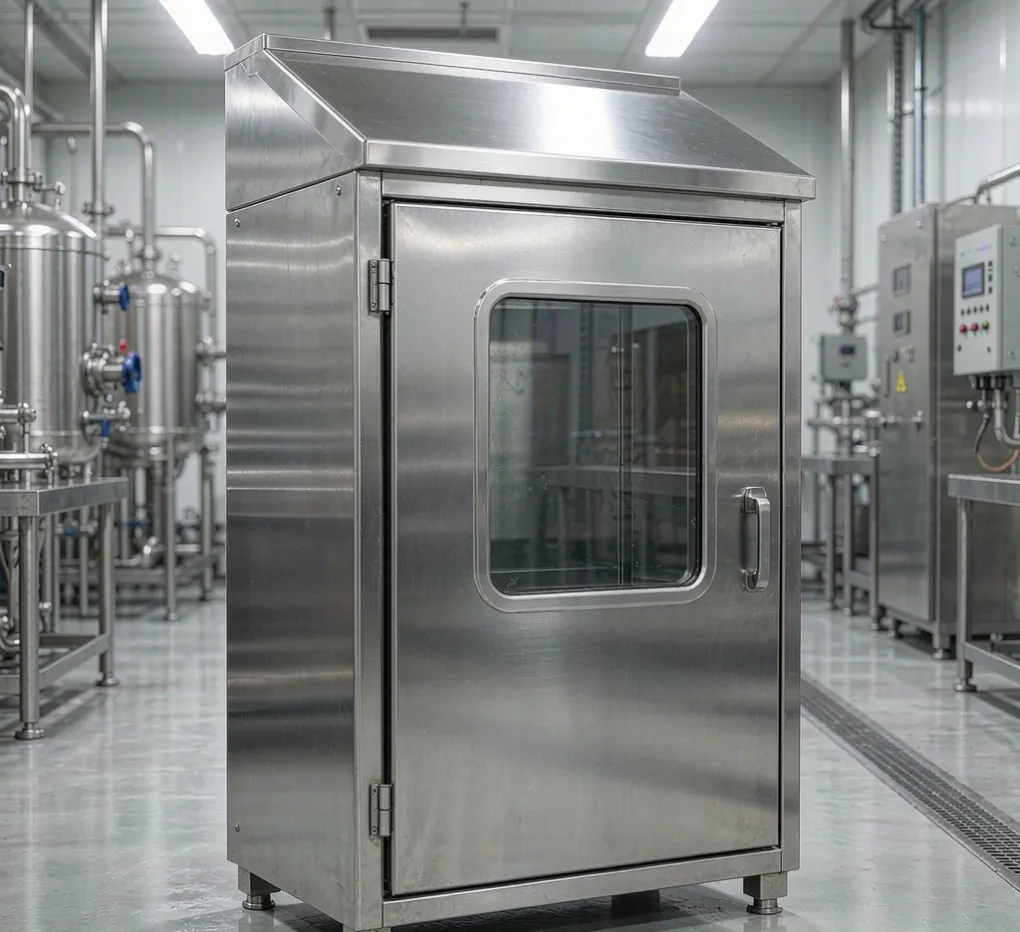
Food, beverage, dairy, pharmaceutical. The enclosure is cleaned daily with high-pressure, high-temperature water and caustic or chlorine-based agents. IP69K-rated designs tolerate close-range, high-temperature spray.
What actually fails: not the steel. It is the gasket (silicone and EPDM behave very differently in caustic wash), the cable glands (a plastic gland becomes brittle), the hinge and latch material, and any crevice where product residue can sit.
Design details that matter more than the material grade: - Sloped top so water and residue run off, never pool. - No horizontal ledges or exposed threads on the exterior. - Standoff mounting so the back can be cleaned and drains freely. - Smooth, continuous gasket with no joins at corners where possible.
Engineering Note — 316 is worth the premium over 304 when chlorides are present: cleaning agents, brine, coastal air. 304 in a washdown environment with chloride-based sanitiser will pit at the welds and around fasteners, usually within 18 months.
8. Outdoor environmental kiosk — the hardest case
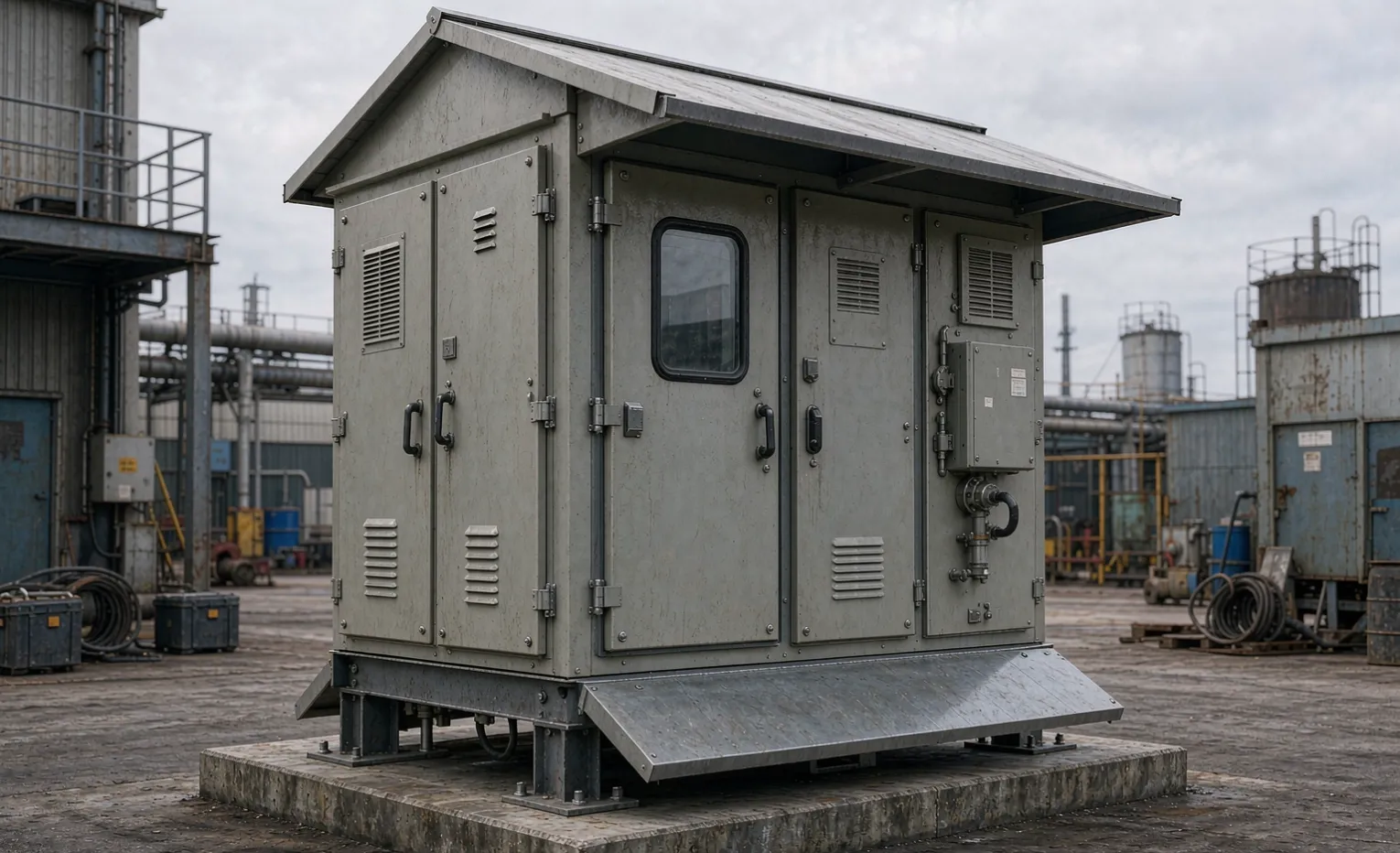
Exposed to rain, sun, dust, and temperature swing. This is where enclosure selection most often goes wrong, because buyers specify the ingress rating and stop there.
Three enemies, in order:
- Solar heat load. A dark cabinet in direct sun can sit 20 °C above ambient before you add internal dissipation. A sun shield, a light external finish, and — for high loads — a double-wall design are not cosmetic upgrades.
- Condensation. Day/night cycling pulls humid air in through any breathing point and condenses on cold internal surfaces. Drains and breathers are part of the design, not accessories. Corrosion and condensation problems are covered in detail in our guides on outdoor cabinet materials and condensation control.
- Water sitting on the roof. Flat roofs pool. A sloped roof and a drip edge cost little and prevent years of trouble.
Ground-level kiosks need a pad. A concrete plinth keeps the base dry and provides a sealed cable entry path.
9. Pole-mount and pedestal enclosures — when there is no wall and no floor
Traffic signal control, roadside telemetry, distributed instrumentation, small remote I/O. Mounted on a pole or a short pedestal.
Specify: pole diameter range and the clamp type (a bracket that fits one pole size is a common procurement error), vibration resistance, and tamper resistance — a hinge that can be lifted off its pin is a security problem, not just an ingress problem.
10. Instrument and RTU enclosures — remote sites with no grid power
Remote well sites, pipeline monitoring, water and wastewater telemetry. Low-power instrumentation, often battery-backed with solar, communicating by radio or cellular.
What drives the design: power budget first, then heat. Because there is no grid supply, every watt of heater or cooling has to come from somewhere. Passive design — light colour, sun shield, ventilation with insect and dust screening — usually beats active cooling here.
Enclosure selection for these sites interacts closely with the panel inside; see our RTU panel selection guide for the system-level view.
Material and rating pairing
Environment | Recommended material | Typical rating | Finish / protection |
|---|---|---|---|
Indoor, dry, climate-controlled | Carbon steel | IP54 / NEMA 12 | Powder coat, RAL 7035 typical |
Indoor, dusty or humid | Carbon steel or 304 | IP65 / NEMA 4 | Powder coat + gasket |
Outdoor, sheltered | Carbon steel or galvanized | IP65 | Powder coat, sloped roof |
Outdoor, fully exposed | 304 stainless or galvanized + coating | IP65 / NEMA 4X | Light colour, sun shield, drain/breather |
Coastal / marine | 316 stainless | IP66 / NEMA 4X | Gasket and hardware in 316 |
Washdown, food/pharma | 316 stainless | IP66 / IP69K | Sloped top, standoff, caustic-rated gasket |
Chemical plant | 316 stainless or coated galvanized | IP66 | Confirm chemical compatibility of gasket |
Remote/telemetry | Galvanized or 304 | IP65 / NEMA 4X | Light colour, passive ventilation |
Engineering Note — we work in carbon steel, 304 stainless, 316 stainless and galvanized steel. Aluminium is not part of our standard supply programme; if a specification calls for it, that is a separate sourcing conversation.
What drives cost and lead time
Enclosure pricing is far less sensitive to size than buyers expect, and far more sensitive to these five things:
Driver | Impact on price | Impact on lead time |
|---|---|---|
Material grade (carbon → 304 → 316) | High | Low to moderate |
Custom size vs standard size | Moderate | High — custom means a new build cycle |
Rating and sealing complexity (IP69K, double-wall) | Moderate to high | Moderate |
Finish (standard powder coat vs marine-grade system) | Moderate | Moderate |
Certification requirement (UL listing per order) | Moderate | High — documentation and, where required, listed production |
For reference, on our standard cabinet programme the minimum order is 5 units and typical build time is around 15 days; control components and spare parts from our distribution range ship in 3–5 days. Custom sizes and third-party listing requirements are the two things that reliably push a delivery date, so raise them at RFQ stage.
Engineering Takeaway
- Specify the job, not the box. Environment → internal heat → access → rating → material, in that order.
- Depth is the most commonly forgotten dimension. Deepest component plus cable bend radius plus 50 mm.
- Outdoor is a thermal and condensation problem before it is a water problem. Sun shield, light colour, sloped roof, drain and breather.
- The seal fails before the steel does. Budget for gasket and gland quality in washdown, coastal and outdoor service.
- 316 over 304 wherever chlorides are present — cleaning agents, brine, or sea air.
- Decide the certification path early. A UL-listed requirement changes who can build it and how long it takes.
Frequently asked questions
What is the difference between IP65 and NEMA 4X? IP ratings (IEC 60529) cover dust and water ingress only. NEMA 250 ratings additionally address corrosion resistance, knockouts, and ice formation. NEMA 4X broadly corresponds to IP66 plus corrosion resistance — which is why 4X usually implies stainless or a corrosion-resistant coating, not just a gasket.
Can I use a wall-mount enclosure outdoors? Yes, if the rating, material and finish suit the exposure and you manage solar load and condensation. In practice, an exposed outdoor site is better served by a purpose-built outdoor design with a sloped roof, sun shield and drain provisions.
Is 316 always worth the premium over 304? No. In an inland, indoor, dry plant room, 304 is usually sufficient and 316 buys you nothing. 316 earns its premium where chlorides are present: coastal air, de-icing salt, brine, or chloride-based sanitisers.
How do I size thermal management? Start from total internal dissipation plus solar load. As a rough guide, once you are past a few hundred watts in a sealed outdoor cabinet, passive ventilation stops being sufficient and you are pricing filter fans or an enclosure air conditioner — which then needs physical space inside or on the door.
What should I specify if the end client requires UL? Say so in the RFQ, and say whether the requirement is for the enclosure (UL 50E) or the assembled control panel (UL 508A). This determines which production line can build it and lengthens the schedule, because documentation and listed components are involved.
What is your minimum order for custom enclosures? Five units on our standard cabinet programme, with roughly 15 days build time. Below that, we can usually work from a modified standard size rather than a fully custom build, which keeps both cost and schedule sane.
Need a second opinion before you order?
Send us your drawing, your single-line diagram, or even a photo of the installation site. Our engineers will run an enclosure review and come back with three things: a material and rating recommendation for your environment, a list of specification gaps that cause field failures, and a realistic lead time. You keep the review even if you buy elsewhere.
Related guides
Need help specifying or sourcing this for your project? Request a quote - we reply within 1-2 working days with a technical review.