
Sep 5, 2026Buying Guides
Buying a Motor & VFD Control Panel: RFQ Guide for Industrial Buyers
A motor and VFD control panel RFQ should include a motor list, starter type, VFD load, enclosure rating, cooling, brands, FAT, certificates, and documents before suppliers quote.
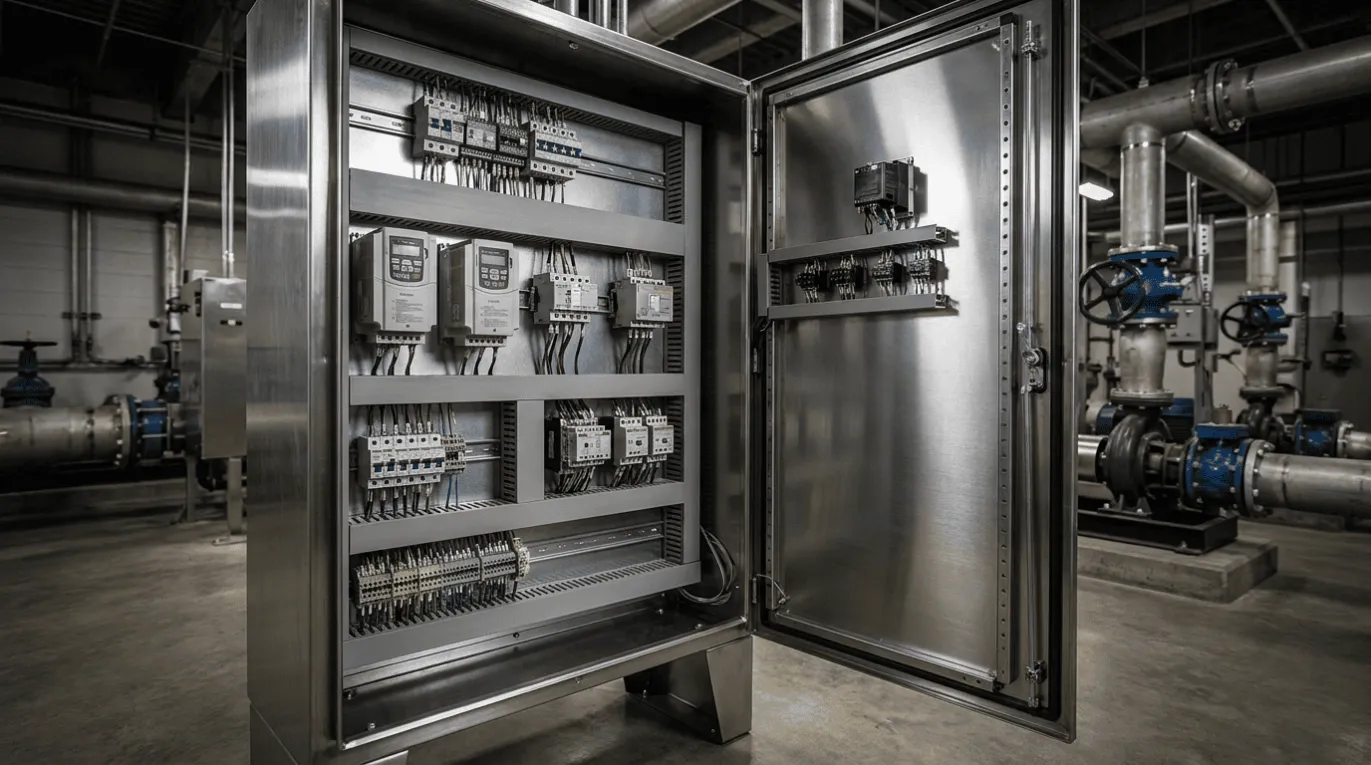
Buying a Motor & VFD Control Panel: RFQ Guide for Industrial Buyers
Three suppliers quoted the same motor list.
The prices differed by 40%.
None of them were quoting the same panel.
That is what often happens when a buyer sends only motor kW, voltage, and quantity. A motor list is useful, but it does not tell the supplier how each motor should start, whether VFD speed control is required, where the panel will be installed, how much heat the cabinet must remove, or which documents must arrive before shipment.
Most motor and VFD control panel RFQ problems are not only electrical. They are usually hidden in starter type, enclosure size, cooling, EMC protection, certificates, and documentation.
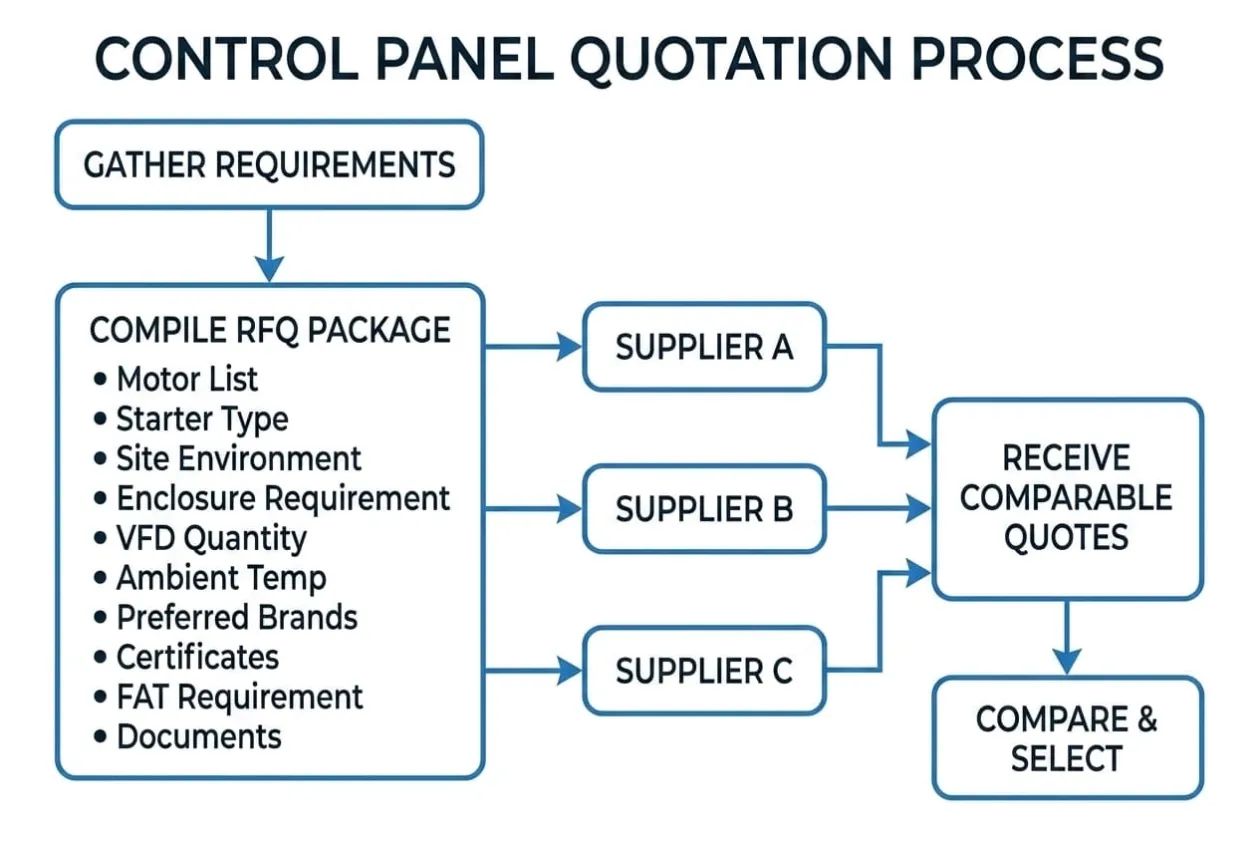
The short answer is this: before asking suppliers to quote, send the motor list, starter type, site environment, enclosure requirement, VFD quantity, ambient temperature, preferred brands, certificates, FAT requirement, and documents. That is how you get quotes you can compare instead of three suppliers guessing three different panels.
What a Motor / VFD Control Panel Usually Contains
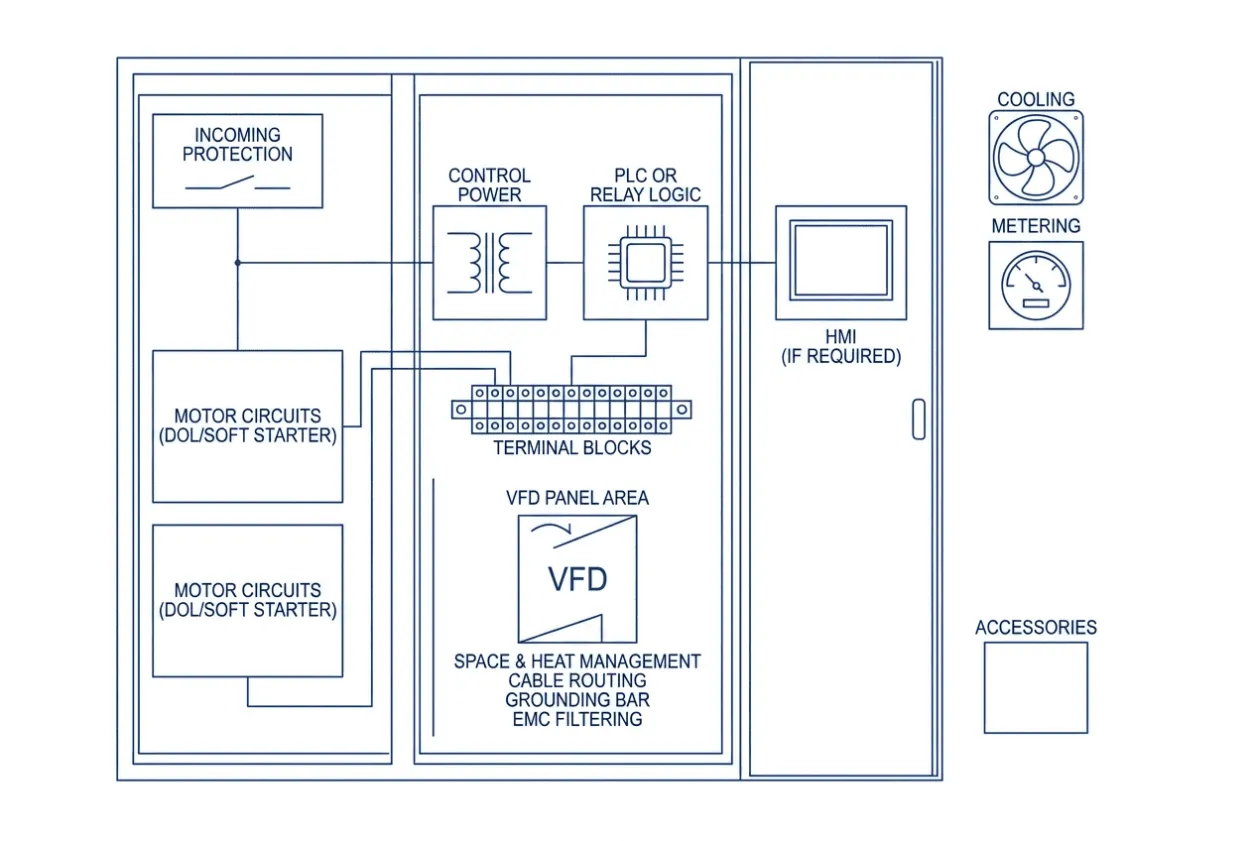
A typical motor control panel includes incoming protection, motor circuits, control power, PLC or relay logic, HMI if required, terminal blocks, cooling, metering, and accessories. With VFD panels, the design also needs space, heat management, cable routing, grounding, and sometimes EMC filtering.
From a buyer’s point of view, the important question is not “What components are inside?” The better question is
Did the supplier quote the panel my motors actually need?
A contactor-only panel and a VFD panel for the same motor kW are not the same purchase. One mainly switches the motor. The other controls speed, generates heat, needs clearance, and may require reactors, screened motor cables, better grounding, and a larger enclosure.
Step 1—Lock the Starter Type First
Every motor panel quote starts to change when the starting method changes. If this decision is unclear, suppliers cannot quote the same scope.
Starter Type | Buyer Use Case | What Changes in the Quote |
|---|---|---|
DOL | Small motors, simple start/stop | Lowest cost, higher inrush |
Star-delta | Medium motors, long running duty | Lower inrush than DOL, more wiring |
Soft starter | Pumps or conveyors needing a gentle start | Better ramp control, lower cost than VFD |
VFD | Pumps, fans, mixers, speed control | Higher cost, heat, cooling, EMC review |
If the motor needs variable speed, a VFD is normally the real choice. If it only needs a gentle ramp, a soft starter may be enough. Buyers can review the full comparison here: DOL vs star-delta vs soft starter vs VFD guide.
One small mistake I see often: the buyer asks for a VFD panel because “it sounds better,” but the process only needs soft start. That can add cost without adding much value. The opposite is worse: buying a soft starter when the process actually needs speed control.
Step 2—Size the Enclosure Around the Drives
A VFD panel should not be sized like a contactor panel. The drive needs airflow, clearance, and heat removal. If the enclosure is too small, the quotation may look cheaper, but the cabinet can become a little heavy after installation.
For buyers, this is the practical rule: do not only send motor kW. Send the number of VFDs, drive ratings, ambient temperature, indoor/outdoor location, and enclosure rating.
Buyer Sends | Supplier Can Decide |
|---|---|
Motor list | Starter size and protection |
VFD quantity and kW | Enclosure size and layout |
Ambient temperature | Cooling method |
Indoor / outdoor / dusty area | IP/NEMA rating and ventilation |
Future expansion | Spare space and terminal planning |
For dusty or outdoor sites, a simple louvered vent can create new problems. A filtered fan may work for indoor dry rooms. A heat exchanger or cabinet air conditioner may be needed for sealed or hot locations. The trade-offs are explained in our best cooling options for outdoor electrical cabinets guide.
Step 3 — Do Not Treat Heat as a Problem for Later
Most VFD trouble I have seen did not start with a bad drive. It started with a cabinet that was too tight, too hot, or too poorly ventilated.
A VFD generates heat while running. Put several drives inside a sealed cabinet, add summer ambient temperature, and the panel may run fine during FAT but trip during real production. That is why “fan included” is not a cooling calculation.
If the supplier does not ask about ambient temperature, total drive power, enclosure location, or whether the panel is sealed, I slow down. A cheap VFD panel that overheats is not a bargain. It is a service call waiting for a hot afternoon.
Step 4—Specify Protection, EMC, and Brands Clearly
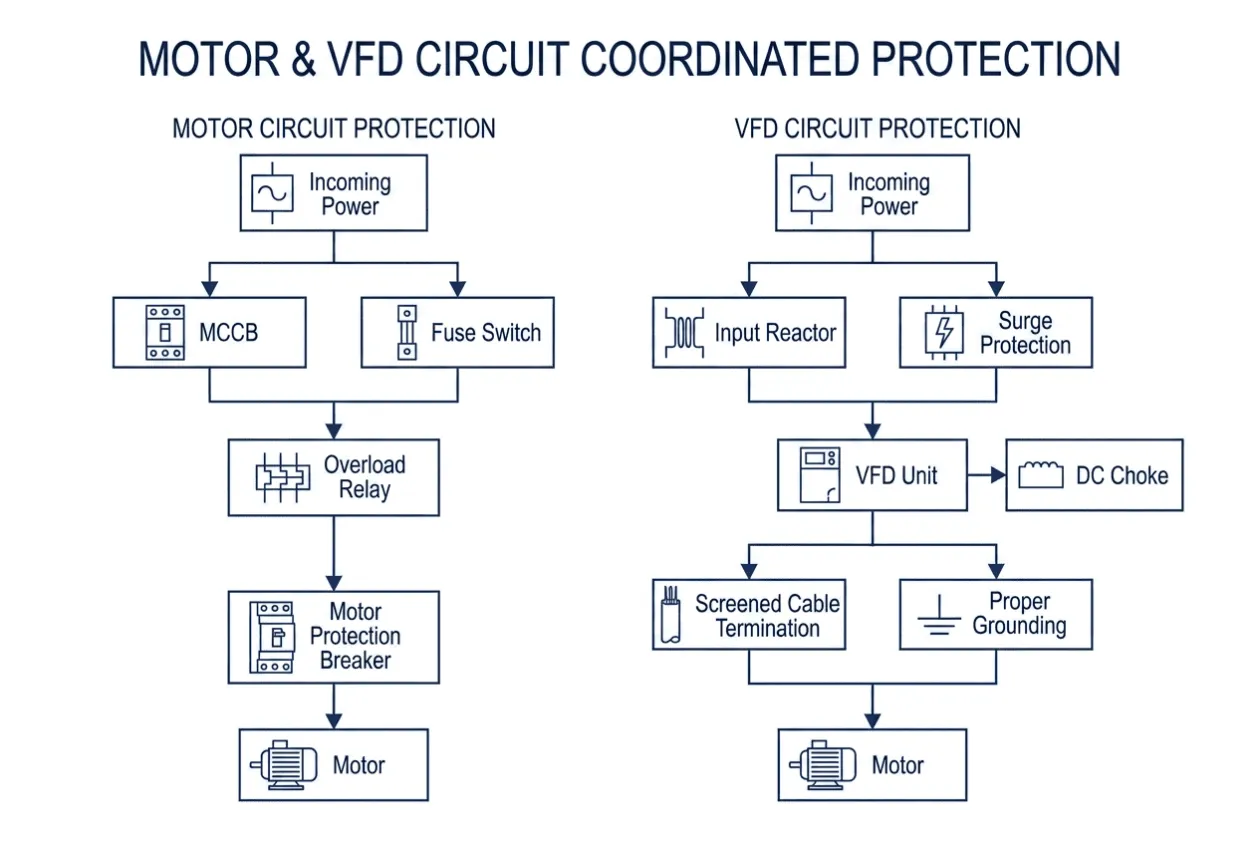
Motor circuits need coordinated protection, not just a pile of components. The supplier should know whether the panel needs an MCCB, fuse switch, overload relay, motor protection breaker, input reactor, DC choke, surge protection, screened motor cable termination, and proper grounding.
This is where some low quotes quietly cut corners. The panel still looks complete from the front door, but the missing details show up as nuisance trips, noise problems, unstable signals, or difficult commissioning.
If your plant already uses Mitsubishi, Siemens, ABB, Omron, or Schneider, say so in the RFQ. Brand preference is not only about preference. It affects spare parts, technician familiarity, programming support, and future maintenance. As a sourcing supplier rather than a brand-locked builder, we quote around the components your plant already uses where possible.
Step 5—Ask for Documents Before Ordering
A panel without documents may leave the factory, but it does not make life easy for the customer. Put the documents in the RFQ before the PO is issued.
Ask for:
- As-built wiring diagram
- Bill of materials with brand and part number
- FAT or test report
- Enclosure rating certificate where required
- UL 508A, UL-listed enclosure, or CE documents when needed
Our control panel build spec checklist gives a fuller template, and the control panel FAQ on lead times and testing covers the questions buyers usually ask before approval.
Buyer Checklist Before RFQ
Before you ask suppliers for a final price, check whether these items are already clear:
✓ Motor list with kW, voltage, phase, and quantity
✓ Starter type for each motor
✓ VFD quantity and power rating
✓ Indoor or outdoor installation
✓ IP/NEMA enclosure rating
✓ Ambient temperature and dust condition
✓ Cooling method or cooling expectation
✓ PLC, HMI, VFD, and component brand preference
✓ EMC requirement, reactors, grounding, and cable notes
✓ FAT, wiring diagram, BOM, certificates, and manuals
This checklist is not paperwork for the sake of paperwork. It helps suppliers quote the same job. If these details are missing, the lowest price may simply be the quote with the most assumptions.
What to Send With Your RFQ
Six answers are usually enough to make the quotation much cleaner:
RFQ Item | What to Send |
|---|---|
Motor list | kW, voltage, phase, quantity, load type |
Starter type | DOL, star-delta, soft starter, or VFD per motor |
Enclosure | Indoor/outdoor, material, IP/NEMA rating |
Site condition | Ambient temperature, dust, humidity, washdown |
Brand preference | PLC, HMI, VFD, breakers, components |
Certificates and documents | UL, CE, FAT, BOM, wiring diagram, lead time |
If you only send “motor control panel, please quote,” the supplier has to guess. If you send these six items, the supplier can quote a panel that is much closer to the real project.
As a China sourcing supplier, UniRegal can quote the panel and enclosure together through our Foshan supplier network. Custom enclosures usually start from 5 cabinets and take around 15 days, while stock components often ship in 3–5 days depending on final specification. Our electrical enclosure supplier guide explains how we review enclosures for overseas projects. If you are still comparing panel builders, the motor control panel supplier shortlist may also help.
When your motor list is ready, you can submit your requirements. For outdoor or large cabinet projects, this RFQ guide for outdoor electrical cabinets is also useful.
FAQ
Can one panel handle both fixed-speed and VFD motors?
Yes. Mixed panels are common. Each motor needs its own starter and protection circuit, while the incoming power and control system can be shared if designed correctly.
How much larger is a VFD panel than a contactor-only panel?
It is often larger because VFDs need clearance and heat dissipation. The exact size depends on drive quantity, power rating, cooling method, and enclosure rating.
Do I need input reactors for VFD panels?
Not always, but they are often worth reviewing, especially when multiple drives are used or the site has power quality and EMC concerns.
Can UniRegal build around our existing VFD brand?
Yes. Mitsubishi, Siemens, ABB, Omron, Schneider, and other brands can be discussed based on your installed base and project needs.
What is the most important information to send first?
Send the motor list and starter type first. Those two items decide much of the panel cost, layout, cooling, and protection design.
Final Thought
A motor list is not a complete RFQ.
A supplier cannot quote the right motor and VFD control panel until they know how the motors start, where the panel lives, how hot the cabinet may become, and what proof the buyer needs before shipment. The dangerous quote is not always the expensive one. It is the one that looks complete while the heat, enclosure, protection, and paperwork are still missing.