
Aug 22, 2026Buying Guides
MCC Panel Buying Guide: How to Specify and Source Without Costly Rework
A practical MCC panel buying guide for EPCs and plant owners: what to specify, how MCC differs from a control panel, enclosure and UL 508A decisions, and the mistakes that cause rework and downtime.
What an MCC panel is — and why buyers get it wrong
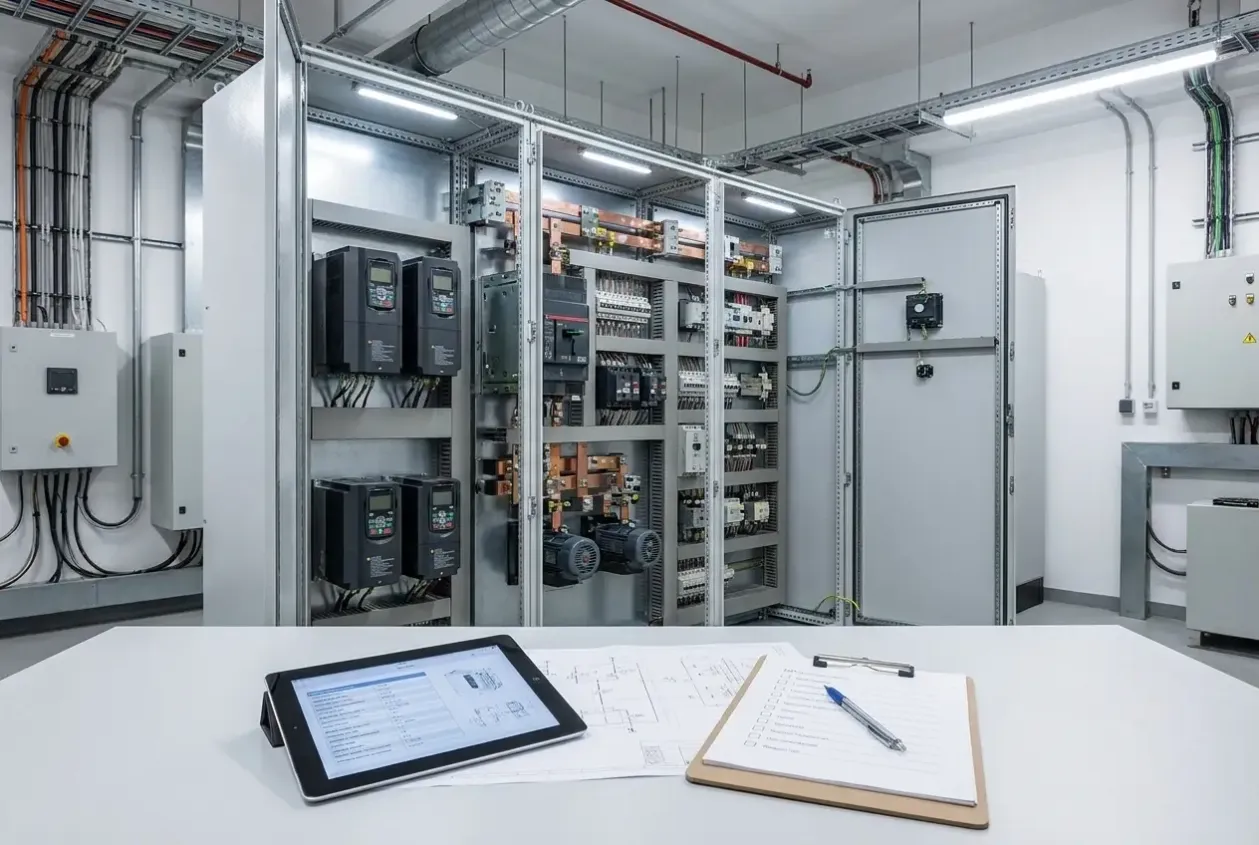
A Motor Control Center (MCC) groups motor starters, variable-frequency drives, soft starters, and branch protection into one floor-standing or wall-mounted assembly. Most buyers do not lose the project on price; they lose it on a vague specification that forces rework after the enclosure arrives on site.
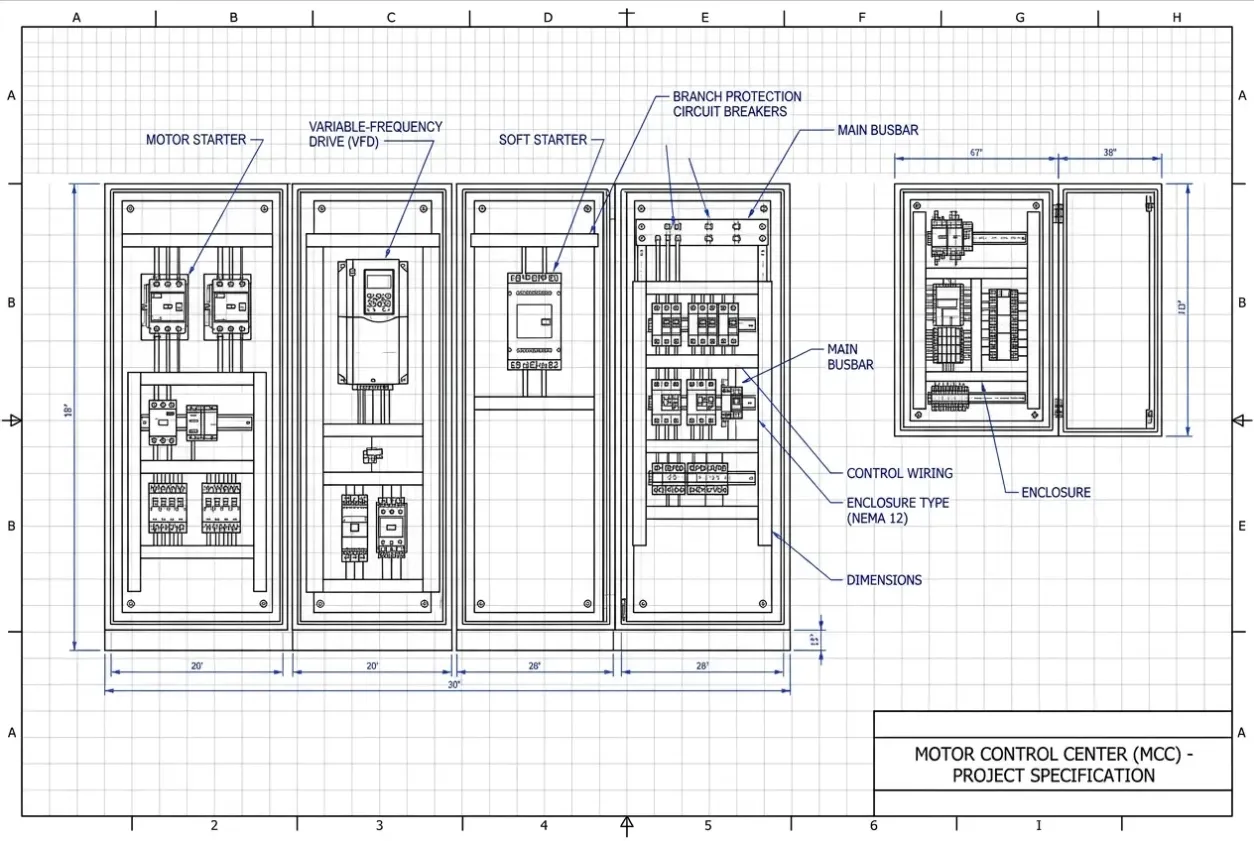
If you are short on time, start with our Top 10 MCC panel manufacturers for a market map, then come back to this guide to write a specification that suppliers can actually quote against.
MCC vs. a standard control panel
The terms get used interchangeably, but the procurement logic is different.
Factor | Motor Control Center (MCC) | General control panel |
|---|---|---|
Primary load | Motors (starters, VFDs, soft starts) | Mixed: PLC, sensors, process loops |
Form factor | Vertical sections, often walk-in lineup | Single enclosure or skid |
Coordination | Bus-rated, sectioned for isolation | Per-panel design |
Best when | Many motors, central plant room | One machine or skid |
An MCC is the right call when you have a cluster of motors (pumps, compressors, conveyors, agitators) that benefit from a single, coordinated, maintainable lineup. For a single machine, a custom control panel is usually cheaper and faster.
The specification checklist before you request quotes
Send this to every supplier so quotes are comparable. Missing items are where cost and schedule blow up.
Item | Why it matters | What to write |
|---|---|---|
Rated bus current | Drives section sizing and copper cost | e.g. 600 A main, 100 A sections |
Motor count & FLA | Sets starter sizes and heat load | Qty + full-load amps per motor |
VFD vs across-the-line | VFDs need cooling, harmonics planning | List which motors are VFD-driven |
Enclosure material | Corrosion and washdown rating | 304 / 316L stainless, carbon steel, or galvanized |
Ingress protection | Outdoor, washdown, or indoor? | IP54 / IP65 / IP66 / IP69K |
Control voltage | 24 VDC vs 120 VAC logic | State both control and power |
PLC / comms | Integration with existing system | Brand + protocol (Modbus, Profinet, EtherNet/IP) |
A related, narrower checklist for a single drive panel is here: motor / VFD control panel spec checklist.
Enclosure and environment decisions
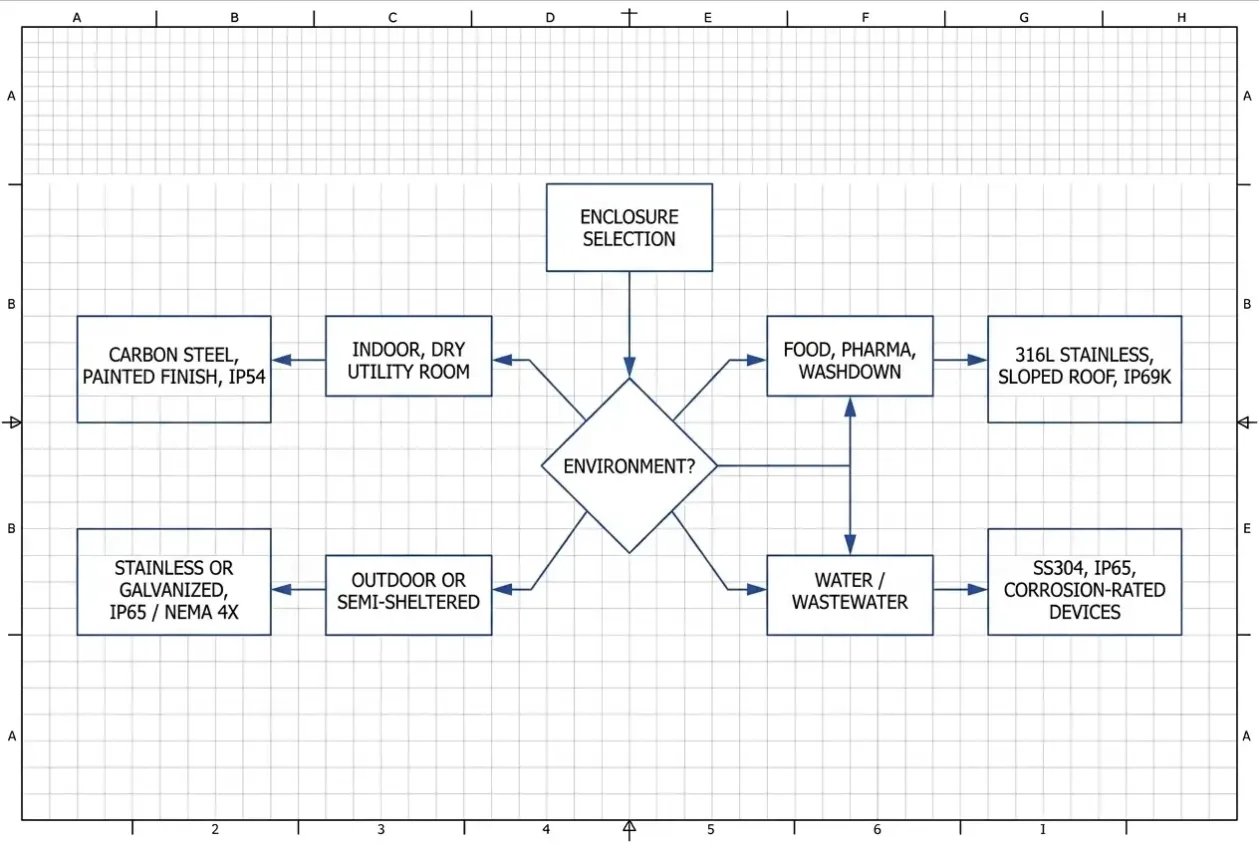
The enclosure is the part most often under-specified. Match it to the worst day on site, not the average.
- Indoor, dry utility room — carbon steel with painted finish, IP54 is usually enough.
- Outdoor or semi-sheltered — IP65 / NEMA 4X, stainless or galvanized. See our oil & gas panel notes for harsh-site examples.
- Food, pharma, washdown — 316L stainless, sloped roof, IP69K-rated devices, no dead legs. Our food processing control panel guide covers the hygiene details.
- Water / wastewater — SS304 with IP65 and corrosion-rated devices, similar to water treatment control panels.
Specifying 316L where 304 would do adds cost; specifying 304 where 316L is needed adds downtime. The environment table above is the fastest way to get it right.
UL 508A and wiring standards
In North America, an MCC should be built to UL 508A (enclosures, short-circuit rating, wire sizing) and carry a recognized short-circuit current rating (SCCR). If your project requires a UL-listed mark, confirm it before awarding — not after fabrication.
As a Foshan-based sourcing partner, we consolidate enclosures and components from local workshops and route UL-required builds to a UL-listed workshop per order. Every build ships with the construction file buyers actually need: torque records, point-to-point wiring verification against the schematic, and a signed Factory Acceptance Test (FAT) report.
Mistakes that cause rework and downtime
- No bus rating — suppliers guess, then the lineup cannot carry the load. State bus current up front.
- VFD cooling ignored — VFDs throw heat; without ventilation or derating the section trips in summer.
- Wrong enclosure grade — indoor panel sent to a washdown area corrodes within a season.
- Comms left vague — "PLC-compatible" is not a specification. Name the brand and protocol.
- No FAT — without a factory test you find the wiring error at 2 a.m. on commissioning.
- Single-source enclosure lock-in — tying the whole lineup to one enclosure brand limits price and lead time. A multi-vendor sourcing model keeps options open.
How UniRegal sources MCC panels
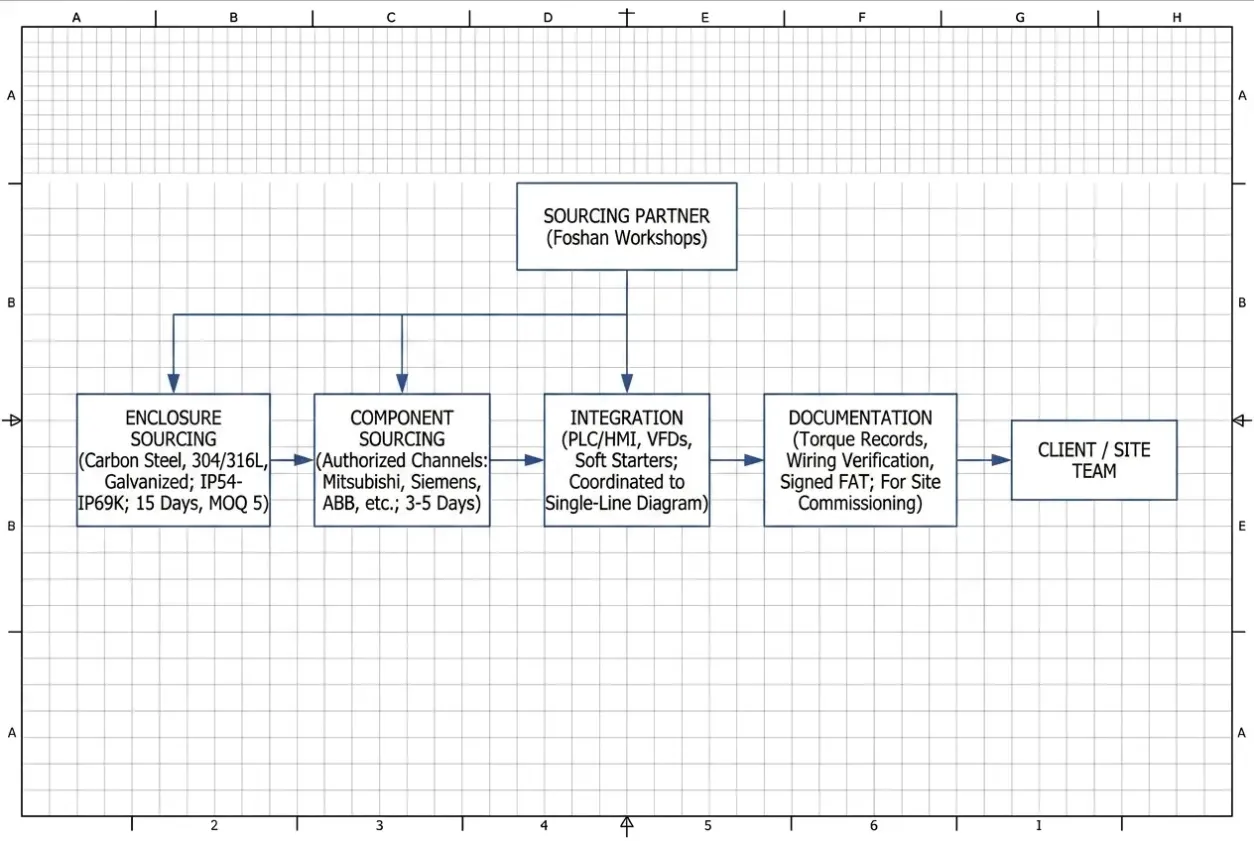
We are a sourcing partner, not a captive factory, which is the point: we match each project to the right Foshan workshops instead of forcing it into one production line.
- Enclosures: carbon steel, 304/316L stainless, or galvanized; IP54–IP69K; typical build about 15 days with an MOQ of 5 units.
- Components: Mitsubishi, Siemens, ABB, Allen-Bradley, Yaskawa, Omron, Schneider — sourced from authorized channels, 3–5 days for most items.
- Integration: PLC/HMI, VFDs, soft starters, and protection coordinated to your single-line diagram.
- Documentation: torque records, wiring verification, and signed FAT — the file your site team needs for commissioning.
For a buyer's view of the vendor landscape, read the Top 10 MCC panel manufacturers before you shortlist.
FAQ
What is the difference between an MCC and a control panel?
An MCC is purpose-built to group motor controls (starters, VFDs, soft starts) in a coordinated, sectioned lineup. A control panel is a broader enclosure that may handle PLC logic, sensors, and process control for one machine or skid.
How do I size an MCC?
Start from the connected motor load: count motors, sum full-load amps, add VFD and soft-start derating, then choose a main bus rating with headroom (commonly 600 A main with 100 A sections). Give suppliers the bus rating, not just "an MCC."
Do MCC panels need UL 508A?
For North American projects, yes — UL 508A construction and a stated SCCR are expected. Confirm UL requirement before fabrication so the build is routed to a UL-listed workshop.
What IP rating should an outdoor MCC have?
IP65 / NEMA 4X as a baseline for outdoor or washdown exposure, stepping to IP69K for direct high-pressure washdown. Match the rating to the worst condition on site.
How long does a custom MCC take?
Enclosure fabrication is typically around 15 days (MOQ 5); components are usually 3–5 days. Integration and FAT add time, so confirm the full critical path, not just the enclosure lead time.
Can I mix drive brands in one MCC?
Usually yes, as long as the bus, cooling, and comms are planned. Name the PLC and protocol (Modbus, Profinet, EtherNet/IP) so the supplier coordinates VFD and starter communications instead of discovering conflicts on site.
Next step
Send your single-line diagram and the table above to our team for a comparable quote. If you are still shaping the requirement, the FAQ section covers common specification questions, and the MCC manufacturer shortlist helps you benchmark suppliers before you commit.
Related Guides: