
Oct 31, 2026Buying Guides
How to Witness a Control Panel FAT Remotely (2026 Buyer's Guide)
Witness a control panel FAT remotely without flying to the build shop. Here is the video-walkthrough protocol, acceptance criteria, and punch-list we use with overseas buyers.
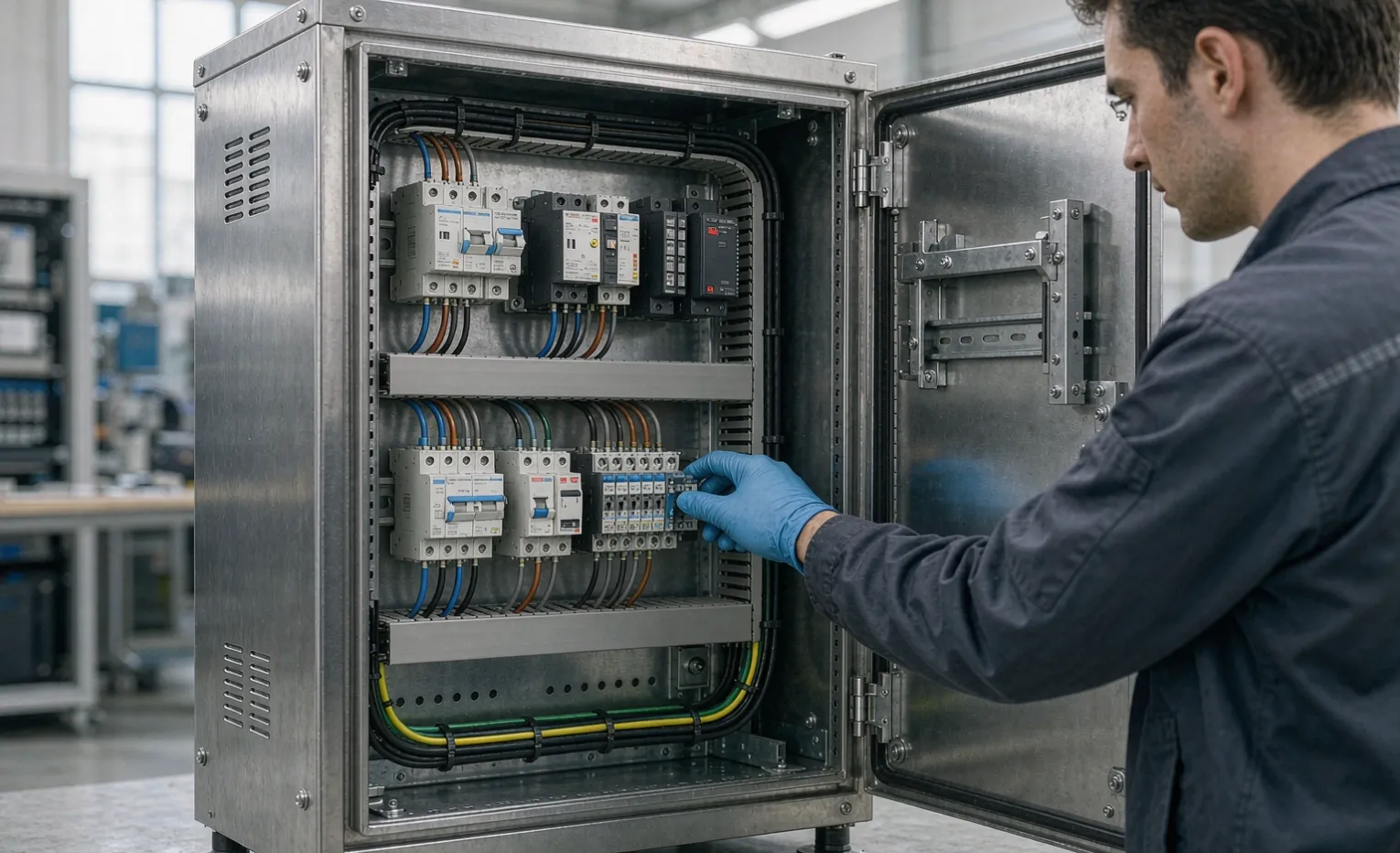
You do not need to fly to the build shop to watch your control panel get tested. A well-run Factory Acceptance Test (FAT) can be witnessed remotely through a structured video walkthrough plus a documented test pack — and for most overseas buyers it is actually stricter than showing up in person, because every check is put on record. Below is the exact protocol we use with buyers who cannot be on site, the acceptance criteria you must agree in writing before the test, and the punch-list that stops surprises at commissioning.
One boundary up front: a remote FAT verifies the panel we built to your drawings and specifications. It does not replace third-party certification (UL 508A, IEC 60204-1) or on-site commissioning—those are separate steps in the build-and-ship flow.
What a control panel FAT actually covers
FAT is the last chance to find a mistake before the panel leaves the build shop. A real test pack is not a handshake and a photo—it is a written sequence of checks tied to your drawings. For a typical custom panel, we split it into five blocks.
Visual and mechanical inspection
The enclosure, paint, gasket, door seals, mounting feet, and fixings are checked against the approved drawing. We confirm material and rating: carbon steel, 304 or 316 stainless, or galvanized; IP65 or NEMA 4X where specified. Dents, seal gaps, and wrong hardware get caught here—not at your site.
Wiring and labeling verification
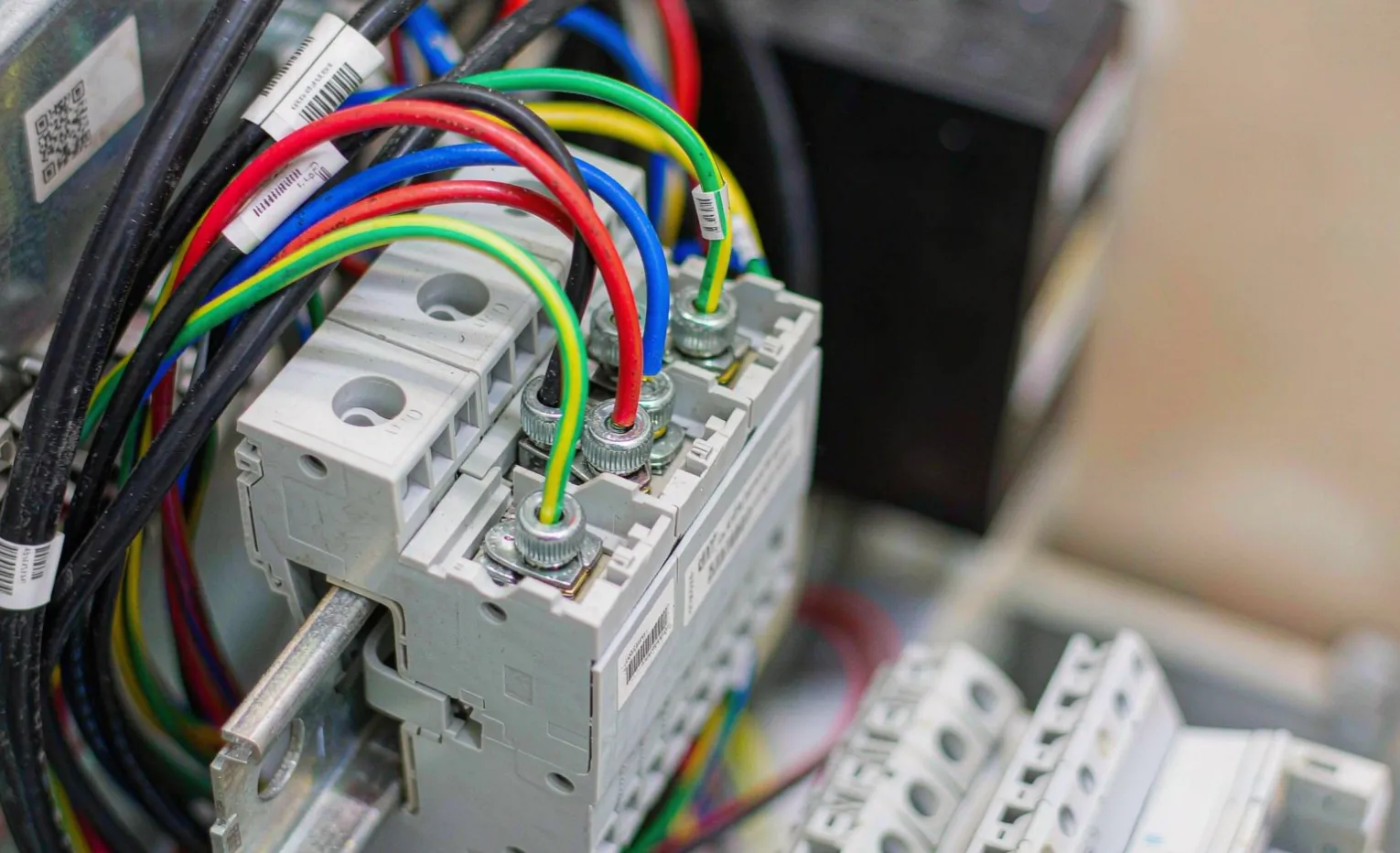
Every wire is traced against the schematic. We check wire size, color, and routing and that each terminal matches the tag on the drawing. Device labels, warning plates, and I/O tags must be readable and consistent. This is where most "it worked in the shop but the tech couldn't find the fault" problems are prevented.
Functional and simulation testing
With no field devices connected, we simulate inputs and watch the logic respond. Pushbuttons, selectors, interlocks, and trip functions are exercised. For PLC-based panels, we run the program against a forced I/O table so you can see the sequence behave as specified.
Protection and safety checks
Insulation resistance, continuity of protective conductors, and correct earthing are measured with calibrated instruments. These checks map directly to NEMA and IEC wiring practice and to the safety intent of IEC 60204-1. A panel that passes these is safe to energize.
Documentation handover
The test pack, as-built drawings, component datasheets, and the FAT report are compiled and handed over. We include FAT records with every panel we ship—it is part of the standard handover, not an extra you have to chase.
The remote witnessing protocol, step by step
Remote witnessing only works if it is structured. A loose video call is worse than no FAT. Here is the order we follow.
Pre-FAT document exchange
Before we book the test, you send the package that defines "correct": reviewed drawings, I/O list, bill of materials, and any specific test plan or acceptance criteria. If those are not agreed, the FAT has no yardstick. This is also the moment to confirm lead time—a full custom panel runs from 1 unit after drawing and BOM review, typically 35–40 days; an empty enclosure or shell is 5 units minimum at about 15 days; loose components ship in 3–5 days.
Live video walkthrough setup
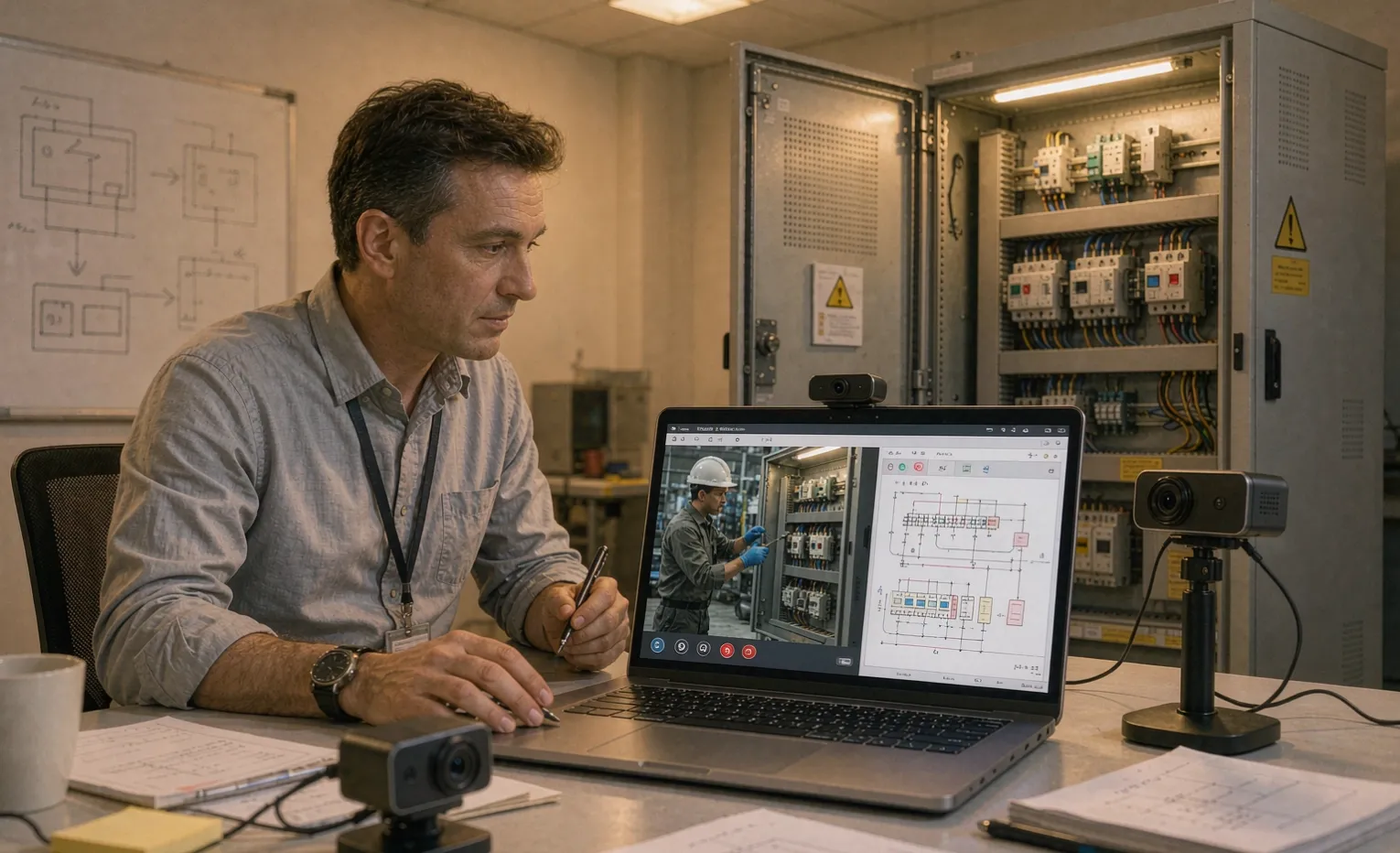
We run a two-way video session with a camera on the panel and screen share of the schematic and the test results. You (or your engineer) watch each block run in real time and can ask us to zoom, re-test, or pause. The session is recorded so the record is not just our notes.
Agree on acceptance criteria in writing first.
The single biggest cause of FAT disputes is a verbal "that looks fine." We write the acceptance criteria into the test plan before the test: which functions must pass, what tolerance is allowed, and what counts as a punch-list item versus a fail. Sign-off then means something.
Punch list and sign-off
Any open items go on a dated punch list with an owner and a fix date. Minor items can be closed before shipment; anything that affects function is resolved and retested. Only then do we mark the FAT accepted and release the panel for packing.
What you can verify remotely vs. what needs a physical presence
Not every check is equally suited to a screen. Be honest about the gaps so you plan around them.
Check | Remote verdict | Why |
|---|---|---|
Visual & mechanical (dents, seals, hardware) | Strong | Camera close-ups and recorded walkthroughs are often clearer than a tired eye on-site. |
Wiring & labeling trace | Strong | A screen share of the schematic next to the live panel makes mismatches obvious. |
Functional / logic simulation | Strong | The forced I/O table shows behavior without field devices. |
Insulation & continuity measurement | Strong | Calibrated instrument readings are read on screen, not by feel. |
Paint / coating thickness | Weak | Needs a gauge on the surface; request a thickness report instead. |
Vibration / thermal soak | Weak | Requires physical test rigs; covered by specification, not live view |
Third-party certification (UL 508A) | Separate | Verified via the listing file number, not the FAT |
The practical rule: anything you can measure or see, you can witness remotely. Anything that needs a gauge, a rig, or a certification body, you cover with a written report or a separate step.
Five mistakes buyers make in remote FAT
Buyer Decision: Treat the remote FAT as a formal gate, not a courtesy call.
- Skipping the written test plan. No plan means no agreed "pass." Insist on it before you book the session.
- Joining without the drawings open. If you are not looking at the same schematic we are, you cannot catch a deviation.
- Accepting verbal assurances. "It's fine" is not a record. Get the FAT report and punch list in writing.
- Forgetting the documentation handover. The panel is only half the deliverable; the test pack and as-builts are the other half.
- Confusing FAT with certification. A FAT we run does not stand in for UL 508A listing or IEC 60204-1 compliance. We build through a partner UL-listed shop, and the file number is verifiable in writing—confirm that separately.
How we run FAT as your sourcing partner
We are a sourcing partner, not one of the panel builders we work with—our job is to make the acceptance step transparent whether you are in the room or eight time zones away. For overseas buyers, the remote FAT is usually the default, not a compromise: it produces a written, recorded record that travels better than memory. If you need an independent witness, we can coordinate a third-party inspector at the build shop; the protocol above stays the same.
Engineering Takeaway
A remote FAT is not "less than" an attended one if it is run to a written plan with a recorded walkthrough and a signed punch list. Send the drawings and acceptance criteria first, watch the five test blocks on video, and take the documentation pack as seriously as the panel itself. The buyers who avoid commissioning surprises are the ones who treated FAT as a gate, not a formality.
Frequently asked questions
Q: Can I really trust a FAT I did not attend in person?
A: Yes, provided it follows a written test plan and is recorded. A recorded walkthrough plus a signed FAT report and punch list is often a stronger audit trail than a single person's memory on site. The key is agreeing on acceptance criteria before the test, not after.
Q: What documents should I receive after a remote FAT?
A: At minimum the FAT report, the as-built drawings, the component datasheets, and the punch list with close-out status. We include FAT records with every panel as standard; ask for them explicitly if a supplier treats them as optional.
Q: How much lead time does the FAT step add?
A: For a full custom panel the FAT sits inside the 35–40 day build window after drawing and BOM review; it does not add a separate week if scheduled up front. Empty enclosures (5-unit minimum, ~15 days) and loose components (3–5 days) have their own shorter cycles. Booking the test slot early is what keeps it free.
Q: Do I need a third-party inspector for a remote FAT?
A: Not usually. Most buyers witness remotely with us directly. If your project contract or local authority requires an independent witness, we can bring one to the build shop and run the same protocol—the record is what matters.
Q: What if the panel fails a remote FAT check? A: Any functional or safety failure is resolved and re-tested before shipment; it is not signed off around. Minor cosmetic or non-functional items go on the punch list with a dated fix. You should never accept a panel with an open functional item.
Q: Can you witness FAT for UL 508A panels?
A: Yes. We build through a partner UL-listed shop, and the listing file number is verifiable in writing. The FAT verifies build quality against your drawings; UL 508A listing is confirmed separately through the file, not during the FAT.
Related guides
- Why a FAT matters for control panel buyers—the business case for treating acceptance testing as a gate.
- The pre-shipment checklist we run before every panel ship—what gets verified before release.
- How to make sure your control panel works before it reaches the site—closing the gap between FAT and commissioning.
- What to send for a control panel quote—the drawing, BOM, and I/O list that define "correct" for both quote and FAT.
- How long a custom control panel takes to build—where FAT fits in the 35–40 day window.
- How busbar distribution is laid out inside a control panel—one of the things the wiring block of a FAT checks.
For the broader build-and-ship picture, see our control panel sourcing guide and the custom control panels we help specify.
Get your panel accepted without the flight.
Send us your drawings, I/O list, and BOM and we will scope the FAT plan with written acceptance criteria before any build starts—full custom panels from 1 unit (35–40 days after review), empty enclosures from 5 units (~15 days), and components in 3–5 days. We reply within one business day.
- WhatsApp: message us with your project outline.
- Email: info@uniregal.com with "FAT + quote" in the subject.
- Form: submit your requirements with drawings attached, or use our contact page.