
Integration & Compatibility
How to Ensure Your Control Panel Works Before It Arrives On Site
How to make sure a control panel works before it reaches the site: FAT, wiring verification and pre-shipment checks that prevent costly on-site rework.
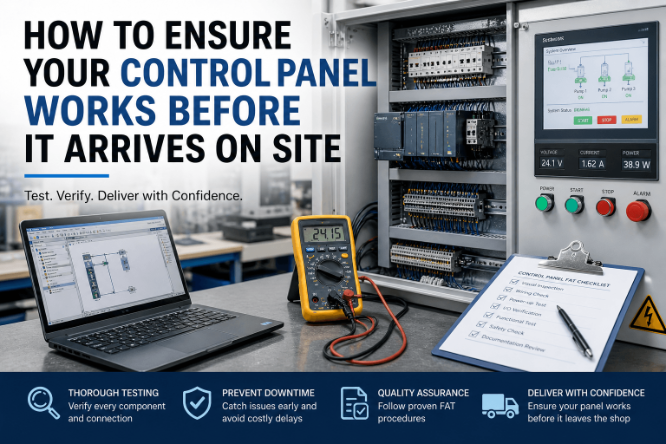
Three calls dominate the first week after a panel lands on site: a drive group that will not join the network, an input card that never lights up because one 24 V wire landed on a 120 V terminal, and a missing crate item — jumper combs, a programming cable, one crate of spares — that idles a crew that flew in on Sunday. None of these are exotic faults. All three are cheap to catch in a workshop and expensive to catch on a scaffold.
So here is the standard worth putting in front of any panel purchase, whether it is built in Foshan, Frankfurt or Ohio: a panel is validated when every failure you could hit on site has already been reproduced at the build shop. Lights-on is not a test. A panel that powers up proves the breaker holds. It proves nothing about whether your HMI tags talk to your drives, or whether terminal 47 carries 24 V and not mains.
This article translates that standard into specific tests, the clause numbers behind them, and the exact wording to put in your purchase order — so that "tested before shipment" stops being a slogan and becomes a checklist someone signs.
Start with the tests the standard already names
You do not have to invent a test regime. IEC 60204-1 — the standard most industrial panels are built against — defines a verification routine in Clause 18, and it is deliberately boring, which is why it works:
Protective bonding continuity (Clause 18.2): a test current of at least 10 A is passed through the protective bonding circuit; the measured voltage drop must not exceed 1 V. This is what actually trips the breaker when a fault occurs — not the green earth symbol on the drawing.
Insulation resistance (Clause 18.3): measured at 500 V DC between power conductors and the protective bonding circuit, minimum 1 MΩ. Catches crushed wire insulation, misrouted harnesses and moisture problems before they become earth faults.
Voltage withstand (Clause 18.4): 1000 V AC applied for 1 second between power conductors and the protective bonding circuit, for panels in the common 400–480 V class. Any flashover means the assembly is not ready to ship.
Ask for these three results, per panel, in writing — measured values, not checkmarks. A shop that declines to record a 10 A continuity test or a 500 V insulation reading is telling you something about its process, and you want to hear that before the panel is crated, not after it arrives.
If the panel carries a UL 508A listing, there is a second lever: the standard requires the enclosure to be marked with its short-circuit current rating (SCCR), and that rating is only as good as the branch protection actually fitted inside. Verify the SCCR label against the fault level of the bus you are tying into — a panel marked 65 kA fed from a transformer that can deliver more is a paper protection scheme.
Communication is a system test, not a component test
The most common "arrived broken" call is not broken hardware. It is hardware that never talked: HMI online but drive group unreachable, PLC run-light on but inputs dead. The pattern behind it is that the shop tested components, not the system.
The difference is specific and checkable. At FAT, the network should be exercised exactly as it will run on site:
Every HMI tag, written and read back: a bit toggled in the controller, the same bit observed on the screen — not a static screen review.
Every bus device, in its final network location: every VFD and remote I/O station enumerated with its firmware revision recorded. A drive that joined the workshop network on firmware v4.20 and arrives on site carrying v5.10 is a commissioning delay waiting to be found.
Every analog loop, injected — not assumed: feed 4 mA, 12 mA and 20 mA at the terminal and read the engineering value in the PLC. If the loop card scales 4–20 mA to 0–100 °C, 12 mA must read 50 °C, within the tolerance your project defines, and written down.
This costs an hour per panel at the shop. On site, the same unresolved fault costs the commissioning engineer half a day, plus the travel days you already paid for.
Point-to-point I/O: the printed list beats the confident memory
Wiring errors are the fault that most often survives a "power-on pass", because nothing heats up or trips until the signal is actually used. The defence is unglamorous: force every input, command every output, and sign a list. The list is the point — memory is not evidence.
Paste this row into your FAT checklist, one per point, signed by the tester: Terminal address | Field signal | Test action (force at terminal / command from PLC) | Expected response (PLC LED, HMI value, contactor action) | Observed | Pass/Fail | Tester + date.
Two rules make the list real. First, analog and digital get the same treatment — a 4–20 mA level input gets three injected points, not one "seems live". Second, the output test commands real devices: the contactor actually pulls in, the solenoid actually fires, with coil voltages matched to the drawing. That is exactly where the 24 V-on-a-120 V-terminal error gets caught, while the panel is still on the bench.
The last crate: what kills the second commissioning week
Ask any commissioning engineer what ruins week two on site and the answer is rarely electricity — it is documentation and small hardware. The panel works; nobody can find the file that makes it work again after a fault. The pre-shipment package should be agreed as a deliverable, with the same status as the hardware:
As-built schematics: the wiring as actually built, including every deviation approved during the build — not the version issued for quotation.
Parameter and program backups: PLC program, HMI project and VFD parameters, with file versions recorded, on media you can actually read.
Spares and consumables per the agreed list: and a crate photo taken before sealing, so what left the shop is not a matter of argument three weeks later.
None of this is technical risk. It is schedule risk — and schedule risk is what your production deadline actually feels.
What to put in the PO, in one paragraph
Everything above compresses into wording you can paste into a purchase order or RFQ:
"Prior to shipment, the panel shall pass: (1) protective bonding continuity test per IEC 60204-1 Clause 18.2, ≥10 A test current, voltage drop ≤1 V; (2) insulation resistance ≥1 MΩ at 500 V DC per Clause 18.3; (3) voltage withstand 1000 V AC / 1 s per Clause 18.4. Results recorded per panel with measured values. FAT shall include full I/O point-to-point verification against a signed list, live read-back of all HMI tags from the PLC, network enumeration of all bus devices with firmware versions recorded, and analog loop verification at 4, 12 and 20 mA. Delivery includes as-built schematics, PLC/HMI/VFD backup files with version record, and the agreed spares list, verified against a pre-sealing crate photo."
A build shop that accepts this wording will not blink — it is their normal process written down. A shop that pushes back on recording measured values has told you where your first site call will come from.
How this plays out from Foshan
As a sourcing partner, we do not run the crimping tools ourselves — we put these tests into the build shop's scope before the PO is signed, witness them at FAT, and hold the shipment until the signed lists exist. For a single custom panel (from one unit, typical build 35–40 days), the FAT day at the shop costs a fraction of the site visit it prevents; for component supply it is the same logic at smaller scale, which is why our component stock ships in 3–5 working days already inspected, rather than "to be checked on arrival".
If you are writing an RFQ now, send us the one-paragraph FAT wording above with your drawing — we will return the quote with the test scope priced in, not promised in an email afterwards. Produced with AI-assisted drafting and reviewed by the Uni Regal team before publication.