
Aug 23, 2026Case Studies
Why FAT Matters for Control Panel Buyers
A failure analysis explaining why FAT matters for control panel buyers, showing how I/O errors, VFD command issues, weak testing, and poor reports can turn into costly startup delays.

Why FAT Matters for Control Panel Buyers: A Failure Analysis
A control panel passed the supplier’s power-on test before shipment. The wiring looked clean, the labels were correct, and the HMI started normally.
Three weeks later, during site commissioning, the motor would not run.
By then, the commissioning team had already lost almost a full day checking what looked like a wiring fault. The VFD was healthy. The motor cable was fine. The PLC was online. The real cause was smaller and more annoying: one permissive signal was mapped to the wrong PLC input, and the VFD start command did not match the intended communication setting.
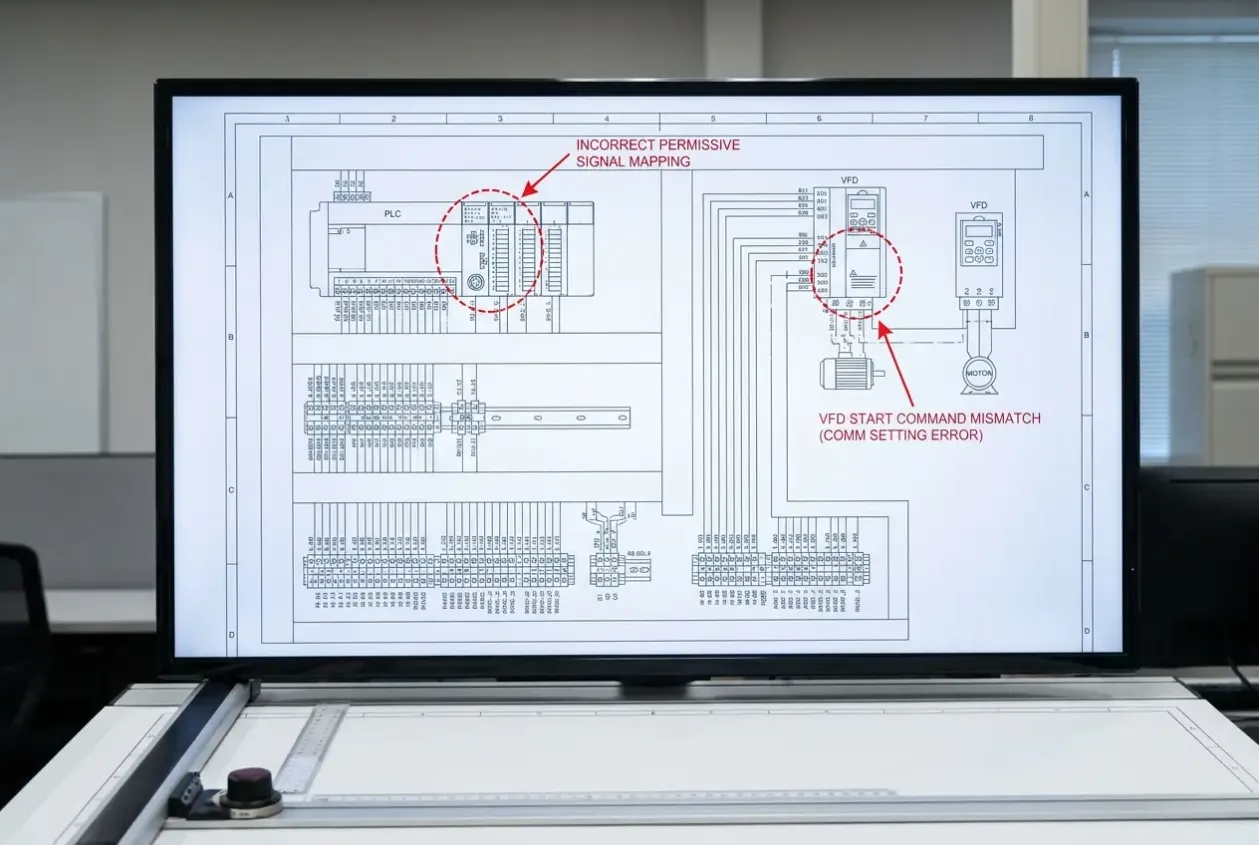
Nothing was physically wrong with the panel. The delay came from finding a control problem that could have been discovered before shipment.
That is why FAT matters.
A power-on test only proves the panel can turn on. It does not prove the panel can control the machine.
What Happened Next
Stage | Result |
|---|---|
Workshop | The panel was powered on and looked normal. |
Shipment | The cabinet was packed and delivered. |
Installation | Site wiring was completed. |
Commissioning | The motor failed to start. |
Failure Found | PLC mapping and VFD command mismatch |
Correction | PLC address mapping and VFD command setting were corrected. |
Retest | The start sequence was tested again and passed. |
The mistake was cheap in the workshop. It became expensive on site.
What Failed
Issue | Site Symptom | FAT Check Needed | Cost If Missed |
|---|---|---|---|
Incorrect PLC address mapping | The start condition never became true. | I/O force test | Startup delay |
VFD command mismatch | PLC showed start, and the drive stayed idle | VFD control test | Extra engineering time |
Unverified interlock | HMI showed ready; the system stayed blocked | Logic simulation | Site troubleshooting |
Weak test record | The team had no clear reference. | Signed FAT report | Slower fault finding |
A proper FAT should verify I/O points, interlocks, start-stop logic, fault response, VFD control, communication mapping, and documentation before the cabinet is crated.
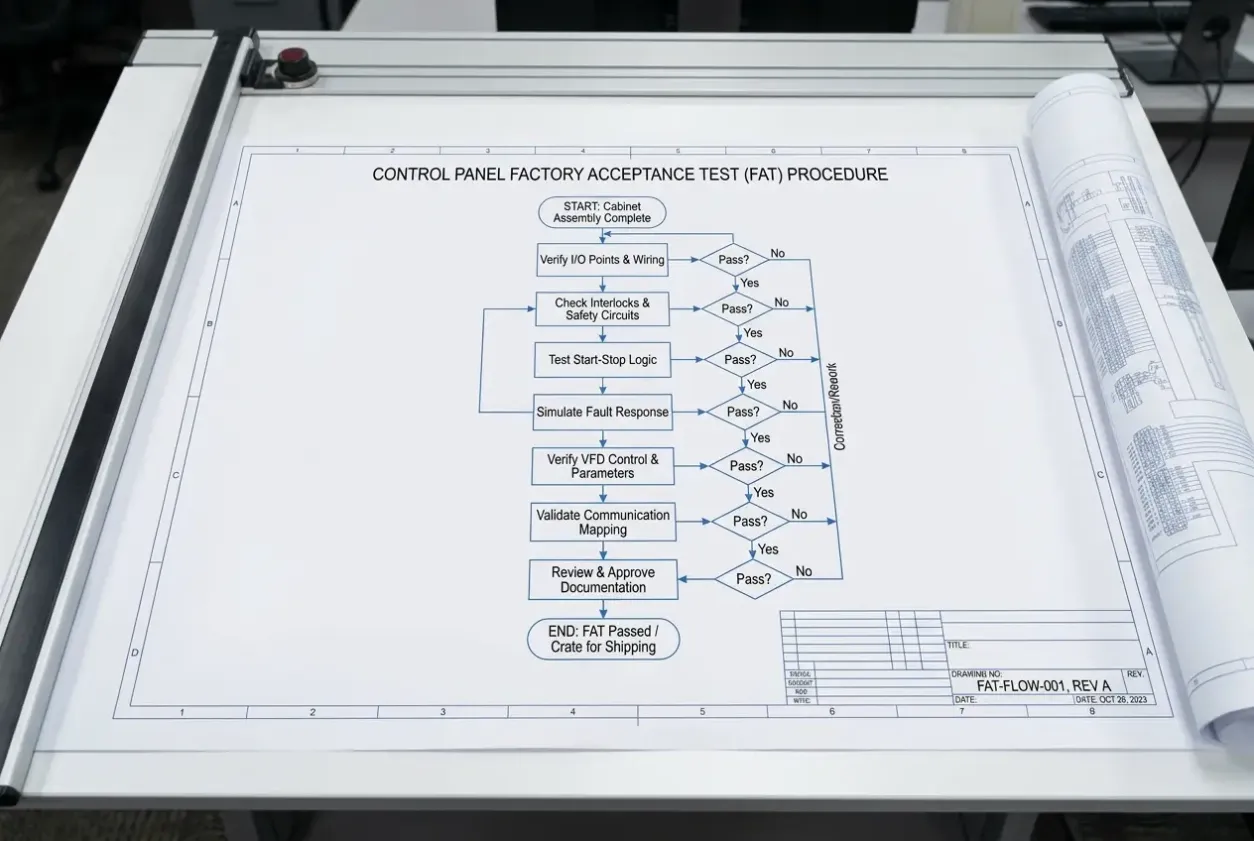
International standards such as IEC 60204-1, IEC 62381, and UL 508A all reinforce the same idea: testing should verify function, not only appearance.
Buyer Advice
Do not ask only, “Is FAT included?” Ask what the FAT includes. For PLC panels, VFD panels, pump control panels, skid panels, or panels with Modbus, Profinet, EtherNet/IP, analog signals, or interlocks, a visual inspection is not enough.
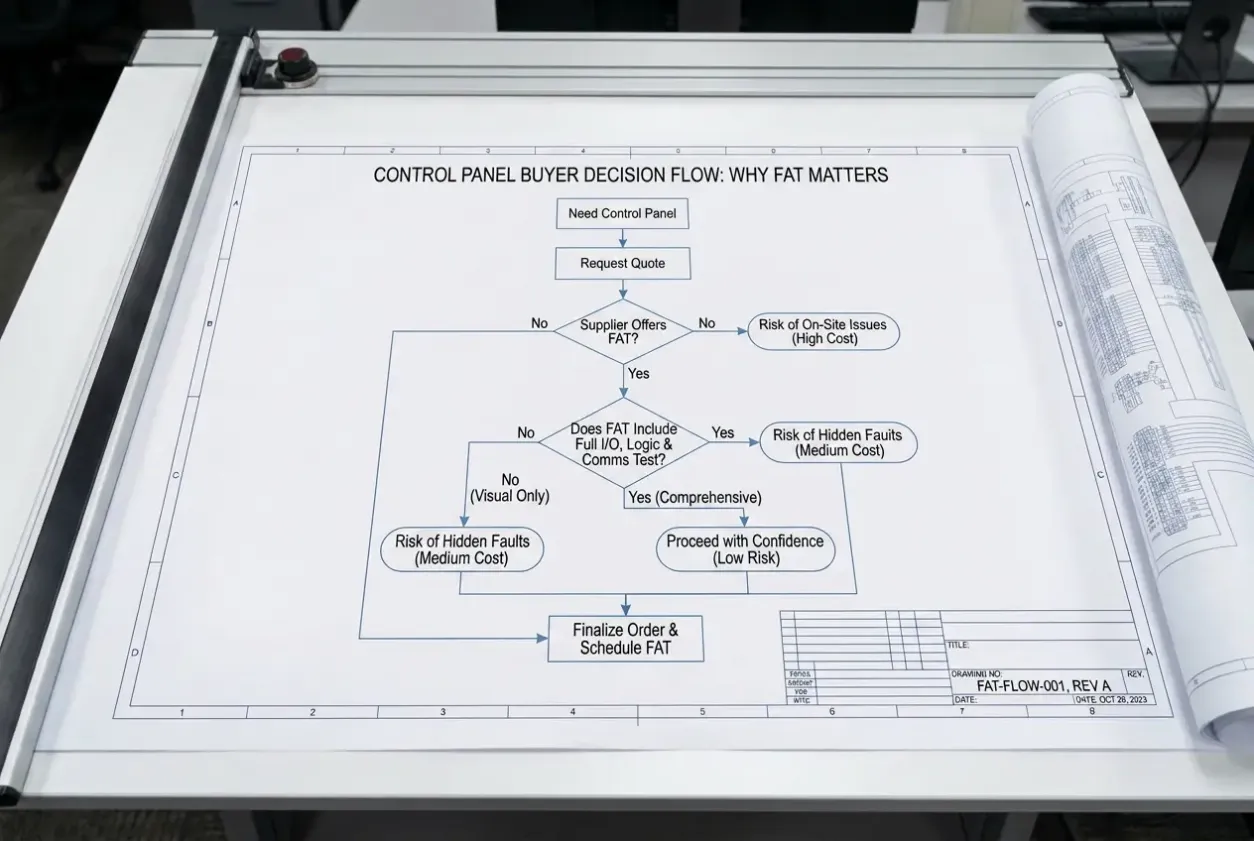
Good FAT does not slow the project.
Bad FAT does.
If a supplier only says “power-on tested,” send the FAT scope back for clarification. The FAT procedure should mention I/O testing, logic simulation, communication checks, issue recording, correction, retesting, and a signed report.
FAQ
Can FAT replace SAT?
No. FAT checks the panel before shipment. SAT checks field wiring, sensors, actuators, installation, and real site conditions.
Do simple panels need FAT?
Basic junction boxes or manual panels may only need visual, continuity, and power checks. PLC or VFD panels need documented FAT.
What should buyers request?
Ask for the FAT procedure, I/O test record, communication test, punch list, correction record, photos or video, and signed report.
Before You Request a Quote
Before requesting a control panel quotation, send UniRegal your drawings, I/O list, sequence description, PLC/HMI requirements, VFD control method, communication protocol, load information, and FAT expectations.
UniRegal can review the FAT scope before quotation and confirm what should be tested before shipment.
The cheapest place to find a control panel problem is still inside the supplier’s workshop.
Related guides