
Case Studies
Why Does a Motor Circuit Breaker Trip on Startup?
Motor breaker trips on startup? Compare B, C and D curves, check inrush current, and learn what buyers should verify before ordering a control panel.
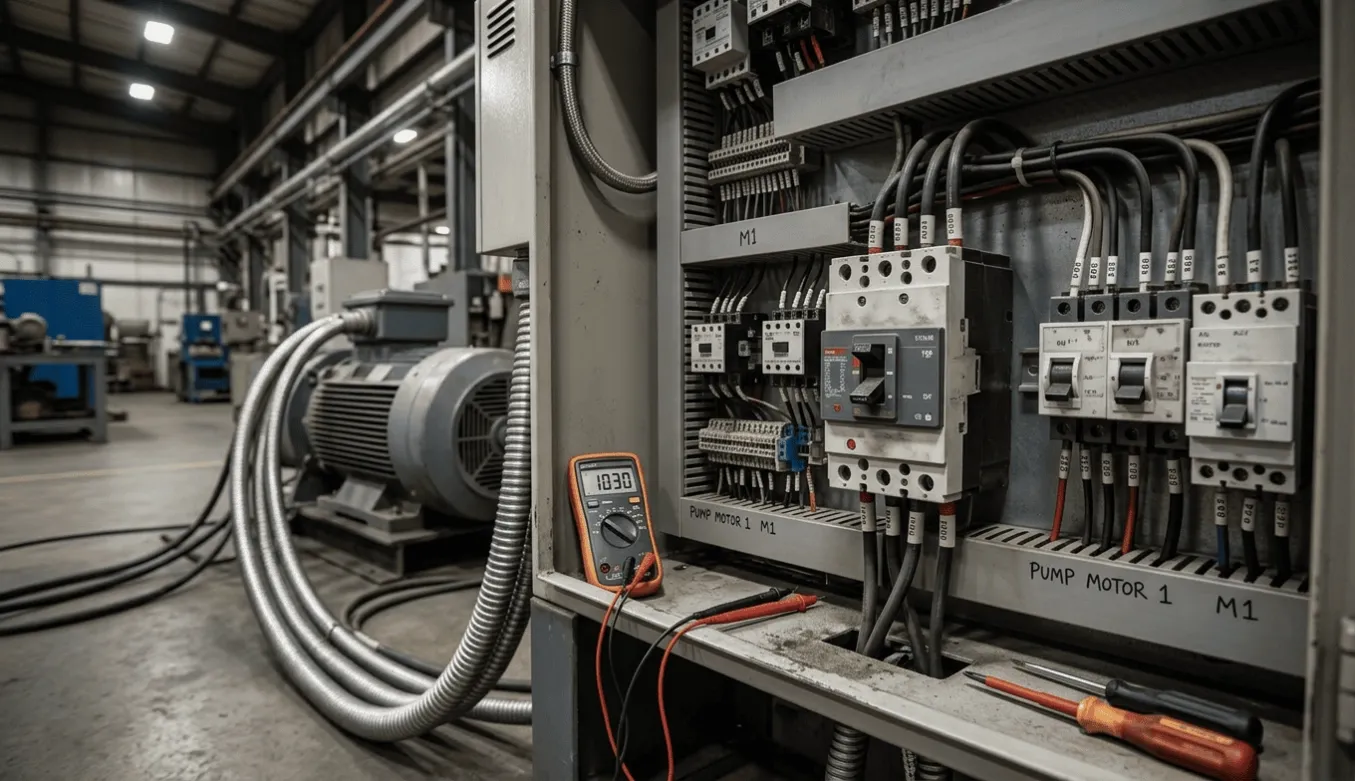
Your motor runs at 15 A, but the 16 A circuit breaker trips almost every time it starts. The first reaction is usually to replace the breaker, especially when the machine has already passed factory testing and nobody wants another commissioning delay.
But the 16 A marking doesn't tell you how the breaker responds to the much higher current drawn during startup. That depends on its trip characteristics, the motor's starting behavior, and the protection arrangement around it.
For a panel buyer, this distinction matters before ordering components. A breaker with the right brand and rated current can still be unsuitable for a particular motor circuit, and discovering that after installation may mean additional engineering, replacement parts, and lost production time.
A 16 A Breaker Is Not Necessarily Designed to Ignore a 100 A Starting Current
Consider a hypothetical 7.5 kW, 400 V, three-phase induction motor drawing approximately 15 A at its rated operating condition. If started directly across the line, it might draw six or more times that current before reaching normal speed.
At six times the rated current, the starting current would be approximately 90 A.
Now imagine the supplier has selected a 16 A B-curve miniature circuit breaker.
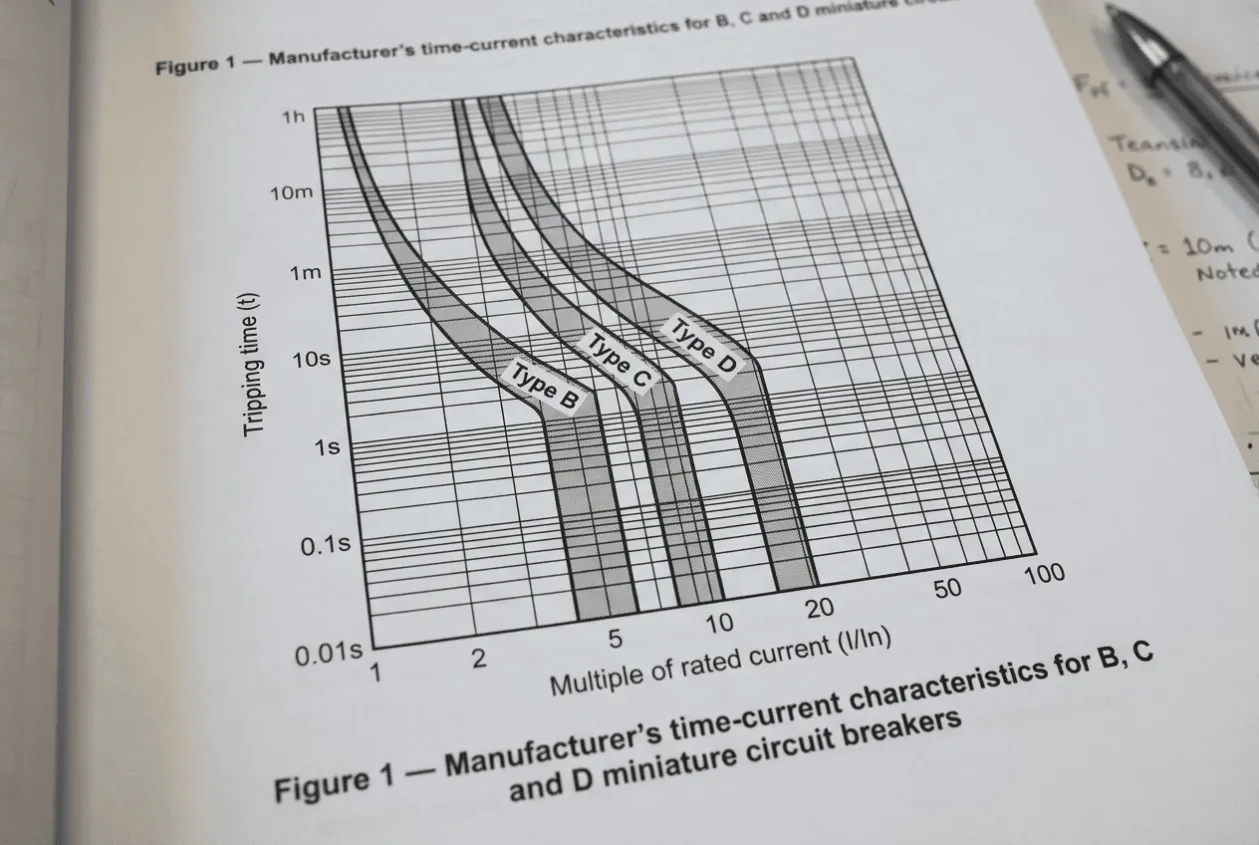
For IEC 60898-1 B-curve devices, the conventional instantaneous tripping range is three to five times the breaker's rated current. A 16 A device therefore has an instantaneous band around 48–80 A.
The motor's hypothetical 90 A starting current exceeds that band, making an instantaneous trip unsurprising.
Changing to a 16 A C-curve device moves the conventional instantaneous range to approximately 80–160 A. This may improve tolerance of the starting current, but it does not guarantee successful starting or adequate fault protection.
The actual motor starting-current profile and manufacturer-specific breaker curve still have to be checked.
Figure 1—Manufacturer's time-current characteristics for B, C, and D miniature circuit breakers.
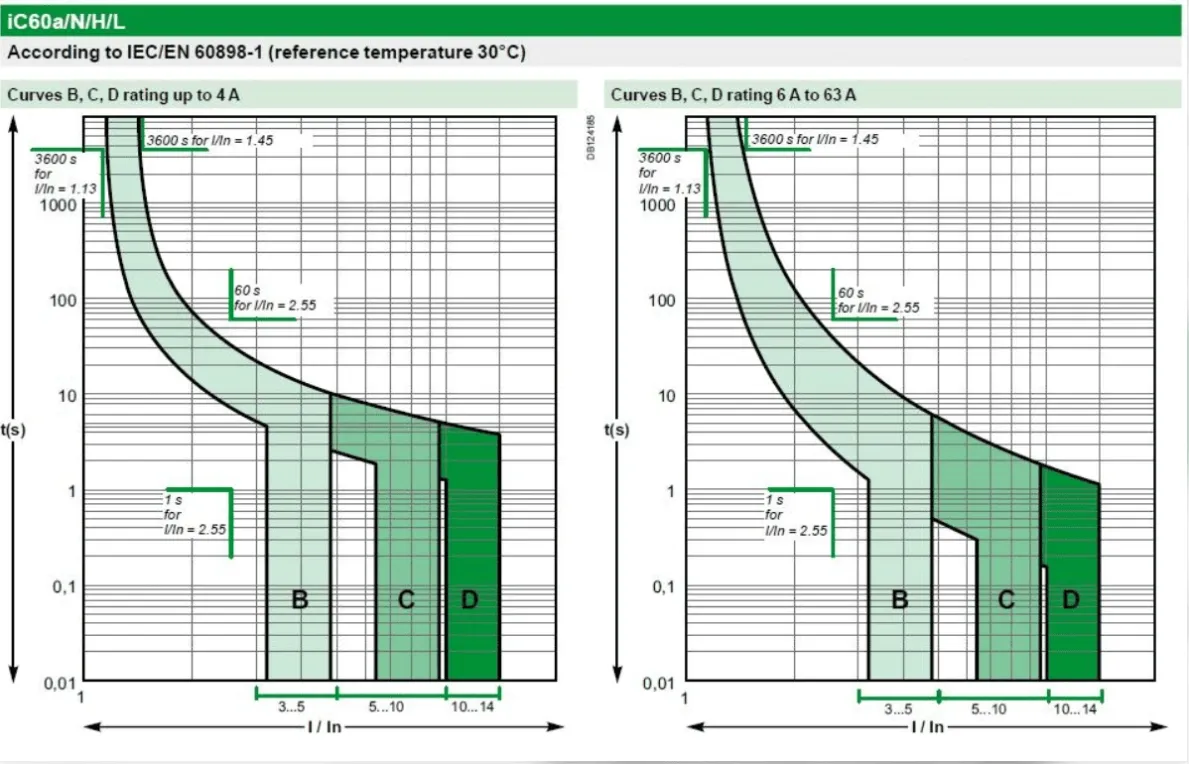
Source: Schneider Electric, Acti9 iC60 trip characteristics. Curves are product-specific and shown at stated reference conditions.
The difference becomes clearer when the three conventional IEC 60898-1 AC instantaneous tripping ranges are compared.
Breaker curve | Instantaneous range | Equivalent for a 16 A breaker | Purchasing implication |
|---|---|---|---|
B | 3–5 × rated current | 48–80 A | Lower magnetic threshold; may be unsuitable for high-inrush loads |
C | 5–10 × rated current | 80–160 A | Greater inrush tolerance, subject to proper fault protection |
D | 10–20 × rated current | 160–320 A | Higher inrush tolerance, requiring careful fault-disconnection verification |
These ranges explain why the curve letter matters, but they are not a product-selection chart. Industrial breakers under IEC 60947-2 may have different or adjustable characteristics, and dedicated motor protection devices need to be evaluated according to their own documentation.
Schneider Electric's technical explanation of B, C and D curves and ABB's published MCB characteristic charts provide useful references.
Before Changing the Curve, Check How the Motor Is Started
When I review a motor control panel quotation, I would not begin by asking whether the supplier has chosen a B, C or D curve. I would first want to understand the starting method.
A direct-on-line motor starter can produce a substantial starting current. A soft starter reduces or controls the starting electrical stress through its operating characteristics, while a VFD supplies the motor through an electronic drive with its own input and output behavior.
Those arrangements cannot be treated as interchangeable when selecting protection.
For example, changing a direct-on-line starter to a VFD does not simply mean using the old breaker with a different curve. The drive manufacturer may specify particular upstream circuit breakers, fuses, cable arrangements, and protective devices.
For some direct-on-line motor circuits, a dedicated motor-protective circuit breaker coordinated with a contactor and overload protection is more appropriate than a general-purpose MCB.
Figure 2—Real motor control panel with protective devices, contactors, and associated wiring.
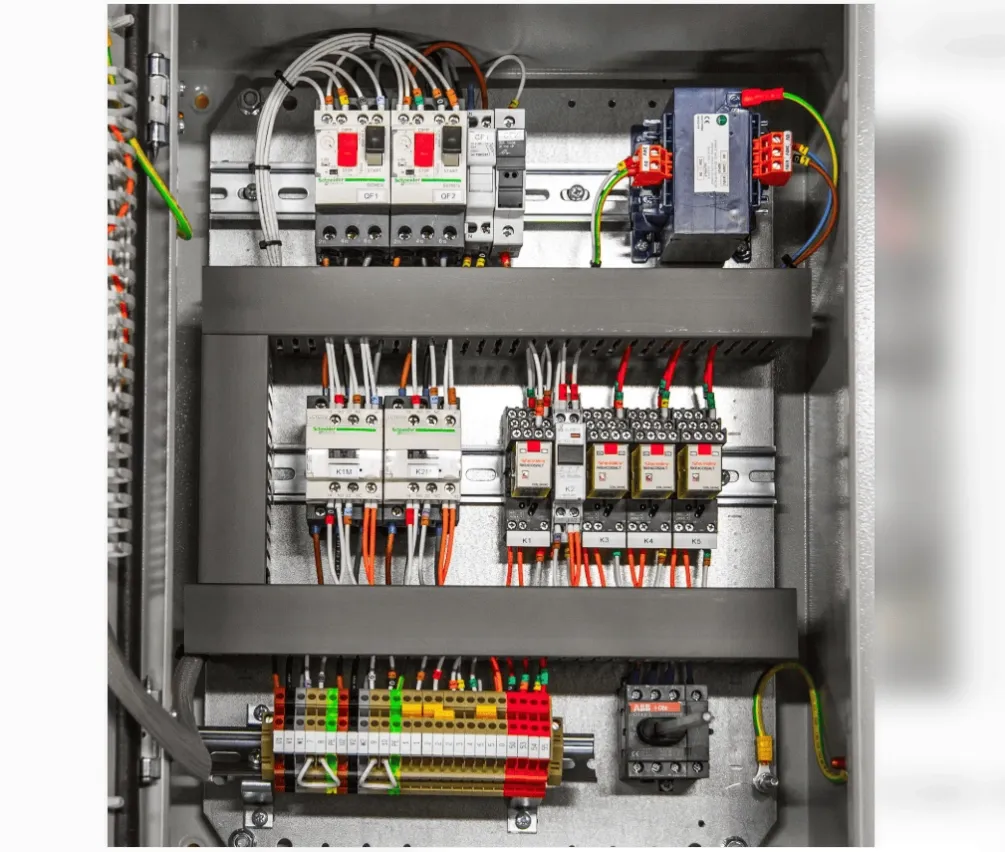
This is why two control panel quotations can contain different protection components even when the motor ratings appear identical.
One supplier may have selected components based on the actual starting method and coordination requirements. Another may have priced the circuit from the motor's rated current alone.
The second quotation may look cheaper, but the component list does not yet demonstrate that the motor will start reliably or that the circuit is properly protected.
A useful supplier response should explain the starting method, expected starting current, overload protection, short-circuit protection and any required coordination between the devices.
The manufacturer's selection documentation is more persuasive than an assurance that the breaker is a well-known brand.
What If the Breaker Trips After the Motor Has Been Running?
A breaker that opens immediately during starting suggests a different investigation from one that trips after an hour of operation.
Schneider Electric recommends first distinguishing startup-related trips from those occurring after sustained operation, because the timing can indicate whether instantaneous or thermal protection deserves attention.
However, timing is a clue rather than proof. A genuine short circuit, earth fault, released accessory, or defective connection can also produce unexpected operation.
For delayed trips, the investigation should include motor load, measured current, supply conditions, and enclosure temperature.
Consider a machine that operates normally during factory testing but repeatedly stops during hot afternoons at its final installation. The problem may be related to enclosure temperature rather than an incorrect breaker rating.
Thermal-magnetic breakers are affected by temperature, and manufacturers publish reference conditions and applicable derating information.
The engineer should compare the actual panel temperature and operating current against the selected device's characteristics rather than apply a generic temperature correction.
Loose or damaged terminations can also produce localized heating. These require inspection and appropriate electrical testing by qualified personnel, not repeated resetting under load.
The following comparison helps identify where an investigation should begin.
Observed problem | What to investigate first | Information worth requesting |
|---|---|---|
Trips immediately when the motor starts | Inrush current, short circuit, instantaneous protection | Motor starting-current data and breaker curve |
Trips after 30–60 minutes | Sustained overload, heating, thermal response | Operating current, temperature, and load history |
Trips more often in hot weather | Enclosure temperature and device derating | Internal panel temperature and manufacturer data |
Trips when another machine starts | Voltage disturbance or release accessory operation | Supply voltage recording and protection schematic |
Trips remain after a suitable replacement. | Circuit fault, application mismatch, or accessory problem | Fault history and qualified diagnostic report |
A breaker that trips is reporting an event. The useful work is determining what happened in the circuit before the event, not merely recording that the device opened.
Why a Bigger Breaker May Be the Wrong Repair
There is a strong temptation to increase a breaker's current rating when repeated trips interrupt production.
If a 16 A device keeps opening, a 20 A or 25 A replacement may seem like a practical solution. Unfortunately, increasing the rating can affect the protection provided to the installed cables and connected equipment.
IEC 60204-1 addresses overcurrent protection for machinery, including the need to accommodate anticipated operating currents while maintaining adequate protection. Its requirements also consider prospective short-circuit current and the breaking capacity of protective devices.
A higher breaking capacity, such as 10 kA instead of 6 kA, does not mean a breaker is less likely to trip during motor starting. Breaking capacity describes its ability to interrupt a specified fault current under defined conditions, not the current that initiates its trip mechanism.
Similarly, selecting a D-curve breaker because it tolerates higher inrush may create another issue if the available fault current and circuit impedance are insufficient to achieve the required disconnection performance.
Before making a substitution, the responsible engineer should verify conductor protection, motor overload protection, fault-disconnection requirements, and the selected device's actual characteristics.
For more on the relationship between conductor size and protective devices, see our Control Panel Wire Sizing Guide.
It may turn out that a different curve is appropriate. It may also turn out that the motor needs a different starting arrangement or that the original circuit has an electrical fault.
Those conclusions require different purchasing decisions.
What Should a Buyer Require in the Control Panel Quotation?
A buyer should not have to perform the panel designer's calculations. But they should be able to tell whether the quotation contains enough information to support a proper engineering review.
If the project includes motors, ask the supplier to identify the protection arrangement for each relevant circuit. The answer should include the exact protective-device model, rated current, trip characteristics or settings, breaking capacity, and the corresponding motor and starter information.
Where the installation conditions are not yet finalized, the supplier should identify the assumptions used for selecting protection.
That becomes especially important when a machine is built in China but installed overseas. Factory testing may confirm that the control sequence works, while the final electrical installation has different supply or fault-current conditions from those assumed during manufacturing.
For a quotation involving a direct-on-line motor, I would use a request along these lines:
Please confirm the proposed motor starting method and protection arrangement, including the breaker model, trip characteristics, overload protection and short-circuit rating. We would also like to understand how the protective devices have been selected against the motor's expected starting current and the installation requirements.
This asks the supplier to explain the design rather than simply supply another brand or a higher-rated breaker.
A supplier who can provide a clear protection schedule, relevant manufacturer references and the assumptions used in the design makes the buyer's technical review easier.
If those details are missing, it is worth resolving them before approving the bill of materials.
Where UniRegal Can Help
At UniRegal, we coordinate industrial control cabinet fabrication and automation component sourcing through our supplier network in China.
For new control panel projects, we can help organize the load information, electrical drawings and component requirements needed for supplier quotations. Where protective-device selection or coordination is involved, the relevant technical decisions must be reviewed by appropriately qualified designers and manufacturers.
For replacement components, the original breaker model and operating conditions are a useful starting point. A replacement should not be selected from rated current alone, particularly when the existing device has been tripping repeatedly.
If you are reviewing a control panel quotation or sourcing motor protection components, send UniRegal your drawings or component list, together with the motor specifications, starting method and destination market.
For an existing tripping problem, include the breaker model and a description of when the trip occurs. Those details can help clarify the sourcing enquiry and identify which technical questions need to be resolved before replacement parts are considered.
The purpose of a well-specified protection system is not simply to keep the machine running without interruption. It is to allow normal operation while ensuring that abnormal electrical conditions are dealt with safely. A purchasing decision that preserves both is worth more than a quick component substitution.