
Sep 28, 2026Buying Guides
How to Choose a Motor Control Panel Supplier in China: 7 Questions to Ask
A practical 7-question checklist for qualifying a motor control panel supplier in China — certifications, component brands, FAT, enclosure rating, MOQ, change control and after-sales — plus a scorecar

Qualifying a motor control panel supplier in China comes down to seven questions. Ask all seven, in writing, and compare the answers side by side before you place the order. Suppliers that answer with specifics—certificate numbers, sample FAT reports, named component brands, real lead times—are the ones that deliver. Suppliers that answer with vagueness are the ones that cost you a line stoppage six months later.
This guide is the practical, pre-RFQ companion to our deeper How to Evaluate a Motor Control Panel Supplier article — use the seven questions below to shortlist, then use the evaluation framework to pick the winner. For the panel-side specification and the components we source, see our Motor Control Panel, MCC Panel, and our broader Custom Control Panels overview — and our Electrical Enclosure Sourcing Guide for the cabinet and cooling side.
A note on who is writing this: we are a sourcing partner and panel-build service, not a manufacturer. We engineer and source motor control panels through audited build shops, quote by named component family, and document every build with FAT records. The checklist below is what we would hand a buyer evaluating us—so it works just as well on any supplier you are considering.
Buyer Decision: Treat the seven questions as a filter, not a formality. One weak answer on certifications, component brands, or FAT is enough to drop a supplier from the shortlist. The cost of finding out after shipment is always higher than the cost of asking now.
Why these seven questions matter
A motor control panel looks simple from the outside: a steel box, some drives, some contactors, and a few meters of wire. It is one of the most failure-prone assemblies in a plant because the failure modes are invisible until the panel is energized under load. The seven questions below target the seven things that actually separate a panel that runs for ten years from a panel that trips in month six.
At the end you will find a scorecard table you can paste into your RFQ. Send it to every supplier and score the replies on the same scale—that removes the "they all sound good on the phone" problem.
Q1: Which certifications can you document?
Certifications are the first filter because they are the easiest to lie about and the easiest to verify. A verbal "we are certified" is worth nothing. You want certificate references, and you want to know which configuration each certificate covers.
The three that matter for export
- UL 508A for North America—the standard for industrial control panels. Ask for the shop's UL 508A listing number, not just a generic "UL certified" claim. (Reference: ul.com)
- CE / EN 61439 for Europe—the low-voltage switchgear and controlgear assembly standard. For a panel, this is the mark a European buyer expects.
- IEC 60204-1 for machinery safety—the electrical equipment of machines standard. If your panel sits inside a machine, this is the one your end customer's auditor will ask about. (Reference: iec.ch)
A sourcing partner should be able to tell you, in writing, exactly which of these they can supply for your configuration—and, if you need a UL mark on a one-off, should be able to route the build through a UL-listed shop on a per-order basis rather than bluffing the certification.
Engineering Note: If a supplier quotes a UL 508A panel but cannot give you a listing number, assume the panel is built to UL 508A wiring practice but is not listed. That is a different thing, and your North American inspector will notice.
Q2: Which component brands do you fit as standard?
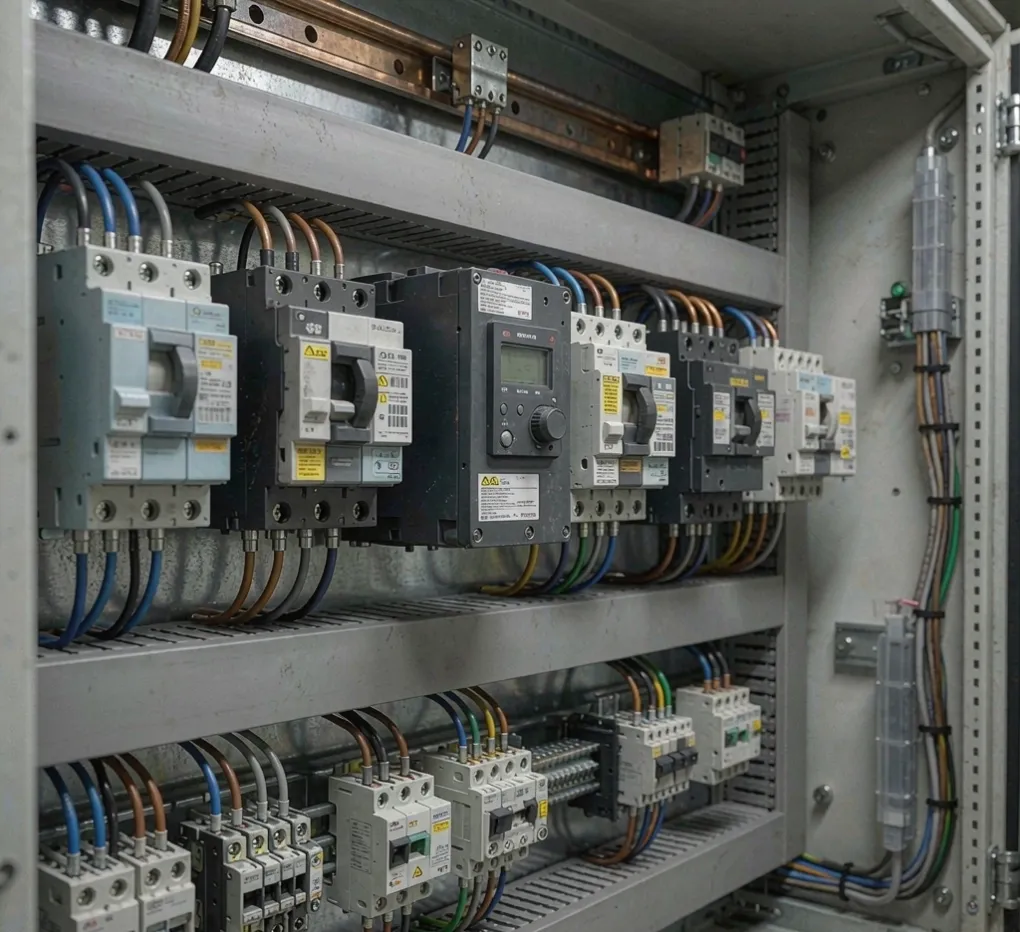
The components inside the panel decide its life. Ask the supplier to quote by component family, not just "a 22 kW drive." The answer should name brands you recognize.
The brands that signal a serious build
For a general industrial motor control panel, standard quotes should name Siemens, Mitsubishi, ABB, Schneider, or Danfoss (for drives and soft starters), or clearly stated equivalents. These are the brands your maintenance team already stocks spares for and the brands whose failure rates you can predict.
Why unapproved substitution is the red flag
If the answer to "which brands?" is "whatever is cheap" or "we use a local equivalent," walk away. Unapproved component substitution is the single most common source of field failures we see on panels sourced purely on price. A drive that is 10% cheaper and 40% more likely to fail is not a saving—it is a future outage with your name on it.
A good supplier will push back: "For a 22 kW pump panel we fit a Siemens G120 or Mitsubishi FR-A800 as standard; if you want a lower-cost alternative, we will name it and flag the trade-off." "That is the answer you want.
Q3: What does your FAT actually cover?
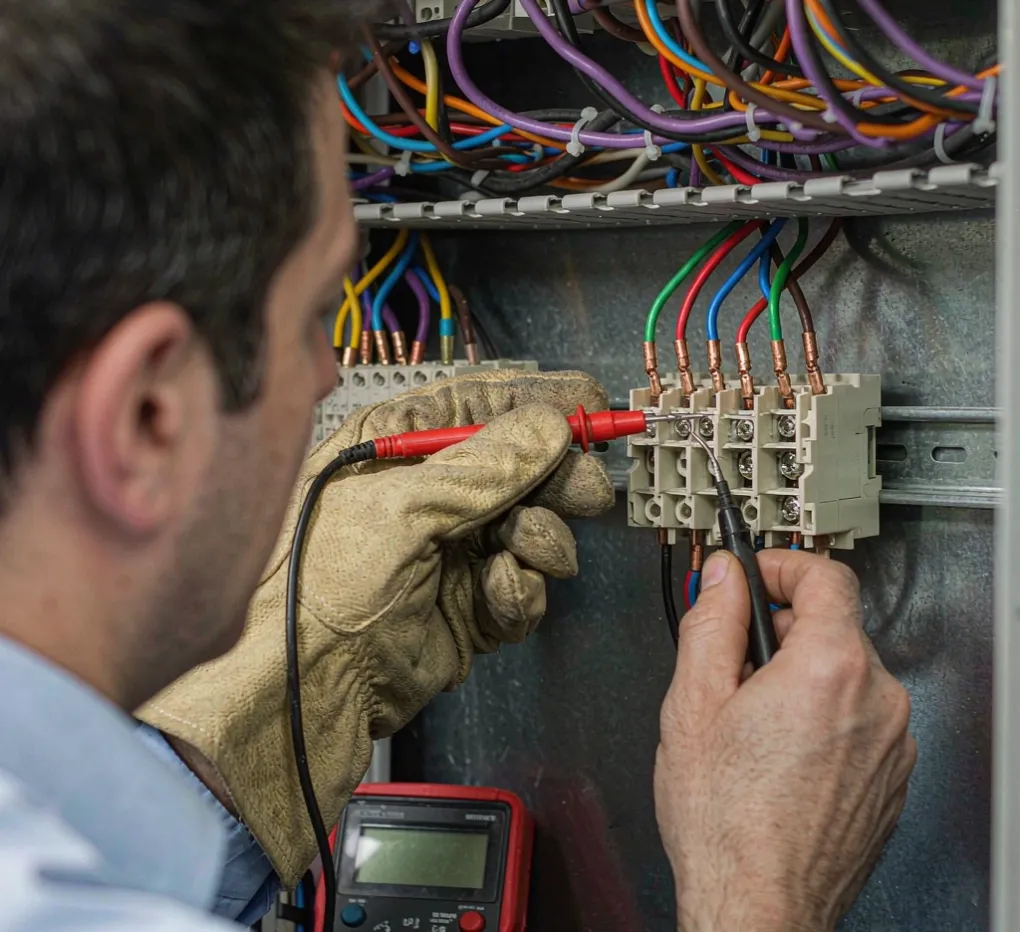
FAT—Factory Acceptance Test—is where a panel proves it works before it leaves the build shop. A real FAT is documented, repeatable, and covers far more than "we switched it on."
What a real FAT report contains
- Wiring verification against the approved schematic—every wire, every terminal, and every cross-reference checked.
- Insulation resistance test—megger readings between live parts and earth, and between circuits, to a stated threshold.
- Point-to-point I/O check—every input and output forced and confirmed, not assumed.
- Functional test of every drive and contactor—each VFD ramped, each starter exercised, each interlock proven, under load where practical.
Ask to see a sample FAT report format before you order. If the supplier cannot show you one—or shows a one-line "tested OK"—that is your answer about quality culture. We include FAT records with every panel we ship; if a supplier will not commit to the same in writing, the panel is a guess.
Buyer Decision: "We test everything" is not a FAT. A FAT is a document with numbers on it. If you cannot get the document format up front, you will not get the document after build either.
Q4: What IP rating and enclosure material do you recommend for my site?
The right supplier asks about your environment before quoting a box. If the first quote arrives with a standard painted steel panel and no questions asked, the supplier is quoting a catalog, not your site.
The standard mapping
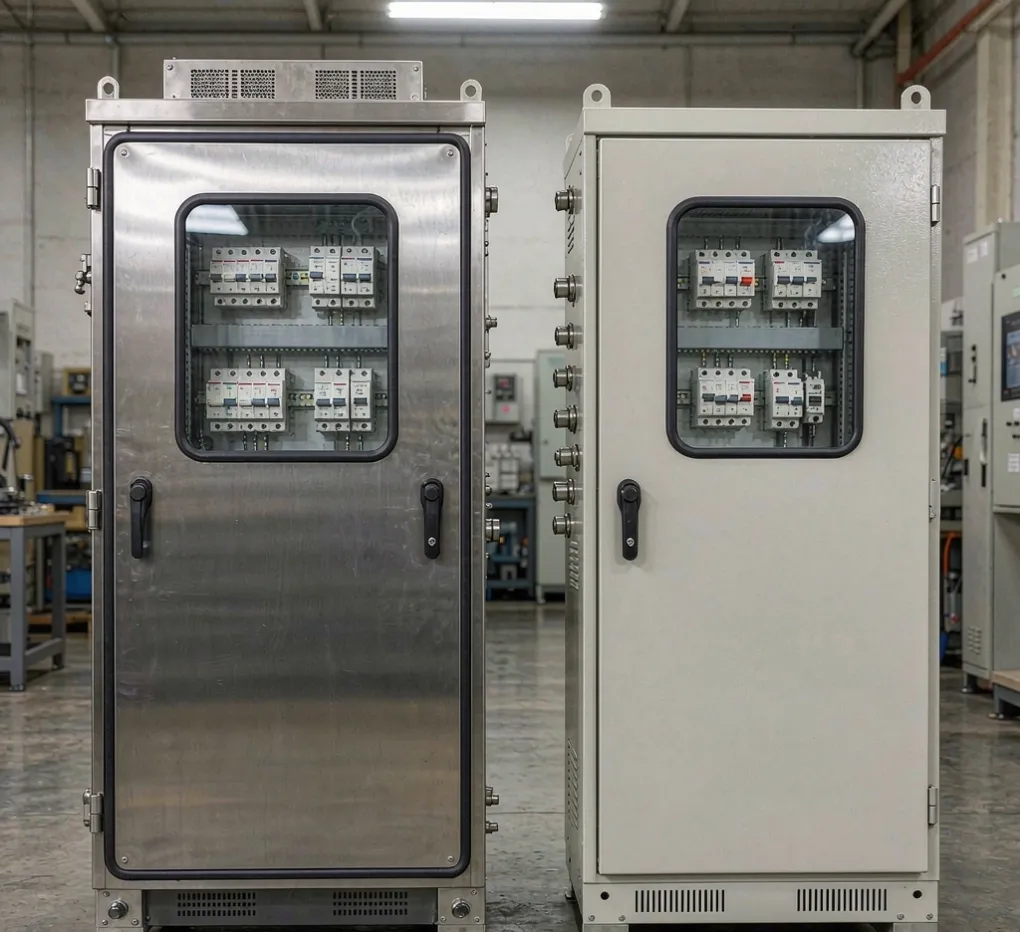
- Indoor, dry: IP41–IP54 coated carbon steel is usually right. Cheap, serviceable, fine in a clean room.
- Outdoor or washdown: IP65–IP66 in 304 or 316 stainless, with a polyurethane-foam gasket and a proper NEMA 4X-equivalent door seal. (Reference: nema.org)
- Corrosive or coastal: 316 stainless over 304, because the chloride in coastal air eats 304.
We do carbon steel, 304 and 316 stainless, and galvanized—we do not build in aluminum, because it does not suit the mechanical and thermal demands of a drive-filled panel. A supplier who recommends the material after hearing about your site, rather than before, is the one thinking about your failure modes.
Engineering Note: IP and NEMA are not the same scale, but for a buyer the practical rule holds: IP65 ≈ NEMA 4, IP66 ≈ NEMA 4X for water ingress. Ask which one your end customer's spec demands and quote to that, not to the cheaper number.
Q5: What are your MOQ and lead times at 5, 10, and 20 units?
Volume terms expose whether you are talking to a sourcing partner or a large factory. The numbers should move sensibly with quantity, and the MOQ should match your reality.
What a sourcing partner quotes
A sourcing partner should be able to quote a 5-unit MOQ without an engineering surcharge, with 15–20 days production at typical panel complexity—because the build is driven by your drawings and BOM, not by a factory's minimum batch. Element-level spares (drives, contactors, HMI) ship in 3–5 days because they are standard stock components.
What a large factory quotes
A larger factory will push you to 50+ units to amortize setup and will quote 4–8 weeks because their line is built for volume, not flexibility. Neither is wrong—but pick the structure that matches your volume. If you need 5 panels now and 20 next quarter, a partner structure fits; if you need 500 identical panels a year, a factory structure fits.
Buyer Decision: State your true volume up front. A supplier quoting 50-unit MOQs to a 5-panel buyer is not a bad supplier — they are the wrong supplier for you. The mismatch itself is the signal.
Q6: How do you handle drawing changes?
Changes are where panels get expensive and where undisciplined suppliers bleed you. The rule every buyer should hear: changes before cutting are cheap; changes after wiring are not.
The process you want in writing
- Drawing review before production—a signed-off approval step where you and the supplier confirm the schematic, BOM, and layout before metal is cut.
- A change-request mechanism—a defined way to submit and price a change, not "just tell us and we'll sort it."
- A revised confirmation—every change produces an updated drawing and an updated quote, re-approved, before work continues.
A disciplined supplier treats the approved drawing as a contract. If your change arrives after wiring has started, you get a revised quote and a revised schedule—not a shrug and a hope. Ask how many revision rounds are included before a change is billable; the answer tells you how confident they are in their first draft.
Q7: What after-sales support do you get from China?
The panel is shipped; the relationship is not over. The minimum a buyer should expect from a China-based supplier:

- Response within 24 hours on any query, not "we'll get back to you next week."
- Remote commissioning support—screen share, PLC program review, and drive parameter help, without you flying an engineer out.
- Spare parts availability—named, stocked components you can reorder by part number, not "send us the panel and we'll see."
Ask the blunt question: how does this supplier handle a failed drive six months after shipment? The answer should name a process—cross-ship a spare, remote-diagnose, RMA the failed unit—not a pause. A sourcing partner lives or dies on this, because a buyer remembers the outage longer than the discount.
A supplier scorecard you can use
Paste this into your RFQ. Score every supplier 1–5 on each dimension, then total. A supplier under 25 of 35 is a risk; a supplier at 30+ with specifics is a shortlist.
Dimension | Red flag (score 1) | Strong answer (score 5) |
|---|---|---|
Certifications documented | "We are certified" (no numbers). | UL 508A / EN 61439 / IEC 60204-1 with listing refs |
Component brands quoted | "Whatever is cheap." | Siemens / Mitsubishi / ABB / Schneider / Danfoss by family |
FAT depth | "Tested OK" | Wiring + insulation + I/O + functional, documented |
Enclosure recommendation | One catalog box for every site | IP/material matched to your environment |
MOQ & lead time | 50+ MOQ, no flexibility | 5-unit MOQ, 15–20 days, scales with volume |
Change control | Ad hoc, after-the-fact | Review → request → revised confirmation, in writing |
After-sales | "Contact us anytime." | 24h response, remote commissioning, spares by P/N |
Engineering Note: The scorecard is only as honest as your scoring. Force every supplier onto the same 1–5 scale and refuse to score a dimension you cannot verify — a "we think 5" with no evidence is a 2.
Red flags to avoid
Consolidated, because they recur:
- No FAT report format available before order—quality is undocumented.
- Vague lead times ("about a month") with no volume break — planning is impossible.
- Refusal to name component brands — substitution risk you cannot manage.
- MOQ that does not match your volume and no willingness to discuss it.
- No drawing-review step — you are approving after the fact, not before.
- No after-sales process for a failed component post-shipment.
Any one of these is a reason to keep looking. Two or more is a reason to walk.
Request an engineering review
You do not have to answer all seven questions alone. Send us your motor list, single-line diagram, or BOM and our engineers review it before quotation — enclosure rating, component brands, FAT scope, and lead time — and respond within 24 hours.
If you are still shortlisting, our Top 10 Control Panel Suppliers in China ranks the field by the same dimensions above, and our How to Choose the Right Motor Starting Method helps you specify the panel correctly before you ask anyone to build it.
FAQ
Do I need UL 508A if I am not shipping to North America?
Only if the panel's final destination is the US or Canada, or if your end customer's spec demands it. For Europe, CE / EN 61439 is the mark; for machinery, IEC 60204-1 applies. Ask the supplier to state which they can document for your destination, not which they hold in general.
Is a 5-unit MOQ realistic for a custom panel?
Yes, from a sourcing partner. The build is driven by your drawings and BOM, so batch size is flexible; 15–20 days is normal at typical complexity. Large factories push 50+ because their line is volume-shaped, not because 5 is impossible.
What if a supplier offers a much cheaper "equivalent" drive?
Make them name it and flag the trade-off in writing — failure rate, spares availability, software support. A cheaper drive with no local spares and a higher failure rate is not a saving; it is deferred downtime.
How much FAT is enough for a simple pump panel?
Wiring verification, insulation resistance, and a functional run of the drive and starters under load. You do not need a full environmental test, but you do need the numbers on paper. If the supplier cannot show the report format, that is the gap.
Can I get a panel in stainless if my site is coastal?
Yes — 316 stainless for coastal and corrosive sites, IP65–IP66 with a NEMA 4X-equivalent gasket. We do not build panels in aluminum; 304/316 stainless, carbon steel, and galvanized cover the real industrial cases. Match the material to the chloride load, not the catalog.
What happens when a drive fails six months after shipment?
A disciplined supplier cross-ships a spare by part number, remote-diagnoses the fault, and RMA the failed unit — without you flying an engineer. Ask this question explicitly; the quality of the answer predicts the quality of the relationship.
Engineering Takeaway
Choosing a motor control panel supplier in China is not about finding the lowest quote — it is about removing the seven unknowns that turn into outages. Certifications you can verify, component brands you can name, a FAT you can read, an enclosure matched to your site, volume terms that fit you, change control you can trust, and after-sales that answer the phone. Ask all seven in writing, score them on one scale, and the right supplier separates from the rest without a site visit. Send us your drawings and we will show you what a specific answer looks like.