
Sep 13, 2026Buying Guides
How to Choose a Motor Control Panel Supplier in China: 7 Questions to Ask
Seven questions that separate a real motor control panel factory in China from a trading company: verifiable certification, test records, lead time, and true landed cost.
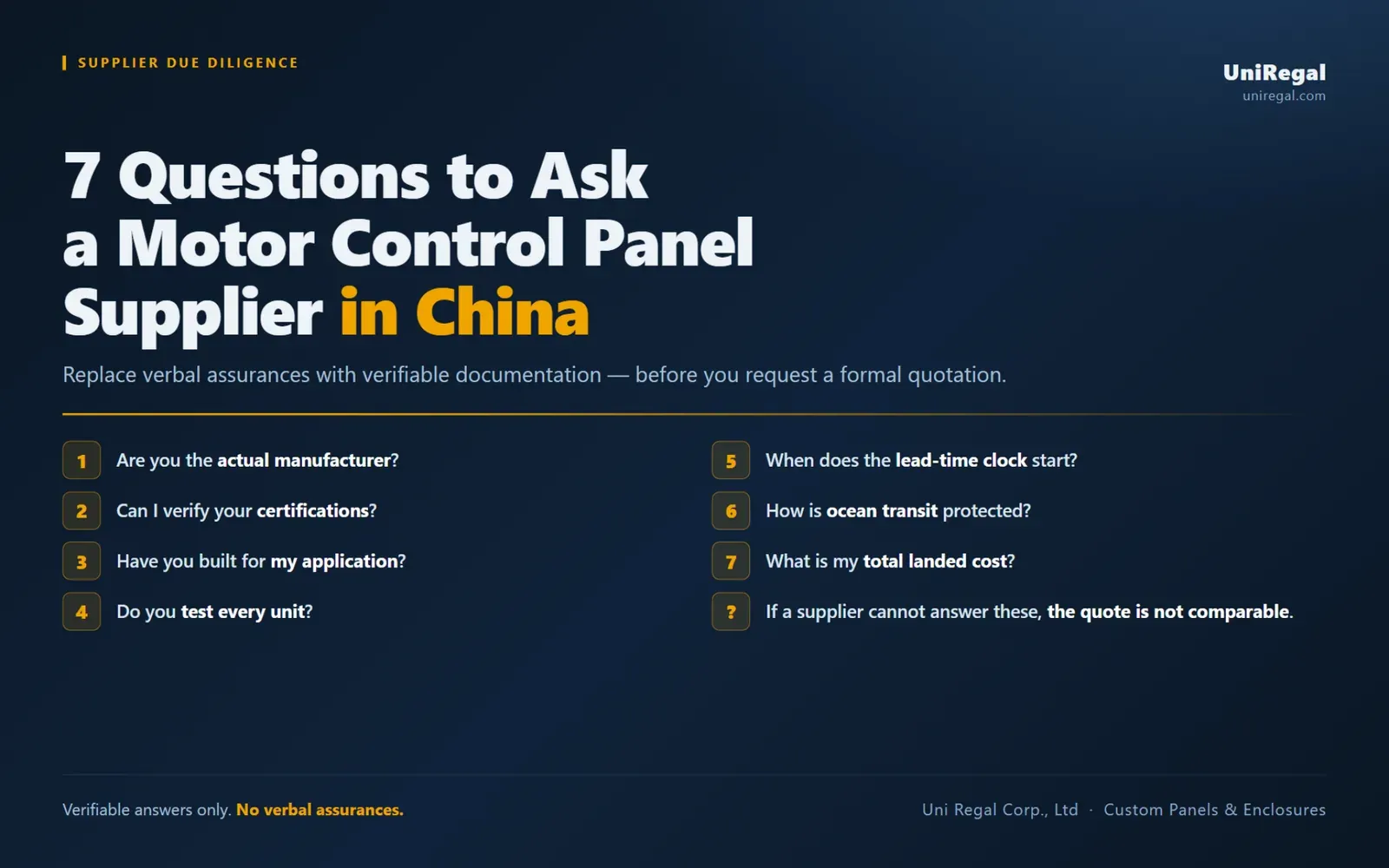
Sourcing custom motor control panels (MCC, VFD, pump, and PLC enclosures) from China can deliver substantial cost and manufacturing advantages, but asking the wrong questions during supplier vetting creates costly delays, non-compliant builds, and unexpected landed costs.
Quick Answer
Choosing a reliable motor control panel manufacturer in China comes down to one principle: replace verbal assurances with verifiable documentation before you request a formal quote. A dependable partner will readily prove manufacturing scope on their business license, provide traceable certification numbers for your destination market, show relevant application references, share routine per-unit test records (hi-pot, insulation, grounding, and torque), commit to a clear lead-time trigger with contractual delay remedies, use seaworthy moisture-barrier packaging, and itemize total landed costs.
The Reality of Sourcing Motor Control Panels from China
When international engineering teams and procurement managers source custom motor control centers (MCC), variable frequency drive (VFD) panels, or industrial pump starter panels from China, the initial evaluation often focuses entirely on the unit price and stated lead time.
However, in custom electrical manufacturing, asking vague questions produces comforting answers that rarely hold up during site installation or customs clearance. An overseas trading intermediary can easily present glossy product catalogs, claim compliance with international standards, and promise rapid shipment. When the panel arrives on site with unverified switchgear components, missing routine test sheets, or moisture ingress from ocean transit, the initial savings are wiped out by field rework, inspection failures, or project shutdowns.
In our experience building custom industrial enclosures and control assemblies for international projects across Southeast Asia, the Middle East, Eastern Europe, Africa, and Latin America, successful overseas procurement requires a disciplined due-diligence framework. You must verify factory authenticity, engineering rigor, regulatory compliance, and commercial accountability before committing engineering resources or milestone payments.
How to Use These Seven Questions
We recommend using these seven questions as a practical due-diligence checklist during your initial supplier pre-qualification, before issuing a detailed Request for Quotation (RFQ).
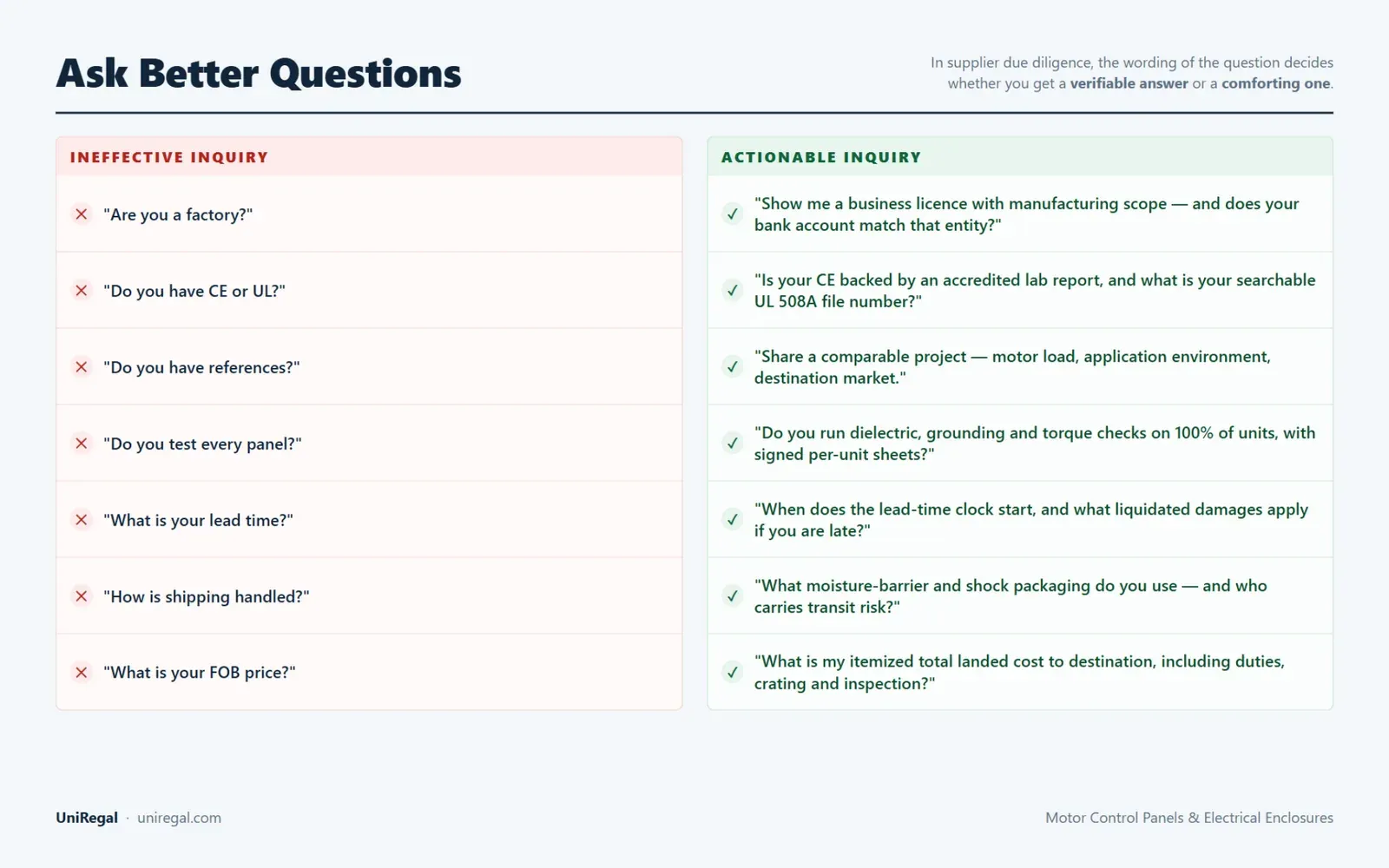
The difference between a frustrating procurement experience and a smooth delivery often comes down to moving from subjective questions to verifiable inquiries:
Ineffective Inquiries (Verbal / Ambiguous) | Actionable Inquiries (Verifiable / Traceable) |
|---|---|
"Are you a factory?" | "Can I see your business license showing 'manufacturing' in its scope, and does your corporate bank account match that entity?" |
"Do you have CE or UL?" | "Is your CE backed by an accredited lab test report, and what is your searchable UL 508A file number?" |
"Do you have references?" | "Can you share a comparable project reference detailing the motor load, application environment, and destination market?" |
"Do you test every panel?" | "Do you perform routine dielectric, grounding, and torque verification on 100% of units and provide signed per-unit test sheets?" |
"What is your lead time?" | "When does the lead-time clock officially start, and what liquidated damages apply for supplier-caused delays?" |
"How is shipping handled?" | "What specific moisture-barrier and shock-absorbing packaging do you use for ocean freight, and who assumes transit risk?" |
"What is your FOB price?" | "What is the itemized total landed cost to our destination port, including duties, crating, and inspection fees?" |
Q1: Are You the Actual Manufacturer, and Can I Verify Your Registered Scope and Production Floor?
Why This Matters
In the Chinese electrical export market, many commercial entities presenting themselves as custom panel builders are actually export trading companies or project brokers. While trading companies have their place in standard commodity sourcing, custom motor control panels require direct engineering collaboration between your electrical team and the panel shop floor. Miscommunication across an intermediary often leads to errors in single-line diagrams, incorrect terminal labeling, or unapproved component substitutions.
What to Ask and Verify
- Registered Business Scope: Request a copy of the supplier's Unified Social Credit Business License. Verify that the registered scope explicitly includes manufacturing, assembly, or fabrication of electrical equipment, rather than strictly commercial trade, distribution, or consulting.
- Corporate Banking Details: Confirm that the proforma invoice bank account name matches the exact legal corporate entity on the business license. Payments routed to unrelated third-party accounts or individual personal accounts represent an immediate governance and fraud risk.
- Live Shop Floor Verification: Request a live video walk-through of the fabrication, busbar bending, wiring, and testing stations, or schedule an independent third-party factory audit if your procurement volume warrants the expense.
When evaluating sheet metal construction alongside internal integration, reviewing our guide on sourcing electrical enclosures from China provides additional criteria for assessing in-house metal fabrication and powder-coating capabilities.
Supplier red flag — The supplier refuses a live shop-floor video walk-through, provides banking details belonging to an offshore trading shell or private individual, or provides a business license limited strictly to commercial consulting and trading.
Supplier green flag — The supplier readily shares an official business license with explicit manufacturing scope, provides an exact-match corporate bank account, and welcomes scheduled video audits or third-party shop inspections.
Q2: Which Certifications Do You Hold for My Destination Market, and Can I Verify the Certificate Numbers?
Why This Matters
Electrical compliance is strictly regional. A panel built to Chinese domestic standards (such as CCC) cannot be installed legally in the European Union or North America without meeting relevant regional directives and electrical safety codes. Furthermore, displaying standard logos on a company presentation does not guarantee that your specific panel build is legally certified or compliant.
What to Ask and Verify
- Low-Voltage Assembly Standards (IEC 61439): For international markets following International Electrotechnical Commission guidelines, verify whether the panel design is backed by design verification reports in accordance with IEC 61439-1 / IEC 61439-2. Inquire whether short-circuit withstand ratings and temperature rise limits were verified by type-testing at an accredited independent laboratory (such as DEKRA, SGS, KEMA, or equivalent) or derived through documented engineering calculations.
- European Union (CE Marking & DoC): Understand that CE marking on industrial control panels under the Low Voltage Directive (2014/35/EU) and Machinery Directive (2006/42/EC) is typically a manufacturer's Declaration of Conformity (DoC). Ask for the formal DoC alongside the underlying test reports issued by an accredited laboratory, rather than accepting a generic graphic mark.
- North America (UL 508A / cUL): If your destination is the United States or Canada, distinguish between vague marketing phrases like "built to UL standards" and genuine listing. Request the supplier's specific UL File Number and verify its active status directly through UL's online certification directory (such as UL Product iQ).
- Destination-Specific Clearance Certificates: For shipments to markets such as Nigeria (SONCAP), Kenya (KEBS), South Africa (SABS), the Eurasian Economic Union (EAC), or the Middle East (SASO/SABER), confirm that the supplier understands the destination conformity assessment program and can provide compliant documentation to avoid customs impoundment.
For broader background on global certification processes and testing protocols, consult our detailed resource on lead time, certification, and testing FAQs.
Supplier red flag — The supplier claims universal worldwide certification without providing searchable certificate numbers, confuses domestic CCC with international export compliance, or describes panels as UL-compliant without possessing a verifiable UL 508A file number.
Supplier green flag — The supplier transparently identifies which standards apply, provides searchable registration numbers, supplies valid Declarations of Conformity backed by accredited lab test data, and clarifies destination-specific customs requirements.
Q3: Have You Built Panels for My Specific Application, and Can You Provide Verifiable References?
Why This Matters
A general-purpose lighting distribution board requires vastly different engineering expertise than a heavy-duty motor control center operating variable frequency drives, soft starters, or reversing contactors. A manufacturer specializing solely in standard commercial distribution may lack experience handling harmonics, dynamic braking resistors, VFD heat dissipation, pump sequencing logic, or PLC communication protocols.
What to Ask and Verify
- Comparable Application History: Inquire whether the engineering team has delivered panels for your exact industry use case—such as multi-pump booster systems, industrial wastewater aeration, conveyor material handling, crushing mills, or HVAC chillers.
- Traceable Technical Parameters: Ask for non-proprietary technical submittals or anonymized schematics from previous projects showing motor ratings (kW/HP), duty cycles, enclosure ingress protection (IP/NEMA ratings), and cooling strategies.
- Destination Environment Awareness: Ensure the supplier understands your local site operating conditions, such as high ambient desert temperatures (requiring derating calculations and panel air conditioners) or corrosive coastal environments (requiring 316 stainless steel or specialized protective coatings).
Before finalizing your technical documentation, cross-reference your project parameters against our motor and VFD control panel specification checklist to ensure critical load and protection criteria are clearly defined.
Supplier red flag — The supplier claims to build every type of industrial equipment but cannot provide single-line diagrams, thermal layouts, or anonymized technical references from previous motor control installations.
Supplier green flag — The supplier demonstrates deep familiarity with motor starting methods, willingly discusses ambient derating considerations and harmonic mitigation, and provides technical examples of past MCC or VFD builds.
Q4: Do You Run Routine Electrical Tests on Every Single Unit, and Will I Receive Per-Unit Test Records?
Why This Matters
Under international standards like IEC 61439-1 (Clause 11), passing an initial type test or design verification proves only that the theoretical engineering design is sound. It does not prove that the physical panel being crated for your project was assembled, wired, and torqued correctly. Routine testing must be conducted on 100% of finished assemblies prior to dispatch.
What to Ask and Verify
- Routine Dielectric & Insulation Resistance Tests: Demand confirmation that every panel undergoes a high-potential (hi-pot) dielectric test at specified test voltages (typically 1.5 times rated voltage or standard-defined thresholds) and insulation resistance testing before leaving the facility.
- Grounding & Protective Circuit Continuity: Verify that protective bonding and earth continuity are measured and recorded between all conductive enclosure parts and the main ground busbar.
- Mechanical Torque Verification: Inquire whether the workshop utilizes calibrated torque wrenches on all power connections and busbar joints, marking inspected fasteners with witness paint.
- Functional Logic & Wiring Check: Confirm that all control circuits, relay interlocks, PLC I/O, and remote trip circuits are fully powered and functionally tested against the schematic diagram.
- Signed Per-Unit Test Reports: Require that a signed, dated quality inspection report with exact serial numbers be included inside the enclosure documentation pocket and sent electronically prior to final shipment.
For a comprehensive framework on evaluating component layouts, thermal calculations, and functional documentation once a technical proposal is received, read our guide on how to evaluate a motor control panel supplier.
Supplier red flag — The supplier states that routine testing is conducted only as a spot check on batch orders, cannot provide a standardized routine test template, or treats FAT documentation as an optional extra.
Supplier green flag — The supplier maintains a standard Factory Acceptance Test (FAT) protocol, provides per-unit signed routine test sheets covering dielectric, grounding, torque, and functional logic, and welcomes customer or third-party inspection sign-offs.
Q5: How Is Lead Time Formally Defined, and What Contractual Remedies Apply for Delays?
Why This Matters
Lead-time misunderstandings are among the most frequent sources of friction in overseas industrial procurement. A supplier quoting "4 to 6 weeks" verbally may mean four weeks from the initial deposit, while their engineering department assumes four weeks from the final sign-off of the electrical schematics and bill of materials (BOM). In custom motor control manufacturing, component lead times (such as specialized MCCBs, VFD units, or PLC racks) can introduce substantial scheduling risks.
What to Ask and Verify
- Clock Start Trigger: Clarify the precise trigger date for the production schedule. In custom panel building, the manufacturing timeline should officially start upon Written Approval of As-Designed Schematics and General Arrangement Drawings, not merely upon receipt of the financial deposit.
- Baseline Manufacturing Horizons: While delivery schedules vary widely based on component availability and customization, standard industry lead-time guidance commonly cited for custom industrial control panels ranges between 6 to 12 weeks following final engineering approval. Any schedule must be confirmed on a project-by-project basis depending on specialized component lead times.
- Liquidated Damages Clause: Protect your project milestones by incorporating clear delay penalties into the formal commercial purchase contract. A typical industry structure includes a liquidated damages clause (for example, 0.5% to 1.0% of the contract value per week of unexcused supplier delay, capped at an agreed percentage), providing contractual accountability.
Refer back to our lead time, certification, and testing FAQs for additional insights on managing international engineering lead times and component procurement milestones.
Supplier red flag — The supplier promises unrealistically short lead times for complex custom builds without reviewing component availability, refuses to tie schedules to drawing sign-off dates, and rejects any contractual late-delivery remedies.
Supplier green flag — The supplier provides a clear critical-path schedule tied to drawing approval milestones, identifies long-lead electrical components upfront, and agrees to reasonable liquidated damages terms for unexcused delays.
Q6: How Do You Protect Assemblies During Ocean Transit, and Who Assumes Risk for Concealed Damage?
Why This Matters
Industrial motor control panels contain delicate microprocessor-based electronics, sensitive VFD power modules, precision instrumentation, and heavy copper busbars. Ocean freight subjects these enclosures to sustained vibration, container hum, extreme temperature cycling, and high relative humidity. If an enclosure is inadequately crated, sea-air moisture can condense inside contactor housings and circuit boards, causing corrosion or catastrophic flashover during on-site commissioning.
What to Ask and Verify
- Moisture-Barrier & Vacuum Sealing: Require heavy-duty heat-sealed vapor barrier packaging (such as aluminum foil vacuum bags) with calculated industrial desiccant packs placed inside the enclosure to maintain low humidity throughout ocean transit.
- Shock Isolation & ISPM 15 Crating: Ensure all export wooden crates comply with international ISPM 15 heat-treatment standards (stamped with the IPPC mark to avoid port quarantine) and feature reinforced structural skid bases suitable for forklift handling. Inquire whether heavy internal components (like large chokes or transformers) are mechanically braced to prevent transit distortion.
- Pre-Shipment Inspection & Damage Protocol: Define clear Incoterms (such as CIF, DAP, or DDP) and confirm the inspection and insurance protocol. Specify who bears liability for concealed moisture or shock damage discovered upon uncrating at your site.
To ensure all physical, electrical, and packaging criteria are verified prior to container loading, review our standardized pre-shipment checklist.
Supplier red flag — The supplier wraps electrical cabinets in standard thin plastic film without moisture barriers or desiccant, uses non-certified timber crating, or disclaims all responsibility once the container leaves the factory gate.
Supplier green flag — The supplier utilizes ISPM 15-certified wooden crating with vacuum foil sealing, internal desiccant bags, mechanical bracing for heavy sub-assemblies, and provides pre-dispatch photo verification of crated units.
Q7: What Is My Total Landed Cost and Payment Structure, Beyond the Basic FOB Quote?
Why This Matters
Evaluating overseas suppliers purely on an FOB (Free On Board) unit price creates a distorted cost comparison. An FOB quote excludes marine freight, transit insurance, import tariffs, port handling charges, customs clearance, domestic inland transport, and third-party inspection fees. Depending on destination duties and container freight rates, total landed cost can exceed the initial FOB equipment price by 25% to 45%.
What to Ask and Verify
- Itemized Landed Cost Elements: Request an itemized quotation structure distinguishing between panel fabrication, specialized packaging/crating, destination compliance documentation, ocean freight estimates, and terminal handling charges.
- Third-Party Pre-Shipment Inspection Budgeting: For project orders exceeding significant value thresholds (industry guidance commonly suggests formal third-party pre-shipment inspections for orders exceeding $20,000 to $50,000), budget approximately 0.3% to 0.5% of order value (or a standard day-rate) for independent inspection firms (such as SGS, Bureau Veritas, or TÜV) to verify wiring, dimensions, and nameplate data prior to final balance payment.
- Balanced Payment Milestones: Avoid high-risk commercial terms such as 100% upfront payment. A balanced, industry-standard commercial structure typically entails a 50% advance deposit upon contract signing and drawing initiation, and the 50% balance payable upon presentation of inspection sign-off, FAT test records, and bill of lading (B/L) copy.
To understand how copper pricing, component brands, enclosure ratings, and customization choices impact your final bottom line, explore our guide on what actually drives control panel cost.
Supplier red flag — The supplier provides a bare-bones FOB number with opaque packaging or documentation fees, insists on 100% prepayment before production, or resists third-party inspection sign-offs before the release of final funds.
Supplier green flag — The supplier provides transparent, itemized pricing across equipment, crating, and documentation, accommodates balanced milestone payment terms, and facilitates third-party inspection verification before final payment.
Final Recommendation
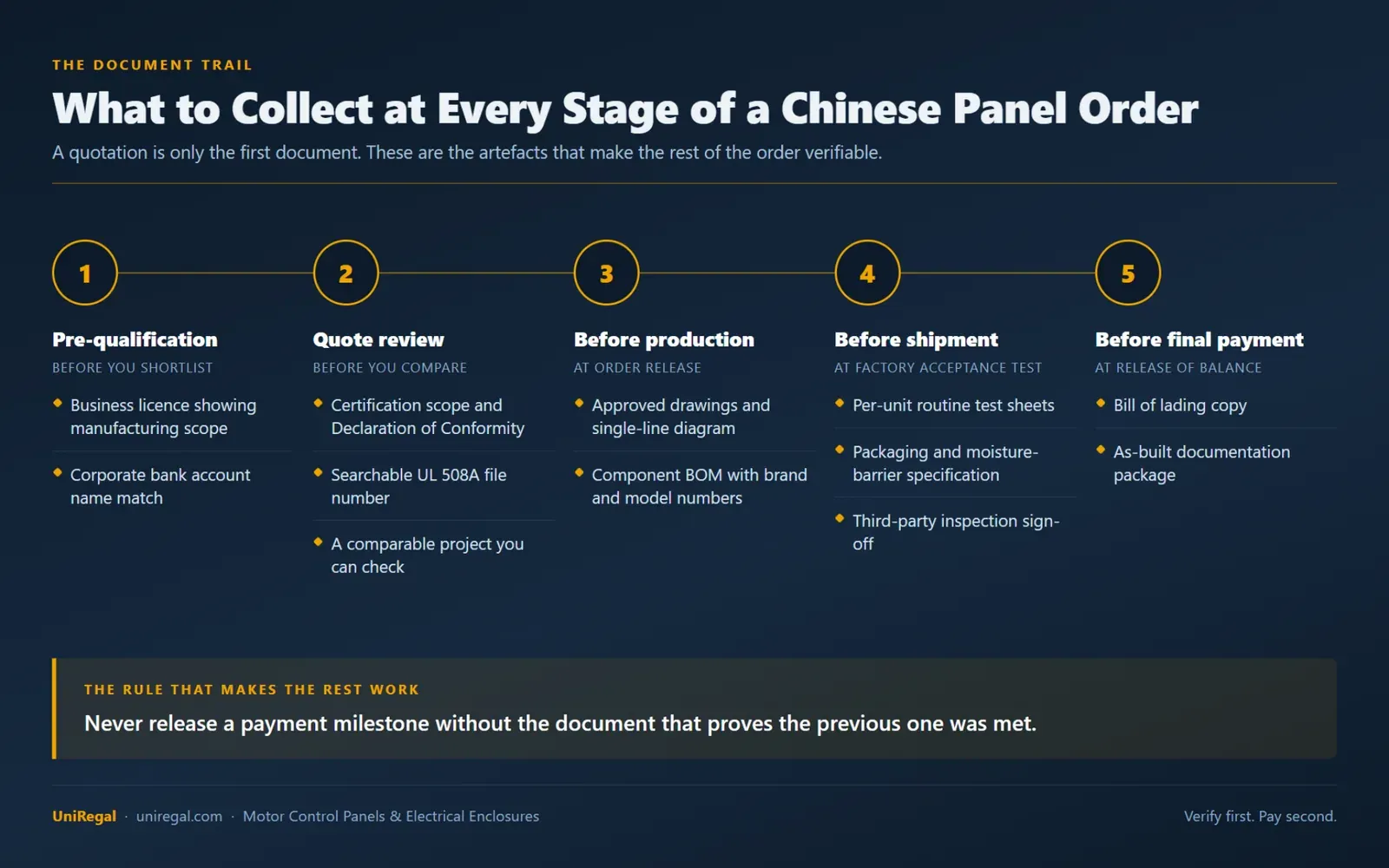
When sourcing motor control panels from China, treating supplier selection as an engineering and quality audit rather than a race to the lowest price is the only reliable way to protect your project timeline. A competent manufacturing partner will not hesitate to share business licenses, walk their shop floor via video, provide traceable certificate numbers, submit per-unit test records, and agree to fair contractual delivery milestones.
Need a Motor Control Panel Quotation?
Before reaching out for an engineering review or commercial quotation, gathering these core technical requirements will significantly accelerate the feasibility assessment and ensure an accurate, buildable proposal:
- Complete Motor Load Schedule: Quantity of motors, rated power (kW/HP), full-load operating current, and supply voltage and frequency (such as 380V/400V/480V, 50Hz/60Hz).
- Starting & Control Method: Direct-on-line (DOL), star-delta, soft starter, or variable frequency drive (VFD), including any bypass requirements.
- Enclosure Specifications & Site Environment: Ingress protection level (such as IP54, IP55, IP65 / NEMA 3R, 4, 4X), enclosure material (carbon steel powder-coated, 304/316 stainless steel), indoor vs. outdoor installation, and maximum ambient operating temperature.
- Preferred Component Brands: Required manufacturers for primary switchgear, contactors, overloads, VFDs, and PLCs (such as Schneider Electric, ABB, Siemens, or certified alternatives).
- Short-Circuit & Protection Parameters: Required Short-Circuit Withstand Rating (kA) and incoming breaker specifications.
- Destination Compliance & Delivery Terms: Target destination country, local certification requirements, and target delivery timeframe.
Send us your motor list and panel requirements — we will review feasibility and come back with a quotation.
Frequently Asked Questions
How can I verify that a Chinese control panel supplier is an actual factory and not a trading company?
Request a copy of their Unified Social Credit Business License and verify that the registered business scope contains manufacturing terms. Additionally, confirm that their corporate banking account matches the licensed entity exactly, and request a live video walk-through of the workshop assembly, wiring, and testing areas.
Is CE marking sufficient for importing motor control panels into Europe?
CE marking under the Low Voltage Directive and Machinery Directive is typically a manufacturer's Declaration of Conformity (DoC). For complex industrial assemblies, you should verify that the CE mark is backed by a formal DoC and comprehensive type or routine test reports issued in accordance with IEC/EN 61439 standards, ideally supported by accredited laboratory testing.
What is the typical lead time for custom motor control panels from China?
While lead times depend heavily on component selection, customization complexity, and project scale, typical industry lead-time guidance for custom industrial control panels ranges between 6 to 12 weeks. Crucially, ensure your contract specifies that the lead-time clock begins upon final approval of engineering drawings, rather than merely from deposit payment.
How do manufacturers prevent moisture and corrosion damage during sea freight?
Professional manufacturers use heat-sealed, moisture-barrier vacuum foil packaging with industrial desiccant bags placed inside the enclosure to absorb ambient humidity. Assemblies should be mounted on shock-absorbing skids and enclosed in ISPM 15-compliant, heat-treated wooden crates with clear shipping marks and center-of-gravity indicators.
What routine electrical tests should always be performed prior to panel dispatch?
In accordance with IEC 61439-1 standards, every single manufactured panel must undergo routine verification prior to shipping. This includes dielectric high-potential (hi-pot) testing, insulation resistance measurement, grounding continuity verification, mechanical torque checks on busbar and terminal connections, and complete functional logic testing of control circuits.
Related Guides & Solution Centers
Evaluating overseas panel builders? Insist on verifiable engineering documentation before shortlisting.