
Sep 24, 2026
Enclosure Heater Selection Guide: PTC, Thermostat, and Anti-Condensation Sizing
Choose the right anti-condensation heater for your electrical enclosure. Compare PTC vs fixed-resistance, thermostat vs hygrostat, sizing math, and placement for IP65/NEMA 4X cabinets.
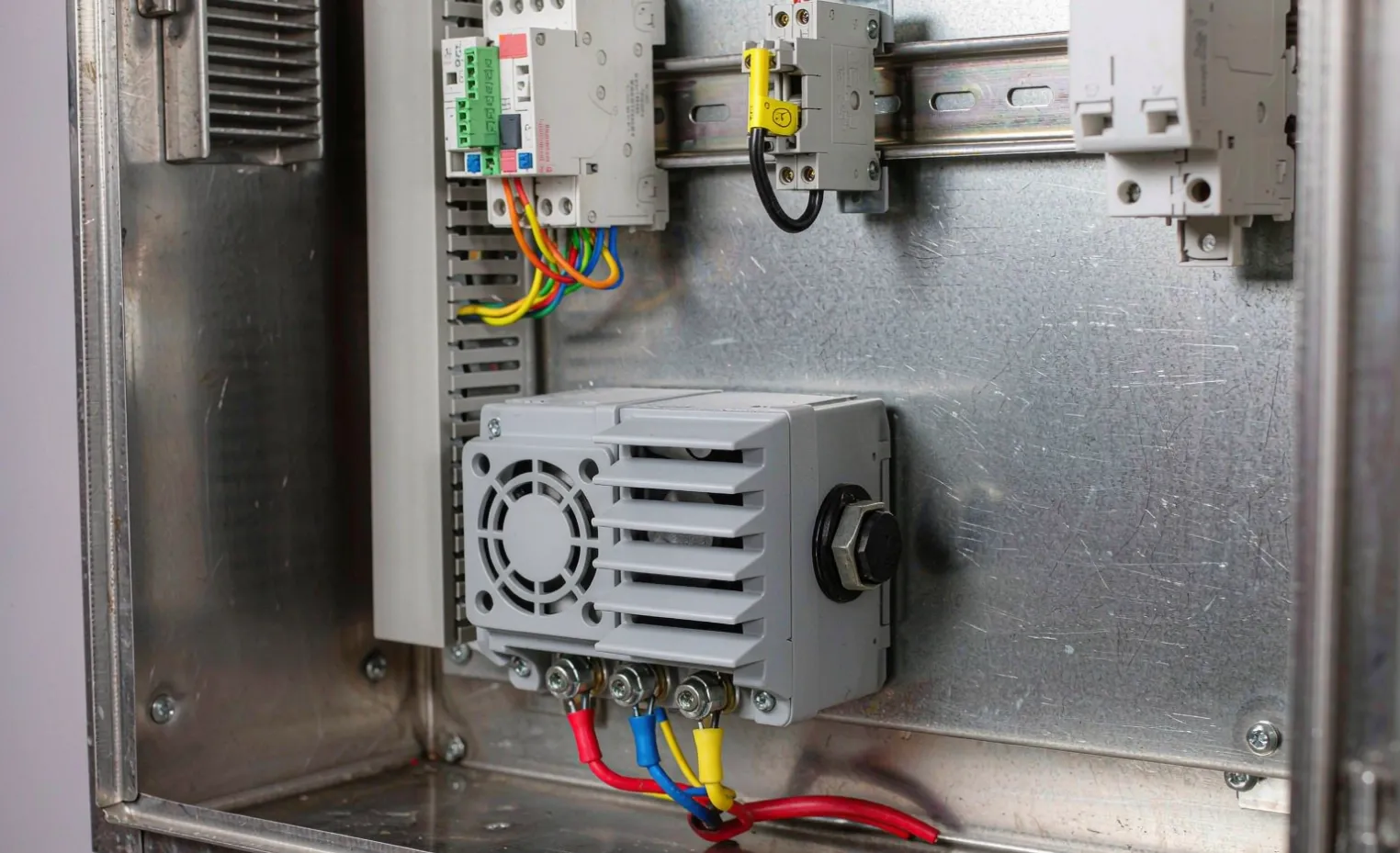
Enclosure Heater Selection Guide: PTC, Thermostat, and Anti-Condensation Sizing
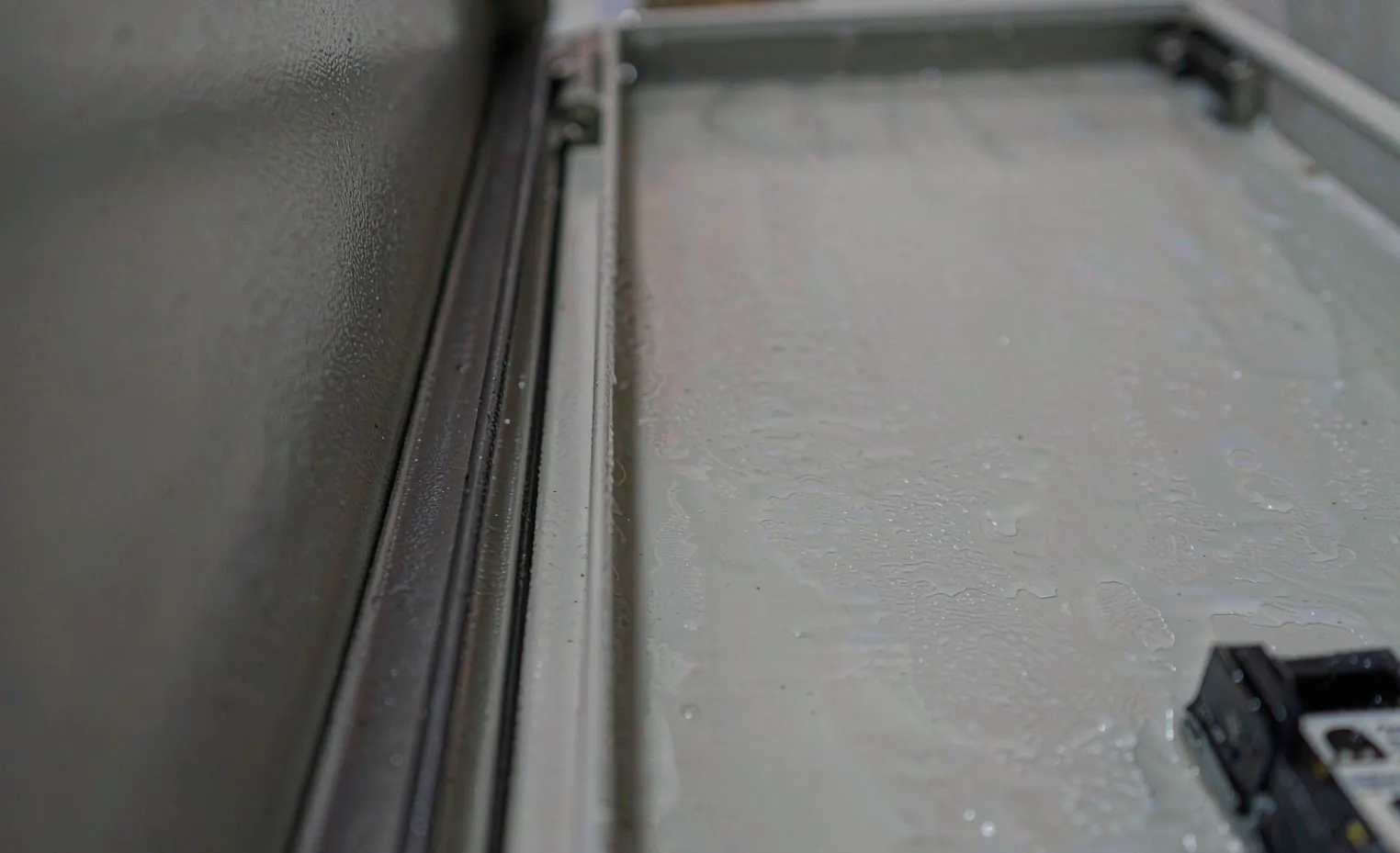
You can seal a cabinet to IP65, fit a perfect gasket, and still watch condensation bead on the backplate the first cold night. In our incoming checks, a surprising number of "water ingress" panels were never leaking at all — they were sweating from the inside. A sealed enclosure traps humid air; when the metal drops below the dew point, that moisture condenses on the coldest surfaces, which are exactly the electronics you are trying to protect.
Condensation control is one of the design features that separates a cabinet that survives outdoors from one that weeps in year two, and it is the quiet counterpart to cooling an enclosure in hot climates. Here we go one level deeper than either of those: what an enclosure heater actually does, why PTC beats a bare resistor, when to add a thermostat or hygrostat, how to size the wattage, and where buyers most often get it wrong. This is also folded into our enclosure sourcing guide as part of the build review.
Buyer Decision — If you remember one thing: a heater does not dry the air. It keeps the internal surface temperature above the dew point so moisture cannot condense in the first place. Size it for the coldest night, not the average day.
Why condensation forms inside a sealed enclosure
The dew-point trap
Air holds water. Warm air holds more than cold air. When a sealed cabinet cools after sunset, the air inside cools too, and once it drops below its dew point the excess water has nowhere to go but onto the nearest cold surface — the backplate, a terminal, the inside of the door. The cabinet can be perfectly sealed and still "rain" on its own components.
The sealed-cabinet paradox
Buyers often assume a higher IP rating solves condensation. It does not. A tighter seal keeps humid air in just as well as it keeps rain out. Without a way to manage the internal microclimate, an IP66 cabinet in a coastal or humid site is more likely to sweat internally than a vented one — because the humidity it trapped on a warm afternoon has no escape when it cools.
Engineering Note — We have opened NEMA 4X stainless panels in tropical sites where the only corrosion was on the inside, not the outside. The seal was perfect. The microclimate was not. A small heater, correctly sized, would have prevented every bit of it.
What an enclosure heater actually does
An anti-condensation heater is a low-wattage element that raises the internal air temperature a few degrees above the ambient low, holding every internal surface above the dew point. It is a prevention device, not a dehumidifier. The IP65 and NEMA 4X ratings your cabinet carries (defined under IEC 60529 and NEMA 250) describe ingress protection, not the internal humidity — two different problems.
Heater, not dehumidifier
The heater does not remove moisture. It raises the temperature so the relative humidity of the trapped air stays low enough that it cannot condense. This is why a 10–30 W heater often does more for reliability than a far more expensive sealing upgrade.
Heater and cooler are partners, not rivals
A common mistake is to think "it is hot here, so I do not need a heater." Daytime heat and nighttime condensation are different problems. A panel in a desert or a coastal site can hit 45 °C by day and drop below the dew point at night. The cooling system handles the day; the heater handles the dawn. In our outdoor cooling selection guide we treat the two as one climate plan.
PTC vs fixed-resistance: the core decision
This is the decision that matters most, and the one most quotations get wrong by defaulting to the cheapest part.
PTC self-regulating heaters
A PTC (positive temperature coefficient) heater uses a ceramic element whose resistance rises as it warms. As it heats, it throttles its own current — so it cannot run away, cannot overheat, and cannot start a fire if a fan fails or airflow is blocked. It settles at a safe self-limiting temperature and sips power to hold it.
- Self-limiting: no thermal runaway
- No separate overheat cutoff required
- Safe in blocked or enclosed spaces
- Slightly higher unit cost
Fixed-resistance (wirewound) heaters
A fixed resistor delivers a fixed wattage as long as it is powered. Cheap, simple, and dangerous if uncontrolled: if it is switched on continuously with no thermostat, it keeps heating; if a fan stops, the local temperature climbs; if the rating is wrong, it can char insulation or worse. Every fixed heater needs a thermostat and careful sizing.
- Lowest unit cost
- Requires a thermostat to avoid overheating
- Fire risk if control fails
- Shorter safe duty without supervision
Buyer Decision — Unless you have a robust, independently tested thermostat in the loop, specify PTC. The small price gap is trivial next to the cost of a panel fire or a damaged PLC. We default our build-shop enclosures to PTC precisely because it removes a whole class of failure.
Heater type at a glance
Attribute | PTC (self-regulating) | Fixed wirewound |
|---|---|---|
Overheat protection | Built in (self-limiting) | Needs external thermostat |
Fire risk if fan fails | Very low | High |
Sizing sensitivity | Forgiving | Strict |
Relative cost | $$ | $ |
Best use | Most enclosures, unattended | Supervised, thermostatically controlled |
Thermostat vs hygrostat: when to add control
A heater that runs 24/7 wastes energy and bakes the electronics. Control lets it run only when needed.
Thermostat — temperature triggered
A thermostat switches the heater on below a set temperature (commonly around 5–10 °C) and off above it. Simple and cheap, and enough for most sites. The limitation: it responds to air temperature, not humidity, so on a cold-but-dry night it may run when it is not needed.
Hygrostatically controlled — humidity triggered
A hygrostat switches on when relative humidity crosses a threshold (often ~60–65% RH), regardless of temperature. This is the better choice in humid or coastal sites because the heater fires only when condensation is actually possible. Many buyers pair a thermostat (lower limit) with a hygrostat (upper humidity limit) so the heater runs in the humid-cold window and nowhere else.
Control decision matrix
Site condition | Recommended control | Why |
|---|---|---|
Temperate, occasional cold | Thermostat only | Cheap, sufficient |
Humid / coastal | Hygrostatically controlled | Fires only when RH risks condensation |
Freezing winters | Thermostat + hygrostat | Covers both cold and humid windows |
Indoor, climate-controlled | None or thermostat | Low condensation risk |
Sizing the wattage: the math buyers skip
Oversizing wastes energy and heats the electronics; undersizing lets condensation win. Here is the practical method.
The volume rule of thumb
A widely used field rule: plan roughly 10 W per cubic metre of enclosure volume as a starting point for mild climates, rising to 15–20 W/m³ in humid or poorly insulated cabinets. That holds the internal temperature several degrees above ambient and keeps surfaces above the dew point.
The delta-T method
A more precise check: estimate the heat loss through the walls. For a steel enclosure, the loss scales with surface area, insulation, and the temperature gap you want to maintain (ΔT). A small 0.1 m³ cabinet in a site that drops to −5 °C might need only 15–25 W to hold a few degrees of margin; a large 1 m³ cabinet in the same site could need 100–150 W. The rule of thumb and the delta-T method should land in the same ballpark — if they do not, revisit your insulation assumption.
Engineering Note — Do not size to the average low. Size to the worst credible night plus a margin. A heater sized for "usually around 5 °C" fails on the night it hits −8 °C, and that is the night the backplate sweats and the relay chatters. We review the site's historical low, not the nameplate climate, during the build review.
Insulation changes everything
A thin layer of internal insulation or an insulated enclosure shell can cut the required wattage by half. If the quotation separates "heater" and "enclosure thermal design," ask how they interact — a bigger heater is often masking a thermal-design gap.
Fan heaters vs still-air heaters
When a fan helps
A fan heater blows warm air around so there are no cold spots and no localized condensation on a distant corner. Useful in tall floor-standing cabinets where heat rises and the bottom stays cold. The trade-off: a fan is a moving part that can fail, and it stirs dust.
When still-air is enough
For small wall-mount cabinets, a low-wattage still-air PTC heater near the bottom is usually sufficient — warm air rises and naturally circulates. No fan, no dust, no extra failure point. This is our default for most compact enclosures.
Placement and mounting mistakes
Mount low, not high
Warm air rises. A heater mounted at the top heats the ceiling; the cold, condensation-prone bottom stays cold. Mount the heater low on the backplate or near the floor of the enclosure so the warmed air rises through the whole volume.
Keep clearance from components
Do not mount a heater directly against a PLC, power supply, or cable bundle. Maintain the heater's rated clearance so you do not cook the very parts you are protecting. Heat the cabinet, not the device.
Hazardous areas need rated parts
In any classified hazardous area, the heater, thermostat, and fan must carry the appropriate certification as part of the certified assembly. Confirm the whole enclosure — not just the heater — is built by a UL-listed build shop on a per-order basis (see UL 50E); an uncertified heater voids the rating.
Where heaters fail: the mistakes we see
Engineering Note — Most heater problems are specification problems, not product problems. The heater was fine. The buyer asked for "a 20 W heater" with no thermostat, no dew-point logic, and no placement note.
No thermostat on a fixed heater
A fixed-resistance heater switched on continuously bakes the enclosure and wastes energy; left uncontrolled in a blocked space it is a fire risk. If you use fixed, you must control it.
Sizing to the average, not the extreme
The rule-of-thumb and the historical-low method both exist for a reason. A heater sized to the average low fails on the worst night — exactly when condensation is most likely.
Forgetting the gasket
A heater cannot fix a leaking seam. If the door gasket is wrong (PSA-only, butt-joined, or compressed), humid outside air keeps entering and the heater fights a losing battle. Pair the heater with a proper gasket and cable glands so the cabinet actually holds its microclimate.
Mixing heater and cooling without a plan
Running the heater and the air conditioner against each other wastes energy and stresses both. Treat them as one climate plan with hysteresis between the heat-on and cool-on points.
Matching the heater to the enclosure build
The heater is only as good as the enclosure it sits in. We source enclosures in carbon steel, 304/316 stainless, and hot-dip galvanized — never aluminum — across IP65 and NEMA 4X duty. The material choice affects how aggressively the cabinet loses heat and therefore how much heater you need: a thin galvanized wall cools faster than a doubleskin stainless panel, so the same site may need more wattage on the lighter cabinet.
For any UL-rated or NEMA 4X project, the heater is reviewed as part of the certified enclosure system, not in isolation. Typical build window is about 15 days for a 5-unit minimum order, while the heater and other components ship from stock in 3–5 days. UL-listed assembly is sourced from a UL-listed build shop on a per-order basis.
Frequently asked questions
1. Do I need a heater if my enclosure is IP66? Yes, very possibly. A higher IP rating seals humidity in. If the site drops below the dew point at night, an IP66 cabinet can sweat internally even with a flawless seal. Rating and condensation are separate problems.
2. PTC or fixed resistor — which should I default to? Default to PTC unless you have a robust, independently tested thermostat in the loop. PTC is self-limiting and removes the thermal-runaway and fire risk that an uncontrolled fixed heater carries. The small cost gap is negligible next to a panel fire.
3. How many watts do I need? Start at roughly 10 W per cubic metre for mild climates, 15–20 W/m³ for humid or poorly insulated cabinets, then sanity-check against a delta-T calculation using the site's historical low. Size to the worst night, not the average.
4. Thermostat or hygrostat? A thermostat is enough for temperate sites. Use a hygrostatically controlled heater in humid or coastal locations so it fires only when relative humidity actually risks condensation. In freezing climates, pair both.
5. Can a heater damage my electronics by overheating them? Only if uncontrolled. A PTC heater self-limits to a safe surface temperature, and a thermostatically controlled fixed heater switches off at setpoint. Keep clearance from heat-sensitive parts and you are safe. The risk comes from an uncontrolled fixed heater left running.
6. Should the heater be part of the enclosure certification? For UL-rated or hazardous-area work, yes — the heater, thermostat, and any fan must be part of the certified assembly built by a UL-listed build shop. Specifying a random uncertified heater can void the enclosure rating.
7. Does the enclosure come with the heater already fitted? Yes. Enclosures are delivered with the specified heater, thermostat, and any fan installed and verified at incoming check, so the internal climate plan is confirmed before the panel leaves the build shop.
Engineering Takeaway
Condensation is the most under-specified failure mode in outdoor and humid-site enclosures, and a small, correctly chosen heater prevents more field failures than most buyers expect. Default to a self-limiting PTC element, control it with a thermostat (and a hygrostat in humid sites), size to the historical low rather than the average, mount it low so warm air rises through the whole cabinet, and pair it with a proper gasket and glands so the microclimate actually holds. Get those five right and the "rain on the backplate" problem disappears — quietly, and for the life of the panel.
Ready to close the condensation gap before you order? Upload your drawing and we will review the enclosure thermal design, heater wattage, and placement as part of an engineering review — then return concrete suggestions before you commit.