
Oct 6, 2026Buying Guides
Cable Tray Buying Guide: Tray, Ladder or Slot | UniRegal
Cable tray quotes vary when buyers miss tray type, finish, load span, and accessories. A clear RFQ helps suppliers price the real installation, not just straight sections.
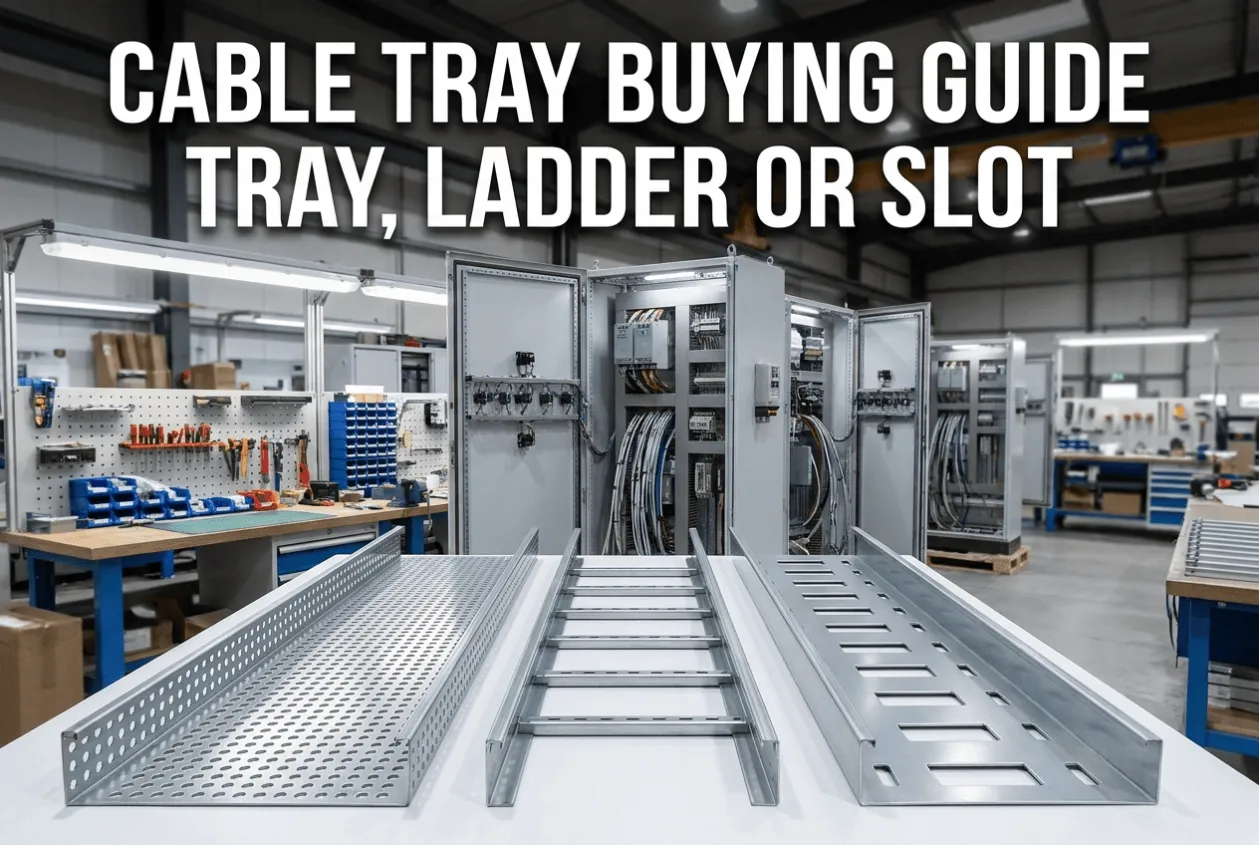
Cable Tray RFQ Guide: Why the Cheapest Quote Often Isn't the Cheapest Installation
A buyer once sent me a cable tray inquiry with one line: “Please quote 300 meters of galvanized cable tray.”
It looked simple, but that sentence was not enough to compare suppliers properly. A supplier could quote it quickly, but the price would be based on assumptions: tray type, width, side height, material finish, support span, covers, bends, tees, reducers, clamps, and packing. When those details are missing, one supplier quotes a real installation package and another quotes only straight tray sections. Of course the prices look different.
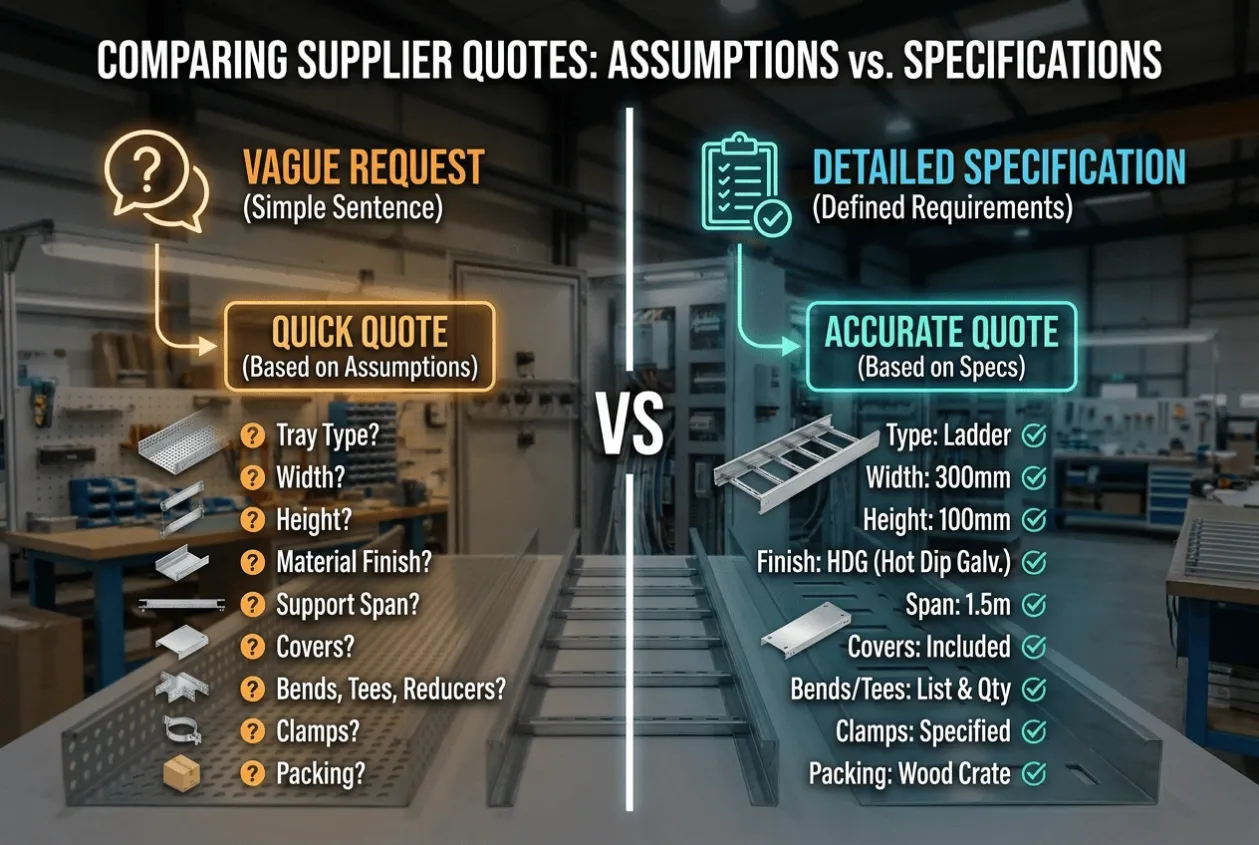
A cable tray is not a complicated product, but it is very easy to buy badly. The buyer’s real question is not only “How much per meter?” It is: “Does this quotation include the tray system my site actually needs?”
In my experience, most cable tray purchasing mistakes come from four decisions: tray type, finish, loading, and accessories. Get those four right, and the quotation becomes much easier to compare.
Four Buying Decisions That Change the Price
Decision 1: Tray Type
The first decision is whether the project needs a tray-type, ladder-type, or slot-type cable tray.
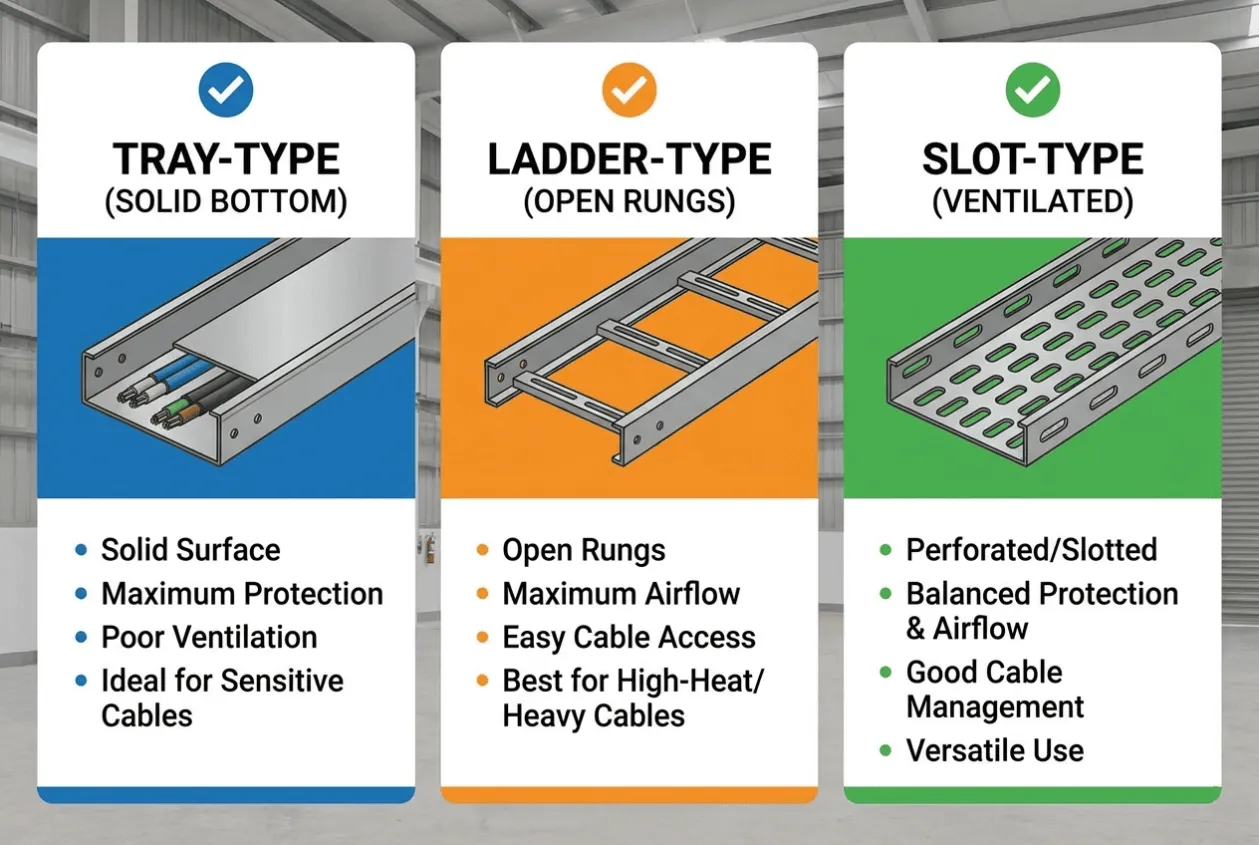
For power cable routes, a ladder tray is often the practical choice because it gives good support, a lighter structure, and better ventilation. For smaller control, communication, and instrumentation cables, a slot-type or perforated tray usually makes the installation cleaner. A tray-type cable tray, with a more closed bottom, can be useful where cables need more support or a neater enclosed route.
One buyer once compared a ladder tray quote with a perforated tray quote and asked why the prices were so different. The answer was simple: the suppliers were not quoting the same product. One assumed heavy power cables. The other assumed smaller control cables. Same route length, different job.
Tray Type | Usually Suitable For | Buyer Risk If Wrong |
|---|---|---|
Ladder tray | Power cables, longer plant routes, better ventilation | Wrong choice may reduce support or ventilation. |
Slot / perforated tray | Control, signal, communication, instrumentation cables | May not suit heavy power cable routes |
Solid-bottom tray | Cleaner support, more protected cable routing | May cost more than needed if used everywhere |
This is why I like to see a cable schedule before pricing. The cable schedule tells the supplier what the tray is carrying, not just how long the route is.
Decision 2: Finish
The second decision is the finish. This is where many buyers either spend too much or save in the wrong place.
Electro-galvanized cable tray is usually fine for clean indoor areas such as commercial buildings, electrical rooms, and dry workshops. Hot-dip galvanized tray is a better choice for outdoor routes, damp plants, and places where corrosion protection matters more. Stainless steel should be considered for chemical plants, coastal sites, wastewater areas, and food processing washdown zones.
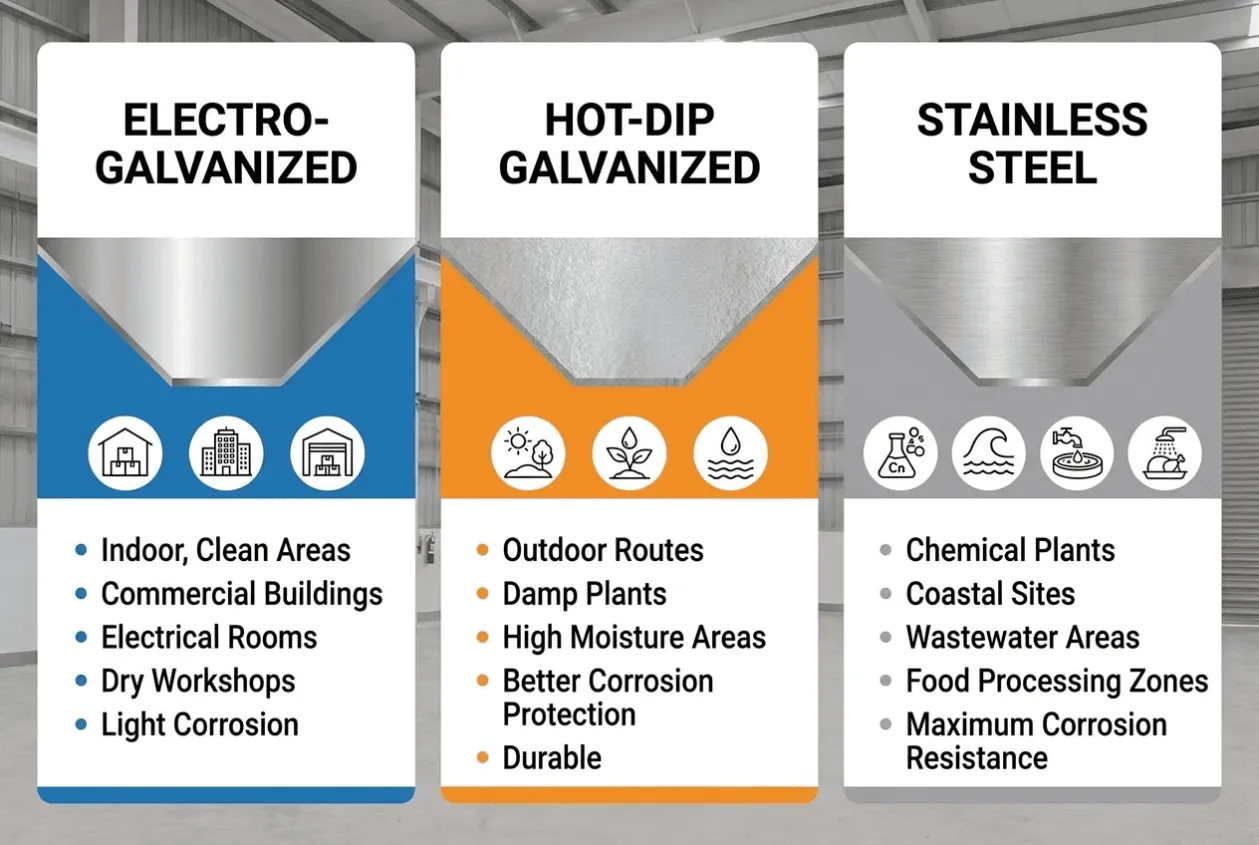
One project used an electro-galvanized tray in a damp outdoor area because it looked cheaper on the quotation. Eighteen months later, the site started asking why rust appeared so early. The original saving had already disappeared into replacement planning, labor, and another round of purchasing.
The question is not which finish costs more. The question is how expensive replacing it later will be.
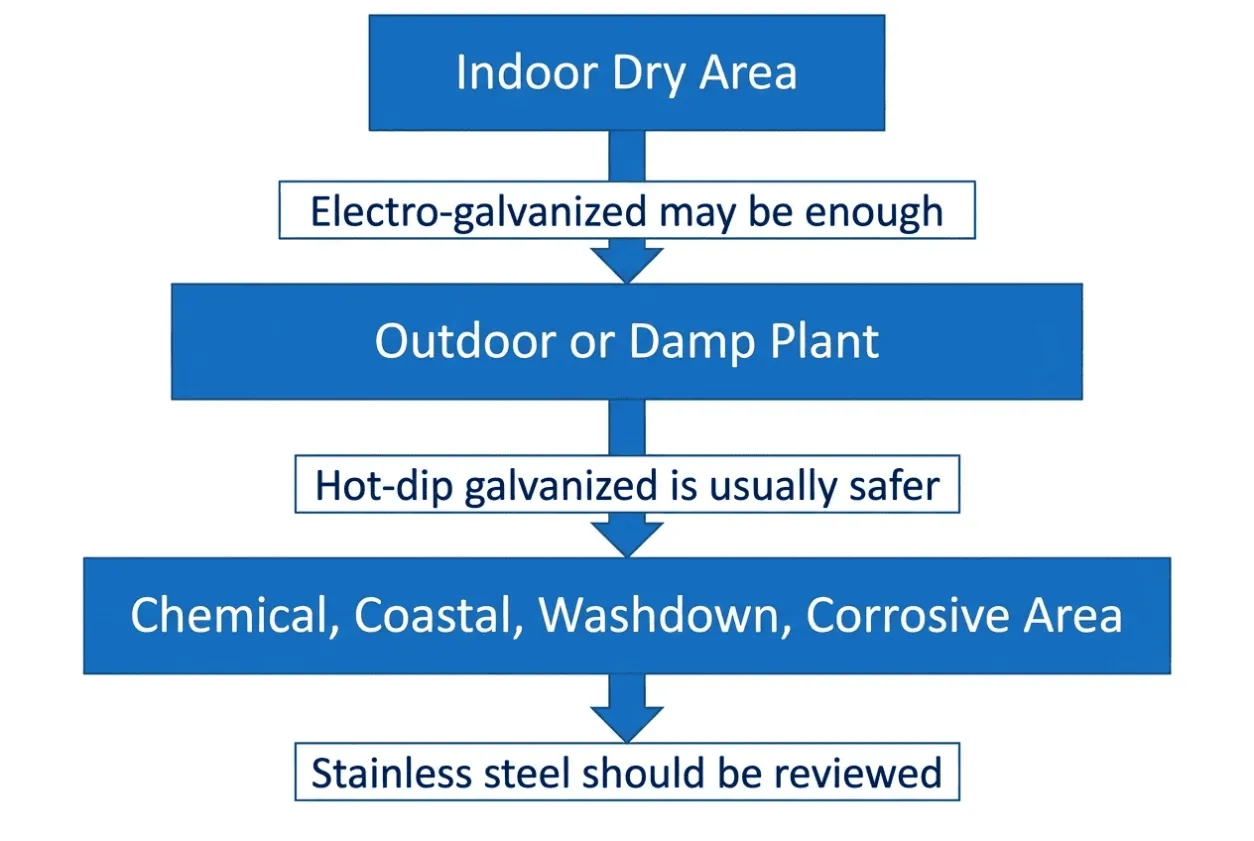
A buyer does not need to become a corrosion expert. But the RFQ should clearly say whether the tray is indoor, outdoor, humid, coastal, chemical, or washdown exposed. That one line can change the correct finish.
Decision 3: Loading and Support Span
The third decision is loading. This is not where buyers need a long calculation in the RFQ, but the supplier needs enough information to choose the right tray and support spacing.
Common cable tray sizes may range from around 200 to 800 mm wide, with side heights often around 60 to 150 mm, depending on the project standard and supplier range. The important point is not memorizing sizes. The important point is knowing how much cable will be installed and how far apart the supports will be.
A tray quoted for a 1.5-meter support span should not be casually installed at a 3-meter span because the site wants fewer brackets. That is when straight cable routes start to sag, and nobody enjoys explaining the sagging tray to the project manager after installation.
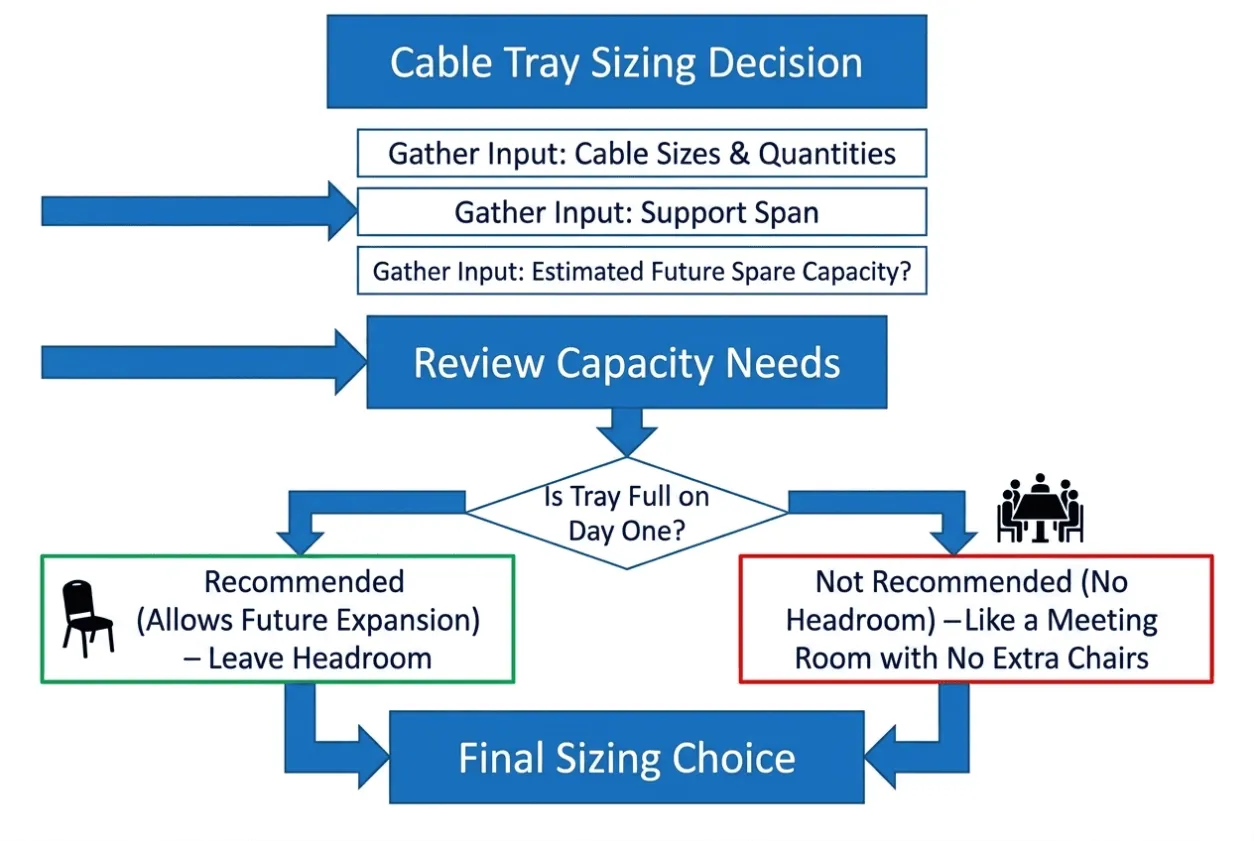
I usually ask buyers for three things: cable sizes and quantities, estimated future spare capacity, and support span. If the route may expand later, leave headroom. A tray that is already full on day one is like a meeting room with no extra chairs. It works until one more person arrives.
Decision 4: Accessories
Accessories are the easiest place to make a cable tray quotation look cheaper than it really is.
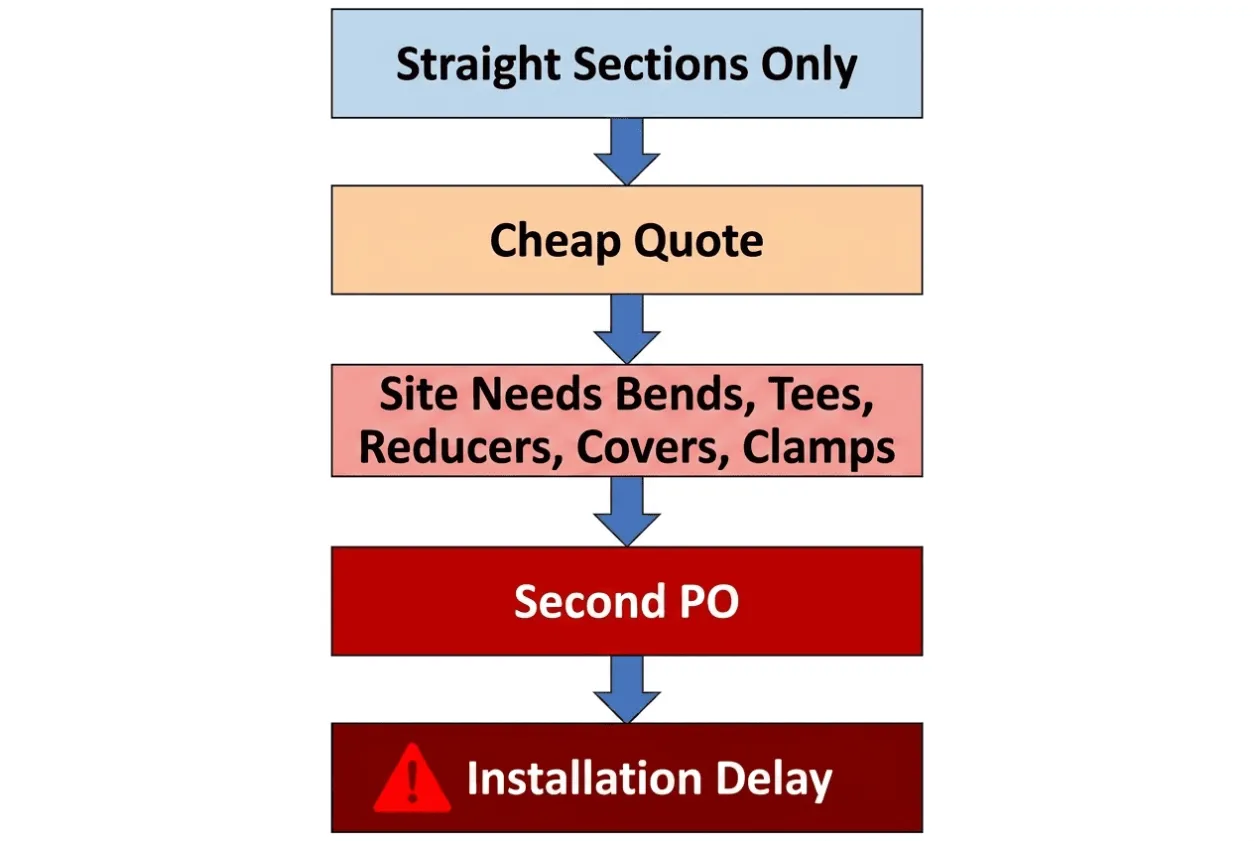
Straight sections alone are not a cable tray system. Real routes need covers, horizontal bends, vertical bends, tees, crosses, reducers, connectors, clamps, supports, and sometimes special fabricated pieces. If those are not included in the RFQ, one supplier may include them and another may leave them out.
I have seen this more than once. The buyer chooses the lower price, the tray arrives, and then the site discovers that the route cannot turn, drop, branch, or reduce without extra parts. That becomes a second PO, urgent freight, and a very boring meeting about who forgot to include accessories.
Before comparing price per meter, always check whether the quotation is for a straight tray only or for the complete route.
What to Send for a Proper Quotation
A good cable tray RFQ does not need to be long. It needs to remove the biggest guesses.
Send the cable schedule, route length, preferred tray type if known, installation environment, support span, required width and side height if already designed, whether covers are needed, and a list of bends, tees, reducers, and other accessories from the route drawing.
A practical RFQ could be written like this:
Please quote ladder-type cable tray for power cable route, hot-dip galvanized finish, 400 mm width, 100 mm side height, 3-meter standard length, support span 1.5 meters. Include covers, horizontal bends, vertical bends, tees, reducers, connectors, clamps, and required accessories. Cable schedule and route drawing attached.
That is not fancy. It is clear. Clear RFQs get better quotations because suppliers do not have to fill the gaps with their own imagination.
What We Need to Quote It Properly
For UniRegal to quote cable trays accurately, the most useful information is simple: cable schedule, route length, support span, environment, and accessory requirement. If the buyer already has drawings, we can check the tray type, finish, covers, and route accessories before pricing.
We supply tray-type, ladder-type, and slot-type cable trays in electro-galvanized, hot-dip galvanized, and stainless steel finishes, with covers and accessories according to the project route. When the RFQ is clear, we can return a much cleaner quotation with finish, size, weight, accessories, and load information instead of only a low number per meter.
FAQ
Why do cable tray quotes vary so much?
Usually because suppliers are quoting different scopes. One quote may include only straight sections, while another includes covers, bends, tees, reducers, clamps, finish requirements, and load information.
Which cable tray type should I choose?
Ladder trays are commonly used for power cable routes. A slot or perforated tray is often suitable for control and communication cables. A solid-bottom tray is useful when cables need more continuous support or protection.
What information should I send for a quote?
Send the cable schedule, route length, installation environment, support span, tray size if known, finish preference, and whether covers and accessories are required.
Final Thought
Cable tray is one of the cheaper items on many project BOMs, which is exactly why buyers sometimes rush it.
But choosing the wrong tray type, finish, loading, or accessories can turn a small purchase into an expensive site problem. A cable tray is one of the cheapest items on many projects. Choosing the wrong one is often one of the most expensive mistakes.
Related Guides:
Related Solutions:
Need help specifying or sourcing this for your project? Request a quote - we reply within 1-2 working days with a technical review.