
Aug 24, 2026Buying Guides
Boiler Feedwater Treatment Buyer Guide
A buyer's guide to boiler feedwater treatment panels: what to specify, common failure points, and how enclosure and component choices affect uptime.
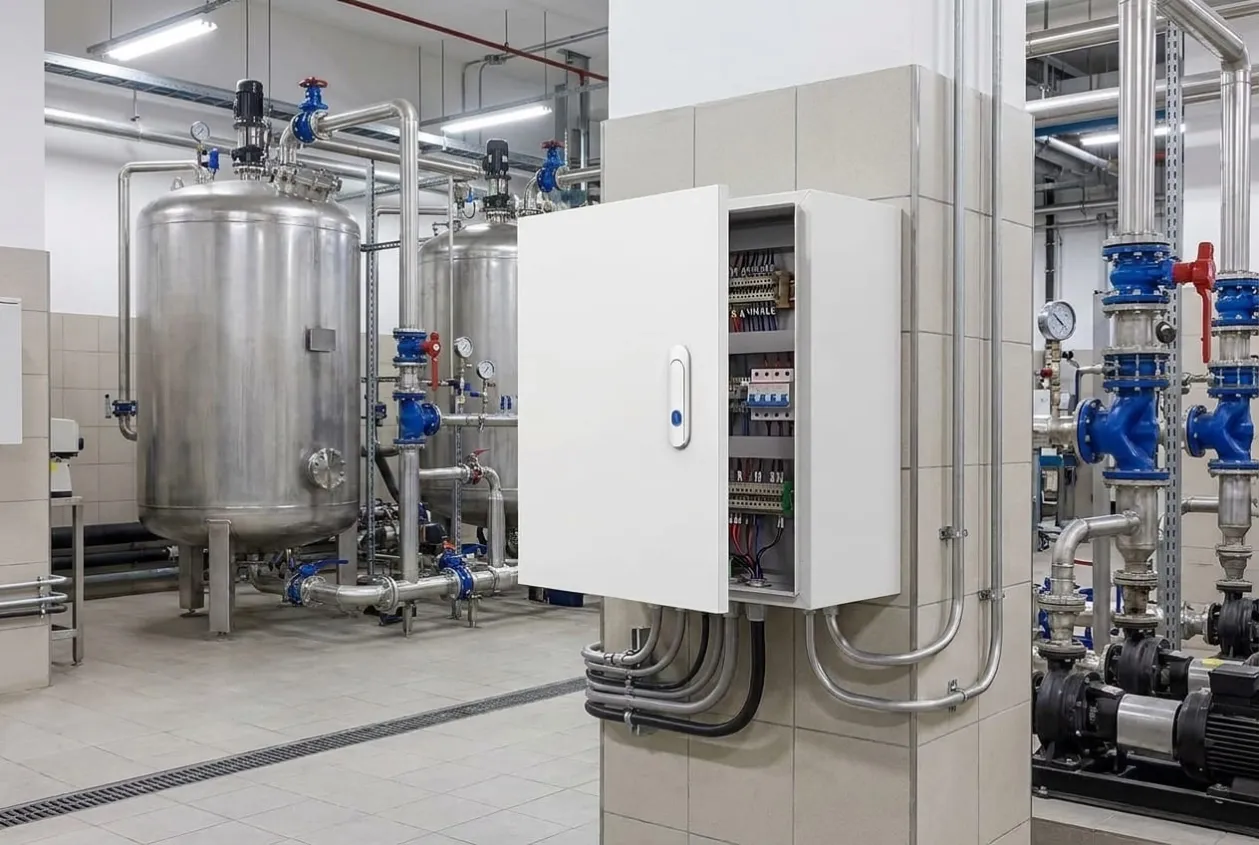
Boiler Feedwater Treatment Buyer Guide: How to Prevent Scale, Corrosion and Steam-Quality Problems
Boiler feedwater treatment should be selected around the complete steam system rather than around one familiar piece of equipment.
A water softener may remove hardness, but it does not remove dissolved oxygen, silica, alkalinity, or most dissolved solids. Reverse osmosis can reduce the ionic load entering the boiler, yet it does not replace proper deaeration, chemical conditioning, or boiler-water control. Even a technically sound treatment package can perform poorly when condensate contamination, uncontrolled blowdown, or weak instrumentation is ignored.
The buyer’s real question is, therefore, not simply:
What equipment should be installed before the boiler?
A better question is
What combination of external treatment, deaeration, chemical dosing, condensate management and automatic control will keep this boiler operating safely and economically under its actual load and water conditions?
This guide explains how industrial buyers should make that decision.
Begin With the Boiler, Not the Water-Treatment Equipment
Many quotations begin with a standard treatment sequence:
Multimedia filter → softener → RO → feedwater tank → dosing system
The arrangement may be appropriate, but it should not be accepted merely because it is commonly used.
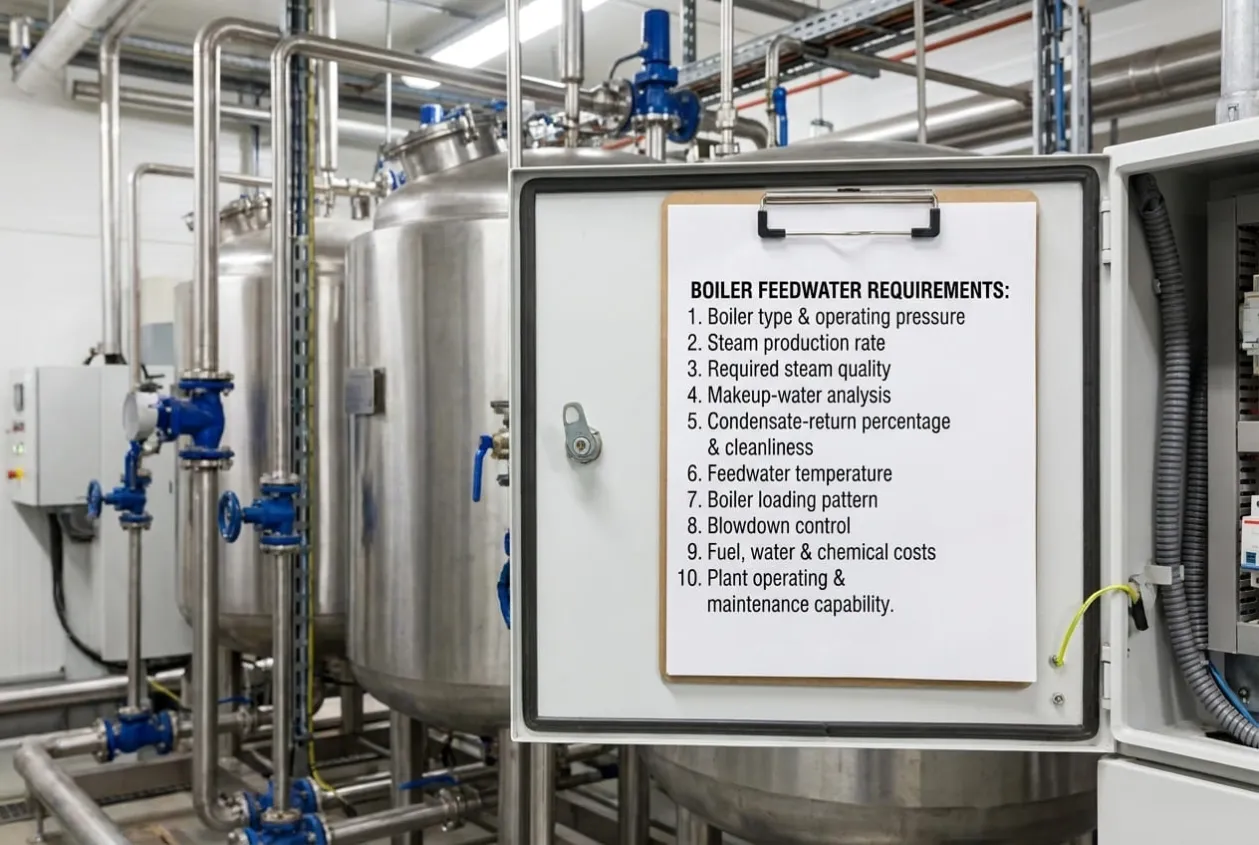
Boiler feedwater requirements are influenced by several connected operating conditions:
- Boiler type and operating pressure
- Steam production rate
- Required steam quality
- Makeup-water analysis
- Condensate-return percentage and cleanliness
- Feedwater temperature
- Boiler loading pattern
- Blowdown control
- Fuel, water and chemical costs
- Plant operating and maintenance capability
Without this information, a supplier can select treatment equipment, but cannot demonstrate that the complete system is correctly matched to the boiler.
Boiler pressure is particularly important because higher-pressure boilers generally tolerate lower levels of contaminants. The acceptable water conditions and treatment programme should therefore be confirmed against the boiler manufacturer’s requirements and the applicable plant standards rather than copied from another project.
Buyer RiskA standard treatment package may produce good-looking water at its outlet while still failing to control the conditions that cause scale, corrosion, carryover or excessive boiler blowdown.
Part 1: Understand What the Feedwater System Must Control
Boilers continuously convert water into steam. Most dissolved and suspended impurities do not leave with the steam, so they become concentrated in the remaining boiler water.
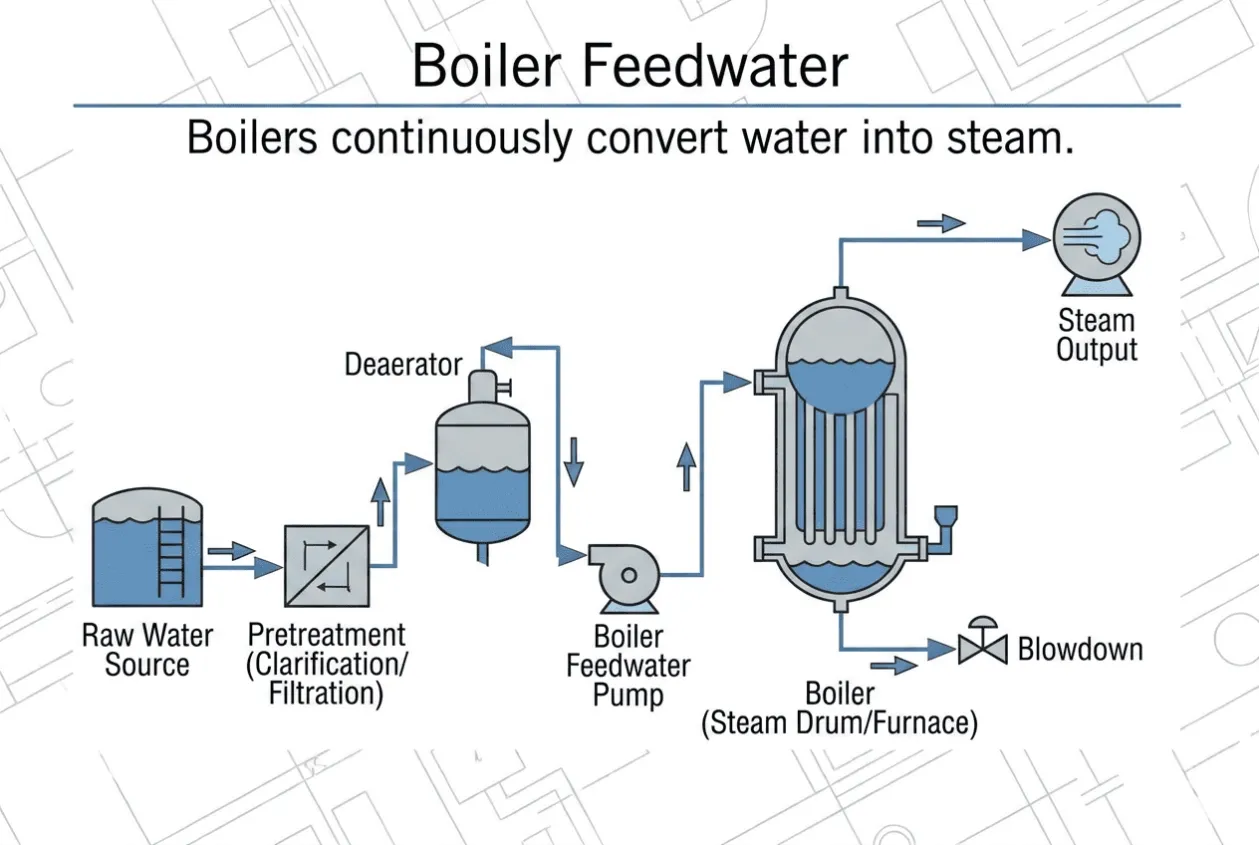
If those impurities are not controlled, they can create deposits, unstable water level, foaming, carryover, corrosion and unnecessary blowdown. The U.S. Department of Energy notes that dissolved solids can promote foaming and carryover, while insufficient blowdown can lead to deposits and excessive blowdown wastes water, heat and treatment chemicals. (The Department of Energy's Energy.gov)
The feedwater-treatment strategy must manage several different risks.
Hardness and Scale Formation
Calcium and magnesium hardness can form deposits on heat-transfer surfaces.
Scale is more than a cleanliness issue. Deposits create thermal resistance between the flame side and boiler water, which can reduce heat-transfer efficiency and raise metal temperatures. Severe deposits may contribute to local overheating and tube damage.
Softening is commonly used to reduce hardness in makeup water. However, the buyer should confirm:
- Maximum inlet hardness
- Required outlet hardness
- Softener operating capacity
- Regeneration frequency
- Salt consumption
- Resin volume and quality
- Duty and standby arrangement
- Hardness-monitoring method
- Response to hardness breakthrough
A softener should not be selected only by nominal flow. It must also have enough exchange capacity to operate reliably between regenerations under the actual hardness load.
Dissolved Solids and Blowdown
Softening exchanges hardness ions but does not substantially reduce total dissolved solids.
The dissolved salts entering with the feedwater remain in the boiler and become concentrated as steam is produced. Blowdown removes part of that concentrated boiler water to keep dissolved solids within the operating limit.
Too little blowdown may lead to deposits, foaming or steam carryover. Too much blowdown sends hot, chemically treated water to drain and increases makeup-water, chemical and fuel demand. DOE guidance identifies both insufficient and excessive blowdown as operating risks. (The Department of Energy's Energy.gov)
Reverse osmosis may be economically attractive where:
- Makeup-water TDS is high
- Boiler pressure requires lower impurity levels
- Blowdown volume is excessive
- Fuel or water costs are significant
- Silica or alkalinity must be reduced
- Steam purity is important
- Condensate return is low
RO should not be justified simply by saying it produces better water. The supplier should show how the lower dissolved-solids load affects blowdown, chemical consumption, boiler operation and lifecycle cost.
Dissolved Oxygen and Corrosion
Dissolved oxygen is a major corrosion risk in boiler feedwater systems. It can attack feed tanks, piping, pumps, economizers and boiler surfaces, often through localized pitting. Carbon dioxide can contribute to acidic conditions and corrosion elsewhere in the steam and condensate system. Spirax Sarco identifies oxygen as a primary cause of corrosion in feedwater equipment and boilers. (spiraxsarco.com)
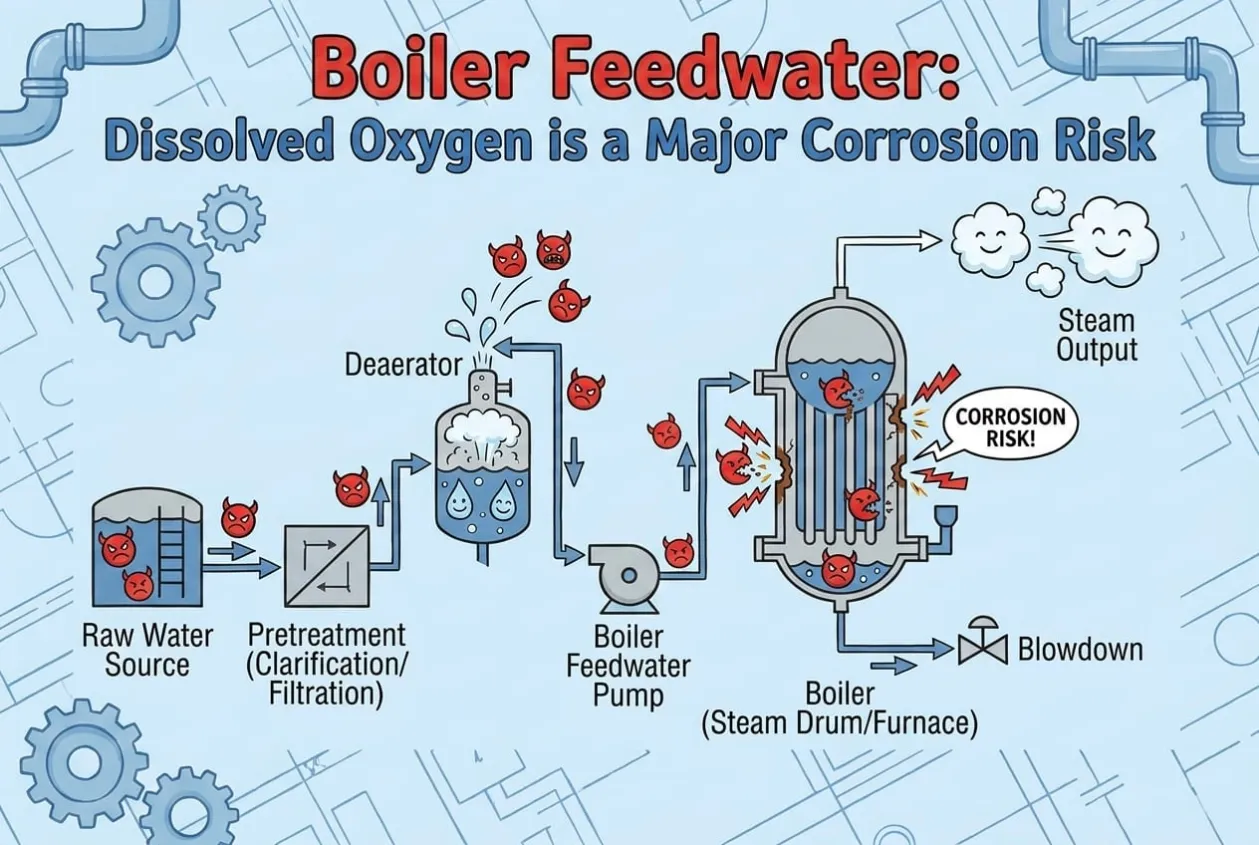
Oxygen control normally involves a combination of:
- Feedwater heating
- Atmospheric or pressurized deaeration
- Correct feed-tank operation
- Chemical oxygen scavenging
- Prevention of air ingress
- Stable condensate return
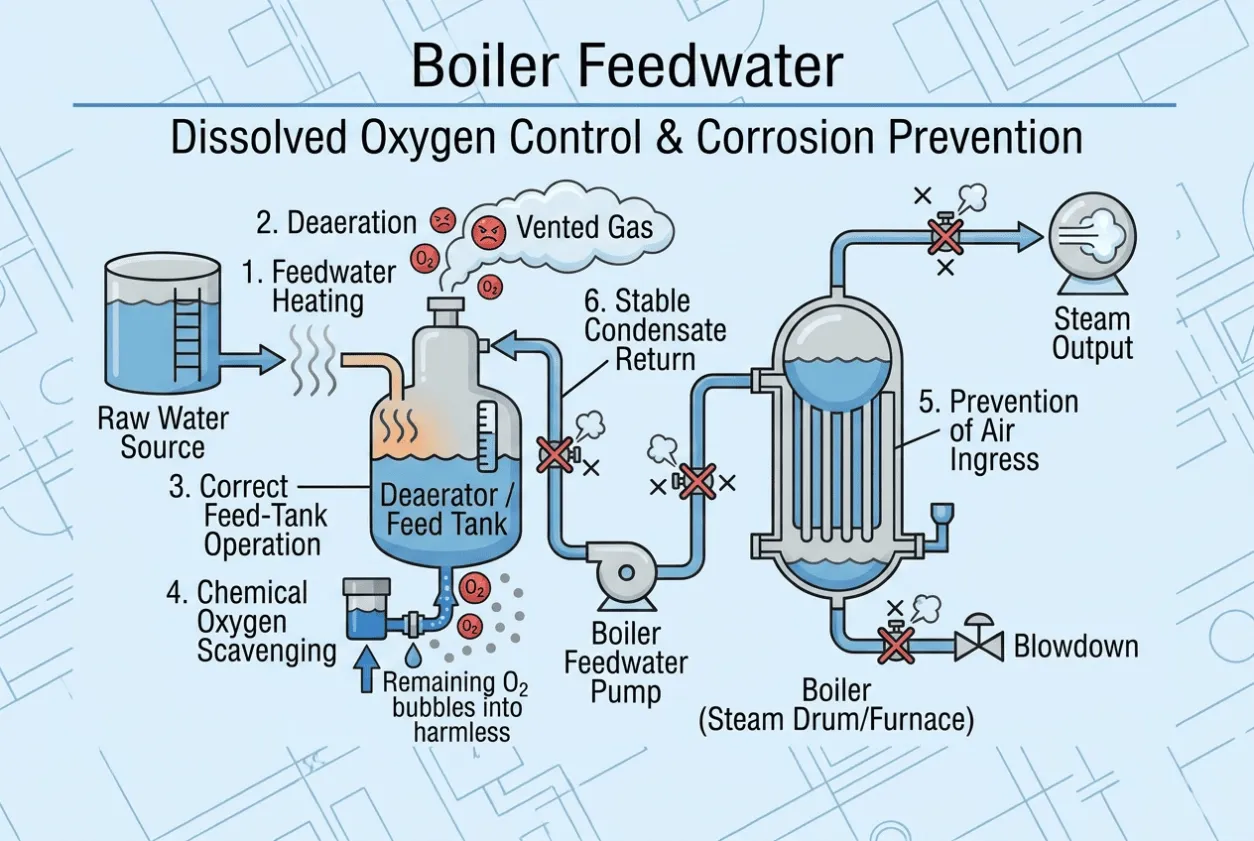
A buyer should not assume that chemical dosing alone will correct poor mechanical deaeration.
When feedwater remains too cold, spray nozzles are blocked, venting is incorrect or the deaerator operates outside its design conditions, the chemical programme may be forced to compensate for a mechanical problem.
Silica and Steam Purity
Silica may contribute to deposits and, under certain boiler conditions, can be carried into the steam. This becomes particularly important where steam drives turbines or where downstream processes require high steam purity.
Softening alone does not reliably remove silica.
Depending on the source water and boiler requirements, silica control may require:
- RO
- Demineralization
- Ion exchange
- Controlled cycles of concentration
- Appropriate boiler-water chemistry
- Continuous monitoring
The required solution should be based on the boiler operating pressure, steam use and permitted feedwater and boiler-water limits.
Alkalinity, pH and Carbon Dioxide
Feedwater and boiler-water pH influence corrosion, chemical performance and deposit formation.
High makeup-water alkalinity may increase carbon dioxide in the steam system, which can affect condensate piping. Very low pH can increase corrosion risk. Poorly controlled chemical addition can also create unstable conditions rather than correct them.
The treatment design should therefore consider the complete cycle:
Makeup water → feedwater → boiler water → steam → condensate return
Treating only the water entering the boiler ignores what happens after steam leaves it.
Part 2: Decide Which Treatment Stages Are Actually Required
There is no single feedwater-treatment arrangement suitable for every boiler plant.
The following treatment stages should be selected according to the risk each one controls.
Treatment Stage | Main Purpose | Typical Reason for Inclusion | What It Does Not Solve |
|---|---|---|---|
Clarification or filtration | Reduces suspended solids and turbidity | Poor or variable source-water quality | Dissolved hardness, salts or gases |
Activated carbon | Reduces chlorine and some organics | Protecting RO membranes or ion-exchange resins | Hardness, TDS or dissolved oxygen |
Softening | Removes calcium and magnesium hardness | Preventing hardness scale | Most TDS, silica, oxygen and alkalinity |
Reverse osmosis | Reduces dissolved salts, silica and alkalinity | Lowering boiler impurity and blowdown load | Dissolved oxygen, condensate contamination or internal boiler chemistry |
Demineralization | Produces very-low-mineral water | Higher-pressure or high-purity applications | Mechanical deaeration or condensate-system protection |
Feedwater heating | Raises water temperature and releases some dissolved gases | Improving oxygen removal and thermal efficiency | Complete oxygen removal under all conditions |
Deaeration | Removes dissolved oxygen and other gases | Reducing corrosion risk | Hardness, dissolved solids or chemical conditioning |
Chemical dosing | Controls residual oxygen, pH, scale and corrosion | Completing the boiler-water treatment programme | Incorrect pretreatment, contaminated condensate or poor equipment design |
Condensate polishing or treatment | Protects feedwater from returned contamination | High-value or contamination-sensitive condensate systems | Problems originating in untreated makeup water |
Blowdown control | Maintains boiler-water concentration within limits | Balancing water chemistry and energy loss | Poor feedwater quality by itself |
A complete proposal should explain why each stage is present.
It should also explain why another stage is not required.
That second explanation is important because an oversized treatment train may increase capital cost, waste water and chemicals, complicate maintenance and create unnecessary operator workload.
Part 3: Is a Water Softener Enough?
This is one of the most common buyer questions.
The answer depends on what the water softener is being asked to achieve.
A softener may be sufficient where:
- The boiler operates at relatively modest pressure
- Makeup-water TDS and silica are acceptable
- Hardness is the main scale-forming concern
- Blowdown requirements remain economically reasonable
- Steam-quality demands are not unusually strict
- Condensate return is high and reliable
- Boiler-manufacturer requirements can be met
- Deaeration and internal chemical treatment are provided separately
A softener may not be enough where:
- Makeup-water TDS is high
- Silica is significant
- The boiler operates at higher pressure
- Blowdown is consuming excessive water and heat
- Steam purity is critical
- Condensate return is low
- Water or wastewater-disposal costs are high
- Chemical consumption is excessive
- Existing boilers experience scale or carryover despite softening
The decision should be supported by a water balance and operating-cost comparison rather than a general claim that RO is either essential or unnecessary.
Engineering ReviewThe correct comparison is not “softener versus RO.” A system may use softening before RO, and both still require appropriate feedwater heating, oxygen control, chemical dosing and boiler-water monitoring. The engineering question is which risks each stage must control.
Part 4: When Does RO Make Commercial Sense?
RO increases equipment cost and creates its own operating requirements, including pretreatment, membrane cleaning, cartridge replacement, reject-water management and maintenance.
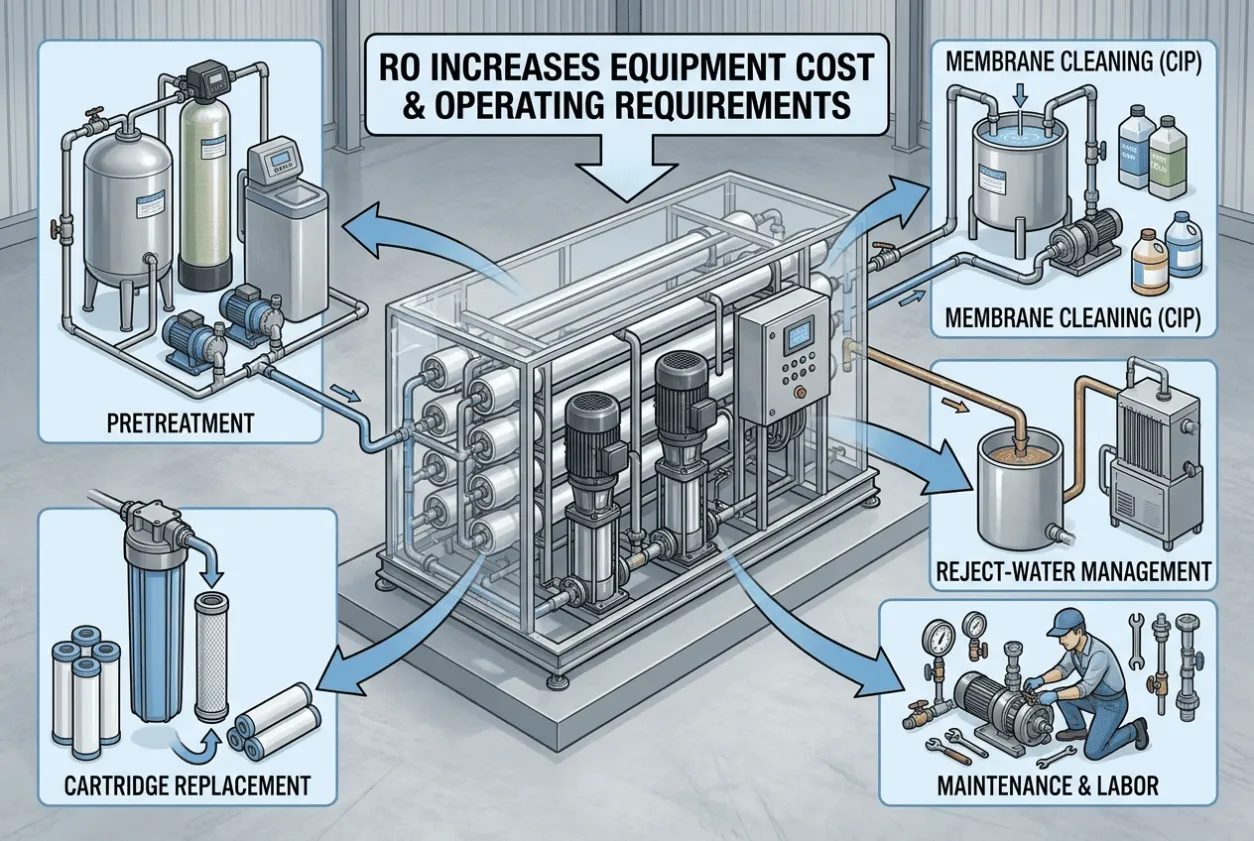
It should therefore be justified through system-level benefits.
Potential Benefits
RO may reduce:
- Dissolved-solids loading
- Silica loading
- Alkalinity
- Boiler blowdown
- Makeup-water demand
- Chemical consumption
- Scaling risk
- Variation in boiler feedwater quality
Lower blowdown can reduce the loss of heated water and treatment chemicals. DOE guidance highlights boiler blowdown as a source of heat loss and notes that recovered blowdown heat may be used to preheat makeup water. (The Department of Energy's Energy.gov)
Costs and Trade-Offs
RO may also introduce:
- Reject-water discharge
- Membrane-replacement cost
- Antiscalant or chemical-cleaning requirements
- Cartridge-filter replacement
- High-pressure-pump energy consumption
- Pretreatment requirements
- Sensitivity to chlorine, fouling and scaling
- Additional instruments and control logic
The buyer should request a lifecycle comparison covering:
- Water and sewer costs
- Fuel savings associated with lower blowdown
- Chemical consumption
- RO power consumption
- Membrane and filter replacement
- Reject-water disposal or reuse
- Maintenance and operator requirements
- Expected system availability
The calculation should show its assumptions.
A precise payback period based on unverified data is less useful than a transparent model showing which variables determine the result.
Part 5: Deaeration Is a Process, Not Just a Tank
Boiler quotations often list a feedwater tank or deaerator without explaining its required operating conditions.
The buyer should confirm whether the proposed unit is:
- A simple atmospheric feed tank
- A heated feed tank
- An atmospheric deaerating system
- A pressurized deaerator
- A spray-type or tray-type unit
- A combination suitable for the boiler capacity and operating pressure
The effectiveness of deaeration depends on more than vessel size.
It may also depend on:
- Feedwater temperature
- Steam pressure
- Spray-nozzle or tray condition
- Venting
- Residence time
- Water-level stability
- Makeup and condensate mixing
- Operating load
- Chemical oxygen-scavenger programme
- Instrumentation and controls
Feedwater tanks also provide storage and can support stable boiler-feed-pump operation. Spirax Sarco notes that feedwater conditioning and treatment should address both scale-forming substances and the overall condition of water supplied to the boiler. (spiraxsarco.com)
A deaerator that is installed but operated at the wrong pressure or temperature may provide far less oxygen removal than the buyer expects.
Part 6: Condensate Return Can Change the Entire Treatment Design
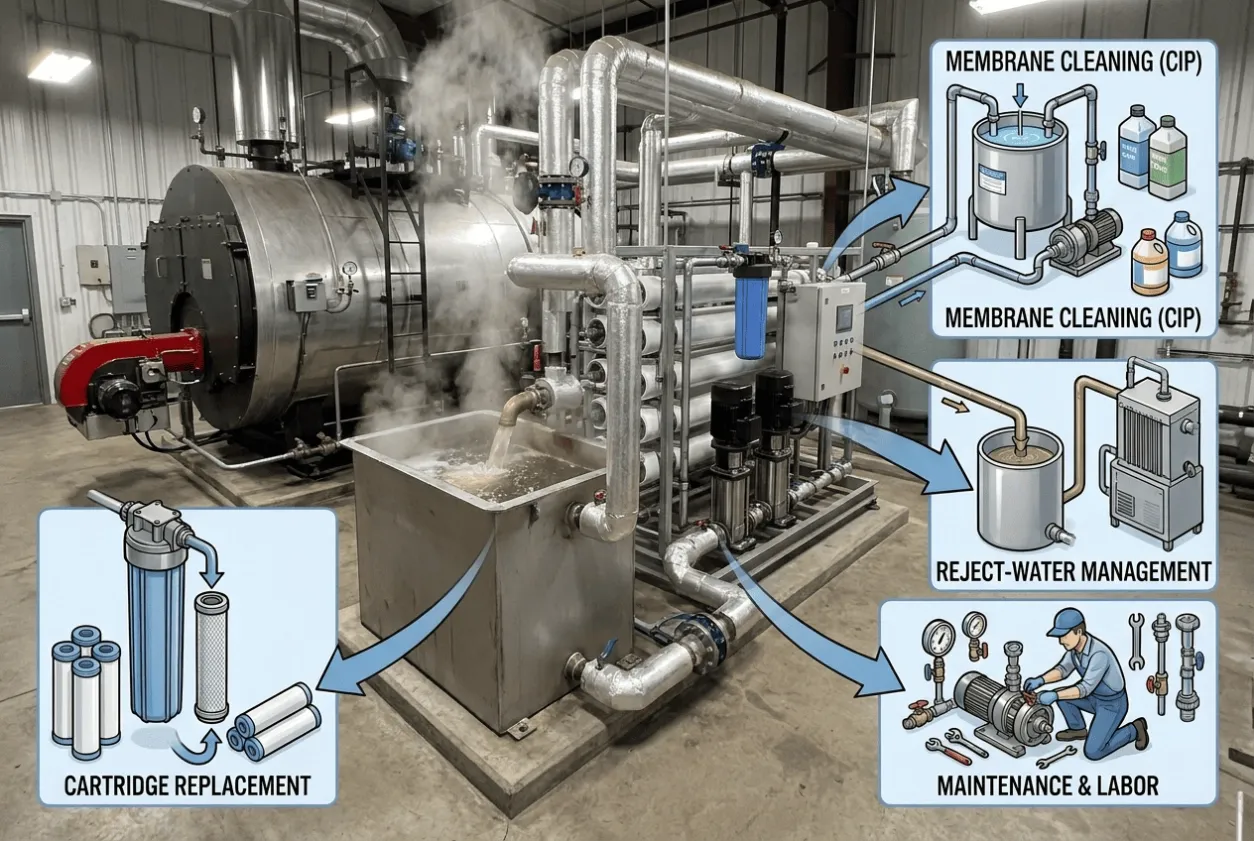
Hot condensate is valuable because it has already been heated and chemically conditioned. Returning clean condensate can reduce makeup-water demand, fuel consumption and treatment-chemical use. Spirax Sarco describes condensate as recovered feedwater that retains heat and treatment value. (spiraxsarco.com)
However, condensate should not be returned blindly.
It may become contaminated by:
- Process leaks
- Heat-exchanger failure
- Oil
- Product contamination
- Cleaning chemicals
- Corrosion products
- High conductivity
- Abnormal pH
The treatment and control system should therefore address two separate questions:
- How much condensate is expected to return?
- How will the system decide whether that condensate is safe to reuse?
Depending on the process risk, the design may include:
- Conductivity monitoring
- pH monitoring
- Turbidity or oil detection
- Automatic diversion
- Condensate polishing
- Sample points
- Alarm and event recording
- Separate clean and suspect return lines
A plant with a high condensate-return percentage may require less makeup-water treatment capacity.
A plant with unreliable or contaminated return may need more makeup capacity and stronger monitoring than the initial steam balance suggests.
Part 7: Internal Chemical Treatment Must Be Designed With the External System
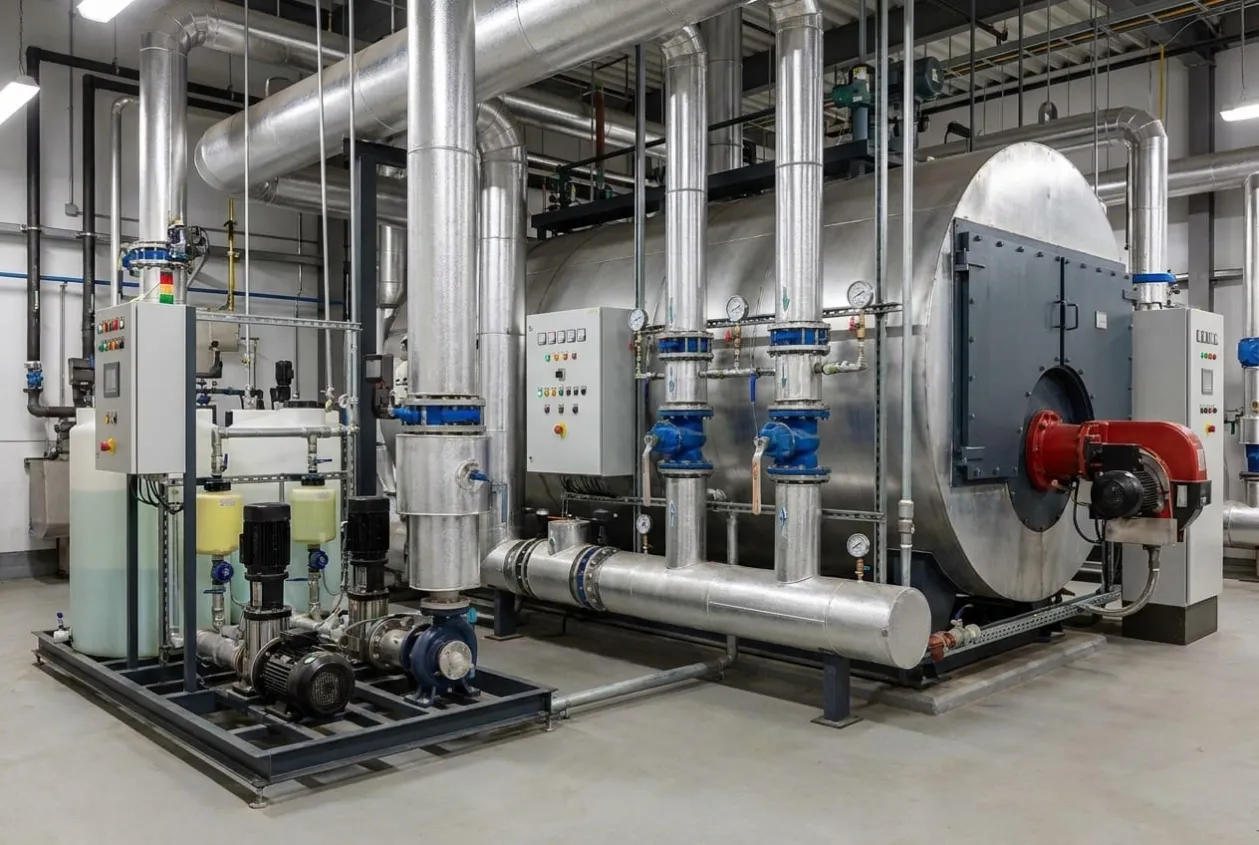
External treatment prepares the water before it enters the boiler.
Internal chemical treatment manages the conditions that remain within the feedwater, boiler and condensate system.
Depending on the boiler and water chemistry, the programme may include chemicals for:
- Oxygen scavenging
- pH or alkalinity adjustment
- Scale inhibition
- Deposit conditioning
- Sludge dispersion
- Condensate corrosion control
The chemical supplier or water-treatment specialist should define the programme around the boiler design, feedwater quality, pressure and applicable requirements.
The equipment supplier should then provide a dosing system capable of delivering that programme accurately and safely.
Buyers Should Confirm
- Chemical name and concentration
- Minimum and maximum dosing demand
- Normal pump operating range
- Wetted-material compatibility
- Injection location
- Mixing conditions
- Duty and standby philosophy
- Tank storage period
- Low-level alarm and low-low trip
- Flow verification
- Calibration method
- Dosing relationship to feedwater flow
- Response to feed-pump shutdown
- Response to analyser failure
- Safe chemical handling and containment
A dosing pump should not be selected only from its maximum litres per hour.
It should operate accurately across the expected demand range and be integrated with the actual boiler-feedwater control sequence.
Part 8: Do Not Treat Blowdown as a Fixed Loss
Blowdown is necessary to control concentrated solids and sludge, but its rate should be managed rather than accepted as an unchangeable operating cost.
DOE guidance states that insufficient blowdown can lead to deposits or carryover, while excessive blowdown wastes water, energy and chemicals. (The Department of Energy's Energy.gov)
The buyer should review:
- Bottom blowdown
- Continuous or surface blowdown
- Conductivity-based control
- Sample cooling
- Heat recovery
- Flash-steam recovery
- Blowdown-disposal requirements
- Boiler-manufacturer limits
- Water-chemistry monitoring
Conductivity-based automatic control can help maintain dissolved solids within the intended range rather than relying only on fixed-time manual blowdown. Spirax Sarco describes closed-loop TDS control using conductivity measurement as a method for controlling boiler-water concentration. (spiraxsarco.com)
Automation does not eliminate the need for water testing, but it can reduce unnecessary variation caused by purely manual operation.
Part 9: Control Philosophy and Instrumentation
The feedwater-treatment package should operate as part of the boiler system, not as an isolated group of skids.
A complete control philosophy may need to coordinate:
- Raw-water storage
- Pretreatment
- Softener regeneration
- RO production
- Permeate storage
- Feedwater-tank level
- Deaerator temperature and pressure
- Boiler-feed pumps
- Chemical dosing
- Condensate return
- Blowdown control
- Alarm handling
- Duty and standby equipment
- Communication with the boiler control system or plant SCADA
Essential Measurements
The final instrument list depends on the treatment process, but buyers may need to review:
Measurement | Decision It Supports |
|---|---|
Raw-water flow | Treatment capacity and consumption tracking |
Softener outlet hardness | Detecting resin exhaustion or breakthrough |
RO inlet and outlet pressure | Monitoring fouling and hydraulic performance |
RO permeate conductivity | Verifying salt rejection |
RO flow and recovery | Detecting performance deterioration |
Feedwater-tank level | Protecting pumps and maintaining boiler supply |
Feedwater temperature | Confirming thermal conditioning and deaeration |
Deaerator pressure | Verifying operating conditions |
Dissolved oxygen | Confirming deaeration performance where required |
Chemical-tank level | Preventing dosing interruption |
Dosing flow or pump feedback | Confirming chemical delivery |
Boiler-water conductivity | Supporting blowdown control |
Condensate conductivity or pH | Identifying contamination |
Boiler-feed-pump pressure | Confirming stable supply to the boiler |
More instrumentation is not automatically better.
Each instrument should provide information that helps the system control the process, protect equipment, verify treatment performance or diagnose deterioration.
Alarm and Interlock Philosophy
A useful system should define what happens when:
- The softener produces high hardness
- RO permeate conductivity rises
- The feedwater tank reaches low level
- The deaerator temperature falls
- The chemical tank becomes empty
- Dosing flow is lost
- A boiler-feed pump fails
- Condensate becomes contaminated
- Conductivity exceeds the blowdown limit
- Communication with the boiler system is lost
An alarm should not merely announce that a value is abnormal.
The control philosophy should state whether production continues, standby equipment starts, water is diverted, chemical dosing stops or the boiler receives a shutdown permissive.
Part 10: The Data Buyers Should Provide Before Requesting a Quotation
A reliable proposal begins with reliable project information.
Boiler Information
Provide:
- Boiler type
- Manufacturer and model
- Rated steam capacity
- Normal steam demand
- Operating pressure
- Maximum design pressure
- Boiler efficiency, if available
- Required feedwater temperature
- Manufacturer’s water-quality limits
- Expected daily operating hours
- Load variation
- Existing blowdown rate
- Steam-use application
Makeup-Water Information
Provide a recent and representative analysis covering, where relevant:
- Hardness
- Alkalinity
- pH
- Conductivity or TDS
- Silica
- Iron
- Manganese
- Chloride
- Sulphate
- Turbidity
- Suspended solids
- Organic content
- Temperature
- Seasonal variation
- Free chlorine
- Microbiological conditions where relevant
One sample may not represent a variable source.
Where river water, well water or industrial recycled water changes seasonally, the design should consider the expected range rather than one favourable result.
Condensate Information
Provide:
- Expected return percentage
- Return temperature
- Pressure
- Conductivity
- pH
- Potential contamination sources
- Existing treatment
- Whether automatic diversion is required
Commercial and Site Information
Provide:
- Electricity cost
- Fuel cost
- Water cost
- Wastewater-disposal cost
- Salt and chemical cost
- Available floor area
- Installation environment
- Operator skill level
- Required redundancy
- Local service capability
- Project timeline
- Applicable standards and approval requirements
These details allow the supplier to compare treatment options on more than purchase price.
Part 11: How to Compare Boiler Feedwater Treatment Proposals
Do not begin by comparing tank sizes, pump brands or the total quotation value.
Review proposals in the following order.
1. Boiler Design Basis
Are all suppliers working from the same boiler pressure, steam load, operating hours and manufacturer limits?
2. Water Analysis
Has the treatment been selected around a representative water analysis and its expected variation?
3. Condensate Return
Has the supplier included the actual condensate-return percentage, temperature and contamination risk?
4. Treatment Objective
Does the proposal define what each stage removes or controls?
5. Water and Energy Balance
Does it show makeup requirement, RO recovery, reject flow, regeneration water, condensate return and blowdown?
6. Chemical Programme
Are the proposed chemicals, dosage basis, control method and safety requirements explained?
7. Automation and Monitoring
Can the system detect hardness breakthrough, RO deterioration, low feedwater level, loss of dosing, condensate contamination and abnormal boiler-water conductivity?
8. Redundancy
Which equipment requires duty and standby capacity, and what happens during regeneration or maintenance?
9. Operating Cost
Does the supplier estimate power, salt, chemicals, cartridge filters, membranes, water loss and maintenance?
10. Commissioning Responsibility
Who will calibrate instruments, confirm control logic, establish operating setpoints, test interlocks and train operators?
11. Performance Responsibility
What feedwater quality is guaranteed, under which inlet conditions and test methods?
12. Exclusions
Which tanks, pipes, cables, chemicals, drains, installation tasks and laboratory tests remain with the buyer?
Only after these points are aligned should the buyer compare price.
Part 12: Procurement Comparison Table
Area | Questions the Buyer Should Ask | Warning Sign |
|---|---|---|
Water analysis | Which analysis and design range were used? | Selection based on a generic or single incomplete sample |
Softener | What capacity and regeneration basis were used? | Equipment selected only by flow rate |
RO | What recovery, flux and pretreatment basis were used? | High recovery claimed without feedwater-risk review |
Deaeration | What temperature, pressure and oxygen-removal basis apply? | Deaerator listed without operating conditions |
Chemical dosing | How was the dosing range calculated? | Pump selected only by maximum output |
Condensate | How will contaminated return be detected? | All condensate assumed clean |
Blowdown | How will concentration be controlled? | Manual blowdown rate with no chemistry basis |
Instruments | What decision does each measurement support? | Instruments included without alarm or control purpose |
Automation | How does the system respond to abnormal conditions? | PLC/HMI listed without a control philosophy |
Operating cost | What annual assumptions are included? | “Low operating cost” with no calculation |
Commissioning | Which tests and responsibilities are included? | “Technical support” with no defined tasks |
Guarantee | What water quality is guaranteed and under what conditions? | Guarantee disconnected from inlet-water limits |
Part 13: Common Buying Mistakes
Buying Only a Softener Because Hardness Is Easy to Understand
Hardness control is important, but scale is not the only feedwater risk.
A softener does not solve high TDS, silica, dissolved oxygen, contaminated condensate or uncontrolled blowdown.
Adding RO Without Calculating the Benefit
RO may substantially reduce dissolved-solids load and blowdown, but the business case should include membrane replacement, reject water, pretreatment and electrical consumption.
Treating the Deaerator as a Standard Tank
Its performance depends on operating temperature, pressure, venting, internal condition and control. A poorly operated deaerator may not deliver the expected oxygen removal.
Ignoring Condensate Quality
High condensate return is valuable only when the returned water is clean. A contamination event can introduce oil, product or chemicals directly into the feedwater system.
Selecting Dosing Pumps Without Reviewing the Control Range
A pump operating near the bottom of its useful range may deliver less stable chemical control than expected.
Comparing Only Capital Cost
The lowest-priced arrangement may use more salt, chemicals, fuel and blowdown water, or require more operator intervention.
Accepting an Equipment List Without a Control Philosophy
The buyer may receive every major component yet still lack clear sequencing, interlocks, alarm handling and recovery logic.
Part 14: A Practical Buyer Decision Path
The following sequence helps buyers move from boiler requirements to an approvable treatment scope.
Step 1: Confirm Boiler Requirements
Obtain the boiler manufacturer’s feedwater and boiler-water limits.
Step 2: Characterize Makeup Water
Use representative water data, including seasonal or production-related variation.
Step 3: Establish the Steam and Water Balance
Calculate steam demand, makeup water, condensate return, blowdown and treatment losses.
Step 4: Identify the Main Risks
Determine whether hardness, TDS, silica, oxygen, alkalinity, organics or condensate contamination controls the design.
Step 5: Select External Treatment
Compare filtration, softening, RO, demineralization or other stages according to the identified risks.
Step 6: Design Feedwater Conditioning
Confirm tank capacity, heating, deaeration, storage time and feed-pump requirements.
Step 7: Define Internal Chemical Treatment
Coordinate dosing chemicals, injection points, storage, pumps, measurements and operating limits.
Step 8: Define Monitoring and Automation
Specify instruments, alarms, interlocks, duty and standby logic, trends and communication interfaces.
Step 9: Calculate Lifecycle Cost
Compare capital cost with water, fuel, salt, chemicals, membranes, filters, labour, blowdown and maintenance.
Step 10: Define Commissioning and Acceptance
State who will verify water quality, dosing, control logic, feedwater conditions and boiler operating baseline.
This method prevents the treatment system from being selected as an isolated utility package.
Part 15: Questions Buyers Should Ask Before Approval
Before approving a boiler feedwater-treatment proposal, ask:
- Which boiler-manufacturer water limits were used?
- Was the treatment selected for normal values or the full expected water-quality range?
- Is a softener sufficient, and what evidence supports that conclusion?
- What benefit does RO provide under this project’s actual costs?
- What RO reject and regeneration water will be produced?
- How will dissolved oxygen be controlled?
- What operating conditions are required for the deaerator?
- Which chemicals are required, and how were their dosing rates calculated?
- How will hardness breakthrough be detected?
- How will RO performance be monitored?
- How will contaminated condensate be detected and diverted?
- How will boiler-water conductivity and blowdown be controlled?
- Which equipment has duty and standby capacity?
- What happens when a pump, analyser or dosing system fails?
- Which annual consumables have been estimated?
- Who is responsible for commissioning and tuning?
- What feedwater quality will the supplier guarantee?
- What remains outside the supplier’s scope?
A supplier who understands the steam system should be able to explain these decisions without relying only on equipment brands or generic boiler-water language.
Related Buyer Questions
Do all steam boilers need RO water?
No. The need for RO depends on boiler pressure, makeup-water chemistry, steam-quality requirements, condensate return, blowdown economics and boiler-manufacturer limits. Some systems operate reliably with softening and appropriate conditioning, while others benefit significantly from RO or demineralization.
Is a water softener enough for boiler feedwater?
It may be enough where hardness is the primary external-treatment concern and the remaining water parameters meet the boiler requirements. It does not remove most dissolved solids, silica or oxygen.
Why is deaeration necessary?
Deaeration reduces dissolved gases, particularly oxygen, that can cause corrosion in tanks, feed lines, pumps and boilers. The required method depends on boiler conditions and the complete chemical-treatment programme. (spiraxsarco.com)
How does RO reduce boiler operating cost?
RO can reduce the dissolved-solids load entering the boiler, which may lower blowdown, chemical use and deposit risk. The benefit must be compared with RO power, membrane, pretreatment and reject-water costs.
Why is boiler blowdown required?
Blowdown removes concentrated dissolved solids and sludge from boiler water. It must be controlled carefully because insufficient blowdown can cause deposits or carryover, while excessive blowdown wastes heat, water and chemicals. (The Department of Energy's Energy.gov)
Why is condensate return valuable?
Clean condensate returns heat and treated water to the boiler system, reducing the need for cold makeup water, fuel and treatment chemicals. It should be monitored where process contamination is possible. (spiraxsarco.com)
Engineering Takeaway
Boiler feedwater treatment should not be purchased as a standard sequence of filters, softeners, RO membranes and dosing pumps.
It should be engineered around the boiler pressure, steam demand, water chemistry, condensate return, blowdown requirement and operating cost of the complete steam system.
The cheapest pretreatment package may reduce the project budget while increasing scale risk, corrosion exposure, chemical consumption, blowdown and operator dependence.
The most sophisticated system may also be a poor investment when its additional equipment does not control a real project risk.
The right solution is the treatment arrangement whose assumptions, operating limits, control philosophy and lifecycle value can all be explained before the order is placed.
Planning a Boiler Feedwater Treatment System?
A supplier can quote a water softener or RO package from a flow rate. A dependable boiler-feedwater solution requires a review of the boiler, makeup-water chemistry, condensate system, chemical programme, instrumentation and operating logic together.
Uniregal can support your project with:
- Boiler feedwater control-panel engineering
- PLC and HMI integration
- Softener and RO sequence control
- Deaerator and feed-tank automation
- Chemical-dosing control
- Boiler-feed-pump duty and standby logic
- Conductivity and blowdown-control integration
- Condensate monitoring and diversion logic
- Alarm and interlock review
- FAT and commissioning-oriented control verification
Send us your boiler datasheet, makeup-water analysis, steam balance, proposed treatment flow diagram or supplier quotation.
We will review whether the proposed automation, instrumentation and control scope supports the water-treatment process the boiler will actually require—not merely whether the equipment list looks complete.
Request a Boiler Feedwater Control and Automation Review
Related Articles:
Related guides
Sourcing boiler feedwater panels? We help specify corrosion-resistant enclosures and components from Foshan suppliers for reliable uptime. Talk to our team about your project.
Related Products: