
Oct 12, 2026Control Panels
Why Do Control Panels Fail in Harsh Environments?
Why Do Control Panels Fail in Harsh Environments? You can install the best PLC in the world. Use premium relays. Choose a beautiful stainless-steel enclosure. And yet, six months later, the production
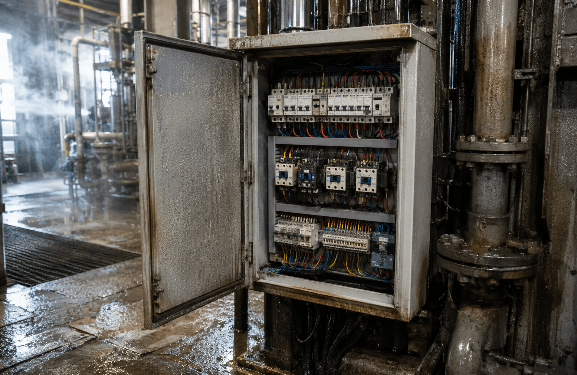
Why Do Control Panels Fail in Harsh Environments?
You can install the best PLC in the world.
Use premium relays.
Choose a beautiful stainless-steel enclosure.
And yet, six months later, the production line still shuts down at 2 a.m. because moisture crept into the cabinet or dust clogged the cooling system.
I have worked with factories long enough to know this truth: most control panels do not fail because the automation technology is bad. They fail because the environment is tougher than people expected.
In harsh industrial environments, control panels are constantly exposed to heat, humidity, dust, vibration, corrosive chemicals, and unstable power conditions. Over time, these factors damage wiring, weaken insulation, loosen terminals, and shorten component lifespan. At UniRegal, we often tell customers that designing a reliable control panel is not just about selecting good components—it is about making sure the entire system can survive the real world outside the engineering drawing.
And honestly, factories are not gentle places.
Industrial environments have a very creative way of testing electrical equipment every single day.
Why Are Harsh Environments So Dangerous for Control Panels?
Because industrial automation equipment likes stability.
Factories usually do not provide that.
A control panel installed inside a pharmaceutical cleanroom lives a very different life compared to one operating in
- Mining facilities
- Cement plants
- Wastewater treatment stations
- Steel mills
- Offshore oil platforms
- Chemical processing plants
These environments expose electrical systems to constant stress.
According to the National Electrical Manufacturers Association (NEMA), environmental contamination and improper enclosure protection remain major contributors to electrical equipment failure in industrial facilities.
Source:
NEMA Industrial Enclosure Standards
Actually, one of the biggest mistakes I see is companies focusing only on the internal components while ignoring the enclosure itself.
That is why choosing the right enclosure matters far more than most buyers realize.
Related reading:
How to Choose the Right Electrical Enclosure
The problem is that environmental damage often happens slowly.
At first, everything looks normal.
Then cooling fans weaken.
Dust starts building up.
Humidity enters through tiny gaps.
Terminal connections loosen from vibration.
And one day, production suddenly stops for “no obvious reason.”
Those are the failures maintenance teams hate the most.
How Does Excessive Heat Damage Control Panels?
Heat is one of the biggest enemies of industrial electronics.
And unfortunately, most control panels generate heat naturally during operation.
PLCs, VFDs, servo drives, power supplies, and transformers all create thermal energy.
If ventilation is poor, temperatures rise fast.
I have opened cabinets that felt more like ovens than electrical enclosures.
The scary part is this: heat damage is usually gradual.
Components rarely fail immediately.
Instead, their lifespan slowly decreases over time.
According to Siemens industrial reliability guidelines, electronic component life expectancy can drop significantly for every 10°C increase above recommended operating temperatures.
Source:
Siemens Thermal Management Guidelines
This is why proper cooling matters so much.
Depending on the application, that may include the following:
- Ventilation fans
- Heat exchangers
- Panel air conditioners
- Filtered airflow systems
And please never install a control panel directly under harsh sunlight unless absolutely necessary.
The sun has zero respect for your thermal calculations.
Why Does Moisture Cause So Many Electrical Failures?
Because water always finds a way.
Especially in industrial environments.
Humidity enters cabinets through the following:
- Poor sealing
- Worn-out gaskets
- Frequent door opening
- Condensation from temperature changes
Once moisture gets inside, problems begin quietly.
Corrosion forms on terminals.
Circuit boards degrade.
Insulation resistance drops.
Sometimes the system still works, but strangely.
Random alarms appear.
Communication becomes unstable.
Sensors start behaving unpredictably.
Those intermittent failures can waste days of troubleshooting time.
According to IEC enclosure protection standards, selecting the proper IP-rated enclosure is critical in humid or washdown environments.
Source:
IEC IP Protection Standards
For example:
Environment | Recommended Rating |
|---|---|
General indoor factory | IP54 |
Dust-heavy workshop | IP65 |
Outdoor installation | IP66 |
Food & beverage washdown area | NEMA 4X |
If you are still confused about NEMA and IP ratings, this article explains the differences clearly:
NEMA vs. IP Ratings: What’s the Difference?
At UniRegal, we usually recommend stainless-steel enclosures for highly corrosive environments because painted steel eventually loses the fight against moisture and chemicals.
It is not a matter of “if.”
Usually just “when.”
How Does Dust Destroy Industrial Control Panels?
People underestimate dust until they see what it does inside a cabinet.
Especially conductive or fine industrial dust.
Industries like:
- Cement manufacturing
- Wood processing
- Metal fabrication
- Mining operations
generate airborne particles constantly.
Once dust enters the panel, it creates multiple problems at once:
- Airflow becomes restricted
- Cooling efficiency drops
- Heat accumulates
- Electrical leakage risks increase
According to ABB industrial maintenance studies, contamination inside electrical enclosures significantly increases the probability of equipment failure and unplanned downtime.
Source:
ABB Industrial Reliability Insights
I once saw a panel in a cement factory where the dust layer inside looked thick enough to plant vegetables in.
The maintenance engineer laughed.
The PLC did not.
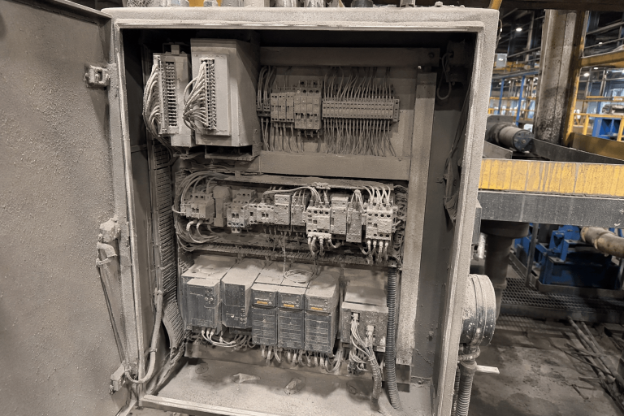
Dust-related failures often become much worse when maintenance is delayed.
Related article:
How to Prevent Component Failure and Protect Your Investment
Why Is Vibration So Hard on Automation Systems?
Because vibration slowly loosens everything.
And electrical systems depend heavily on stable connections.
This issue is common in environments with:
- Heavy motors
- Compressors
- Press machines
- Conveyor systems
- Marine engines
Over time, vibration can loosen the following:
- Terminal blocks
- Relay contacts
- Power connections
- Ethernet communication cables
The dangerous part is that intermittent loose connections are difficult to diagnose.
Sometimes the system runs perfectly.
Then suddenly fails for three seconds.
Then it works again.
According to Rockwell Automation reliability documentation, vibration-related wiring issues are a frequent cause of intermittent industrial automation faults.
Source:
Rockwell Automation Reliability Guide
This is why proper cable routing, ferrule crimping, and terminal torque inspection matter more than people think.
Good panel building is not just electrical work.
It is mechanical discipline too.
And honestly, this is exactly why proper integration matters.
A poorly integrated panel usually reveals itself under harsh conditions first.
Related reading:
Why Integration Matters More Than Price in Industrial Automation
Can Poor Maintenance Make Environmental Damage Worse?
Absolutely.
Even the best-designed control panel still needs maintenance.
But many factories treat electrical cabinets like sealed mystery boxes.
Nobody opens them until something burns.
That approach becomes expensive very quickly.
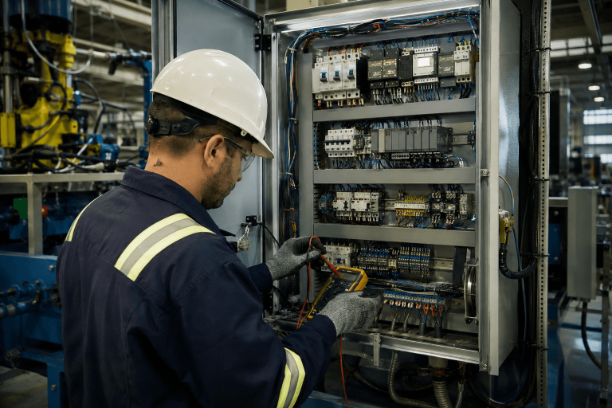
Preventive maintenance should include:
- Thermal inspections
- Fan cleaning
- Filter replacement
- Terminal tightening
- Moisture inspection
- Dust removal
According to Deloitte’s manufacturing industry research, predictive maintenance strategies can reduce downtime and extend equipment life significantly.
Source:
Deloitte Predictive Maintenance Research
And honestly, replacing a cooling fan early is much cheaper than replacing an entire production shutdown later.
This is also why proper testing before installation matters so much.
Related article:
How to Ensure Your Control Panel Works Before It Arrives On Site
How Can You Protect Control Panels in Harsh Industrial Environments?
The good news is that most environmental failures are preventable.
Here are the methods we commonly recommend at UniRegal:
Choose the Correct Enclosure
Never underestimate the environment.
A cheap enclosure often becomes the most expensive mistake later.
Improve Cooling and Ventilation
Heat management is critical for long-term reliability.
Use Industrial-Grade Components
Consumer-grade electrical parts do not belong in demanding industrial applications.
Perform Routine Maintenance
Small inspections prevent major failures.
Design for the Actual Environment
Not the ideal environment.
The real one.
Because factories are messy.
Hot.
Dusty.
Humid.
Sometimes all at once.
If you are sourcing a new panel supplier, this article may also help:
What Most Buyers Miss When Sourcing Control Panels
More Related Questions
What is the best enclosure rating for outdoor control panels?
IP66 or NEMA 4X enclosures are commonly used for outdoor industrial environments.
Can humidity damage PLC systems permanently?
Yes. Long-term moisture exposure can corrode terminals and reduce insulation performance.
Why do industrial cooling fans fail frequently?
Dust buildup and continuous operation shorten fan lifespan significantly.
How often should industrial control panels be inspected?
Most critical systems should be inspected every 3–6 months depending on environmental conditions.
Is stainless steel better than painted steel for harsh environments?
Yes. Stainless steel provides stronger corrosion resistance, especially in chemical or marine industries.
Does dust really cause electrical short circuits?
Yes. Conductive dust can create leakage paths and damage sensitive electronics.
Conclusion
Most control panel failures in harsh environments are not sudden accidents. They are slow problems that build quietly over time through heat, moisture, dust, vibration, and neglect. In my experience, reliable industrial automation is not about buying the most expensive components—it is about designing systems that can survive the reality of the factory floor.
Need help specifying or sourcing this for your project? Request a quote - we reply within 1-2 working days with a technical review.