
Oct 6, 2026PLC & Automation Systems
NEMA vs. IP Ratings: What’s the Difference?
NEMA vs. IP Ratings: What’s the Difference? Choosing the Wrong Enclosure Rating Can Lead to Costly Failures Many buyers assume that all electrical enclosures provide similar protection. In reality, ch
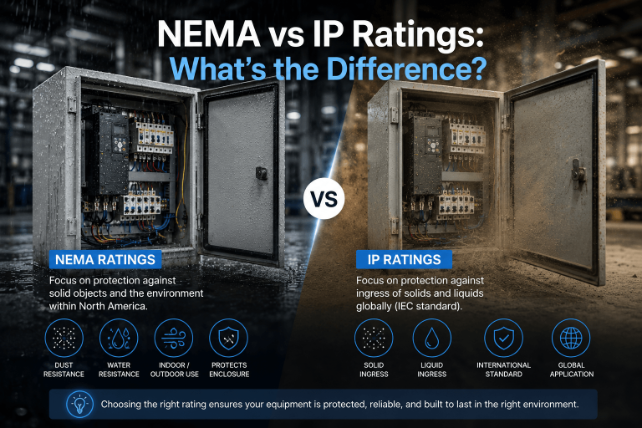
NEMA vs. IP Ratings: What’s the Difference?
Choosing the Wrong Enclosure Rating Can Lead to Costly Failures
Many buyers assume that all electrical enclosures provide similar protection. In reality, choosing the wrong enclosure rating can result in water ingress, dust contamination, corrosion, equipment failure, and expensive downtime.
This is especially critical for industrial control panels, outdoor electrical cabinets, UPS systems, and automation equipment operating in harsh environments.
The main difference between NEMA and IP ratings is that IP ratings focus primarily on protection against dust and water ingress, while NEMA ratings also evaluate factors such as corrosion resistance, oil exposure, ice formation, and suitability for hazardous industrial environments. IP ratings are used internationally, while NEMA standards are more common in North America.
Understanding the difference helps buyers select the right industrial enclosure for long-term reliability and compliance.
What Is an IP Rating?
IP stands for Ingress Protection.
The IP rating system is defined by the International Electrotechnical Commission (IEC 60529) and is widely used worldwide to classify how well an enclosure protects against:
- Solid particles (dust)
- Liquid ingress (water)
IP Rating Structure
An IP rating contains two digits.
Example:
- First digit = protection against solids
- Second digit = protection against liquids
Common IP Ratings
IP Rating | Protection Level |
|---|---|
IP54 | Limited dust protection and water splashes |
IP65 | Dust-tight and protected against water jets |
IP66 | Dust-tight and protected against powerful water jets |
IP67 | Temporary immersion protection |
According to IEC 60529, IP66 enclosures are tested against powerful water jets from multiple directions, making them common in industrial automation and outdoor electrical cabinet applications.
What Is a NEMA Rating?
NEMA stands for the National Electrical Manufacturers Association.
NEMA ratings are mainly used in the United States and Canada to classify electrical enclosures based on environmental protection and durability.
Unlike IP ratings, NEMA standards evaluate additional factors such as the following:
- Corrosion resistance
- Oil and coolant exposure
- Ice formation
- Outdoor weather resistance
- Hazardous locations
This makes NEMA standards broader in scope for industrial applications.
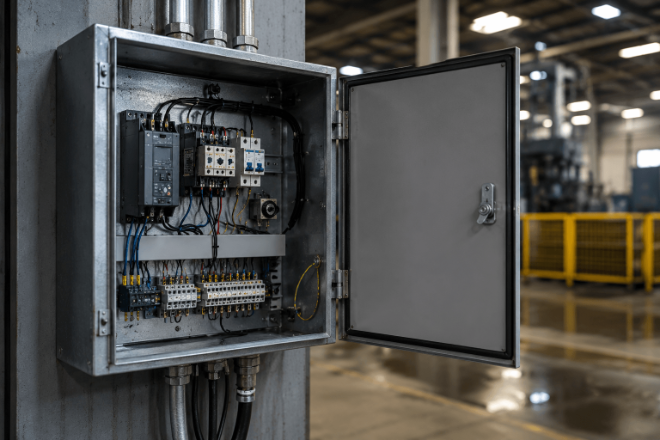
Common NEMA Ratings
NEMA Rating | Typical Application |
|---|---|
NEMA 1 | Indoor protection against dust and accidental contact |
NEMA 3R | Outdoor rain protection |
NEMA 4 | Indoor/outdoor water-tight protection |
NEMA 4X | Corrosion-resistant washdown environments |
NEMA 12 | Indoor industrial dust and oil protection |
According to NEMA Standards Publication 250, NEMA 4X enclosures provide additional corrosion protection compared to standard NEMA 4 enclosures.
Source:
NEMA 250 Standard
https://www.nema.org/standards/view/enclosures-for-electrical-equipment-1000-volts-maximum
The Main Difference Between NEMA and IP Ratings
Although both standards classify enclosure protection, they are not identical.
NEMA vs IP Comparison Table
Feature | IP Rating | NEMA Rating |
|---|---|---|
Dust Protection | Yes | Yes |
Water Protection | Yes | Yes |
Corrosion Resistance | No | Yes |
Ice Formation Protection | No | Yes |
Hazardous Environment Evaluation | No | Yes |
Mainly Used In | International markets | North America |
Standard Organization | IEC | NEMA |
One important point is that there is no exact one-to-one conversion between NEMA and IP ratings.
For example:
NEMA Rating | Approximate IP Equivalent |
|---|---|
NEMA 4 | IP66 |
NEMA 4X | IP66 |
NEMA 12 | IP54 |
NEMA 3R | IP24 |
However, equivalent ratings may still differ in testing methods and environmental coverage.
Source:
Rittal Industrial Enclosure Guide
https://www.rittal.com/us-en_US/Company/Rittal-Stories/IP-vs-NEMA-Which-Rating-Does-Your-Enclosure-Need
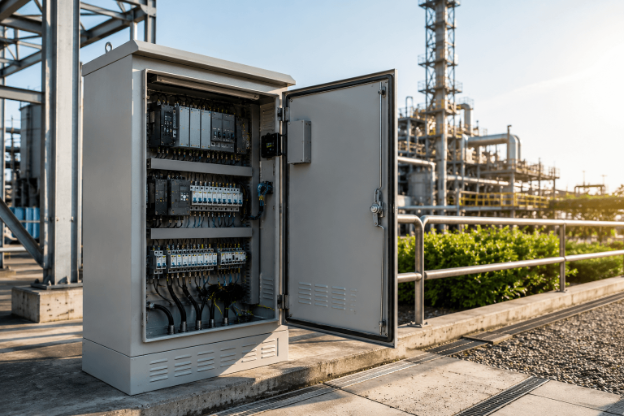
Why Outdoor Electrical Cabinets Often Require NEMA 4 or IP66
Outdoor industrial environments create several risks for electrical equipment:
- Rain exposure
- Dust accumulation
- UV exposure
- Temperature fluctuations
- Corrosion
According to a report from the U.S. Department of Energy, environmental contamination and moisture are among the leading causes of electrical equipment degradation in industrial facilities.
For outdoor control cabinets, buyers commonly choose the following:
- NEMA 4
- NEMA 4X
- IP66
These ratings are widely used in:
- Industrial automation
- Water treatment plants
- Renewable energy systems
- Oil & gas facilities
- Telecommunications infrastructure
When Should You Choose NEMA 4X?
NEMA 4X is commonly recommended for harsh industrial environments where corrosion resistance is critical.
Typical applications include the following:
- Food processing plants
- Chemical facilities
- Marine environments
- Coastal installations
- Pharmaceutical manufacturing
In these environments, stainless steel electrical enclosures are often preferred because they provide stronger corrosion resistance than painted carbon steel cabinets.
According to Nickel Institute corrosion studies, stainless steel significantly improves enclosure lifespan in chloride-rich and high-humidity environments.
Can an Electrical Enclosure Have Both NEMA and IP Ratings?
Yes.
Many industrial enclosure manufacturers design products that comply with both standards.
For example:
This approach is common for international industrial projects where equipment may be installed in North America but sourced globally.
Dual-rated enclosures help simplify the following:
- Global compliance
- Engineering approvals
- International procurement
- Export projects
How to Choose the Right Enclosure Rating
Choosing the correct enclosure protection rating depends on several factors.
Consider the installation environment.
Ask:
- Is the cabinet installed indoors or outdoors?
- Will it be exposed to rain or washdown cleaning?
- Is dust present?
- Is corrosion a concern?
Consider the industry.
Different industries require different protection levels.
Industry | Common Rating |
|---|---|
Indoor automation | IP54 / NEMA 12 |
Outdoor telecom | IP66 / NEMA 4 |
Food processing | NEMA 4X |
Chemical plants | NEMA 4X |
Clean indoor environments | NEMA 1 |
Consider Regional Standards
- North American projects often specify NEMA ratings
- International projects commonly use IP ratings
Understanding customer specifications early can prevent redesigns and project delays.
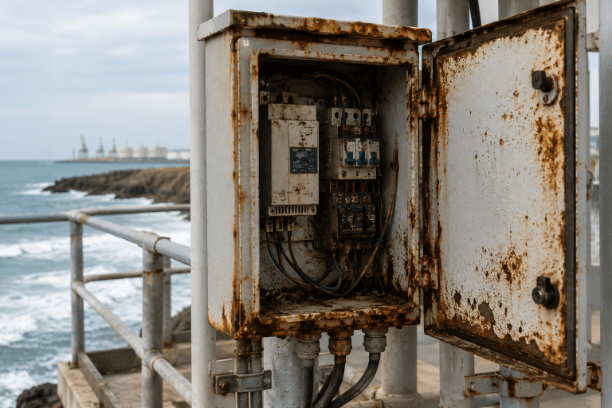
Real-World Example: Corrosion Failure in Coastal Installations
A 2023 industrial maintenance case study published by Plant Engineering highlighted multiple enclosure failures in coastal wastewater facilities caused by inadequate corrosion protection.
Several painted steel cabinets experienced the following:
- Surface corrosion
- Seal degradation
- Water ingress
- Internal electrical failures
After upgrading to stainless steel NEMA 4X enclosures, maintenance frequency and equipment failures were significantly reduced.
Frequently Asked Questions
Is IP67 the same as NEMA 4?
No.
IP67 mainly evaluates dust protection and temporary water immersion, while NEMA 4 also includes additional environmental considerations such as ice formation and durability testing.
Which is better: NEMA or IP?
Neither system is universally better.
- IP ratings are simpler and widely used internationally
- NEMA ratings are broader and often preferred in North American industrial projects
The best choice depends on the application and project requirements.
What rating is best for washdown environments?
NEMA 4X is commonly recommended for washdown applications because it combines water protection with corrosion resistance.
Final Thoughts
Choosing the correct enclosure protection rating is not just about compliance. It directly impacts equipment reliability, maintenance costs, and long-term operational performance.
For industrial control panels, UPS cabinets, and electrical enclosures, understanding the difference between NEMA and IP ratings helps buyers avoid costly failures and select the right solution for demanding environments.
As industrial projects become more global, many manufacturers now design electrical cabinets that support both NEMA and IP standards to meet international engineering requirements.
Need help specifying or sourcing this for your project? Request a quote - we reply within 1-2 working days with a technical review.