
Aug 24, 2026Integration & Compatibility
How to Ensure Your Control Panel Works Before It Arrives On Site
How to make sure a control panel works before it reaches the site: FAT, wiring verification and pre-shipment checks that prevent costly on-site rework.
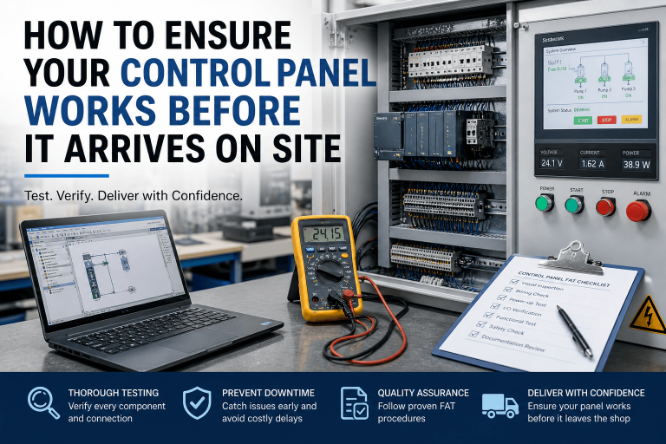
Shipping a control panel is easy. Ensuring it actually operates the moment it’s powered up on a remote site is the real challenge.
In industrial automation, the most expensive place to find a bug is at the customer’s facility. When a panel arrives and the HMI shows a "Communication Error" or the PLC inputs don't trigger, you aren't just looking at a technical glitch—you are looking at mounting engineering hours, travel costs, and project delays.
Here is the professional roadmap to validating a control panel before it leaves the shop floor.
1. Beyond the "Power-On" Test: System-Level Validation
Many shops think if the lights come on, the panel is ready. That’s a dangerous assumption. True reliability is found in system-level validation.
At this stage, we simulate the site environment. It’s not about checking individual components; it’s about checking if they talk to each other as a single unit.
The Connectivity Audit (PLC + HMI + VFD)
The most common on-site failure is a communication breakdown.
- Firmware Alignment: Does the PLC firmware version match the project file? A version mismatch can brick a system during site commissioning.
- Protocol Handshaking: We verify that the EtherNet/IP, Profinet, or Modbus settings are hard-coded and tested.
- The "Data-Point" Check: We don't just check if the HMI screen is on; we toggle bits in the PLC to ensure the HMI tags respond in real-time.
2. I/O Mapping: Preventing "Signal Ghosting"
Wiring errors are the #1 cause of physical damage during startup. If a 24VDC signal is accidentally wired to a 120VAC terminal, your hardware is gone before the project starts.
To ensure 100% accuracy, we perform a point-to-point I/O check:
- Input Simulation: We trigger every sensor terminal to ensure the correct LED lights up on the PLC input card.
- Output Command: We force PLC outputs to verify that the corresponding relays click and the contactors engage.
- Analog Scaling: For 4-20mA or 0-10V signals, we use signal generators to ensure the PLC "sees" the same value that the field device is sending.
3. The "Last-Mile" Accessory & BOM Audit
A missing $2 terminal jumper or a specific communication cable can halt a multi-million-dollar installation.
Before crating, we verify the BOM (Bill of Materials) for completeness:
- Connectors & Jumpers: Are all external interface ports included?
- Protection Components: Are the fuses and circuit breakers sized correctly for the actual field motors (not just the theoretical design)?
- Spares: Are there extra terminals provided for future field expansions, as per the spec?
4. Documentation: The "Silent" Component
A panel without accurate drawings is a "black box" that site engineers will struggle to maintain.
Your pre-shipment package must include:
- The "As-Built" Diagrams: Not the original design, but the actual wiring as it exists in the cabinet.
- I/O List & IP Address Schedule: A clear map for the software team to follow.
- Parameter Backups: A USB or digital cloud link containing the VFD parameters and PLC/HMI source code.
Why Pre-Deployment Validation is a Financial Strategy
For buyers and project managers, "pre-shipment testing" isn't a technical luxury—it’s risk mitigation.
On-Site Troubleshooting | Pre-Shipment Validation (FAT) |
|---|---|
Expensive: Field engineer rates + travel. | Included: Part of the assembly process. |
Slow: Limited tools and spare parts on site. | Fast: Full shop resources and inventory. |
High Stress: Production deadlines are looming. | Controlled: Done in a quiet, professional lab. |
How UniRegal Eliminates the "Site Arrival" Anxiety
At UniRegal, we treat the shipping date as the "Final Exam." Our validation protocol ensures that when you apply power at your site, the system performs exactly as expected.
Our process covers:
- Full PLC/HMI/VFD compatibility verification.
- Wiring integrity checks against industrial standards (IEC/UL).
- Firmware synchronizatioRelated guides
- Want panels that work on arrival? We run FAT and wiring verification before shipment from Foshan — so your team avoids on-site rework. Talk to our team about your project.n to match your existing ecosystem.
- Complete documentation packages for seamless handovers.
Protect your project timeline. Don't wait until the panel is on-site to find out it’s not ready.
👉 Need a validated control solution for your next project?