
Oct 6, 2026Buying Guides
Stainless Steel vs Carbon Steel Electrical Cabinets
Stainless Steel vs Carbon Steel Electrical Cabinets — The Real Cost of Choosing the Wrong Enclosure Material Most Cabinet Failures Do Not Start with Electrical Problems In many industrial projects.
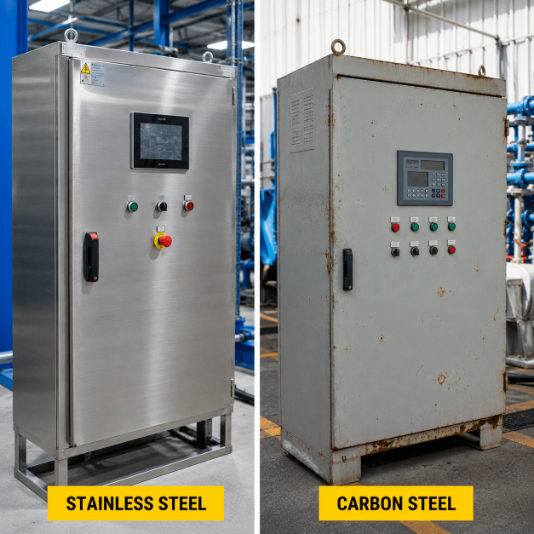
Stainless Steel vs Carbon Steel Electrical Cabinets — The Real Cost of Choosing the Wrong Enclosure Material
Most Cabinet Failures Do Not Start with Electrical Problems
In many industrial projects, electrical cabinets fail long before the equipment inside reaches the end of its service life.
Not because the PLC failed.
Not because the UPS failed.
Not because the automation system was poorly programmed.
But because the enclosure itself slowly deteriorated over time.
At first, the damage is almost invisible:
- Small coating scratches
- Condensation around door seals
- Slight rust near hinges
- Tiny signs of corrosion around cable entries
Then years later:
- Moisture reaches live components
- Grounding performance degrades
- Ventilation weakens
- Maintenance costs rise
- Unexpected shutdowns begin appearing
And by that point, replacing the cabinet is far more expensive than choosing the right material from the beginning.
Stainless steel electrical cabinets provide superior corrosion resistance, longer service life, and better protection in harsh or hygienic environments, while carbon steel cabinets offer a lower upfront cost and strong structural performance for controlled industrial applications. The correct choice depends on lifecycle cost, environmental exposure, maintenance strategy, and long-term operational risk — not simply material price.
This is the part many sourcing discussions miss:
The true cost of an electrical cabinet is rarely the purchase price.
It is the cost of what happens after years of exposure to the real industrial environment.
Why Electrical Cabinet Material Impacts More Than Corrosion
Many buyers think enclosure material only affects appearance.
In reality, cabinet material directly affects the following:
- Equipment lifespan
- Electrical reliability
- Thermal performance
- Maintenance frequency
- Downtime risk
- Long-term operating cost
Industrial control panels are no longer simple power boxes.
Modern electrical cabinets now contain:
- PLC systems
- VFD drives
- Industrial PCs
- Networking equipment
- UPS systems
- Remote monitoring devices
These systems are increasingly sensitive to:
- Moisture
- Heat
- Dust contamination
- Corrosion-related grounding issues
According to the U.S. Department of Energy, electrical reliability problems caused by environmental exposure remain one of the leading contributors to industrial equipment degradation.
The enclosure is no longer just protecting components.
It has become part of the reliability strategy itself.
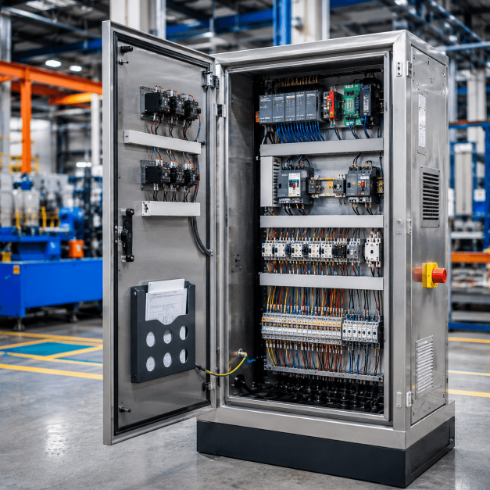
Corrosion Is Not a Surface Problem—It Is an Operational Risk
One of the biggest misunderstandings in industrial projects is treating corrosion as a cosmetic issue.
In reality, corrosion often becomes the following:
- A safety issue
- A maintenance issue
- A downtime issue
- A thermal issue
- An electrical reliability issue
According to AMPP (formerly NACE International), global corrosion-related costs exceed the following:
$2.5 trillion annually
which equals approximately
3–4% of global GDP
But the real industrial problem is not visible rust.
It is what corrosion quietly causes over time:
- Increased resistance at grounding points
- Moisture penetration
- Seal degradation
- Reduced enclosure integrity
- Heat retention
- Internal contamination
Many cabinet failures begin years before operators notice external damage.
Why Carbon Steel Cabinets Still Dominate Industrial Applications
Despite corrosion concerns, carbon steel electrical cabinets remain extremely common worldwide.
And honestly, for many industrial environments, they are still the correct engineering choice.
Carbon steel cabinets provide the following:
- Excellent structural strength
- Lower manufacturing cost
- Easier fabrication
- Good load-bearing capability
- Strong mechanical durability
This is why they are widely used in the following:
- Indoor automation systems
- Manufacturing plants
- Power distribution rooms
- Dry industrial facilities
In controlled environments, a properly coated carbon steel cabinet may perform reliably for many years.
The problem starts when buyers assume the following:
“Indoor conditions today will remain the same forever.”
Industrial environments often change over time:
- Ventilation deteriorates
- Humidity increases
- Processes evolve
- Cleaning procedures become more aggressive
- Facilities expand
And cabinets designed only for ideal conditions may struggle years later.
The Hidden Weakness of Powder-Coated Carbon Steel
This is one area many sourcing discussions oversimplify.
A powder-coated carbon steel cabinet does not fail because the steel itself is weak.
It fails because:
coatings eventually become vulnerable.
Over time:
- UV exposure
- Cleaning chemicals
- Abrasion
- Mechanical impacts
- Thermal cycling
can damage protective coatings.
Once coating integrity is compromised:
- Moisture reaches exposed steel
- Oxidation begins
- Corrosion spreads underneath the coating itself
This is especially dangerous because corrosion often develops:
- Around hinges
- Door seams
- Cable gland openings
- Welded joints
- Mounting points
areas that operators may not inspect regularly.
Why Stainless Steel Performs Differently
Stainless steel behaves differently because corrosion resistance is built into the material itself—not only the surface coating.
The chromium inside stainless steel forms a passive oxide layer that continuously protects the surface from oxidation.
This is why stainless steel cabinets are widely used in the following:
- Food processing
- Wastewater treatment
- Marine applications
- Pharmaceutical facilities
- Chemical plants
Even if the surface experiences scratches or minor damage, the material itself still resists corrosion far better than carbon steel.
According to the Nickel Institute, stainless steel significantly outperforms coated carbon steel in chloride-rich and high-humidity environments.
This becomes extremely important in the following:
- Coastal installations
- Outdoor infrastructure
- Washdown environments
- Chemical exposure areas
where environmental stress never truly stops.
304 vs 316 Stainless Steel — The Difference Many Buyers Underestimate
One of the biggest mistakes in industrial projects is assuming the following:
“All stainless steel is the same.”
It is not.
304 Stainless Steel
Most commonly used.
Advantages:
- Lower cost
- Good corrosion resistance
- Suitable for general industrial environments
However:
304 may still struggle in environments with:
- Salt exposure
- Chlorides
- Aggressive chemicals
316 Stainless Steel
316 stainless steel contains molybdenum, which improves resistance to the following:
- Chlorides
- Salt spray
- Chemical corrosion
This is why 316 is often preferred for the following:
- Coastal facilities
- Marine applications
- Offshore projects
- Chemical processing
According to corrosion performance studies from the British Stainless Steel Association, 316 stainless steel provides significantly better pitting resistance than 304 in chloride-heavy environments.
This difference may not matter during installation.
But five years later, it can completely change maintenance costs.
The Real Cost Difference Is Not Material Price — It Is Lifecycle Cost
This is where experienced industrial engineers think differently from basic procurement teams.
A stainless steel enclosure may cost significantly more upfront.
But the real question is
What happens over 10–15 years of operation?
Lifecycle cost may include the following:
- Corrosion repairs
- Cabinet replacement
- Production downtime
- Maintenance labor
- Seal replacement
- Cleaning procedures
- Inspection frequency
According to industrial asset management studies from Deloitte, maintenance-related downtime remains one of the largest hidden operational costs in manufacturing environments.
In harsh environments, the cheaper cabinet is not always the cheaper solution.
Why Food and Pharmaceutical Facilities Almost Always Choose Stainless Steel
This is not just about corrosion.
It is also about hygiene.
Food and pharmaceutical facilities often require the following:
- Frequent washdowns
- Chemical sanitation
- Smooth cleanable surfaces
- Reduced contamination risk
Painted carbon steel surfaces may eventually
- Chip
- Crack
- Trap bacteria
- Degrade under aggressive cleaning chemicals
This is why stainless steel NEMA 4X enclosures are widely specified in hygienic industries.
In these facilities, enclosure material affects the following:
- Compliance
- Product safety
- Cleaning efficiency
- Audit performance
not just durability.
The Thermal Management Problem Most Buyers Ignore
This is another issue many enclosure discussions completely overlook.
Modern industrial cabinets generate significant heat from the following:
- PLC systems
- VFD drives
- UPS systems
- Power supplies
- Industrial networking devices
Corrosion and contamination can reduce the following:
- Airflow efficiency
- Cooling performance
- Seal effectiveness
which gradually increases internal temperatures.
According to Schneider Electric, elevated cabinet temperatures are one of the leading contributors to premature electrical component failure.
In other words:
Poor enclosure material selection may eventually become a thermal reliability problem — not just a corrosion problem.
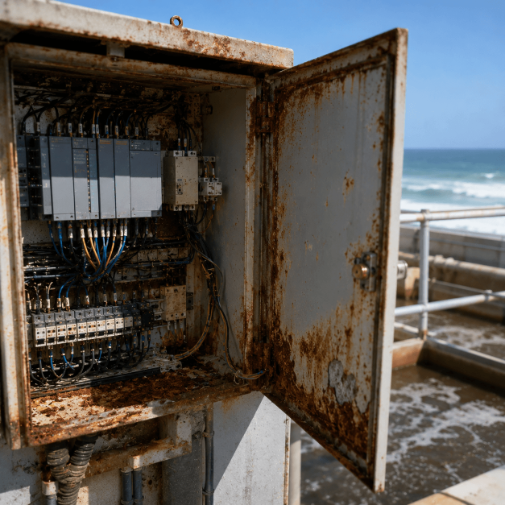
Real-World Example: Coastal Wastewater Facility Failure
A wastewater treatment facility near a coastal region initially selected powder-coated carbon steel electrical cabinets to reduce upfront project cost.
During the first years, the system operated normally.
But over time:
- Salt-laden air damaged cabinet coatings
- Corrosion developed around hinges and cable entries
- Moisture entered several control panels
- Maintenance frequency increased significantly
The facility later upgraded to the following:
- 316 stainless steel NEMA 4X enclosures
According to maintenance reports, corrosion-related failures and service interventions dropped substantially afterward.
This situation is extremely common in the following:
- Coastal infrastructure
- Marine projects
- Water treatment facilities
where environmental exposure is continuous and unavoidable.
Common Buyer Mistakes When Selecting Electrical Cabinet Materials
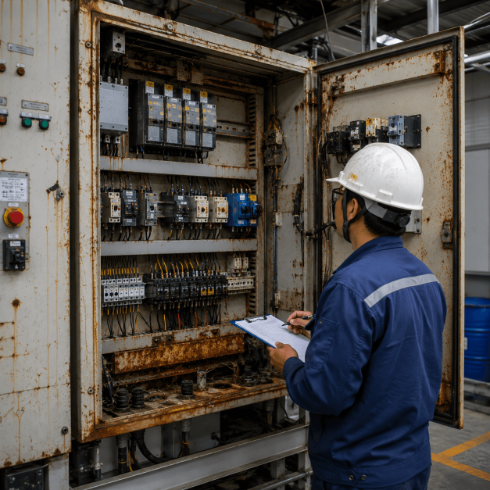
Choosing Based Only on Upfront Cost
Initial savings may create much larger maintenance expenses later.
Assuming "Indoor" Means "Low Risk"
Humidity and contamination can still create corrosion indoors.
Underestimating Coastal Air Exposure
Salt corrosion can spread far faster than many buyers expect.
Over-Specifying Stainless Steel for Simple Indoor Applications
Not every project requires premium corrosion resistance.
Ignoring Future Environmental Changes
Industrial environments rarely stay identical over a 10-year equipment lifecycle.
How Experienced Engineers Actually Choose Cabinet Materials
Professional enclosure selection usually starts with environmental risk assessment.
Experienced engineers evaluate:
- Humidity levels
- Chloride exposure
- Cleaning chemicals
- UV exposure
- Maintenance capability
- Expected service life
- Downtime tolerance
- Total lifecycle cost
—not simply
- initial cabinet price.
Because in industrial automation, the enclosure is not just protecting components.
It is protecting long-term operational reliability.
Final Thoughts
Stainless steel and carbon steel both play important roles in industrial electrical cabinet design.
Neither material is universally better.
The real question is
Which material best matches the long-term environmental and operational reality of the project?
Carbon steel may be the ideal choice for controlled industrial environments.
Stainless steel may prevent years of maintenance problems in harsh conditions.
But the biggest mistake is not choosing one material over another.
The biggest mistake is underestimating how aggressively industrial environments attack electrical systems over time.
Because in many facilities, enclosure problems develop slowly, quietly, and invisibly — until one day they suddenly become operational problems.
And by then, the real cost is no longer measured in cabinet price.
It is measured in downtime.
Need help specifying or sourcing this for your project? Request a quote - we reply within 1-2 working days with a technical review.