Oct 6, 2026Buying Guides
Why Integration Matters More Than Price in Industrial Automation
From Components to Control Panel: Why Integration Matters More Than Price in Industrial Automation Have you ever sourced all the right components, but the system still failed to start? In industrial
From Components to Control Panel: Why Integration Matters More Than Price in Industrial Automation
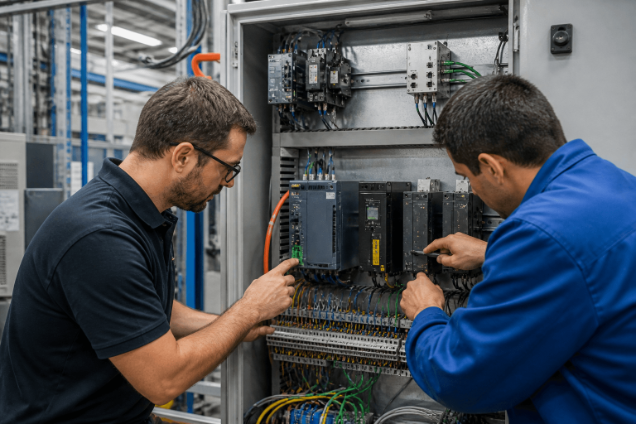
Have you ever sourced all the right components, but the system still failed to start?
In industrial automation, most failures are not caused by wrong parts but by components that do not work together as a system.
A PLC may be correct.
An HMI may be from a trusted brand.
A drive may meet specifications.
But once installed:
- The system cannot start
- Devices cannot communicate
- Commissioning is delayed for days
This is the gap between buying components and building a working control panel.
Components vs Control Panel: What Is the Real Difference
Many buyers assume that selecting correct parts is enough to ensure system performance.
In reality, a control panel is a fully integrated system, not a collection of independent components.
Key Differences
Aspect | Component Sourcing | Control Panel Integration |
|---|---|---|
Focus | Individual parts | Complete system |
Responsibility | Procurement | Engineering + Integration |
Risk Visibility | Hidden until commissioning | Identified before delivery |
Final Result | Parts delivered | System ready to run |
Sourcing components ensures availability.
Integration ensures functionality.
Why Price-Driven Sourcing Leads to Higher Risk
Cost control is important, but focusing only on price often increases total project risk.
Lower component prices do not reduce overall cost if integration issues delay commissioning or stop production.
Typical Consequences
- Production lines cannot start after installation
- Engineers spend days troubleshooting compatibility issues
- Systems require reprogramming or part replacement
- Project timelines are delayed
In real projects, downtime costs far exceed component savings.
Where Integration Problems Actually Come From
Integration failures are rarely caused by a single component.
Most issues come from mismatches between PLC systems, HMIs, drives, and field devices.
Common Integration Risks
- PLC and HMI incompatibility Communication protocols or firmware do not align
- Drive and motor mismatch Incorrect parameters or configuration
- Wiring and layout errors Incorrect connections lead to system failure
- Incomplete BOM Missing relays, terminals, or protection components
Each part may be correct individually, but the system fails as a whole.
Why Issues Only Appear During Commissioning
One of the most critical challenges in industrial automation is timing.
Integration problems are usually discovered only when the system is powered on and expected to run.
At this stage:
- Installation is already complete
- Project deadlines are fixed
- Any delay directly impacts production
Typical Scenario
- Components are delivered on time
- The panel is installed on-site
- System is powered on
- The system does not run
Troubleshooting at this stage is complex, time-consuming, and costly.
How to Ensure Control Panel Integration Before Delivery
Avoiding these risks requires system-level validation before shipment.
A reliable control panel must be verified as a complete system, not just a list of components.
Pre-Deployment Validation Checklist
- Verify PLC, HMI, and VFD compatibility
- Check firmware versions and system alignment
- Confirm complete BOM, including small components
- Inspect wiring layout and panel assembly
- Prepare documentation for installation and export
Component vs System Validation
Level | Focus | Result |
|---|---|---|
Component Level | Specifications | Parts are correct |
System Level | Integration & compatibility | The system works on-site. |
System validation before shipment significantly reduces commissioning risks.
How UniRegal Reduces Integration Risks
At UniRegal Automation, we approach projects from a system perspective rather than simple component supply.
We ensure that automation components do not just match on paper but work together in real operating conditions.
Our Approach
- Cross-brand compatibility verification (Siemens, Mitsubishi, ABB, Allen-Bradley)
- PLC, HMI, and drive system matching
- Firmware and version alignment
- Complete BOM and accessory validation
- Panel-level inspection and photo verification
- Export-ready documentation for global delivery
This process helps industrial buyers reduce risk, especially in projects with tight timelines or cross-border sourcing.
Conclusion
Industrial automation success is not defined by the components you buy but by how well they work together.
For B2B buyers, integration is not an added value—it is the key factor that determines whether a system runs or fails.
Choosing lower-cost components may reduce upfront expenses, but poor integration can lead to higher overall project costs.
If your project involves multiple brands, tight timelines, or global delivery, integration risks should be addressed before shipment.
UniRegal Automation supports OEMs, EPC contractors, and industrial distributors with control panel integration and automation solutions.
Send us your requirements:
- Country
- Brand / system
- Model numbers
- Application or project type
- Required delivery time
We will help you verify compatibility and ensure your system is ready to run upon arrival.
Need help specifying or sourcing this for your project? Request a quote - we reply within 1-2 working days with a technical review.