
Oct 19, 2026Control Panels
What a Skid-Mounted RTU Panel Does at a Well Site
Skid-mounted RTU panel guide: I/O schedules, SCADA links, hazardous-area review, backup power and FAT — and the questions to ask before approval.

What a Skid-Mounted RTU Panel Does at a Well Site—and What Buyers Should Review Before Approval
A Procurement Story for Multi-Well RTU Panel Projects
Three Suppliers Quoted. The Slowest One Won.
Picture a quotation package for 24 skid-mounted RTU panels used across several well sites. The RFQ looked straightforward at first: outdoor installation, Class I Division 2 area, Modbus RTU communication, NEMA-rated enclosure, skid-mounted structure, and export documentation.
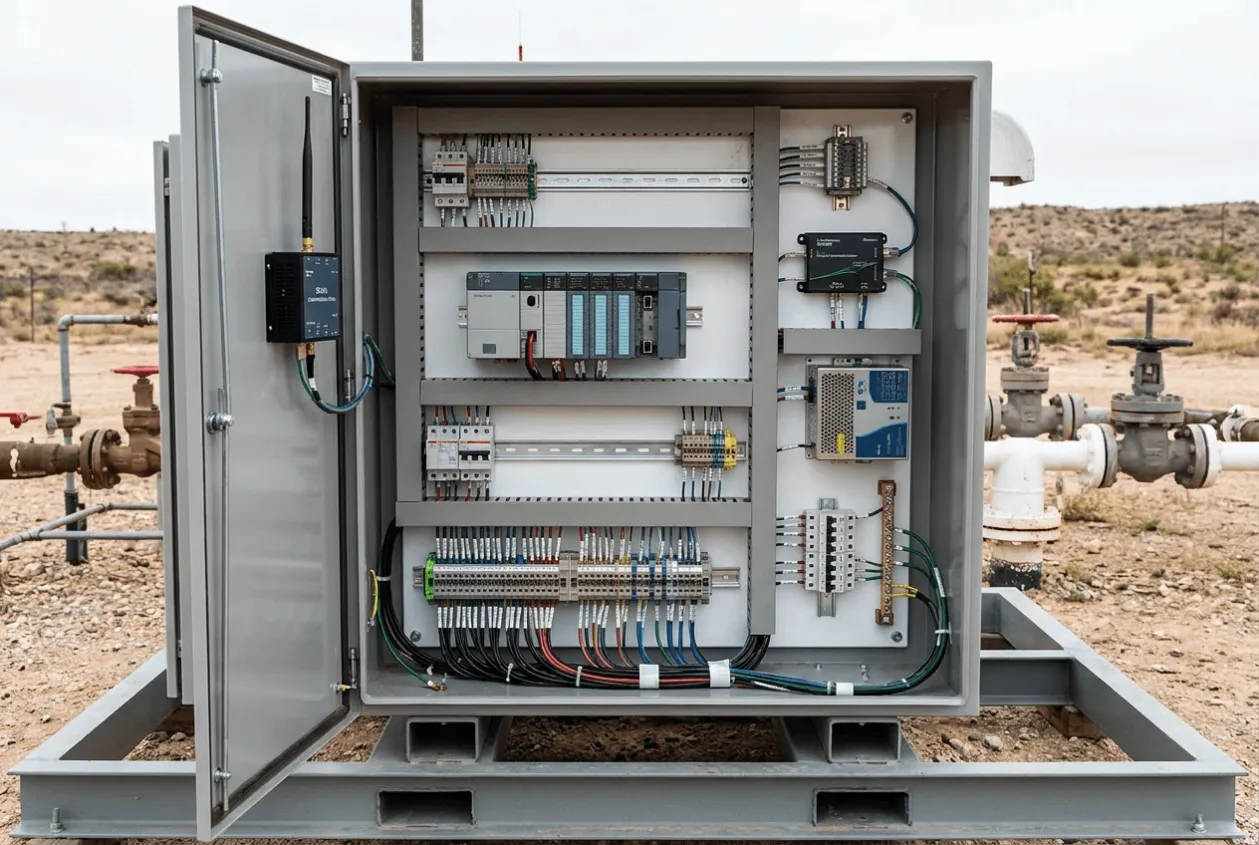
Three suppliers were invited to quote.
Two suppliers returned prices within 48 hours. Their quotations looked clean enough. They confirmed the enclosure material, RTU brand, cabinet size, estimated delivery time, and commercial terms.
The third supplier did not quote immediately. They came back with a question first:
At first, that delayed the purchasing process. But that supplier eventually became the strongest candidate.
Why?
Because they understood something the faster suppliers missed. The real risk was not whether a workshop could assemble 24 RTU cabinets. The real risk was whether all 24 panels would match the field signals, transmitter power, SCADA settings, hazardous-area requirements, site power conditions, and commissioning sequence.
Scenarios like this point to one rule we still use today:
In multi-well projects, we rarely compare suppliers by enclosure price first. We compare them by the questions they ask before quoting.
A skid-mounted RTU panel is not just a cabinet with a controller inside. It is a repeatable well-site control package. If the review is done properly before production, the site team receives something close to “land it, connect it, test it, and commission it.” If the review is weak, the same order becomes 24 separate field troubleshooting jobs.
What Buyers Expected the RTU Panel to Do
In that project, each skid-mounted RTU panel acted as the local control and data hub for a well site. The panel needed to read field signals, run basic local logic, and send operating data back to the SCADA host.
The expected signals included pressure, temperature, flow, level, valve position, pump running status, emergency shutdown input, and alarm contacts. Some sites also required output signals for valve commands, pump control, reset functions, and status feedback.
The communication requirement was Modbus RTU, but that single phrase was not enough for procurement approval. The buyer still needed to confirm RS-485 wiring, RTU addresses, baud rate, register mapping, gateway responsibility, and how communication would be tested before shipment.
Mounting the RTU panel on a skid made sense because this was not a one-off retrofit. The buyer wanted a repeated package across multiple well sites. The enclosure, frame, terminals, power supply, RTU, communication hardware, cable routing, drawings, labels, and FAT records all needed to follow the same logic.
For one existing shelter, a wall-mounted RTU panel may be easier. For a multi-well program, skid-mounted design can reduce site wiring, repeated coordination, and commissioning uncertainty.
Procurement Advice In a multi-well RTU project, the buyer is not only buying panel hardware. The buyer is buying repeatability across field sites.
The First Procurement Lesson: The I/O Schedule Came Before the Cabinet Drawing
In a 24-panel program, the I/O schedule quickly becomes the most important document in the quotation review. Before anyone can judge enclosure size, terminal layout, spare capacity, or even the final RTU configuration, the review needs to understand what each site actually has to read and control.
A useful I/O schedule should not only say “pressure transmitter” or “valve signal.” It should separate DI, DO, AI, and AO points. It should also define whether discrete signals are dry contacts, 24 VDC signals, relay outputs, or device-specific interfaces. For analog signals, the supplier should know whether each transmitter is loop-powered or separately powered. Spare I/O also needs to be planned because field changes are common in well-site projects.
In this case, the supplier who asked for the I/O schedule immediately showed better project judgment. They understood that a standard RTU panel can still fail commercially if the I/O count, signal type, or terminal plan does not match the field instruments.
Supplier Red Flag
The supplier accepts “standard I/O” without asking for signal types, transmitter power, spare points, or SCADA tag references.
Supplier Green Flag
The supplier asks for DI/DO/AI/AO counts, 4–20 mA loop details, terminal layout, spare capacity, and communication mapping before confirming the design.
Looking Back, the Whole Project Came Back to Eight Review Areas
Reviewing the quotation details, almost every technical discussion comes back to the same eight areas. These were not abstract checklist items. Each one affects whether a 24-panel package can be built, shipped, installed, and commissioned with fewer surprises.
Review Area | What We Checked | Why It Mattered in the Project |
|---|---|---|
Site Duty | Wellhead, pump station, metering skid, separator, or injection skid | Different sites needed different signals and control logic |
Hazardous Area | Class I Division 2, Zone 2, or non-hazardous | Affected enclosure, components, labeling, wiring, and documents |
Enclosure | IP65, IP66, NEMA 4X, 304/316 stainless, coated steel | Remote sites faced sun, rain, dust, corrosion, and possible H2S exposure |
I/O Schedule | DI, DO, AI, AO, signal type, transmitter supply | Wrong assumptions would delay commissioning |
Communications | Modbus RTU, RS-485, cellular, radio, Ethernet | SCADA connection had to be repeatable across sites |
Power | 24 VDC, 120/240 VAC, solar, UPS, grounding | Remote well sites often have unstable or limited power |
Skid Design | Frame, cable route, lifting, vibration, field landing | The package had to survive transport and installation |
FAT Package | I/O simulation, wiring check, communication test, signed records | Testing had to prove the site package, not only the cabinet |
Hazardous Area Review Could Not Be Treated as a Small Note
In a 24-panel program, the hazardous-area requirement is often listed in the RFQ, but not all suppliers treat it with the same seriousness. Some simply repeated the phrase “Class I Division 2” in the quotation. Others used the word “explosion-proof,” which is often too vague for a serious review.
For well-site RTU panels, the buyer should confirm the actual classification with the end user, EPC contractor, engineer of record, or authority having jurisdiction. Class/Division or Zone information affects enclosure selection, approved components, wiring method, labeling, documentation, and inspection responsibility.
The review should also clarify whether the project needs a UL 508A listed panel, UL-listed components inside the panel, CE declaration, ATEX/IECEx consideration, or a self-declaration package with complete test records.
Useful external references include UL 508A industrial control panel information, OSHA’s definition of Class I Division 2 locations, NEMA enclosure types, and the official Modbus Application Protocol Specification.
Supplier Red Flag
The supplier says “explosion-proof” without asking for the actual hazardous-area classification, gas group, temperature class, certification scope, or installation location.
Supplier Green Flag
The supplier asks for Class/Division or Zone information, gas group, temperature class, component approval, enclosure type, and documentation requirements before quoting.
Engineering Note “Explosion-proof” is not a complete specification. For well-site RTU panels, buyers should specify the actual hazardous-area classification and the documentation required for approval.
Procurement Lesson 1: Enclosure Selection Was About Site Survival
In a 24-panel program, the enclosure discussion is not only about dimensions. The sites were outdoors and remote, which meant the panels had to deal with heat, dust, rain, possible corrosion, UV exposure, and installation variation between locations.
For many onshore sites, coated carbon steel or 304 stainless may be acceptable when the environment is moderate. For coastal, offshore, or high-H2S fields, 316 stainless is often a safer direction. If the site faces driving rain, washdown, or salt spray, IP66 or NEMA 4X requirements should be reviewed carefully.
The mistake I try to avoid is approving enclosure material only by price. A cheaper cabinet may look reasonable in the purchase order but become expensive if corrosion, water ingress, or poor cable entry creates field service problems later.
Supplier Red Flag
The supplier chooses enclosure material mainly by price and does not ask about H2S, salt, humidity, sun exposure, rain, or site mounting.
Supplier Green Flag
The supplier reviews outdoor exposure, corrosion risk, enclosure rating, cable entry direction, skid mounting, and future maintenance access before finalizing the enclosure.
Procurement Lesson 2: Skid-Mounted Design Made Sense Because This Was a Program
The buyer initially compared skid-mounted RTU panels with panel-mounted alternatives. The panel-mounted option looked cheaper at the unit level, but that was not the full cost picture.
Because the project involved 24 sites, skid-mounted design offered a practical advantage. The frame, enclosure, field terminals, cable routes, RTU hardware, communication device, grounding points, labels, and FAT procedure could be repeated. That reduced variation between sites and made commissioning more predictable.
Factor | Skid-Mounted RTU Panel | Panel-Mounted RTU Panel |
|---|---|---|
Best Fit | Multi-well programs and greenfield sites | Single retrofit or existing shelter |
Shipping | Pre-assembled package | Panel and field wiring often handled separately |
Site Work | Less field wiring and fewer interfaces | More site coordination |
Commissioning | Easier to repeat across many sites | More dependent on local installation quality |
Unit Price | Usually higher | Usually lower |
Total Installed Cost | Often better for multi-site programs | Often better for simple retrofit work |
For a single retrofit, I would not automatically recommend skid-mounted. For 24 similar sites, however, repeatability had more value than a slightly lower panel price.
Procurement Lesson 3: Communication Details Had to Be Confirmed Before Production
During the same project, communication became one of the most important review points. The RFQ said Modbus RTU, but a supplier still needed to confirm the practical details: RS-485 wiring, RTU address, baud rate, parity, register map, gateway, radio or cellular device, antenna, surge protection, and host SCADA expectations.
This matters because communication problems do not always appear as obvious wiring mistakes. A panel may power up correctly, the gateway may be energized, and the RTU may be running, while the site still appears offline at the SCADA host because an address, mapping, or protocol setting was not aligned.
For a repeated project, one small communication assumption can be copied into every panel. That is why I prefer to include communication verification in FAT, even if the final SCADA host is simulated.
Supplier Red Flag
The supplier quotes communication hardware but does not define how Modbus, gateway, radio, cellular, or SCADA communication will be tested.
Supplier Green Flag
The supplier records communication settings and includes protocol verification, address check, register review, and gateway configuration in the FAT package.
Procurement Lesson 4: Power Backup and Grounding Were Not Optional Details
Well sites rarely share the same power stability. That means the RTU panel review needs to include control voltage, surge protection, grounding, modem or radio load, heater or ventilation load, and whether the RTU needed to keep reporting during short power interruptions.
For remote sites, it is not enough to keep only the RTU powered. If the communication gateway, radio, or cellular modem loses power, the site may still disappear from SCADA. When reporting continuity matters, the UPS or DC backup should be sized for the complete control and communication load, not only the controller.
This is where a small industrial UPS or DC UPS may be useful. The right selection depends on actual load and required ride-through time.
Supplier Red Flag
The supplier ignores backup power, surge protection, grounding, or communication device power consumption.
Supplier Green Flag
The supplier asks which devices must stay alive during a power interruption and how long the site must continue reporting.
Procurement Lesson 5: FAT Had to Prove the Well-Site Package
For a 24-panel program, FAT is not only a workshop formality. It is the main tool for preventing the same mistake from being repeated across every skid.
A useful Factory Acceptance Test for a skid-mounted RTU panel should include wiring verification, power-up testing, I/O simulation, communication testing, RTU logic checks, ESD input verification, alarm and status checks, label inspection, terminal verification, drawing review, and signed test records.
When a project includes many repeated panels, I prefer approving one first-article unit before releasing the full batch. That first unit gives the buyer and supplier a chance to correct I/O, communication, labeling, enclosure, or documentation issues before they become batch problems.
Supplier Red Flag
The supplier treats FAT as a basic power-on check and photo record.
Supplier Green Flag
The supplier uses FAT to verify I/O, communication, alarms, labels, drawings, documentation, and customer-specific functions before shipment.
When I Would Reject an RTU Panel Supplier
In this project, the suppliers were not eliminated because they were unable to build cabinets. They were eliminated when their questions showed that they were not reviewing the field package.
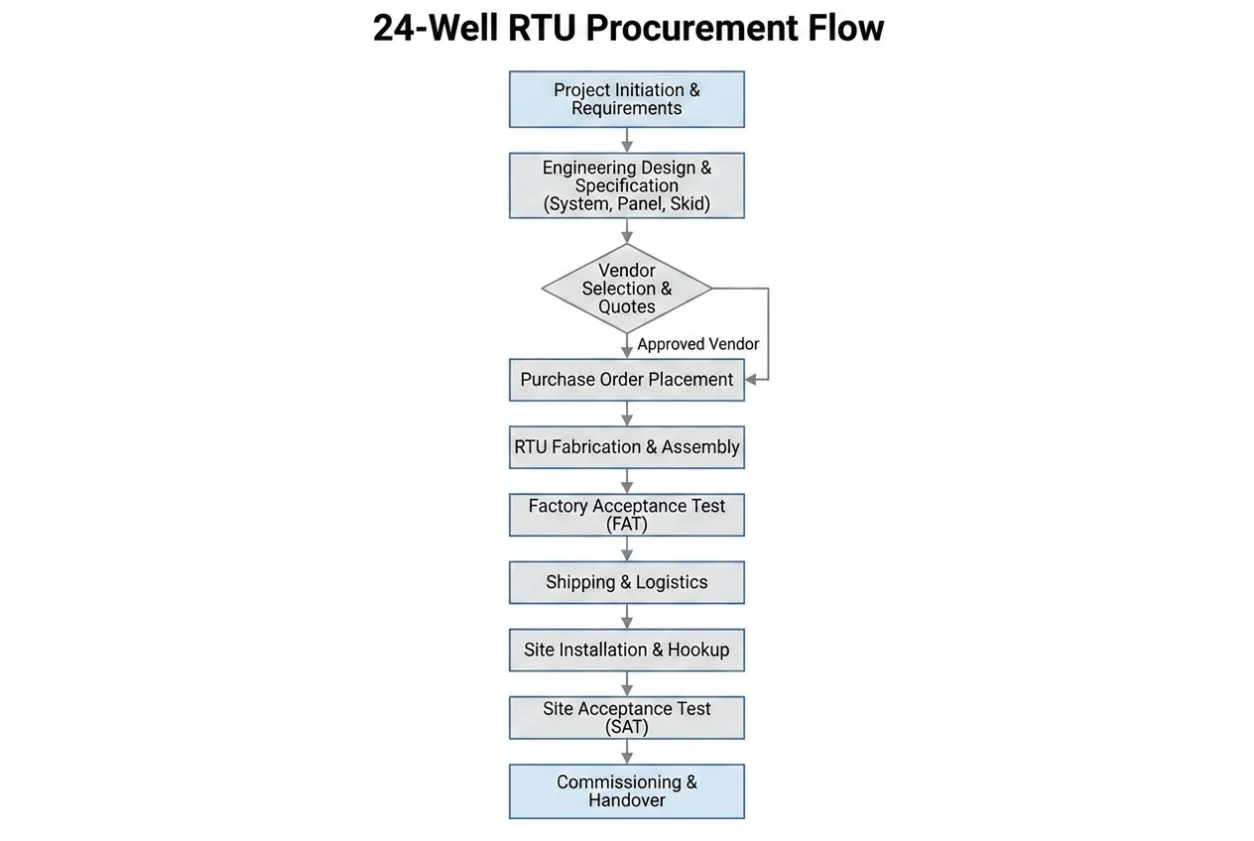
I would usually stop technical review when a supplier never asks for an I/O schedule, ignores hazardous-area classification, uses “explosion-proof” loosely, does not clarify SCADA communication details, ignores backup power and grounding, cannot explain skid mounting or cable entry, offers no FAT checklist, or cannot distinguish a UL 508A listed panel from a panel using UL-listed components.
For oil and gas buyers, that difference is important. A cabinet assembler can give a price. A good RTU panel supplier should help reduce commissioning risk.
Procurement Decision Box
If the Supplier Asks Only About... | My Reaction |
|---|---|
RTU brand | Be careful |
Enclosure size | Be careful |
Price target | Be careful |
Quantity only | Be careful |
Generic communication method | Be careful |
If the Supplier Also Asks About... | My Reaction |
|---|---|
I/O schedule | Shortlist |
Signal type and transmitter power | Shortlist |
Hazardous area classification | Shortlist |
Enclosure exposure and material | Shortlist |
SCADA protocol and gateway | Shortlist |
Power backup and grounding | Shortlist |
Skid mounting and field cable entry | Shortlist |
FAT and documentation scope | Shortlist |
Export packing and delivery plan | Shortlist |
Weak suppliers quote the RTU cabinet. Strong suppliers review the well-site package.
What the 24-Panel Project Reminded Us
One lesson holds across every multi-panel program: repeatability begins with signals, not sheet metal.
It is tempting to standardize the enclosure and RTU hardware first because those items are visible and easy to price. But the first commissioning problems usually come from less visible details: missing I/O, wrong transmitter assumptions, incomplete SCADA mapping, weak power backup review, or unclear FAT scope.
The panel may still be well built, but the package is not fully ready for the field.
That is why UniRegal reviews the I/O schedule before finalizing the enclosure and component package. For well-site RTU panels, the strongest quotation is usually the one that reduces uncertainty before production starts.
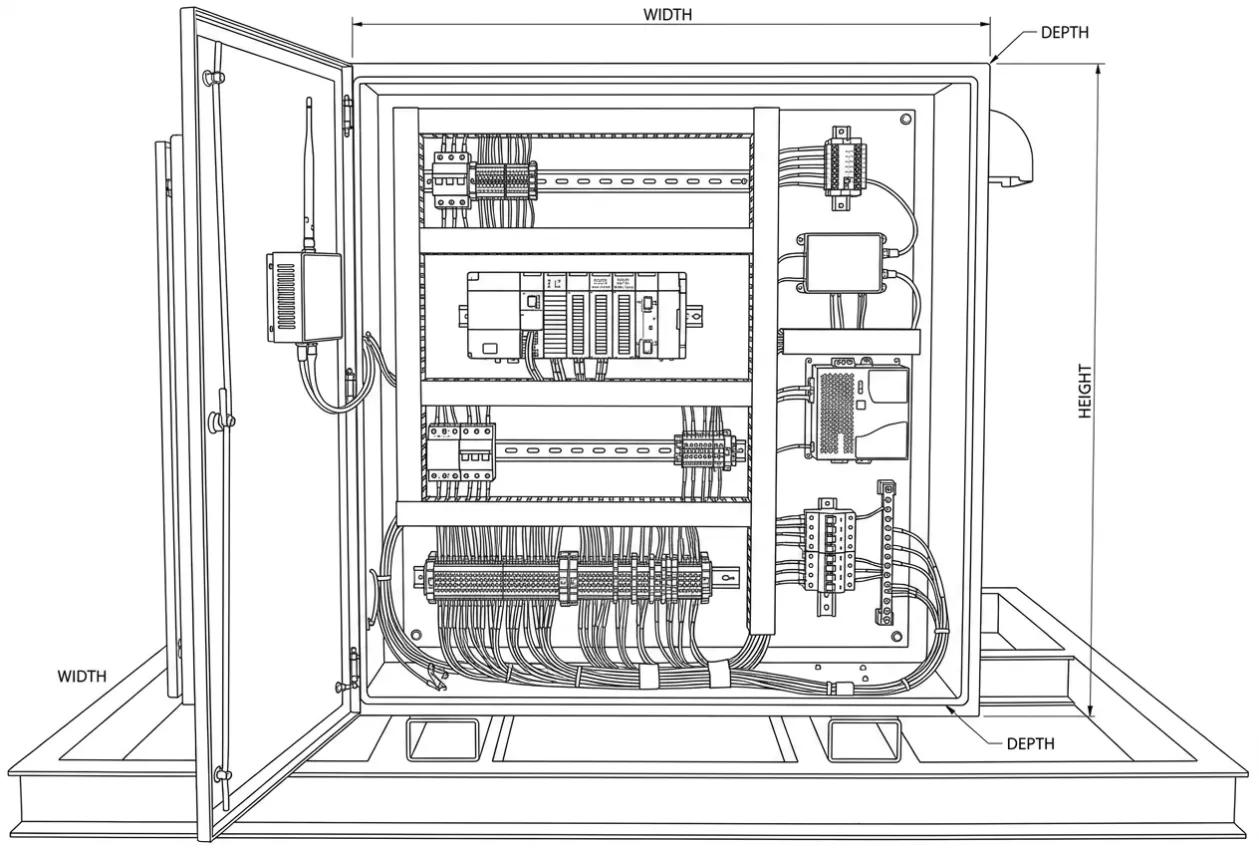
What to Send Your RTU Panel Supplier
For a serious quotation, send the supplier enough information to review the site package, not only the cabinet.
- Site type Wellhead, pump station, metering skid, injection skid, separator package, or tank battery.
- Hazardous area information Class I Division 2, Zone 2, non-hazardous area, gas group, temperature class, and certification expectation.
- I/O schedule DI, DO, AI, AO counts, signal types, transmitter supply, spare I/O, and terminal requirements.
- Communications Modbus RTU, RS-485, Modbus TCP, cellular, radio, Ethernet, gateway, host SCADA details, and tag list if available.
- Enclosure requirement 304 stainless, 316 stainless, powder-coated carbon steel, IP65, IP66, NEMA 4X, skid-mounted or panel-mounted.
- Power and backup Control voltage, site power, battery, solar, UPS, surge protection, grounding, and required ride-through time.
- Brand constraints Approved RTU, PLC, HMI, modem, radio, power supply, relay, terminal, and enclosure brands.
- Certification and FAT UL 508A listed panel, UL-listed components only, CE, self-declaration, I/O test, communication test, signed FAT report, torque records, and export documents.
A one-page I/O schedule is often the most valuable document in the RFQ. It turns a rough RTU panel price into a real engineering quotation.
Lead Time and MOQ Planning
For custom skid-mounted RTU panels, lead time usually depends on enclosure material, skid base fabrication, hazardous-area documentation, cable entry design, communication hardware, and FAT requirements.
A standard wall-mounted RTU cabinet is usually faster than a skid-mounted package with stainless construction, custom cutouts, communication gateway, customer-witness FAT, and export packing. The longer lead time is not only assembly time. It reflects the work needed to coordinate the enclosure, skid frame, cable route, I/O testing, communication settings, documentation, and shipping package.
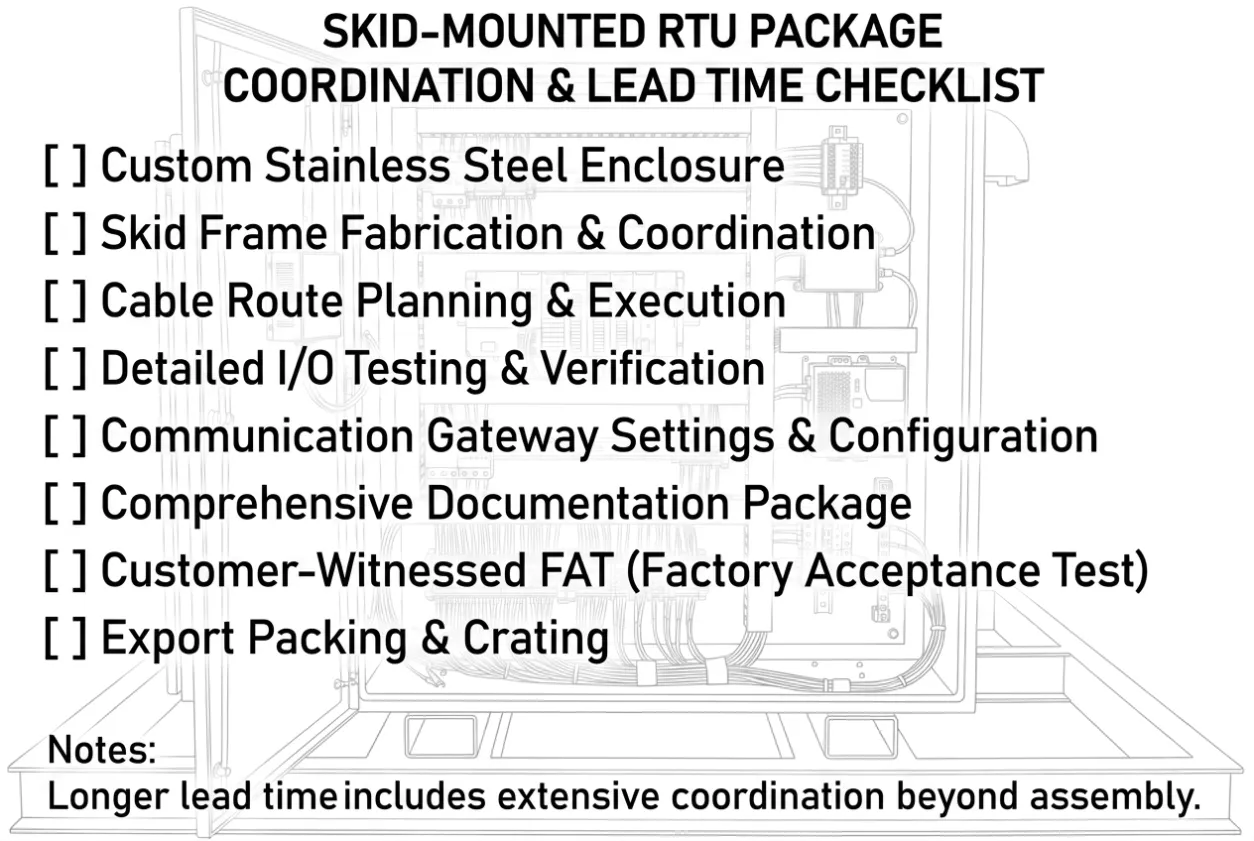
Typical planning items include:
- Enclosure material and rating
- Skid frame fabrication
- Cutouts for glands, antenna, HMI, or junction points
- RTU, modem, radio, relay, terminal, and power supply availability
- Stainless or coated steel fabrication
- Hazardous-area documentation review
- I/O simulation and communication testing
- FAT and customer witness inspection
- Export packing, HS codes, invoice, and packing list
FAT should not be treated as time added after assembly. It should be included in the project schedule from the beginning.
Related Guides
FAQ
What does a skid-mounted RTU panel do at a well site?
A skid-mounted RTU panel reads field I/O, runs basic local logic, and sends well-site data back to SCADA. It can monitor pressure, temperature, flow, level, valve position, pump status, ESD inputs, and alarms.
Is skid-mounted better than panel-mounted for well sites?
For multi-well programs, skid-mounted RTU panels often reduce site wiring and commissioning risk because the package is pre-assembled and tested. For a single retrofit inside an existing shelter, panel-mounted may be simpler and cheaper.
What enclosure rating do I need for a well-site RTU panel?
Many outdoor well-site panels use IP65 or IP66. NEMA 4X is often considered where corrosion, rain, dust, or hose-directed water are concerns. Offshore, coastal, or high-H2S fields may require 316 stainless steel.
Do RTU panels for well sites need UL 508A?
Some projects require UL 508A listed industrial control panels, while others only require UL-listed components inside. Confirm this before quotation because the cost, workshop route, and documentation package can be different.
What should I include in an RTU panel RFQ?
Include the site type, hazardous area classification, I/O schedule, signal types, communication protocol, enclosure rating, power supply, backup requirement, approved brands, FAT scope, and export documentation needs.
Do remote well-site RTU panels need backup power?
Often yes. If the RTU must keep reporting through a short power interruption, pair the panel with an industrial UPS or DC UPS sized for the RTU, modem, radio, and control load.
Final Recommendation
If you are buying skid-mounted RTU panels for multiple well sites, do not start with the RTU brand.
Start with the field package. Review the I/O count, signal types, hazardous-area classification, enclosure exposure, SCADA communication, power quality, skid vibration, grounding, documentation, and commissioning repeatability. Then choose the enclosure and the RTU hardware.
That is the difference between buying a cabinet and buying a repeatable well-site control package.
Need a Skid-Mounted RTU Panel Quotation?
Before requesting a quotation, prepare these six items:
- Site type
- Hazardous area classification
- I/O schedule
- Communication protocol
- Enclosure rating and material
- FAT and certification requirements
Send UniRegal your I/O schedule, site classification, enclosure requirement, preferred RTU or PLC brand, communication method, power supply details, FAT expectations, and delivery schedule. Our team can help review enclosure selection, skid mounting, I/O layout, communication hardware, backup power, documentation scope, and export feasibility before production starts.
A better skid-mounted RTU panel starts with a better well-site review.
Need help specifying or sourcing this for your project? Request a quote - we reply within 1-2 working days with a technical review.