
Aug 24, 2026Control Panels
Best PLC Panel Manufacturers for OEM Machines
Choosing PLC panel manufacturers for OEM machines: integration depth, enclosure options and lead-time flexibility that fits a build-to-order production line.
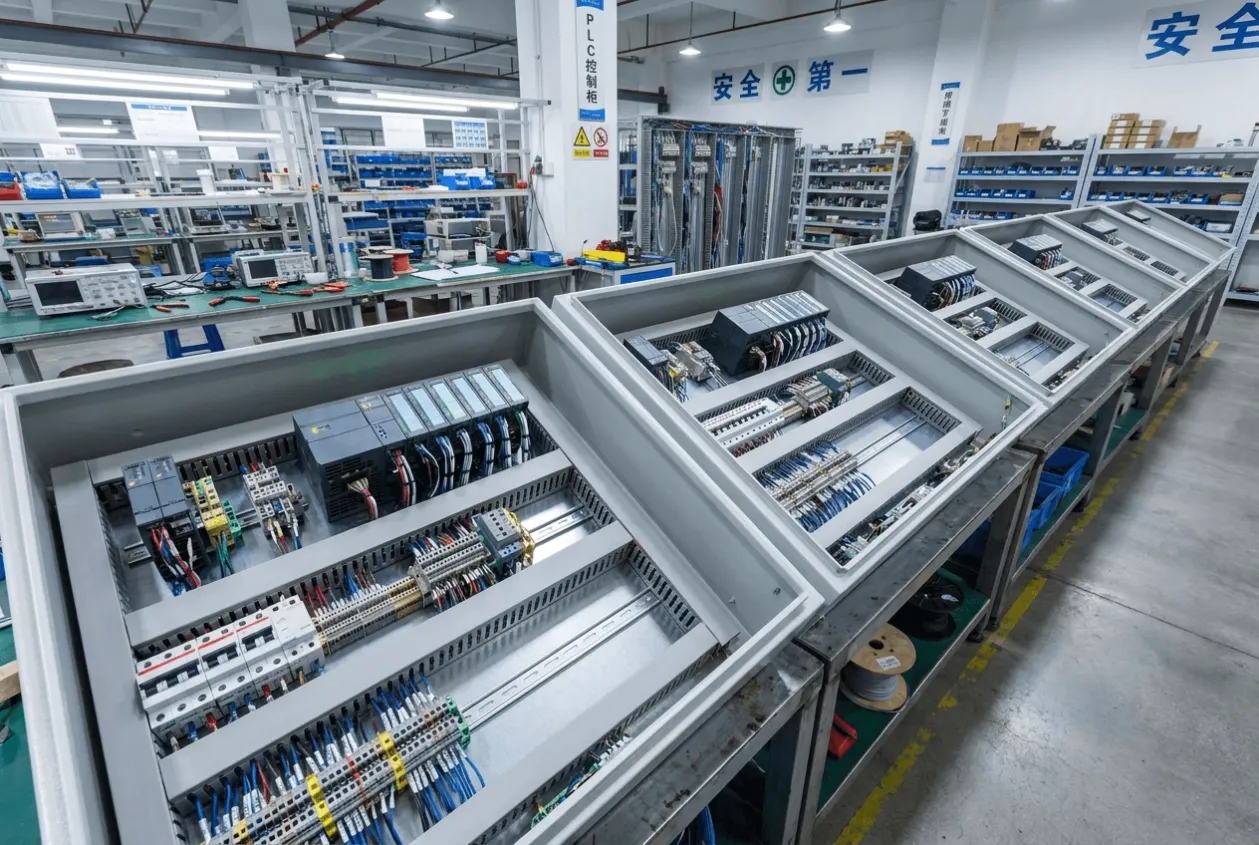
Best PLC Panel Manufacturers for OEM Machines: A Practical Buying Guide for Machine Builders
Quick Answer
The best PLC panel manufacturers for OEM machines are not simply the companies that can assemble electrical cabinets at the lowest price. For OEM machine builders, the stronger suppliers are usually those that understand repeated production, PLC and HMI integration, wiring consistency, enclosure limitations, documentation control, field service access, and the pressure of machine delivery schedules.
In most OEM projects, buyers often shortlist several types of suppliers:
- Rockwell-focused panel builders for Allen-Bradley-based machines
- Siemens automation integrators for export-oriented or European-style machine platforms
- Mitsubishi-oriented panel suppliers for compact machines, packaging equipment, and assembly systems
- Schneider-based panel builders for broad electrical and automation compatibility
- ABB-related panel builders for drive-heavy and electrical distribution applications
- UniRegal for custom PLC panels, enclosure flexibility, mixed-brand component sourcing, and repeated OEM machine panel builds with project-level variation
The right choice depends less on the supplier name and more on how well the manufacturer can control repeatability, revision changes, component compatibility, lead time, and after-sales support.
Buying Tip For OEM machines, one good panel is not enough. The real test is whether the fifth, tenth, and twentieth panel still follow the same wiring logic, labeling habits, terminal numbering, and service layout.
Why This Guide Can Be Trusted
I look at PLC panel manufacturers from the perspective of real machine projects, not from a supplier directory. In OEM automation, the panel is not just an electrical box. It becomes the point where engineering decisions, purchasing decisions, production discipline, and field service all meet.
Over the years, I have seen two very different kinds of panel suppliers.
The first type can build a nice-looking cabinet once. The second type can repeat that cabinet again and again, with stable quality, clean documentation, controlled revisions, and enough flexibility when the machine design changes. OEM buyers usually need the second type.
That is why this guide does not rank suppliers only by brand reputation. Instead, it explains which type of PLC panel manufacturer fits which type of OEM machine builder, and what buyers should check before placing an order.
For projects shipped to North America or Europe, buyers should also pay attention to standards and compliance expectations. For example, UL 508A industrial control panel requirements, NFPA 79 for industrial machinery, and IEC 60204-1 for electrical equipment of machines are often important references when discussing control panels, machine wiring, and electrical safety.
Market Overview: Why OEM Machines Need a Different Panel Supplier
A general electrical contractor may be suitable for a building project, a power distribution job, or a one-time control cabinet. But OEM machines create a different challenge.
An OEM machine builder usually needs panels that can be repeated, modified, documented, and serviced across multiple machine batches. The panel may need to support different options for the same machine platform, such as extra sensors, servo axes, safety circuits, remote I/O, communication modules, or future expansion space.
This is where many procurement problems begin. A supplier may quote a lower price, but if every batch has slightly different wiring habits or unclear documentation, the cost appears later during commissioning, troubleshooting, or overseas service.
I have seen buyers spend weeks negotiating a small price reduction, only to lose far more money when the panel drawing did not match the actual wiring. For OEM production, this is not a small mistake. It affects delivery, customer confidence, and future machine support.
A good OEM-focused PLC panel manufacturer should think about:
- Repeated build consistency
- Component standardization
- PLC, HMI, VFD, servo, safety, and power supply integration
- Heat dissipation and cabinet ventilation
- Cable routing and maintenance access
- Terminal numbering and wire labeling
- Drawing revision control
- FAT checklist support
- Export documentation
- Replacement parts availability
Engineering Note A PLC panel layout should not only look clean when the cabinet door is open. It should make troubleshooting easier when the machine stops at 2 a.m. and the service engineer has limited time, limited tools, and pressure from production.
Comparison Table: PLC Panel Manufacturers for OEM Machines
Supplier Type | Best For | Main Strength | Possible Limitation | What Buyers Should Check |
|---|---|---|---|---|
Rockwell-focused panel builders | OEM machines for North American factories | Strong Allen-Bradley PLC, HMI, drive, and safety ecosystem familiarity | Component cost and availability may vary by region | Allen-Bradley experience, UL 508A capability, Rockwell support access |
Siemens machine automation integrators | Export machines, European-style automation platforms, advanced motion projects | Strong PLC, HMI, drive, and industrial network integration | Programming and support quality depends heavily on the integrator | Siemens project references, TIA Portal experience, documentation quality |
Mitsubishi-oriented panel suppliers | Compact machines, packaging, assembly, and Asian machine platforms | Good fit for compact PLC and motion applications | May be less suitable if the end user requires another ecosystem | Mitsubishi PLC and servo experience, local spare parts support |
Schneider-based panel builders | Mixed electrical and automation systems | Broad electrical components, protection devices, and automation compatibility | Supplier capability can vary widely | Schneider component sourcing, panel design standards, lead time control |
ABB-related panel builders | Drive-heavy equipment, motor control, process-related machine systems | Strong electrical, drive, and power distribution background | PLC panel capability should be verified separately | VFD integration, thermal design, motor control experience |
UniRegal | Custom OEM PLC panels, repeated builds, mixed-brand projects, export coordination | Flexible manufacturing, enclosure coordination, practical engineering support | Best suited for buyers who need project communication and customization, not only commodity assembly | BOM control, drawing review, FAT process, component alternatives |
1. Rockwell-Focused Machine Panel Builders
Rockwell-focused PLC panel builders are often a strong choice for OEM machine builders serving North American factories. Many U.S. plants are familiar with Allen-Bradley PLCs, PanelView HMIs, PowerFlex drives, GuardLogix safety systems, and related industrial networks.
For OEM buyers, this matters because the final customer may already have maintenance engineers trained on Rockwell architecture. In that case, choosing a Rockwell-based panel can reduce the learning curve after installation.
Rockwell also has an official Partner Network system integrator program, which can help buyers identify integrators and partners with Rockwell automation experience.
However, buyers should be careful not to assume that every Rockwell-focused supplier is equally suitable for OEM panel manufacturing. System integration skill and panel production discipline are related, but they are not the same thing. A supplier may be good at programming and commissioning, but still weak in repeat-build documentation, wire labeling, or cabinet layout standardization.
Best fit for:
- OEM machines sold into North American plants
- Projects where the end user specifies Allen-Bradley
- Machines requiring strong PLC, HMI, drive, and safety integration
- Buyers who need familiar local maintenance support
Possible limitation:
Rockwell-based panels can be more expensive, especially when component availability is tight or when the machine uses a large number of I/O, safety, or drive modules. Buyers should confirm lead time early and avoid approving the design before checking critical component availability.
Procurement Advice When a customer specifies Allen-Bradley, do not only ask whether the supplier “can use Rockwell.” Ask whether they can provide consistent drawings, approved part lists, terminal plans, and repeatable panel layouts across several machine batches.
2. Siemens Machine Automation Integrators
Siemens-focused panel manufacturers and automation integrators are commonly shortlisted for export machines, European-style automation systems, and projects where advanced motion, industrial networking, or machine data integration is important.
Siemens has a broad automation ecosystem around SIMATIC PLCs, HMIs, drives, and industrial communication. Buyers can also reference the official Siemens partner network when looking for automation and software partners.
For OEM machine builders, Siemens can be a good fit when the equipment is shipped to customers who already use Siemens platforms, or when the machine design needs strong integration between PLC, HMI, drives, safety, and digital engineering tools.
The key point is that Siemens capability depends heavily on engineering experience. A good Siemens panel supplier should understand more than wiring devices into a cabinet. They should understand how the panel layout supports the machine program, diagnostics, network structure, and long-term service.
Best fit for:
- Export-oriented OEM machines
- European customer projects
- Machines using Siemens PLCs, HMIs, and drives
- Applications requiring structured programming and detailed documentation
Possible limitation:
Siemens projects can become complex if the supplier lacks real commissioning experience. For OEM buyers, it is important to check whether the panel manufacturer can support the machine builder during testing, not only deliver the cabinet.
A useful question to ask is:
“Can your FAT checklist follow our machine sequence, alarm logic, safety devices, and optional functions?”
If the supplier cannot answer clearly, they may be more of an electrical assembler than a machine automation partner.
3. Mitsubishi-Oriented PLC Panel Suppliers
Mitsubishi-oriented panel suppliers are often a strong match for compact machines, packaging lines, assembly machines, small motion systems, and OEM equipment designed around Asian automation platforms.
Mitsubishi Electric’s e-F@ctory Alliance also shows how Mitsubishi works with partners to support integrated factory automation solutions. For OEM buyers, this ecosystem can be useful when machines need practical PLC, servo, HMI, and production data integration.
One reason Mitsubishi-based panels are popular in some machine segments is their balance between compact size, automation capability, and practical machine control. For machines with limited cabinet space, compact PLC and servo systems can make layout easier.
But buyers still need to evaluate the supplier carefully. A compact panel is not automatically a good panel. When space is limited, layout discipline becomes even more important. Poor cable routing, crowded terminals, or no space for future I/O can create service problems later.
Best fit for:
- Packaging machines
- Assembly machines
- Compact automation systems
- Machines with limited control cabinet space
- OEMs already using Mitsubishi PLC and servo platforms
Possible limitation:
If the final customer requires Rockwell, Siemens, or Schneider compatibility, a Mitsubishi-oriented panel may not be the best choice. The OEM should align the automation platform with the target market before confirming the panel design.
Common Mistake Many buyers treat cabinet size as a cost-saving item. In reality, a cabinet that is too small often increases wiring difficulty, heat concentration, troubleshooting time, and future modification cost.
4. Schneider-Based OEM Panel Suppliers
Schneider-based PLC panel suppliers are suitable for OEM machine builders who want broad electrical and automation compatibility. Schneider Electric has a wide product range covering automation, control, protection, power distribution, and industrial electrical components.
For buyers who need both control and electrical protection devices from one ecosystem, Schneider can be practical. Its official industrial automation system integrator program is also useful for finding partners with automation project experience.
Schneider-based suppliers can be a good fit when an OEM machine requires PLC control, HMI, motor protection, breakers, relays, contactors, power supplies, and enclosure-related electrical products. In some projects, this helps simplify sourcing and component coordination.
However, the supplier’s actual engineering capability still matters more than the brand name on the component. Some panel builders are strong in power distribution but weaker in PLC programming, network diagnostics, or machine sequence testing. Others are excellent automation integrators but may not be as disciplined in repeated panel manufacturing.
Best fit for:
- OEM machines requiring broad electrical component compatibility
- Projects involving both control and protection devices
- Buyers who prefer a balanced automation and electrical ecosystem
- Machines where local Schneider availability is strong
Possible limitation:
Schneider-based solutions can vary significantly depending on the supplier. Buyers should check whether the panel manufacturer has experience with similar OEM machines, not only general electrical cabinets.
5. ABB-Related Panel Builders
ABB-related panel builders are often considered for machines involving motor control, VFD-heavy systems, pumping equipment, fans, process-related machinery, and electrical distribution applications.
ABB has official channel partner programs that include distributors, system integrators, panel builders, and service providers. For buyers dealing with drive-heavy machines, this type of supplier can be useful because the control panel design must consider electrical performance, heat, motor protection, and drive service access.
In machine panels with multiple drives, thermal design becomes especially important. It is not enough to mount VFDs neatly. The panel manufacturer should calculate heat, reserve airflow, separate power and signal wiring properly, and keep enough space for future maintenance.
Best fit for:
- Machines with multiple motors or VFDs
- Pumping, fan, conveyor, and process-related equipment
- Projects where electrical distribution and drives are central
- Buyers who need strong motor control experience
Possible limitation:
ABB-related capability does not always mean strong PLC panel capability. Some suppliers are excellent with drives and electrical power but may need to prove their PLC, HMI, safety, and communication experience.
Why It Matters In drive-heavy panels, heat is not a small engineering detail. Poor thermal design can shorten component life, create nuisance faults, and make the machine look unreliable even when the control logic is correct.
6. UniRegal
UniRegal is a practical choice for OEM buyers who need custom PLC panels, enclosure flexibility, mixed-brand component coordination, and repeated machine panel builds with project-level variation.
Many OEM projects are not perfectly standardized. One customer may request Siemens PLCs, another may ask for Allen-Bradley, while another machine version may require different sensors, safety relays, servo drives, or communication modules. This is where flexible engineering coordination becomes valuable.
UniRegal is especially suitable when buyers need support around:
- Custom PLC control panels
- Industrial electrical enclosures
- PLC, HMI, VFD, servo, relay, and power supply integration
- Customer-approved component lists
- Repeated OEM machine builds
- Export project coordination
- Drawing review and manufacturing communication
- Practical support before production
The value is not only in building the cabinet. It is in helping the buyer reduce the risk between design, procurement, assembly, testing, delivery, and future service.
For OEM machine builders, this is often where hidden cost is controlled. When the panel supplier understands why consistency matters, they are more likely to keep wiring standards, terminal numbering, cabinet structure, and documentation aligned from one order to the next.
Best fit for:
- OEM machine builders needing custom PLC panels
- Buyers with repeated builds but small project variations
- Export projects requiring flexible component sourcing
- System integrators needing manufacturing coordination
- Buyers who want practical engineering communication, not only assembly
Possible limitation:
UniRegal is not the right choice for buyers who only want the cheapest commodity panel with no engineering discussion. It is better suited for projects where layout, documentation, compatibility, and repeatability matter.
How OEM Buyers Should Choose a PLC Panel Manufacturer
The best way to choose a PLC panel manufacturer is to evaluate how the supplier behaves before the order. Good suppliers ask questions. Weak suppliers rush to quote.
Before placing an order, OEM buyers should check these points carefully:
1. Can the supplier support repeated builds?
Ask whether the manufacturer can keep wiring conventions, label format, terminal numbering, cable routing, and drawing structure consistent across several batches.
This matters because OEM machines are not one-time projects. If every panel is slightly different, your field service team will pay for that inconsistency later.
2. Can they work with your approved component list?
Many OEMs already have preferred PLCs, HMIs, power supplies, relays, breakers, terminals, sensors, and enclosure brands. A good supplier should respect the approved list while also warning you when a component has long lead time or practical replacement risks.
3. Do they understand enclosure constraints?
A PLC panel is not only about electrical wiring. The enclosure must support heat dissipation, mounting depth, door clearance, cable entry, maintenance space, and safe separation between power and signal wiring.
4. Can they provide useful documentation?
Documentation should include more than a basic wiring drawing. For OEM machines, buyers should request:
- Electrical schematics
- BOM
- Terminal layout
- Wire numbering rules
- Panel layout drawing
- Device label list
- FAT checklist
- Revision record
- Spare parts reference
5. Can they support project changes?
Machine designs change. Options are added. Sensors move. Safety circuits are revised. A strong PLC panel manufacturer should have a clear process for revision control instead of relying on memory or informal messages.
Procurement Advice A small drawing mistake can become a big shipping delay when the panel is already installed in the machine. Always confirm revision control before repeated production starts.
Common Mistakes When Choosing PLC Panel Manufacturers
Mistake 1: Comparing only unit price
The lowest quotation may look attractive, but OEM buyers should calculate the total cost of poor repeatability, unclear wiring, weak labeling, and slow technical communication.
A cheap panel becomes expensive when it delays commissioning.
Mistake 2: Ignoring future service
Some panels are built only for delivery inspection. Better panels are built for the person who will troubleshoot them three years later.
Leave space. Label clearly. Keep drawings accurate.
Mistake 3: Choosing a supplier without checking brand experience
Using Siemens, Rockwell, Mitsubishi, Schneider, or ABB components is not the same as understanding their practical application. Always ask for relevant project experience.
Mistake 4: Not checking lead time early
PLC, HMI, servo, VFD, and safety components may have different availability depending on brand and region. A good panel manufacturer should flag supply risks before the project schedule becomes tight.
Mistake 5: Treating FAT as a formality
For OEM machines, FAT should follow the machine logic, safety functions, I/O list, alarm response, and optional functions. A simple power-on test is not enough.
Questions to Ask Before Ordering OEM PLC Panels
Before choosing a supplier, ask these questions:
- Have you built PLC panels for similar OEM machines before?
- Can you keep wiring and labeling consistent across repeated orders?
- Can you follow our approved component list?
- Can you support different PLC, HMI, VFD, and power supply brands?
- How do you manage drawing revisions?
- Can you reserve cabinet space for future I/O or machine options?
- Can you provide FAT checklists based on our machine sequence?
- Can you support export documentation if the machine ships overseas?
- What happens if a key component has long lead time?
- Can you provide photos or inspection records before shipment?
These questions are simple, but they quickly separate a basic panel assembler from a serious OEM panel manufacturing partner.
Frequently Asked Questions
What is a PLC panel manufacturer?
A PLC panel manufacturer designs and builds electrical control panels that house PLCs, HMIs, relays, terminals, power supplies, breakers, contactors, drives, safety components, and communication devices. For OEM machines, the manufacturer must also understand repeatability, documentation, enclosure layout, and future maintenance.
What is the difference between a PLC panel manufacturer and a system integrator?
A PLC panel manufacturer focuses on cabinet design, assembly, wiring, labeling, and testing. A system integrator may also provide PLC programming, HMI design, commissioning, and complete automation system integration. Some companies do both, but buyers should verify their actual capability.
Which PLC brand is best for OEM machines?
There is no single best PLC brand for every OEM machine. Rockwell is often preferred in North America, Siemens is strong for many export and European-style projects, Mitsubishi is practical for compact machines and Asian platforms, Schneider offers broad electrical and automation compatibility, and ABB is strong in drive and electrical applications. The best choice depends on the end user, machine type, local support, spare parts availability, and long-term service strategy.
Should OEM buyers choose a local or overseas PLC panel manufacturer?
Local suppliers can provide faster onsite support, while overseas suppliers may offer cost advantages, flexible manufacturing, or better sourcing options for certain projects. The decision should depend on project complexity, communication quality, documentation control, lead time, and whether the supplier can support repeated builds reliably.
Why is repeatability so important for OEM PLC panels?
Repeatability affects production efficiency, machine commissioning, spare parts management, and field service. If every panel is wired differently, technicians need more time to troubleshoot. For OEM machine builders, consistent panel manufacturing protects both delivery schedules and brand reputation.
Final Recommendation
The best PLC panel manufacturer for OEM machines is not always the biggest supplier or the lowest-cost quote. It is the supplier that helps you reduce repeat-build friction.
For OEM machine builders, I would focus on five things before making a decision:
- Can the supplier build the same panel consistently across multiple batches?
- Do they understand your PLC, HMI, drive, safety, and power supply requirements?
- Can they manage documentation and revision changes properly?
- Do they design the enclosure for real maintenance, not only neat appearance?
- Can they communicate clearly when lead time, component substitution, or layout risks appear?
Rockwell-focused builders are strong for Allen-Bradley-based North American projects. Siemens integrators are useful for export machines and structured automation platforms. Mitsubishi-oriented suppliers are practical for compact machines and packaging applications. Schneider-based panel builders can support broad electrical and automation needs. ABB-related panel builders are valuable for drive-heavy and electrical applications.
UniRegal fits OEM buyers who need custom PLC panels, flexible enclosure solutions, repeated machine panel builds, mixed-brand component sourcing, and practical engineering communication throughout the project.
A PLC panel may look like one part of the machine, but in real OEM production, it often decides how smoothly the machine can be built, tested, shipped, and serviced. Choosing the right panel manufacturer is not only a purchasing decision. It is a project reliability decision.
Related Guides:
- What Certifications ShoulRelated guides
- Building PLC panels for OEM machines? We integrate to your PLC brand with Foshan multi-supplier lead times that match build-to-order lines. Talk to our team about your project.d a Control Cabinet Have?