Oct 30, 2026Buying Guides
Outdoor Enclosure UV Resistance: How to Spec a Coating That Survives the Sun
Outdoor enclosure coatings chalk and fade under sun long before the steel corrodes. Here is how to specify UV-resistant finishes that hold color and gloss in high-irradiance sites.
Outdoor Enclosure UV Resistance: How to Spec a Coating That Survives the Sun
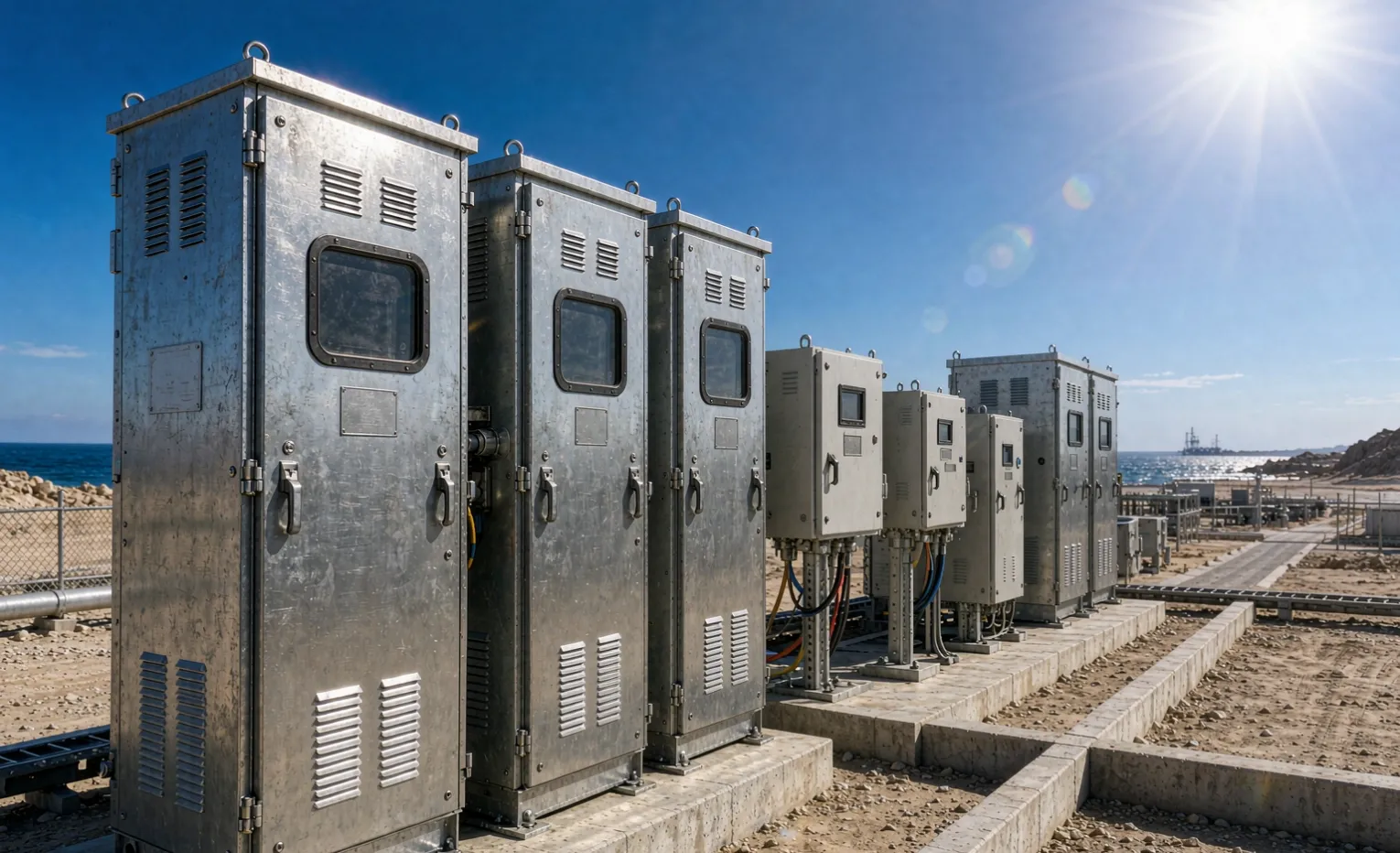
Spec the wrong coating on an outdoor enclosure, and the box looks like it has been sitting in a desert for a decade—in about eighteen months. The steel is still fine. The paint is not. Ultraviolet light breaks down the polymer binder in a powder or liquid coating, so the color drifts, the gloss goes flat, a white powder (chalk) blooms on the surface, and eventually the substrate sits exposed to whatever the weather throws at it. The fix is not a "better brand"—it is specifying the right resin chemistry, enough film build, verified substrate prep, and an accelerated-weathering number you can actually trust.
This guide is written from a sourcing partner point of view. We help buyers specify and source enclosures and panels built to survive their site, and we are not an enclosure OEM. Our interest is to give you the decision framework so the finish on your cabinets still looks like paint—not talcum—when the warranty clock runs out.
If you are scoping the wider enclosure program, our electrical enclosure sourcing guide covers supplier qualification end to end. For the build itself, see our outdoor electrical enclosure solutions. If you only read one section here, read the coating decision table and the RFQ checklist.
Buyer Decision: Stop asking "is it powder coated?" Start asking "what resin, what film build, what accelerated-weathering result, and tested against which standard?" Powder coating is the floor, not the answer.
What the sun actually does to an enclosure coating
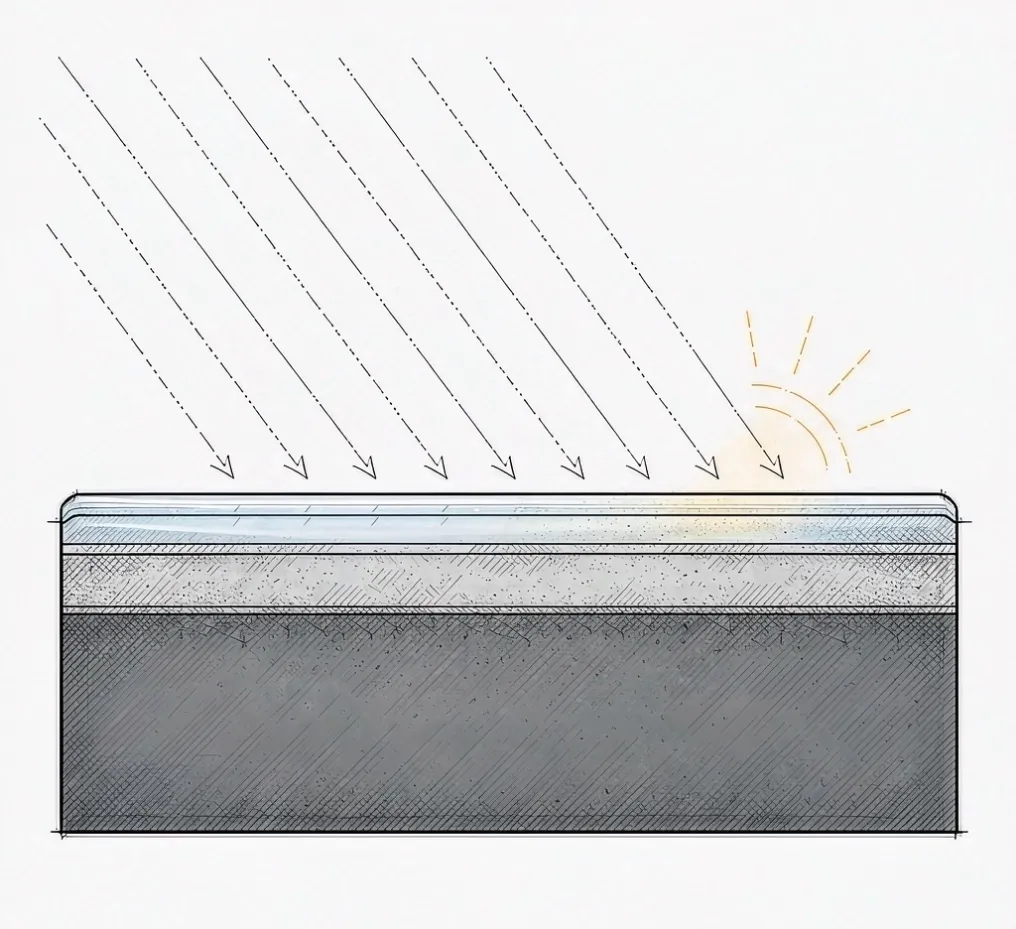
Ultraviolet radiation does something corrosion does not: it attacks the coating itself, independent of whether any water or salt ever touches the panel. The binder that holds the pigment and the film together is a polymer, and UV photons have enough energy to cleave the bonds in that polymer. Once the binder fails, the coating loses cohesion from the top down.
UV photodegradation is not corrosion.
This is the first point buyers miss. A NEMA 4X rating tells you the box resists water, dust, and corrosion. It says nothing about whether the paint keeps its color in Riyadh or Perth. You can have a perfectly sealed, corrosion-free enclosure whose finish has turned a chalky, patchy mess. The two failure modes travel on different clocks:
- Corrosion is a metal-loss process—slow on 316 stainless, faster on carbon steel if the coat is breached.
- UV degradation is a coating-breakdown process—it starts the day the panel is commissioned and is driven by irradiance hours, not by humidity.
Engineering Note: A coating can pass every salt-spray test and still chalk in a sunny climate, because salt spray measures corrosion protection (barrier integrity), not polymer UV stability. The two test suites answer different questions. Ask for both.
The three symptoms you will see in the field
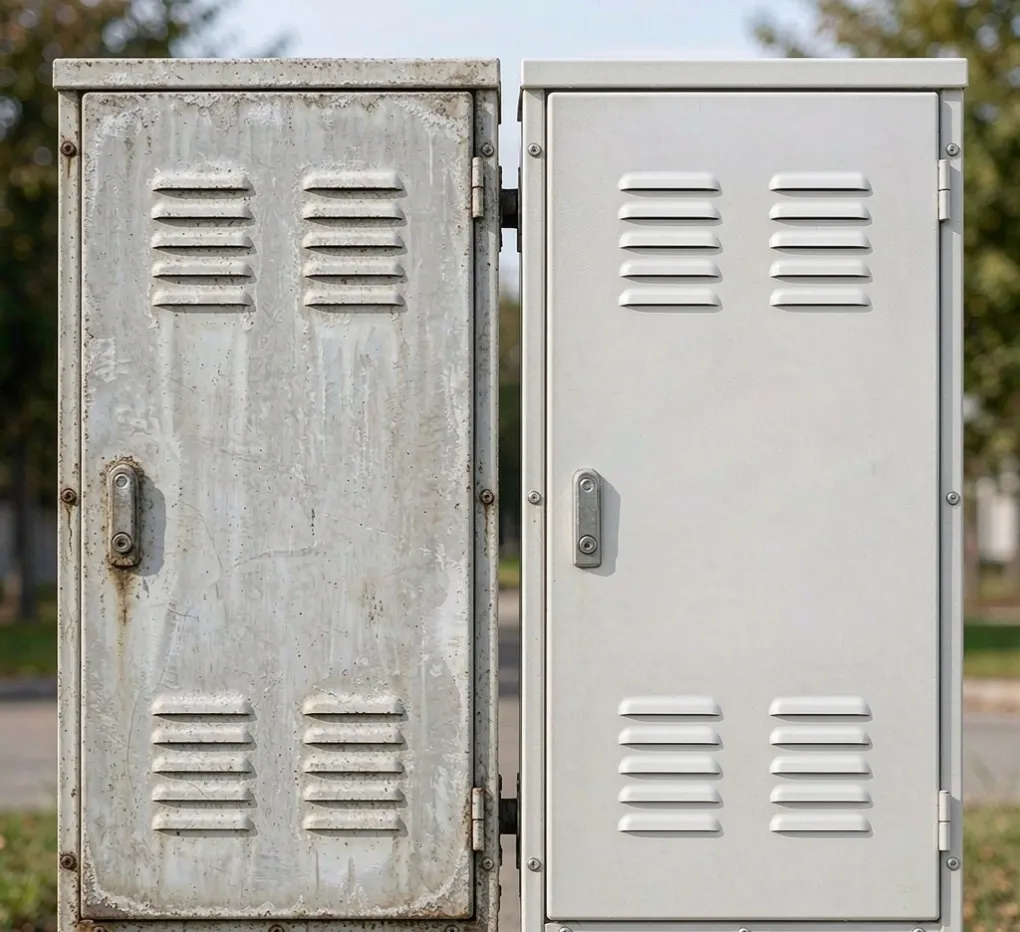
- Chalking—a powdery residue you can wipe off with a finger. This is the binder breaking down and leaving loose pigment on the surface. It is the earliest and most common UV symptom.
- Color fade/shift—the panel drifts toward a lighter, washed-out version of the original color. Measured as a ΔE (Delta-E) against the original.
- Gloss loss—the surface goes from glossy to matte. Often the first thing a site inspector flags, because it reads as "cheap."
Coating chemistries that actually survive
The resin chemistry decides how long the finish lasts in direct sun. For an enclosure buyer, you are really choosing between four families, and the price ladder tracks the UV stability closely.
Standard polyester (TGIC or non-TGIC)
This is the default powder for most enclosures. It is cheap, flows well, and looks good on day one. In moderate climates it is acceptable. In high-irradiance sites it is the one that chalks first—often within 12–24 months on a south-facing panel. "Superdurable polyester" (a higher-grade resin) roughly doubles the UV life and is worth the small premium for anything going outdoors in a sunny market.
Epoxy—great primer, poor topcoat in sun
Epoxy has excellent adhesion and chemical resistance, which makes it a strong primer. But as an exterior topcoat it chalks and yellows badly under UV. If a supplier offers "epoxy finish for outdoor," that is a red flag for a sunny site unless it is buried under a UV-stable topcoat.
Polyurethane topcoat
A polyurethane (PU) topcoat over an epoxy primer is the workhorse for color- and gloss-critical outdoor gear. It holds gloss and color far longer than polyester and is the standard for infrastructure and transit enclosures. The trade-off is cost and a slightly more demanding cure process.
PVDF / fluoropolymer
Polyvinylidene fluoride (PVDF) and similar fluoropolymer finishes are the gold standard for UV stability — they shrug off decades of sun with minimal color shift. You see them on architectural cladding and premium outdoor cabinets. They are the most expensive option and usually supplied as a thin-film or coil-coated system rather than a standard electrostatic powder, which limits how and where they are applied.
Powder vs. liquid
Powder coating dominates enclosure finishing because it gives a uniform, thick, solvent-free film. Liquid (wet) PU or PVDF systems still win where a fluoropolymer or a very smooth thin film is required. For most buyers the practical choice is superdurable polyester powder or epoxy-primer + PU topcoat, with PVDF reserved for the most exposed, longest-life installs.
Coating decision table
Coating system | UV stability | Relative cost | Best use | Watch out. |
|---|---|---|---|---|
Standard polyester powder | Low–moderate | $ | Indoor / mild climate | Chalks fast in high sun |
Superdurable polyester powder | Moderate–good | $$ | General outdoor, sunny | Still not PVDF-class |
Epoxy primer + PU topcoat | Good | $$$ | Color-/gloss-critical outdoor | Needs correct cure |
PVDF / fluoropolymer | Excellent | $$$$ | Decades-in-sun, premium | Application limits |
Epoxy alone (topcoat) | Poor in the sun | $$ | Primer only | Yellows / chalks outdoors |
Film build, substrate prep, and why they beat the brand name
Buyers fixate on the coating trade name and ignore the two things that decide real-world life: how thick the film is and how clean the metal was before it was coated.
Primer plus topcoat, not a single pass
A two-coat system (primer + topcoat) covers edges and minor surface defects far better than a single thick pass, and it gives the UV-stable topcoat something to bond to. For outdoor enclosures, we default to a zinc-rich or epoxy primer under a UV-stable topcoat unless the spec says otherwise.
Surface profile—sandblast to Sa 2.5
Coating adhesion lives or dies on surface prep. Bare steel should be abrasive-blasted to roughly Sa 2.5 (near-white metal, ISO 8501-1) before priming. Skipping or lightening this step to save a day is the quiet reason coatings fail early—the film peels at the edge where UV bites first, then water follows.
Edge coverage is where UV wins first.
Sharp edges and cut surfaces get the thinnest film and the most UV exposure per unit area. A finish that looks fine on the flat faces will start chalking and rusting at the corners months earlier. Specify edge radiusing or a stripe coat on cut edges for outdoor builds; it is a cheap insurance policy.
How to verify UV resistance without guessing
Anyone can write "UV resistant" on a quote. The number that matters is the result of an accelerated weathering test against a named standard.
The standards that mean something
- ASTM G154—fluorescent UV lamp accelerated weathering (the common "QUV" test).
- ISO 4892-3—plastics/laboratory light-source exposure, including fluorescent UV.
- ASTM D4587—cyclic UV condensation exposure.
- IEC 60068-2-5—solar radiation endurance test for electrotechnical products, relevant because enclosures are exactly that.
These are the tests that simulate years of sun in a chamber. Reference them by name; the IEC and NEMA frameworks sit behind most enclosure durability expectations.
What "2000 hours QUV" actually tells you
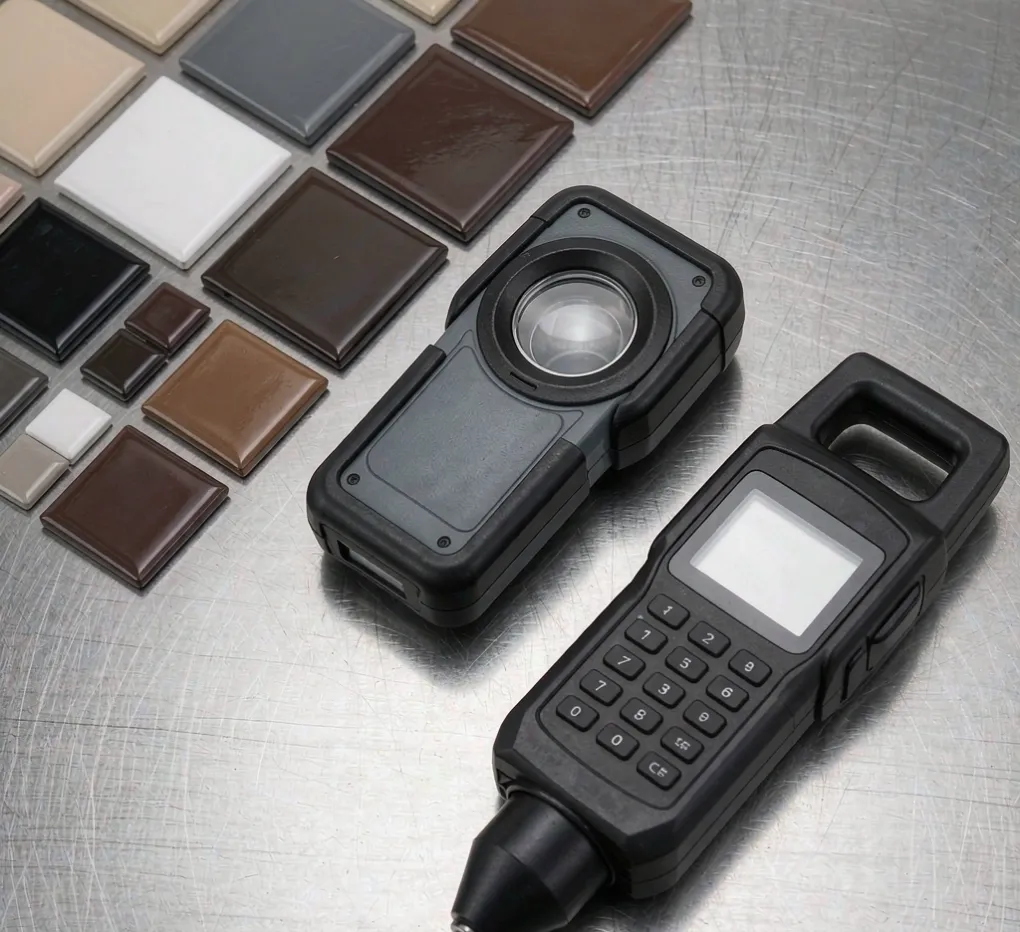
A QUV figure is only useful with the result, not just the hours. A supplier who says "tested 2000 hours" but will not give you the gloss retention % and ΔE color shift after that exposure is telling you little. For a sunny-site enclosure, look for something like "2000 h ASTM G154, >80% gloss retention, ΔE < "5"—that is a number you can hold them to.
Engineering Note: Accelerated weathering is comparative, not a literal "years" converter. But a coating that retains 80%+ gloss at 2000 h will visibly outlast one that drops to 40%. Use the retention percentage as your ranking tool, not the brand.
Climate decides how strict you need to be.
Solar irradiance is not uniform, and the same coating that lasts eight years in northern Europe may chalk in two in the Gulf. Global horizontal irradiance (GHI) is the number to anchor your spec to.
Region / site type | Approx. GHI (kWh/m²/yr) | Coating spec to require |
|---|---|---|
Northern Europe / Pacific NW | 900–1,100 | Standard or super durable polyester is OK. |
Central US / Mediterranean | 1,500–1,900 | Superdurable polyester minimum |
Australia / Middle East / Gulf | 2,000–2,300+ | PU topcoat or PVDF; verify weathering |
Coastal + sunny (Gulf, SE Asia) | 2,000+ + salt | Primer + PU + edge stripe; corrosion + UV |
The bottom row is the worst case: high UV and salt. There the coating has to do double duty—protect against corrosion and survive solar breakdown—so a primer-plus-PU system with verified weathering data is the floor, not a luxury.
Where we sit as your sourcing partner
To be transparent: Uni Regal is a sourcing partner and panel-build shop, not an enclosure manufacturer. We do not make steel or run a proprietary coating line, and we will not imply otherwise. Our role is to help you specify the enclosure correctly—material, rating, and finish—source the build through qualified build shops, and verify the result against your acceptance criteria before it ships. We are a fit when you need a documented, site-matched enclosure or panel built to your drawings. We are not the right call if you are looking for a branded enclosure line of our own.
Lead time and MOQ that shape your finish choice
The coating spec also interacts with how you ship and stage the enclosures:
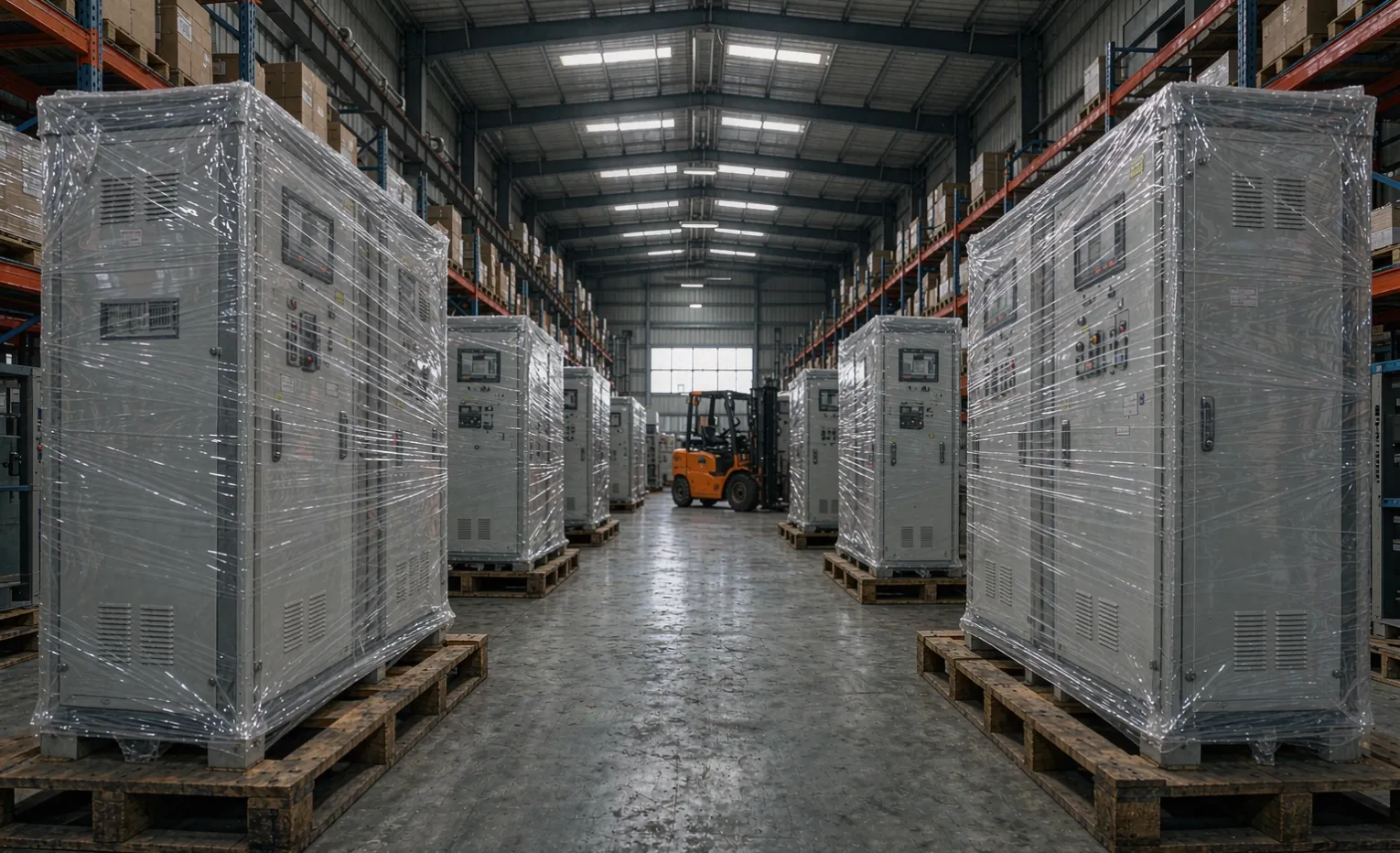
- Complete custom panel or built enclosure: from 1 unit, after drawing and BOM review—about 35–40 days. This is where a specified, verified finish matters most, because the unit is one consolidated, fully built shipment.
- Empty enclosure/shell: MOQ 5 units, about 15 days. Ships as enclosures, so the coating choice is decided at the shell stage, and you populate elsewhere.
- Loose components: 3–5 days from stock.
We work carbon steel, 304 and 316 stainless, and galvanized steel for enclosures—we do not work in aluminum for this product line. Ratings we build to include IP65 and NEMA 4X, and UL-listed builds run through a partner UL file shop with the file number provided in writing (see UL 50E / UL 746C for the enclosure and polymeric-material framework).
Price anchor
For budgeting, benchmark the empty enclosure body. A standard IP66 outdoor cabinet commonly lands in the $180–$650 band depending on size, material, and finish, before components. A superdurable polyester or PU topcoat adds a small premium over standard polyester; PVDF is a step up again. Always compare quotes on the same shell spec and the same stated weathering result, or the price and the durability math are meaningless.
Mistakes that waste your coating budget
- Specifying "powder coated" with no resin named — you get standard polyester by default and it chalks in the sun.
- Trusting "UV resistant" with no test number — ask for gloss retention % and ΔE after a named standard.
- Skipping surface prep to save a day — the coating fails at the edges first.
- Single-coat on a sunny, corrosive site — no primer means no backup when the topcoat is breached.
- Confusing NEMA 4X with UV life — the rating is about ingress and corrosion, not color retention.
- Choosing PVDF when PU would do — you pay a premium for a system that may not even apply to your enclosure geometry.
Decision checklist (scorecard)
Before you release a PO on an outdoor enclosure, confirm each:
- [ ] Resin named (superdurable polyester / PU topcoat / PVDF), not just "powder coated"
- [ ] Film build and primer+topcoat system specified
- [ ] Surface prep stated (abrasive blast to ~Sa 2.5 for bare steel)
- [ ] Edge coverage / stripe coat called out for outdoor
- [ ] Accelerated-weathering result given: hours + standard + gloss retention % + ΔE
- [ ] Climate matched to spec (GHI by region)
- [ ] Rating confirmed (IP65 / NEMA 4X) and kept separate from UV spec
- [ ] Material confirmed (carbon / 304 / 316 / galvanized; no aluminum)
- [ ] UL path defined if required (partner file shop + written file number)
FAQ
Q: Does a NEMA 4X rating mean the paint won't fade in the sun?
No. NEMA 4X certifies the enclosure against water, dust, and corrosion — it says nothing about coating color or gloss retention under UV. A NEMA 4X box can still chalk and fade in a sunny climate. You need a separate UV-stability spec (resin choice + weathering test result) on top of the rating.
Q: What coating is best for outdoor enclosures in a very sunny country?
For most sunny, non-coastal sites, a superdurable polyester powder or an epoxy-primer-plus-polyurethane topcoat is the practical choice. For the harshest, longest-life installs (Gulf, Australia, desert infrastructure), PVDF or fluoropolymer tops the table. The deciding inputs are your site irradiance and how long the finish must look like paint.
Q: How do I verify a supplier's "UV resistant" claim?
Ask for the accelerated-weathering result against a named standard — typically ASTM G154 or ISO 4892 — and insist on the gloss retention percentage and ΔE color shift after the test hours (for example, 2000 h, >80% gloss retention, ΔE < 5). A claim with no number is not verifiable; treat it as marketing.
Q: Is PVDF worth the extra cost over polyester?
Only if the enclosure sits in very high irradiance for a long service life and appearance matters — think decades-in-sun architectural or infrastructure installs. For a typical industrial enclosure in a sunny but ordinary site, superdurable polyester or a PU topcoat gets you most of the way at a fraction of the cost. Match the spec to the climate, not to the brochure.
Q: Does outdoor coating choice change my lead time or MOQ?
The coating itself is a finish decision, not a structural one, so it does not change the build tiers: complete custom enclosures from one unit (~35–40 days), empty shells from five units (~15 days), components in 3–5 days. But specifying a less common system (PVDF, or a specific PU) can narrow which build shops can do it, so confirm applicability early in the RFQ.
Q: Can the coating and the corrosion protection be specified together?
Yes, and for coastal-sunny sites they should be. A primer-plus-UV-stable-topcoat system does both jobs: the primer and material choice (316 stainless, galvanized) handle corrosion, while the topcoat handles solar breakdown. Specify edge coverage too, because that is where both failure modes start.
Engineering Takeaway
UV resistance is a coating-specification problem, not a brand problem. The finish on your outdoor enclosure will outlast the warranty only if you name the resin (superdurable polyester, PU topcoat, or PVDF), require a primer-plus-topcoat system with proper surface prep and edge coverage, and demand a real accelerated-weathering number — hours, standard, gloss retention, and ΔE — instead of the words "UV resistant." Tie the spec to your site's irradiance, keep NEMA 4X / IP65 as a separate ingress rating, and you stop buying enclosures that look a decade old in eighteen months.
Related guides
- Corrosion-Protection Coating Standards — the corrosion half of the durability story, and how to separate it from UV life.
- Stainless Steel 304 vs 316 Outdoor Electrical Enclosures — picking the substrate that survives sun and salt together.
- NEMA 4X Enclosure Buying Guide — what the rating does and does not cover.
- IP65 vs IP66 Enclosure — matching ingress protection to the site.
- Outdoor Enclosure Cooling Selection Guide — handling the heat the sun adds inside the box.
- Wall-Mount vs Floor Enclosure — form factor and where the sun hits it.
Get your enclosures built to survive the site
Send us your enclosure requirement — material (carbon / 304 / 316 / galvanized), target rating (IP65 / NEMA 4X), finish spec (resin + weathering result), and any UL or market requirement — and we will return a quoted, documented build with the coating spec verified before it leaves the dock. Complete custom enclosures from one unit (drawing and BOM review, then ~35–40 days), empty enclosures from five units (~15 days), and loose components in 3–5 days; UL-listed builds run through a partner UL file shop with the file number in writing. We are a sourcing partner and panel-build shop, not a manufacturer — our job is to get your specified, site-matched enclosure built, verified, and delivered.
- WhatsApp: message us with your slug — we reply within 1 business day.
- Email: info@uniregal.com with your drawings attached.
- Form: submit your requirements and we will route it to the right build shop. Or use the contact form to reach us directly.