
Sep 2, 2026Case Studies
Corrosion Protection & Coating Standards for Electrical Enclosures
Corrosion protection starts in the RFQ. This article explains how buyers compare materials, coatings, ISO 12944 classes, and site conditions before approving enclosure suppliers.
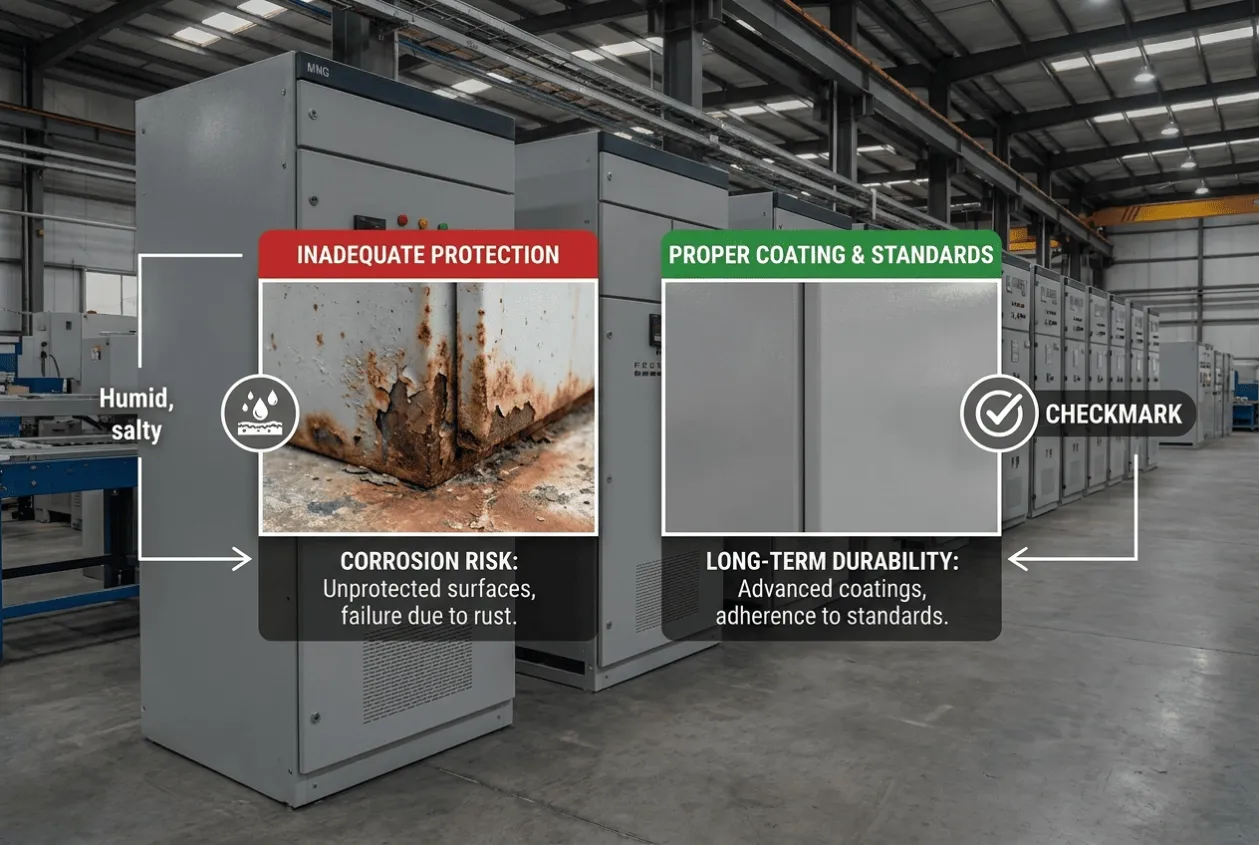
The Enclosure Passed Inspection. So Why Did It Rust Two Years Later?
Corrosion Protection & Coating Standards for Electrical Enclosures
A buyer once showed me photos of an outdoor electrical enclosure that had been installed less than two years earlier. The panel had passed commissioning, the door gasket still looked acceptable, and no water had entered the electrical compartment. From the inside, the cabinet was still doing its job.
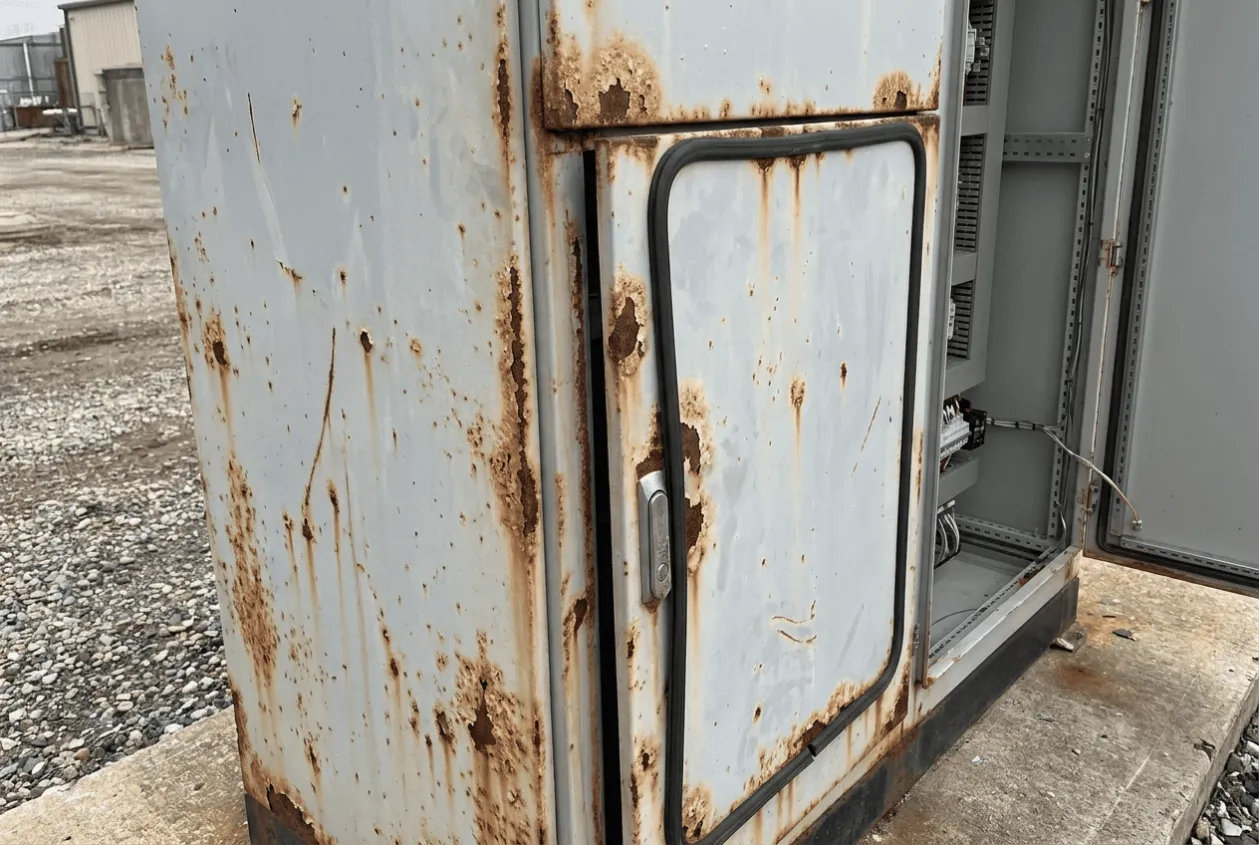
The problem was the outside.
Rust had started around the bottom seam, several screw points, and one welded corner. The buyer’s first question was understandable: “But it was IP66. How did this happen?”
That is a very common misunderstanding. IP rating helps describe ingress protection, but it does not fully answer the corrosion question. A cabinet can keep water out and still lose the fight against salt air, chemical vapor, wastewater gas, UV exposure, or poor coating preparation.
Looking back, the real mistake was not made during installation. It was made during the RFQ, when the enclosure was described only as “weatherproof powder-coated steel.”
Everyone thought the specification was finished.
The rust disagreed.
I start by asking what is trying to destroy the enclosure.
One habit changed the way I review enclosure quotations.
I stopped asking only, “What material is it?”
I started asking, “What is trying to destroy it?”
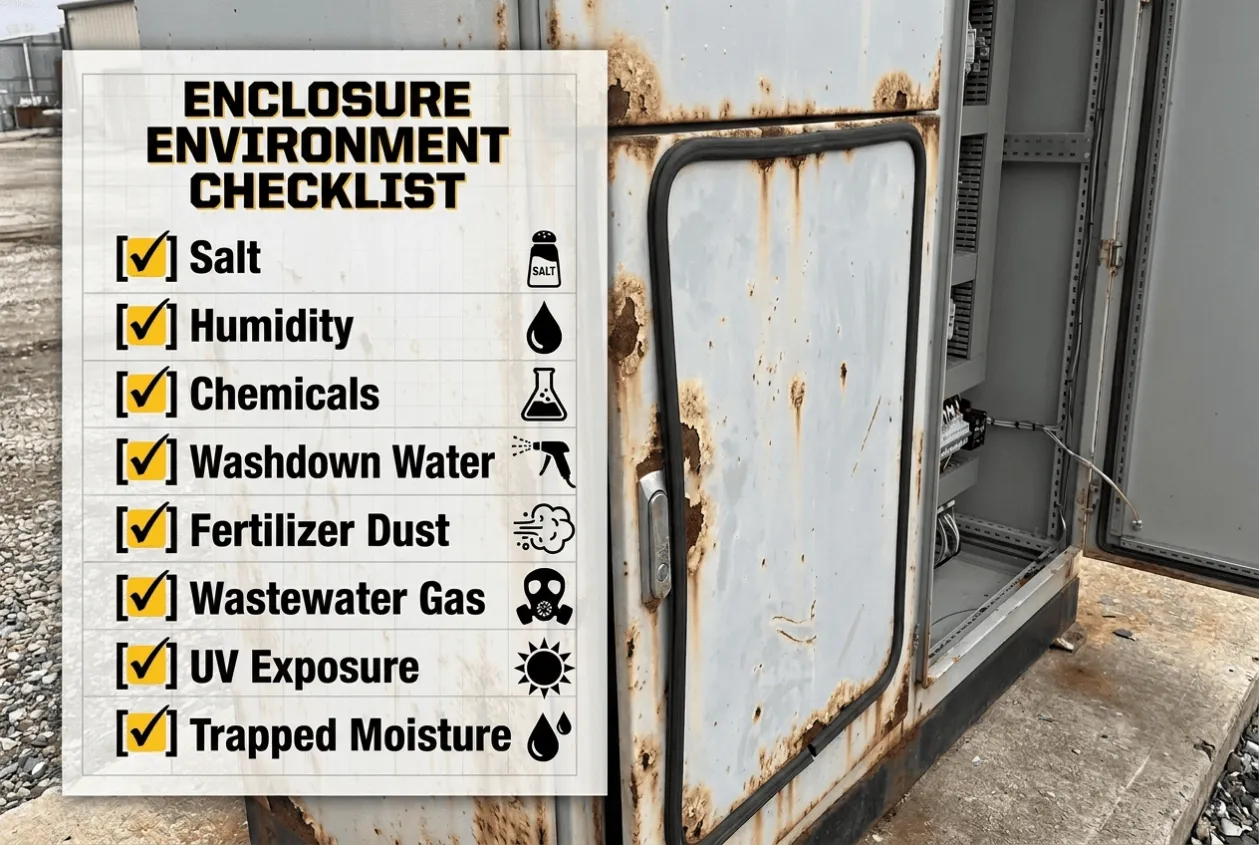
That question is much more useful. Salt, humidity, chemicals, washdown water, fertilizer dust, wastewater gas, UV exposure, and trapped moisture all attack enclosures differently. Once the environment becomes clear, the material and coating discussion becomes more practical.
Years ago, I never asked suppliers about ISO 12944. I only asked whether the enclosure was powder coated. Looking back, that was a poor question. Powder coating describes a process; ISO 12944 starts describing performance.
Buyer Insight #1 Corrosion is an environmental problem before it becomes a material problem.
For a dry indoor electrical room, powder-coated carbon steel may be a sensible and economical choice. For an outdoor industrial yard, I want more detail about coating thickness, pretreatment, and corrosion class. Near the sea, I become much less relaxed about plain powder-coated steel. In wastewater, chemical, or marine environments, the conversation usually moves toward galvanized-and-coated systems, 316 stainless steel, better fasteners, seam treatment, and touch-up repair.
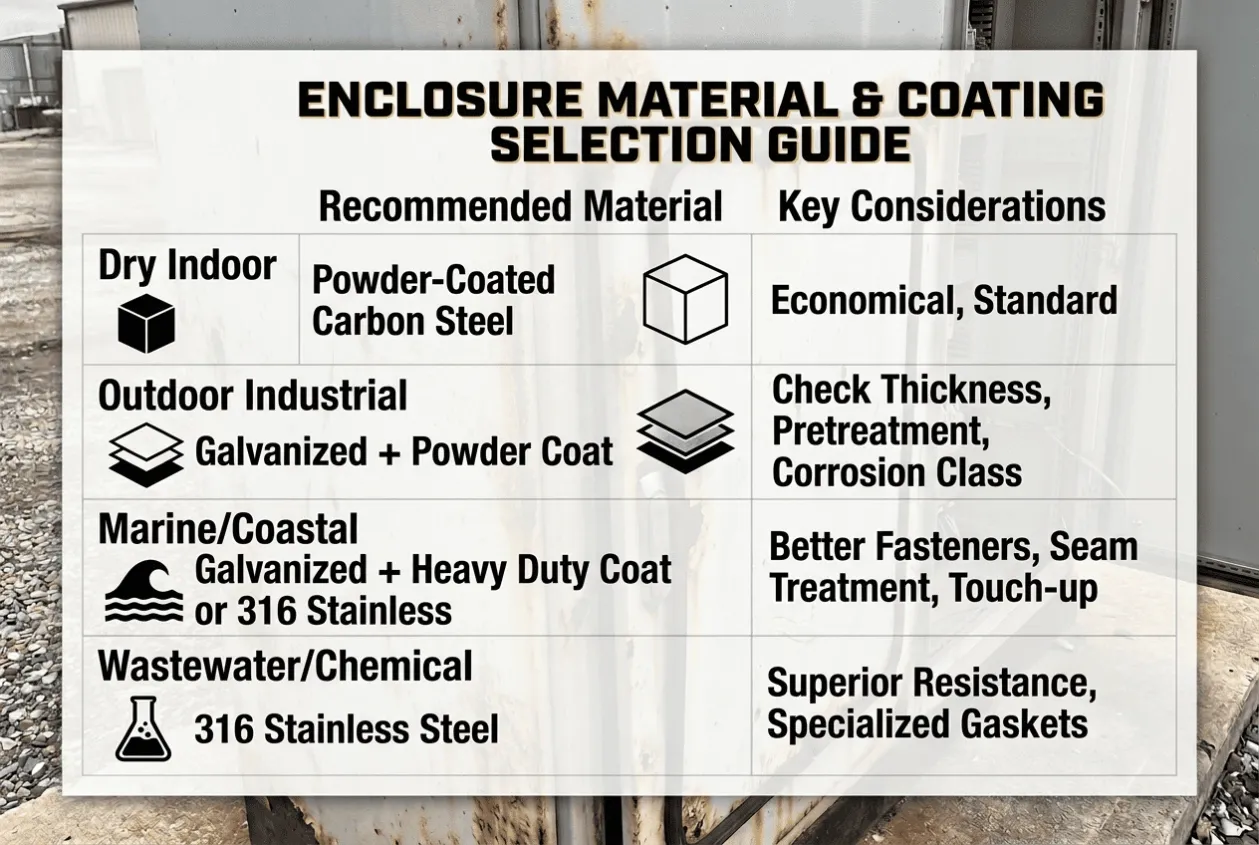
That is why I do not like choosing enclosure material by habit. “Use stainless” sounds safe, but it can be lazy. “Use carbon steel” sounds economical, but it can be expensive later. The real question is how much corrosion risk this project can afford.
Material Comparison for Buyers
Environment | Material I Would Review First | What I Would Be Careful About |
|---|---|---|
Dry indoor electrical room | Powder-coated carbon steel | Avoid overpaying for corrosion resistance the site does not need. |
Outdoor industrial site | Better-treated coated steel or galvanized steel | Ask for coating thickness and corrosion class, not only color. |
Coastal location | 316 stains quickly. duplex coating system | Salt finds edges, scratches, seams, and cheap fasteners quickly. |
Wastewater or chemical site | Galvanized steel with a suitable top coat, or stainless where justified | Gas, moisture, and chemical exposure can attack weak coating systems. |
Temporary or low-risk installation | Standard-coated steel may be acceptable. | Make sure the expected service life matches the price. |
This table is not trying to crown one material as the winner. I have seen carbon steel perform well for years in the right environment, and I have seen stainless steel disappoint buyers when the grade, hardware, or cleaning chemicals were not considered.
Every enclosure ages. The purchasing decision decides whether aging becomes acceptable weathering or an early replacement discussion.
If I Were the Buyer
- Indoor dry room: I would review powder-coated carbon steel first and avoid paying for corrosion protection the site does not need.
- Outdoor industrial site: I would ask for coating thickness, pretreatment, and corrosion class before discussing color or finish texture.
- Coastal outdoor site: I would start the discussion with corrosion class and chloride exposure, not with whether the cabinet “looks weatherproof.”
- Wastewater or chemical site: I would ask about seams, fasteners, gas exposure, coating repair, and touch-up procedure, not only stainless steel.
- Unknown environment: I would stop the quotation until the site condition is clear, because the wrong assumption will become part of the enclosure.
Why “Powder Coated” Is Not Enough
One supplier once told a buyer, “Don’t worry, it is powder coated.”
I know what he meant. He meant the cabinet was not bare steel. He meant it had a finish. He probably also meant that similar cabinets had shipped before without complaints.
Still, that answer does not give me enough comfort.
Powder coating does not tell me the surface preparation, coating thickness, edge coverage, salt-spray result, or corrosion class. Two enclosures can both be powder coated and still have very different service lives.
When a supplier says “good anti-corrosion coating,” my next question is usually, “Which ISO 12944 class are you quoting?”
I do not expect buyers to memorize ISO 12944.
I expect suppliers to.
That standard gives both sides a more useful language than “good coating” or “outdoor finish.” It helps clarify whether we are talking about a mild indoor environment, a C4 outdoor industrial site, a C5 marine site, or a chemical-heavy environment that needs a stronger system.
The difference may not show up when the cabinet arrives. It shows up after rain, sun, salt, scratches, and time have done their work.
Salt-Spray Hours Can Mislead Buyers
Some buyers ask for 1,000 hours of salt-spray testing because it sounds strong. Some ask for more because they assume a bigger number means a better cabinet.
I usually ask another question: “1,000 hours on what coating system?”
Salt-spray testing, such as ASTM B117 or ISO 9227, is useful for comparing coating performance, but it is not a direct field-life promise. A 1,000-hour result does not mean the enclosure will last exactly a fixed number of years near the sea. It means the coating system performed under a controlled accelerated test.
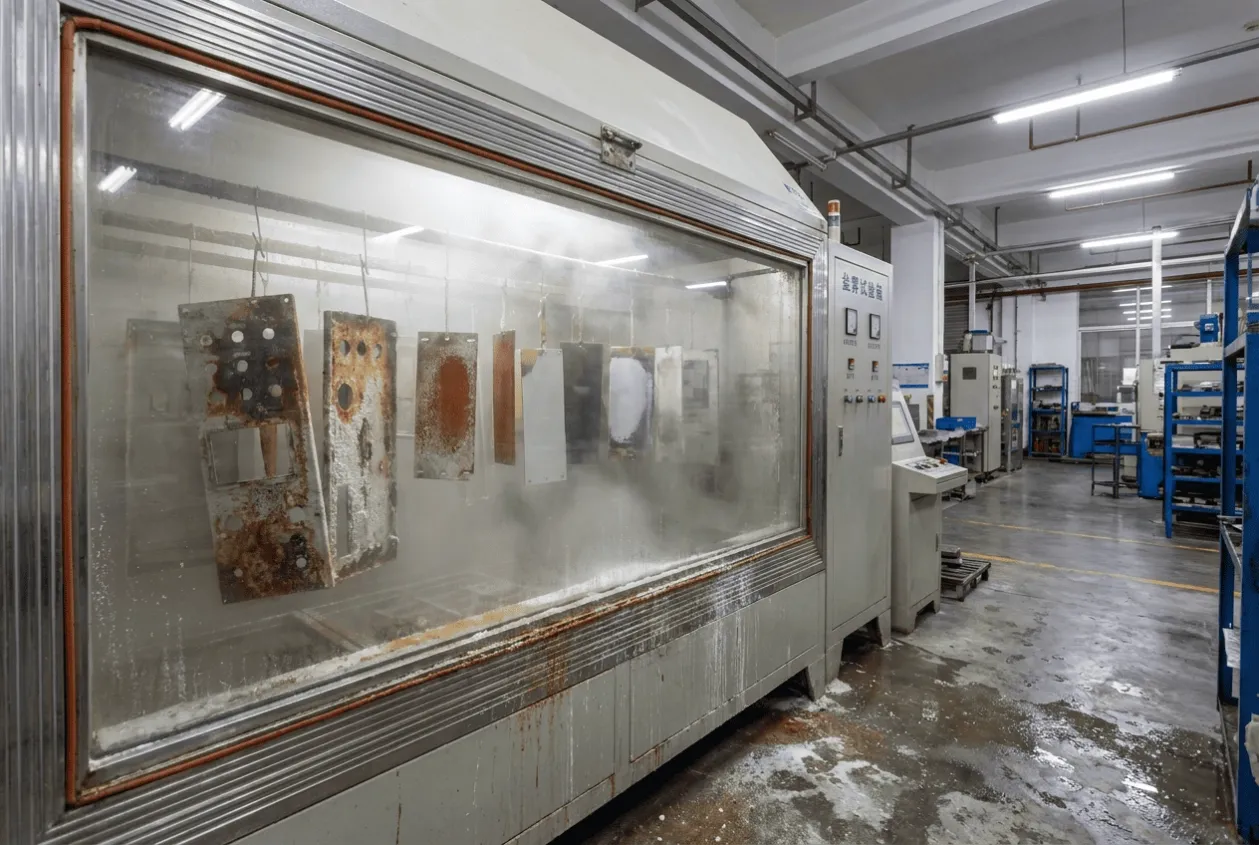
For purchasing, the number only becomes meaningful when it is tied to substrate, surface preparation, coating thickness, and test condition. A salt-spray figure floating alone in a quotation is easy to misunderstand. It looks technical enough to stop questions, which is exactly why buyers should keep asking.
Salt spray reports do not stop rust. Good specifications do.
The Small Saving That Became Expensive
One coastal project still comes to mind. The buyer had two enclosure quotations. The cheaper one used powder-coated carbon steel. The more expensive one proposed a galvanized substrate with a powder top coat. The price difference was not huge per cabinet, but across several units it was enough to get attention.
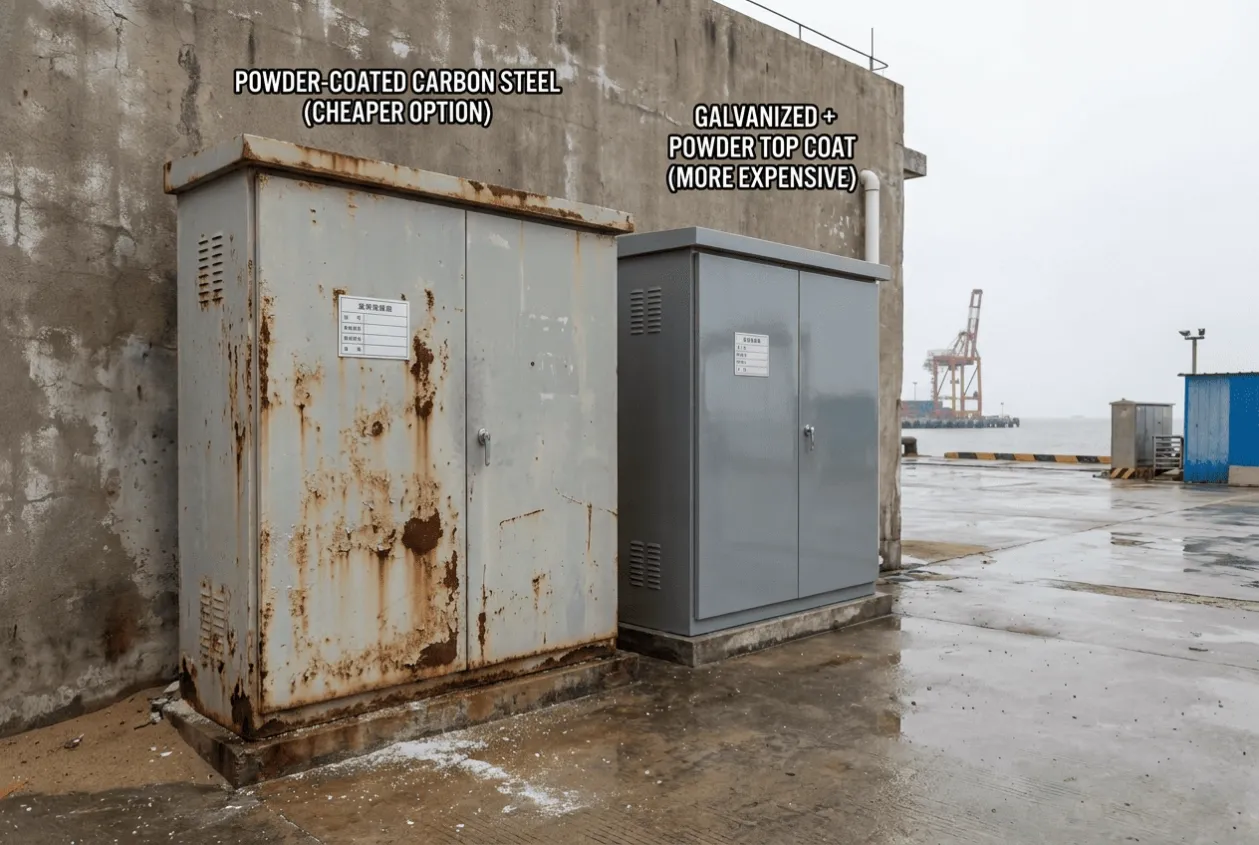
At first, the cheaper quotation looked practical.
Then we checked the site location. The cabinets were close enough to the sea that salt air was not a possibility; it was part of the environment.
The cheaper option might have looked fine after delivery and commissioning. The real risk was later, around scratches, bottom seams, screw points, and any place where coating coverage was weak. Saving a few hundred dollars per cabinet can become a poor deal when replacement, shutdown, freight, and site labor appear three years later.
Buyer Insight #2 If two suppliers quote the same enclosure but different coating systems, they are not quoting the same product.
Corrosion usually starts in the RFQ. It only becomes visible after installation.
Before I sign the PO
Before I sign the PO for a corrosion-sensitive enclosure, I want seven things clear:
- Where will the cabinet be installed?
- What is in the air around it?
- What base material is being used?
- What coating system is applied?
- Which ISO 12944 class or equivalent performance level is quoted?
- What salt-spray target is tied to that coating system?
- How will scratches or installation damage be repaired on site?
The last point sounds boring until someone drags the cabinet across a concrete floor, scratches a corner during installation, or cuts a new hole for cable entry. Site damage is not rare. It is part of real projects. Without a touch-up method, those small damaged areas can become the first corrosion points.
For buyers sourcing from China, this review matters because two suppliers can quote the same enclosure size, same IP rating, and same material description while offering very different coating performance. One price may be lower simply because the corrosion protection is lighter, not because the supplier is more efficient.
Questions Buyers Often Ask Me
“Does IP66 mean the enclosure will not rust?”
No. IP66 mainly describes ingress protection. Corrosion resistance depends on material, coating system, surface preparation, hardware, seams, and the environment around the cabinet.
“Is powder-coated carbon steel a bad choice?”
Not at all. For dry indoor or mild industrial environments, it can be a good cost-effective choice. It becomes risky when the site is coastal, chemical, or wastewater, or heavily exposed outdoors, and the coating system is not clearly specified.
“Should I choose 304 or 316 stainless steel?”
304 stainless is often suitable for inland outdoor or general washdown use. For coastal, marine, chloride, or chemical-heavy environments, 316 is usually the safer discussion because chloride exposure is where 304 can struggle.
“What should I write in the RFQ?”
Write the site environment, expected service life, enclosure rating, base material, coating class, coating thickness, salt-spray requirement, fastener material, and touch-up requirement. Avoid vague phrases such as “weatherproof” or “anti-rust coating.”
“Can UniRegal help compare two enclosure quotations?”
Yes. Send the site condition, material options, coating description, enclosure rating, and expected service life. We can help check whether the quoted corrosion protection matches the actual environment, not just the drawing.
Final Thought
Steel does not decide how long an enclosure lasts by itself. The specification usually does.
The enclosure often starts rusting long before rust appears. It starts when the RFQ leaves too much unsaid.
Related guides
Get a coating specification that matches your site.
If you know the environment your enclosures will live in, we can turn it into a finish specification—substrate, ISO 12944 class, salt-spray target, and hardware—and source the boxes from Foshan-area suppliers with the component brands you already use inside. Tell UniRegal Team the duty and quantities on our requirements page, and we will come back with a matched bill of materials.