
Oct 6, 2026Buying Guides
How to Prepare an Explosion-Proof Enclosure RFQ That Passes Inspection
Hazardous-area enclosure RFQs should start with area classification, gas group, T-code, cable entry, certificates, material, and heat load to avoid inspection failure.
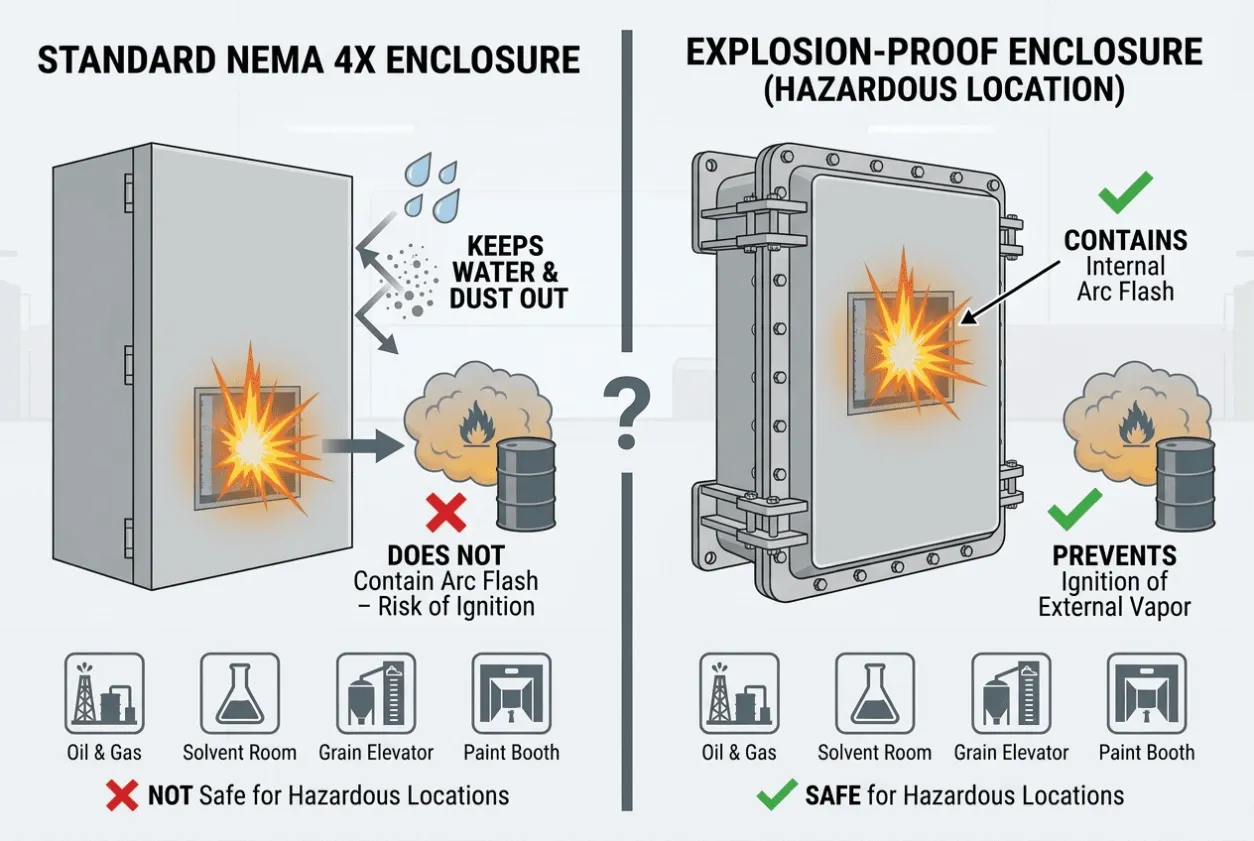
A standard NEMA 4X enclosure keeps water and dust out. It does not keep an arc flash from igniting the flammable vapor outside it. If your panel sits in an oil-and-gas skid, a solvent room, a grain elevator, or a paint booth, the box is only as good as its hazardous-location rating — and most buyers learn this the hard way, at the inspection gate, after the cabinet has already shipped.
We are a China-based sourcing partner. We do not build enclosures ourselves; we work with Foshan fabricators and source certified components, then help you specify the right hazardous-area package. That keeps the advice below supplier-neutral: the goal is a cabinet that passes the authority having jurisdiction (AHJ), not a brand we want to push.
If you are still choosing the base enclosure type, start with the electrical enclosure selection guide. For the corrosive half of the problem, see stainless steel vs carbon steel cabinets. When the enclosure is part of a larger panel order, the electrical enclosures solutions page shows how we bundle specification, sourcing, and FAT.
What actually makes an area "hazardous"
A hazardous location is anywhere a concentration of flammable gas, vapor, dust, or fiber could meet an ignition source. The enclosure's job in that location is not just to survive — it is to contain an internal explosion or to prevent one from ever occurring.
There are two rating worlds you must speak fluently:
- North American: Class / Division (or Class / Zone). Class I = flammable gas or vapor. Class II = combustible dust. Class III = ignitable fibers. Division 1 = hazard present normally or frequently; Division 2 = hazard only under fault. Zone systems (Zone 0/1/2 for gas, 20/21/22 for dust) are the newer IEC-aligned alternative used in the same geography.
- International: Zone + IECEx / ATEX. ATEX (2014/34/EU) covers the EU; IECEx is the international scheme built on IEC 60079. Both use Zones and add gas groups (IIC is the most severe, e.g. hydrogen/acetylene) and a T-code (T1–T6) that caps the surface temperature the equipment may reach.
Buyer decision: Before you price a single enclosure, get the site's area classification drawing. If no one can hand you a Class/Division or Zone map with gas group and T-code, stop — every enclosure you spec without it is a guess.
Enclosure protection methods for hazardous locations
You do not always need a heavy cast "explosion-proof" box. Four recognized methods exist, and picking the wrong one wastes money or fails inspection.
- Explosion-proof / flameproof (Type "X", NEMA 7/9).
The enclosure is built to contain an internal explosion and cool the escaping gases below the auto-ignition temperature. Required where the hazard is inside or immediately around the enclosure. Heavy, costly, and runs hot.
- Increased safety (Type "e").
No arcs inside; the enclosure prevents sparks and limits surface temperature. Used for terminals and distribution, not for devices that arc.
- Purge and pressurization (Type "Y" / "Z").
A protective gas (instrument air or inert) maintains positive pressure so a flammable atmosphere cannot enter. Lets you put ordinary equipment inside a hazardous area. Needs a reliable air supply and a pressure switch.
- Intrinsic safety (Type "i").
Limits energy so a circuit literally cannot spark. Mostly for instruments and signals, not power enclosures.
NEMA vs. IECEx/ATEX: the mapping that ends arguments
Buyers exporting equipment ask the same question constantly: "My US customer wants NEMA 7—what's the ATEX equivalent?" There is no perfect one-to-one, but this gets you close enough to specify:
North American | IECEx / ATEX equivalent | Typical use |
|---|---|---|
NEMA 7 (Class I, Div 1) | Ex d IIC T6, Zone 1 | Gas/vapor, a hazard normally present |
NEMA 9 (Class II, Div 1) | Ex tD A21, Zone 21 | Combustible dust, hazard present |
NEMA 4X + purge (Type Y/Z) | Ex p, Zone 1/2 | Ordinary equipment made safe by pressure |
Division 2 enclosure | Zone 2 / Ex nA | Hazard only under fault |
The key takeaway: NEMA Type and ATEX "Ex" codes describe different things. NEMA describes the enclosure's environmental rating; the "Ex d / Ex e / Ex p" prefix describes the protection method. A compliant package states both.
Material choices when the location is both corrosive and explosive
A hazardous-area enclosure is often outdoors in a chemical or coastal plant, so you are solving two problems at once.
- 316 stainless steel—the default for offshore, coastal, and chemical service. Resists both the atmosphere and most process spills. More expensive than 304 but worth it where chloride corrosion is real.
- Cast aluminum (copper-free)—common for NEMA 7 explosion-proof boxes. Light and strong, but watch the anodize/paint in corrosive atmospheres; bare aluminum pits near seawater.
- 304 stainless—adequate for indoor or mild outdoor duty, not for chloride-heavy sites.
- Coated carbon steel—cheapest, but in a hazardous and wet location it is a maintenance liability; once the coating is scratched, corrosion starts.
The certification chain a buyer must verify
An enclosure that "looks explosion-proof" is worthless without paperwork. Before you approve a purchase order, confirm:
- Listing mark for the location type—UL 1203 (US) or equivalent for explosion-proof; UL's hazardous-location program is the reference buyers trust.
- ATEX / IECEx certificate with the exact Ex code, gas group, and T-code matching your site.
- NEMA Type stated explicitly (7, 9, or 7/9 combination)—see theNEMA rating definitions.
- Temperature code at or below the site's auto-ignition requirement.
- Conduit entries threaded to the correct standard (NPT in North America, metric in most of the world)—mismatched threads are a classic field failure.
Engineering note: A T6 enclosure (max surface 85 °C) is not interchangeable with a T4 (max 135 °C) just because both are "explosion-proof." In a hydrogen area you may need T2/T1; in a grain area T3/T4 is often enough. Match the code to the gas, not to the price.
Common specification mistakes that fail inspection
- Using a Division 2 box in a Division 1 area—the single most common and most expensive error. Div 2 enclosures are not built to contain an explosion.
- Mixing Div and Zone threads on one job—conduit and fittings must match the declared system, or the AHJ rejects the run.
- Ignoring the T-code—the enclosure passes the explosion test but exceeds the site's temperature limit, so the whole installation is non-compliant.
- Forgetting heat derating—explosion-proof boxes run hotter because they are sealed. The devices inside (drives, transformers) lose capacity; size up.
- Specifying ordinary cable glands—hazardous areas need certified glands (Ex d / Ex e) with the right sealing; a standard PG gland breaks the protection concept.
Sizing and thermal reality
Explosion-proof enclosures are sealed, so heat has only one way out: the walls. That changes your sizing math versus a vented NEMA 4X box.
- Budget for internal heat load from every device, then confirm the enclosure's surface area can dissipate it below the T-code limit at your ambient.
- Expect to derate VFDs and power supplies 10–20% inside a sealed hazardous box.
- If the heat load is too high, move to purge-and-pressurize (Type Y/Z) with ordinary equipment inside, or split the load across two smaller enclosures.
Decision matrix: which method fits your site?
If your site has… | Choose | Why |
|---|---|---|
Gas/vapor hazard normally present (Div 1 / Zone 1) | Explosion-proof (Ex d, NEMA 7) | Must contain an internal explosion |
Dust hazard (Div 1 / Zone 21) | NEMA 9 / Ex tD | Dust-ignition-proof construction |
Hazard only on fault (Div 2 / Zone 2) | Increased safety or ordinary + Ex nA | No containment needed |
Ordinary equipment you must place in a hazard | Purge & pressurize (Ex p) | Makes safe by pressure, not by box |
Low-energy instruments/signals | Intrinsic safety (Ex i) | Energy too low to ignite |
FAQ
Q: Is NEMA 4X good enough for a hazardous location?
No. NEMA 4X is an environmental rating (water/dust/corrosion), not a hazardous-area rating. In a classified area you need NEMA 7/9 or an IECEx/ATEX "Ex" method on top of any environmental protection.
Q: Can I use one enclosure for both gas and dust hazards?
Often yes—a NEMA 7/9 combination or an Ex d + Ex tD certificate covers both, but only if the certificate explicitly lists both. Do not assume; read the marking.
Q: Does ATEX approval let me sell in the US?
Not directly. ATEX is EU law; the US generally requires UL listing (e.g., UL 1203). IECEx is accepted more widely, but still check the local AHJ. Plan for both if you ship across borders.
Q: Why are explosion-proof enclosures so expensive?
They are thick-walled, precision-machined to contain explosions, and individually certified. The cost is in the testing and the metal, not the markup.
Q: How do I know the T-code I need?
From the gas or dust present at the site and its auto-ignition temperature, stated on the area-classification drawing. When in doubt, ask the process safety engineer—never guess downward.
Q: What happens if I spec the wrong method?
At best, the AHJ refuses sign-off, and you rework the job. At worst, you create a genuine ignition risk. The enclosure is safety-critical; spec it from the classification, not the catalog.
Engineering Takeaway
Specifying a hazardous-area enclosure starts and ends with the site's classification drawing—Class/Division or Zone, gas group, and T-code. Pick the protection method (explosion-proof, increased safety, purge, or intrinsic safety) from that data, confirm the certification chain (UL 1203 / ATEX / IECEx with the exact Ex code), and derate for the sealed-box heat. A box that "looks explosion-proof" without the right paperwork is not compliant, and in this category non-compliant means it does not ship.
Related guides
Get a compliant quote.
If your site is classified and you need an enclosure package that passes inspection the first time, tell us the area classification, gas group, and T-code. We will source certified NEMA 7/9 or IECEx/ATEX enclosures and bundle them into your panel build. Submit your requirements and we will come back with a spec and a quote.
Need help specifying or sourcing this for your project? Request a quote - we reply within 1-2 working days with a technical review.