
Control Panels
Control Panel Drawing Approval: How to Avoid Costly Changes During Manufacturing
An approved drawing is a baseline, not a picture. Learn which drawings to freeze, who may release a revision, and what a late change actually costs.
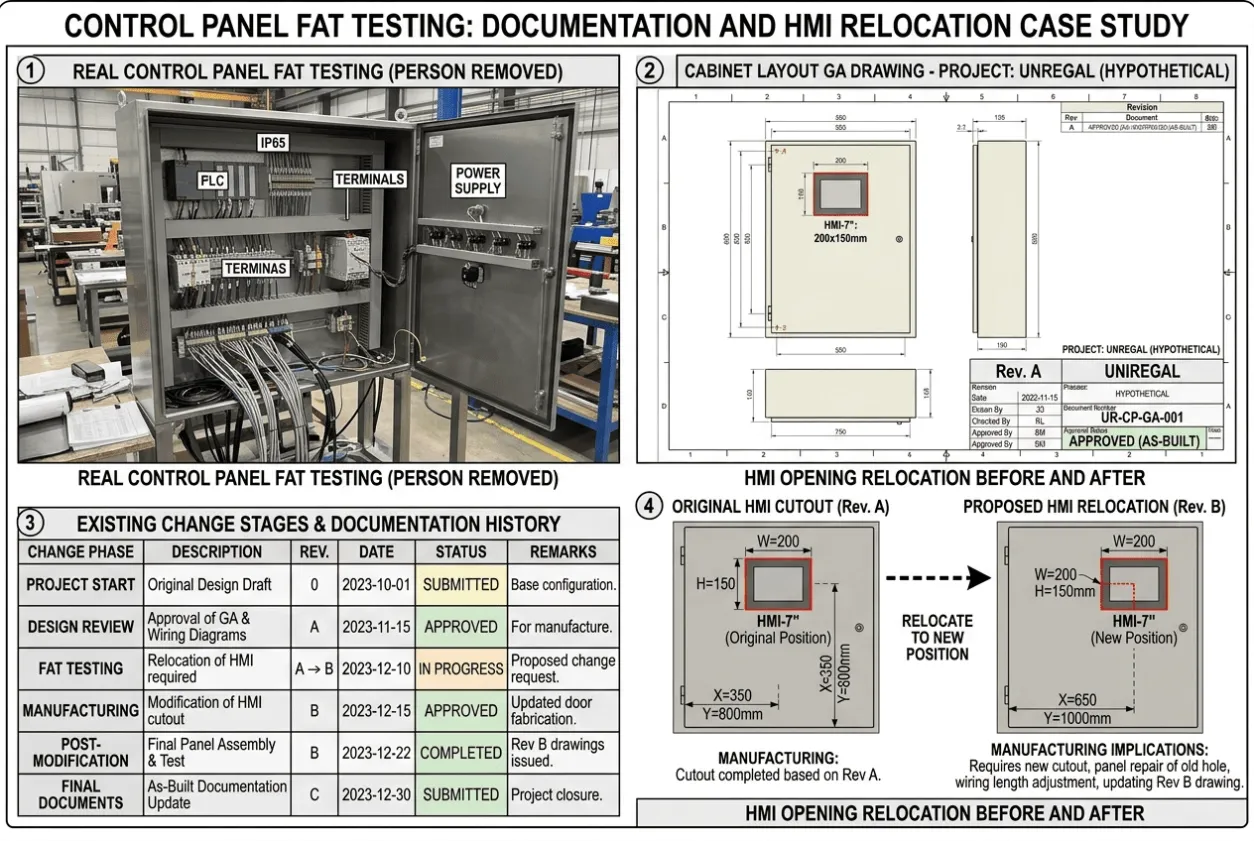
Moving an HMI opening 100 mm to the left sounds like a small request, especially when you are looking at a drawing on your computer. But if the supplier has already cut the cabinet door, mounted the components and started wiring, the same adjustment may involve replacing fabricated parts and repeating some of the work.
The frustrating part for a buyer is often not the additional cost itself. It is discovering that the supplier considers the drawing approved for production, while your engineering team thought it was still under review.
This is why I would treat drawing approval as a purchasing decision, not simply an engineering formality. When ordering custom electrical enclosures or control panels from China, you need to know exactly which information has been approved, what the factory is allowed to manufacture, and how later changes will be handled.
A Drawing Can Look Finished Without Being Ready for Production
A general arrangement drawing may show the enclosure dimensions, door openings, HMI position, and mounting plate. For an empty cabinet, that might cover much of the required fabrication information.
For a fully wired control panel, however, the external layout is only one part of the design. The electrical schematic, bill of materials, internal component arrangement, and terminal information must also agree with one another.
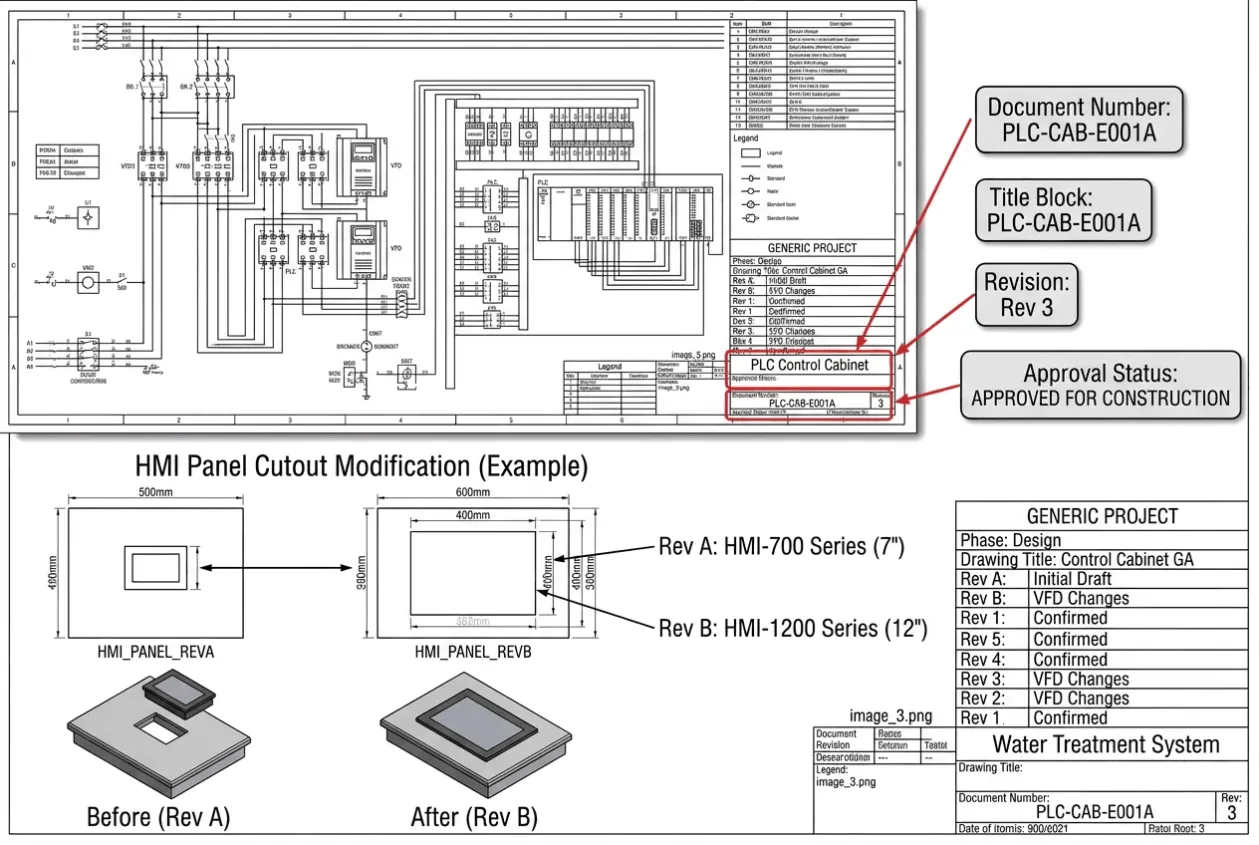
Consider a customer who approves the cabinet dimensions while the final VFD model is still being selected. The supplier begins fabricating the enclosure, only to discover later that the chosen drive requires more ventilation space than the preliminary model.
The customer may feel the factory should have anticipated this, while the supplier may argue that the enclosure was manufactured according to the approved drawing. Neither argument resolves whether the original approval actually authorized fabrication before the electrical design was finalized.
A sensible review should identify the documents being approved and the manufacturing work that approval releases.
For example, the buyer might approve the enclosure's external dimensions and material specification but withhold approval of the mounting plate until the component arrangement is confirmed.
That is a legitimate way to keep a project moving, provided the unfinished details do not affect the work being released.
Why a Small Drawing Change Can Become an Expensive Manufacturing Change
The timing of a revision often matters as much as the revision itself.
Imagine five identical control cabinet doors with HMI cutouts already completed. The customer then requests the opening to be moved 100 mm.
If the request arrived before cutting, the manufacturer might only need to update the CAD file. After fabrication, the original openings cannot necessarily be moved without replacing the doors or producing a technically acceptable repair.
For an assembled panel, relocating the HMI may also affect cable routing, wire lengths, internal clearances, and the final inspection.
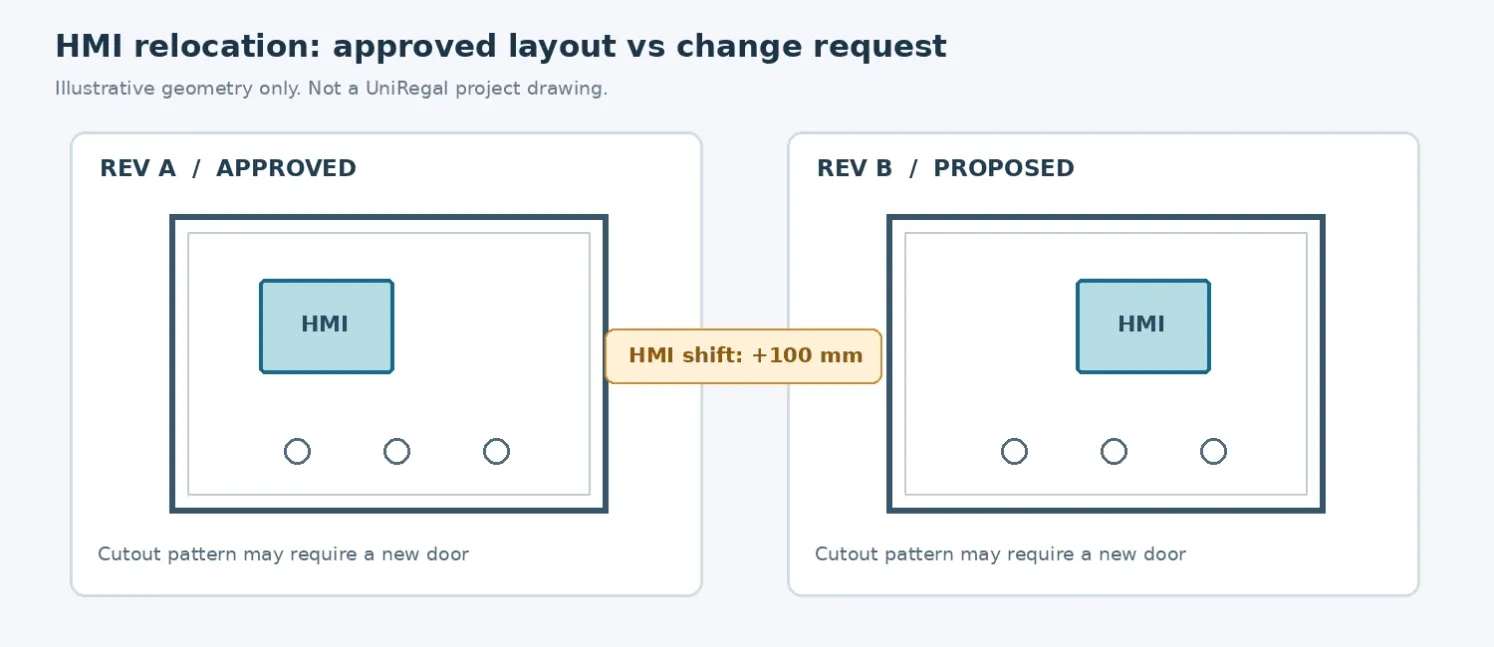
Figure 1. A hypothetical HMI relocation from an approved drawing to a proposed revision. The drawing illustrates the manufacturing implications; it is not a completed UniRegal customer project.
The following comparison shows why the same request may produce very different quotations.
Production status | Likely impact of a change | What the buyer should ask |
|---|---|---|
Drawing review only | CAD and specification revisions | Is additional engineering included? |
Materials ordered, fabrication not started | Purchasing adjustments or restocking costs | Which materials are already committed? |
Door or mounting plate already cut | Replacement or rework of fabricated parts | Can the affected part be modified acceptably? |
Panel assembled and wired | Mechanical changes, wiring adjustments, and retesting | Which operations must actually be repeated? |
These are possible consequences, not predetermined charges.
If the manufacturer cut an opening in the wrong position compared with the approved drawing, that is not the same as the customer requesting a new position after production release.
The buyer should establish the cause before accepting any additional charge.
Buyer Insight: Approval Timing Matters More Than the Number of Revisions
A project with ten drawing revisions is not necessarily poorly managed. Engineers often need several rounds to resolve installation details.
The more useful question is whether each revision occurred before or after the affected work was released.
A change made during design development may cost very little. The same change after fabrication can require replacement material and additional labor.
This is why buyers should ask suppliers to distinguish between drawings issued for review and drawings released for manufacturing.
The distinction is particularly important when purchasing custom enclosures from a supplier that handles fabrication separately from electrical assembly.
Can You Approve Some Work While Other Details Remain Open?
Yes, and this is one of the most practical ways to avoid unnecessary delays.
Suppose the final cable-entry position has not been confirmed because the installation contractor is still reviewing the conduit arrangement.
The supplier may be able to fabricate the enclosure body while leaving a removable gland plate uncut.
Instead of withholding approval for the entire cabinet, the buyer can authorize defined work and identify the unresolved area.
A useful instruction might state:
Enclosure dimensions, material and door arrangement approved under Drawing GA-104 Rev. C. Bottom gland-plate machining remains on hold pending cable-entry confirmation. The supplier shall not release that operation without written approval.
This gives the manufacturer a clear production boundary.
However, partial approval only works when the released work does not depend on the unresolved details. If the gland-plate arrangement affects internal component clearances, approving the enclosure layout prematurely may still create problems.
I would expect the supplier to identify those dependencies rather than simply accept the instruction without comment.
Buyer Decision Reference: What Can Be Released to Manufacturing?
The following table is intended for buyers reviewing actual custom enclosure or panel drawings.
Design information | Release decision | Reason |
|---|---|---|
Confirmed enclosure dimensions and material | Usually ready for fabrication approval | Defines the main mechanical requirements |
HMI cutout with model and dimensions confirmed | Can be approved if clearances are checked | Determines irreversible door machining |
Cable entry awaiting site confirmation | A conditional hold may be suitable. | A removable plate might be fabricated later. |
Mounting plate with final BOM unresolved | Hold affected machining. | Component dimensions and mounting patterns may change. |
The main breaker or VFD model is still undecided. | Hold affected electrical layout and procurement. | Ratings, clearances, and connections may change. |
Finished assembly with approved modifications | Release after required verification | Final records should reflect the product actually built. |
The table is a decision aid rather than a universal manufacturing rule. The responsible designer and manufacturer still need to evaluate the dependencies in the actual project.
What I would avoid is approving a complete manufacturing package just to keep the delivery date on paper, while knowing that major component decisions remain unresolved.
What Does a Properly Controlled Drawing Package Look Like?
You don't need an elaborate document management system for every small cabinet order, but you do need an unambiguous record of what the supplier is supposed to manufacture.
At minimum, the relevant drawings should be identifiable by document number, revision, issue date, and approval status.
The bill of materials should also identify the components being purchased, including exact ordering codes where those details affect compatibility or performance.
ISO 10007: 2017 provides guidance on configuration management, including the identification of controlled information, change management, and configuration records.
IEC 61082-1: 2014 provides rules for presenting electrical documents, including diagrams, drawings, and tables.
These standards offer useful principles, but they do not automatically become mandatory contractual requirements for every custom enclosure order.
For buyers, the practical benefit is straightforward: six weeks after approval, you should still be able to identify exactly which drawing revision the factory used.
That becomes especially important when multiple departments exchange files by email. A production supervisor cannot reliably distinguish an authorized revision from an informal engineering suggestion merely because it arrived later.
When a Component Is Substituted, the BOM Must Follow
Drawing changes are not always initiated by the customer.
A supplier may discover that a specified PLC, circuit breaker, or power supply has a long lead time and propose another model.
The alternative may be acceptable, but matching the basic electrical rating does not establish complete equivalence.
A replacement component can have different mounting dimensions, terminal configurations, accessory requirements, or certification conditions.
Before approving the change, the buyer's technical representative should receive the proposed manufacturer's exact ordering code and relevant technical information.
For some projects, an alternative device may also affect the control panel's electrical evaluation or required documentation.
This is why the approved BOM should be treated as part of the controlled manufacturing information rather than a list that purchasing staff can change independently.
How Should Buyers Handle an Additional Change Charge?
I would not reject a supplier's change quotation merely because the amount seems high compared with the original drawing adjustment.
Instead, I would ask which work has already been completed and what must now be repeated.
If a door requires replacement, the quotation should distinguish the new fabricated part from additional engineering or assembly work. If a component change requires rewiring and retesting, those operations should be identified rather than hidden inside one unexplained charge.
For an order involving several identical units, the buyer should also ask whether the change affects every unit or only those already released to production.
A fair change proposal explains the technical reason for the work, the incremental cost and the effect on delivery.
That gives both parties a basis for approving or negotiating the revision without relying on assumptions.
Frequently Asked Questions
Who should approve electrical control panel drawings?
The appropriate technical representative, usually the customer's electrical engineer or system integrator, should approve technical content. Commercial approval for changes affecting price or delivery may belong to purchasing or project management. The responsibilities should be identified before production so that comments from one department are not mistaken for full project authorization.
Can a manufacturer begin fabrication before the electrical design is complete?
Sometimes. Fabrication can proceed against specifically approved information when unfinished electrical details do not affect the released mechanical work. However, affected machining, mounting arrangements or component procurement should remain on hold until the relevant decisions are confirmed.
Who pays for a drawing change after production has started?
The answer depends on the cause of the change and the purchase agreement. Buyer-requested changes may justify additional charges, especially after material has been cut. If the supplier failed to follow the approved drawing, the correction should be evaluated under the supplier's contractual obligations rather than automatically charged to the buyer.
What if the supplier uses an older drawing revision?
Compare the manufacturer's production record with the authorized release documents. If an updated revision was properly approved and released before the affected work began, the discrepancy should be addressed under the agreed change and correction procedures. An informal email attachment is not necessarily sufficient evidence that production was authorized to change.
Should I request as-built drawings before shipment?
For wired control panels, updated electrical drawings and component information are valuable for installation, maintenance and future modifications. For an empty enclosure, final fabrication drawings may be sufficient. The documentation scope should be agreed in advance, and any approved changes should be reflected in the relevant final records.
Need a Fabrication Quote for Custom Electrical Enclosures?
At UniRegal, we coordinate custom electrical enclosure fabrication and industrial automation component sourcing through our supplier network in Foshan, China.
When reviewing an enquiry, we can help clarify enclosure dimensions, material specifications, mounting arrangements, cutouts and other information needed for supplier quotations. Electrical design approval and specialist engineering decisions remain with the appropriately qualified parties responsible for the project.
If you are preparing a new enclosure or control cabinet project, send us your drawings or BOM, together with the required quantity, material, destination and delivery expectations.
Where drawing details are incomplete, identifying those questions before manufacturing is often more useful than issuing a quotation that assumes the design will never change.
Related guides
- Comparing suppliers before you freeze a drawing: electrical enclosure supplier sourcing guide
- What a late change looks like on arrival: control panel arrival, acceptance and rejection guide
- Attaching payment milestones to documents: control panel payment terms and contract guide
- Preparing the enquiry package in the first place: what to send for a control panel quote
- Deciding what goes on the sheet: control panel wire sizing guide
- Following the package through to build and shipment: custom control panels