Buying Guides
What Should You Check on the Declaration Before Accepting It?
Who signs the EU Declaration of Conformity for control panels imported from China? Compare manufacturer responsibilities, documents, and buying options.
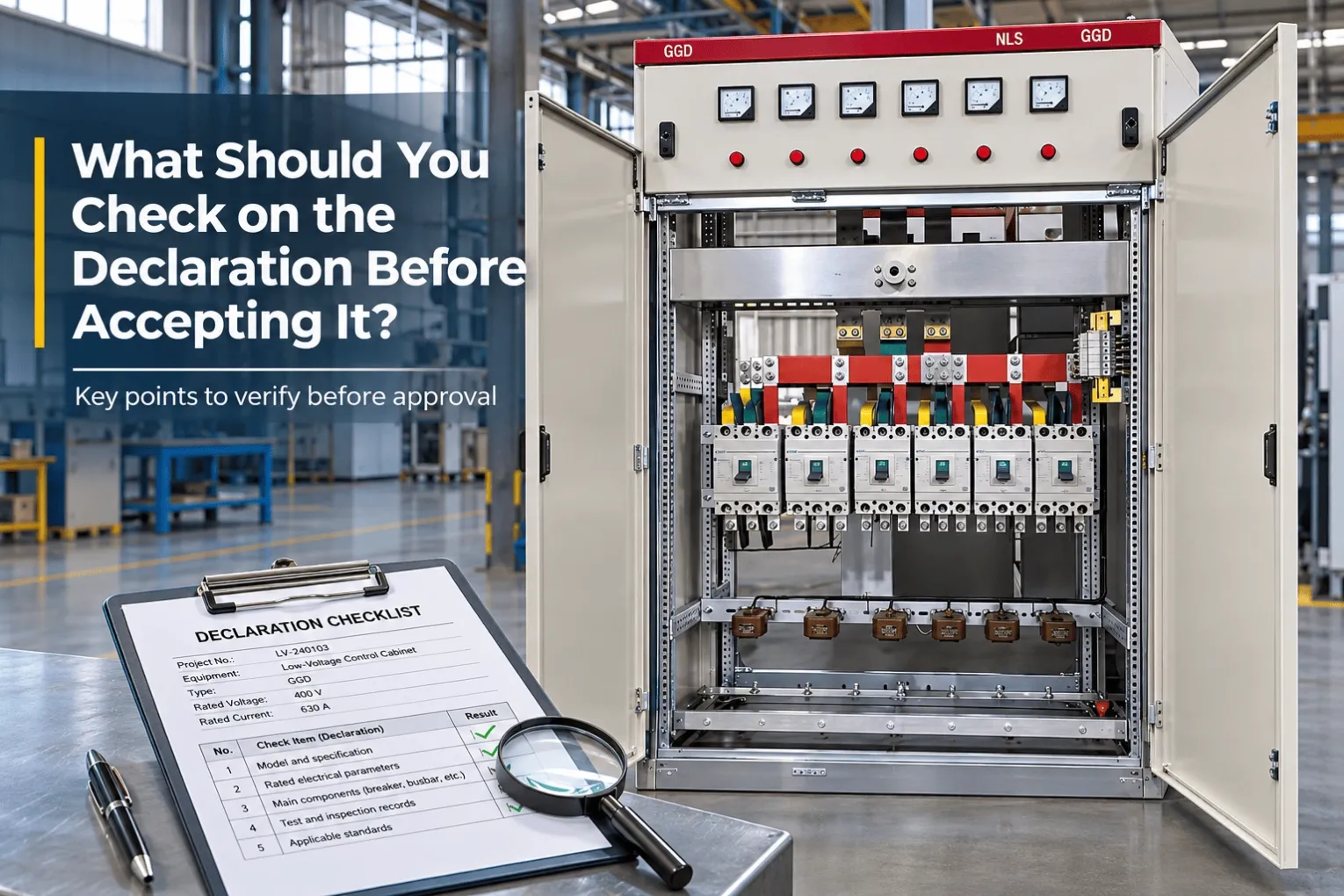
CE Marking a Control Panel for the EU: Who Signs the Declaration? (2026 Buyer's Guide)
A European machine builder orders a control panel from China. The drawings are approved, the components come from familiar brands, and the supplier confirms that the equipment is “CE compliant.” Everything looks straightforward until the purchasing manager requests the EU Declaration of Conformity (DoC).
The supplier responds with declarations for the PLC, power supply, and circuit breakers. Unfortunately, none identifies the finished control panel.
So who is supposed to sign the declaration?
For a control panel covered by EU CE-marking legislation, the declaration is issued under the responsibility of the manufacturer of the finished product and signed by an authorized person on its behalf. That manufacturer may be the Chinese supplier, a European panel builder, or an OEM selling the equipment under its own name.
For buyers, the important question is not simply whether the supplier offers CE marking. It is whether the quotation clearly identifies the finished product, the responsible manufacturer, and the compliance work included in the price.
Who Is Responsible for CE Marking When Buying from China?
Under the EU Low Voltage Directive 2014/35/EU and EMC Directive 2014/30/EU, where applicable, manufacturers must assess their products against the relevant requirements and prepare the appropriate conformity documentation.
A manufacturer does not have to be established in Europe. A Chinese company can issue a valid EU Declaration of Conformity for a product it manufactures and markets under its own name, provided the applicable obligations are fulfilled.
However, the factory physically assembling the panel is not always the legal manufacturer.
If an EU company purchases control panels and markets them under its own brand, that company may assume manufacturer responsibilities. An importer also has obligations, although importing a Chinese-branded product does not automatically make the importer its manufacturer.
The distinction becomes clearer when we look at common purchasing arrangements.
Who Takes Responsibility? A Buyer's Reference Table
Purchasing arrangement | Typical responsibility | What the buyer should confirm |
|---|---|---|
Complete control panel sold under the Chinese manufacturer's brand | The Chinese manufacturer handles applicable finished-product conformity. | Finished-panel DoC, product identification, and documentation availability |
Complete panel manufactured under an EU OEM's own brand | The EU brand owner may become the legal manufacturer. | Assessment responsibilities, technical file access, and signing authority |
Empty enclosure supplied to an EU panel builder | The panel builder handles the conformity of the electrical assembly it completes. | Fabrication specifications, drawings, and relevant enclosure documentation |
Control panel incorporated into a complete machine | Responsibilities depend on the panel and finished-machine arrangements. | Applicable legislation, integration documentation, and responsible parties |
These are typical scenarios. The final legal classification depends on the actual product and how it is placed on the market.
For a purchasing manager, establishing this responsibility before accepting the quotation avoids a difficult conversation later about who was expected to prepare the declaration.
Why CE-Marked Components Do Not Automatically Cover the Whole Panel
Imagine comparing two quotations for an industrial control panel.
Both suppliers propose CE-marked circuit breakers, a PLC, power supplies, and other components. One quotation is cheaper, but its documentation package includes only the individual component declarations.
The other supplier has explicitly included conformity assessment and documentation for the completed electrical assembly.
These are not necessarily equivalent offers.
A component declaration provides information about that component. Once components are installed together, the finished assembly must be assessed against the EU legislation applicable to it.
Depending on the panel's design and intended use, electrical safety and electromagnetic compatibility may both require consideration.
The cheaper supplier has not necessarily supplied unsafe equipment. However, if its quotation excludes assessment or documentation that the buyer expected, the remaining work may create additional cost and responsibility.
This is why I would ask for the conformity documentation scope before comparing final prices. A low unit price tells you very little when important parts of the deliverables have not been defined.
How to Check an EU Declaration of Conformity Before Accepting It
Receiving a PDF titled “CE Certificate” should not be the end of the document review.
The European Commission provides guidance on the information required in an EU Declaration of Conformity. For a purchasing manager, the following checks are a practical starting point.
Five Things to Check on the Declaration
What to check | What should appear | Potential warning sign |
|---|---|---|
Manufacturer identification | Manufacturer's name and business address | Only a supplier logo or trading name without the responsible manufacturer |
Product identification | Model, type, or other details allowing product traceability | "Declaration" refers to a different product or model. |
Applicable EU legislation | References to the relevant EU directives or regulations | Only a generic statement saying “CE approved” |
Standards and specifications | Relevant harmonized standards or other technical specifications used | No identifiable technical basis or unclear references |
Authorised signature | Signatory's name, position, place/date, and signature | Missing signing information or unclear signing authority |
Based on the European Commission's EU Declaration of Conformity guidance. Exact requirements depend on the applicable legislation.
A particularly useful check is comparing the declaration with the panel's nameplate, final drawing, and purchase order.
For example, if the delivered assembly is identified as CP-400-02, but the supplier provides a declaration covering only an individual power supply, that document does not establish conformity for the complete panel.
Another important distinction concerns signatures. A manufacturer or its authorized representative may sign the declaration, but signing does not automatically transfer every manufacturer's legal responsibility to the person holding the pen.
If a document does not clearly identify the product and responsible manufacturer, request clarification before accepting it as the finished-panel declaration.
Empty Enclosure or Complete Control Panel: What Documents Do You Actually Need?
Not every European buyer needs a Chinese supplier to deliver a fully assembled electrical panel.
Many panel builders already have their own engineering teams, wiring facilities, and conformity assessment procedures. Their purchasing requirements may be limited to a fabricated enclosure that matches an approved drawing.
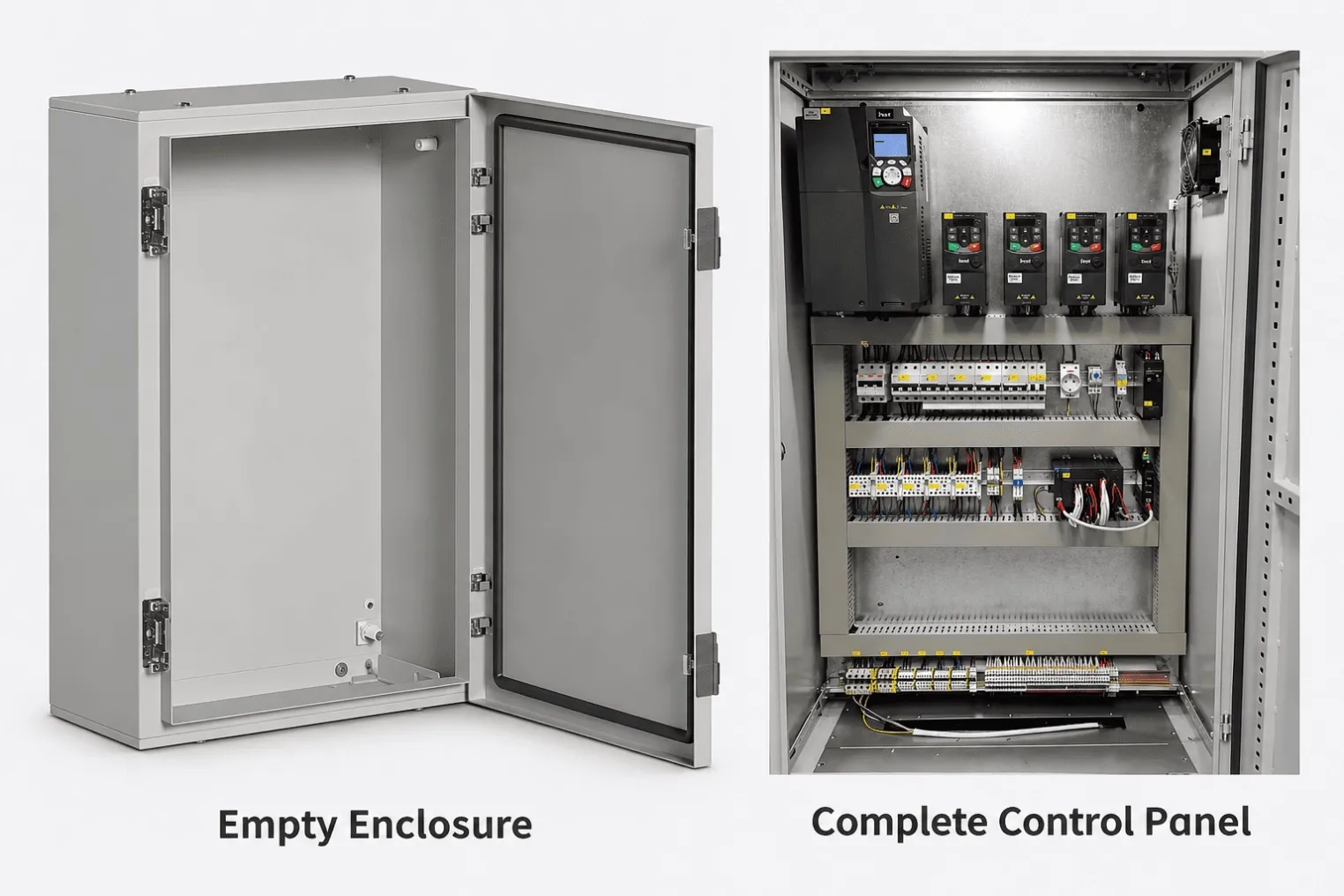
Other buyers need complete electrical equipment and the documentation associated with that finished product.
These requirements should not be mixed together.
Documentation Comparison for EU Buyers
Required information | Custom empty enclosure | Complete electrical control panel |
|---|---|---|
Approved fabrication drawings | Essential | Normally required |
Material, thickness, and surface finish | Essential | Required as relevant |
Mounting plates and cable-entry details | Confirm before fabrication. | Confirm against electrical arrangement. |
Electrical schematic and final BOM | Prepared by the final assembler | Normally part of the technical documentation |
Electrical inspection and test records | Not applicable to an unwired enclosure as a complete panel | As required by the design, legislation, and contract |
EU Declaration of Conformity | Depends on legislation applicable to the enclosure itself | Required when applicable CE-marking legislation covers the finished assembly |
Technical-file responsibility | Confirm enclosure-related documentation. | Identify the responsible finished-product manufacturer. |
An empty enclosure is not automatically exempt from all EU product requirements, but neither should every fabricated metal cabinet be treated as a finished CE-marked electrical assembly.
For buyers sourcing empty cabinets, the immediate priorities are often dimensional accuracy, material specifications, mounting arrangements, cable openings, and conformity with the approved fabrication drawing.
For complete panels, the electrical assessment and associated documentation become part of the purchasing discussion.
The difference matters because buyers should pay for the work they actually need, rather than asking every supplier to provide documents outside its agreed supply scope.
Buyer Insight: When Is the Cheapest Panel Quote Actually More Expensive?
A European panel builder with qualified electrical personnel may prefer to purchase custom empty enclosures from China and complete the electrical assembly locally.
That arrangement can make sense when the company already controls the design, component selection, testing procedures, and applicable conformity assessment.
Outsourcing sheet-metal fabrication allows the buyer to separate cabinet manufacturing from the electrical work it already knows how to manage.
The same approach may be unsuitable for a distributor without engineering or panel-building resources. Purchasing an inexpensive empty enclosure would leave substantial work unfinished, and the distributor would still need competent parties to complete the electrical assembly and address conformity requirements.
The choice should therefore reflect the buyer's actual capabilities.
When should you reconsider a supplier's quotation?
If a supplier offers a complete “CE-compliant control panel” but cannot identify the manufacturer responsible for the declaration, explain the assessment scope or confirm which documents will be delivered, the quotation needs clarification before approval.
On the other hand, if you are buying only a fabricated enclosure and your European team will complete the electrical assembly, asking the sheet-metal supplier to sign a declaration for your future finished panel makes little sense.
Neither arrangement is automatically better. The better purchase is the one where the price, scope of supply and responsibility match the work each party will perform.
What Should You Put in the RFQ?
A simple question such as “Do you have CE certification?” often produces an equally simple answer: “Yes.”
Unfortunately, that answer does not tell you very much.
A more useful request would be:
Please confirm whether your quotation covers an empty enclosure or a completed electrical control panel. For a completed panel, identify the manufacturer responsible for conformity assessment and the EU Declaration of Conformity, the applicable EU legislation and the technical documents available before shipment. Please also specify any assessment or documentation work excluded from your quotation.
For private-label projects, ask who will prepare the technical documentation and what information will be made available to the brand owner.
This gives the supplier an opportunity to clarify the arrangement while the quotation is still being evaluated, rather than after the order has entered production.
What About Technical Files and the 2027 Machinery Regulation?
Under the Low Voltage and EMC Directives, manufacturers generally must retain the relevant technical documentation and EU Declaration of Conformity for ten years after the product is placed on the market.
Importers also have documentation obligations. Under the Low Voltage Directive, for example, importers must retain a copy of the declaration and ensure that technical documentation can be made available to authorities upon request.
A notified body is not automatically required for every electrical control panel. The Low Voltage Directive uses internal production control, while the EMC Directive permits internal production control or an applicable notified-body assessment route. Other legislation may introduce different requirements.
Machine builders should also consider Regulation (EU) 2023/1230, which applies from 20 January 2027, replacing the Machinery Directive.
For projects entering the EU market around that transition, the machine builder and panel supplier should clarify their respective responsibilities. Supplying a control panel does not automatically make its supplier responsible for conformity of the entire machine.
Where UniRegal Fits into Your Purchasing Process
Some European companies already have the technical resources to complete their own control panels. What they need from an overseas supplier is not another conformity consultant, but an enclosure manufactured correctly to their specifications.
UniRegal supports custom electrical enclosure and sheet-metal fabrication requirements, including mounting plates, cable openings, internal supports, material selection and specified surface finishes.
Our approach is to establish the fabrication scope against the buyer's drawings and clarify what is included in the quotation.
For customers managing electrical assembly and conformity assessment in Europe, this provides a practical way to source the enclosure separately while keeping responsibility for the completed electrical equipment with the appropriate party.
Frequently Asked Questions
Can a Chinese manufacturer sign the EU Declaration of Conformity?
Yes. A Chinese manufacturer can issue the declaration for a product it is legally responsible for, provided the applicable EU requirements are met. The EU importer has separate obligations.
Does a CE mark on the components cover the complete control panel?
No. Component declarations may support the assessment, but they do not automatically establish conformity of the finished electrical assembly.
Who signs when the panel is sold under my company's brand?
The company marketing the product under its own name or trademark may be considered the manufacturer. The responsibilities and documentation arrangements should be established before ordering.
How long must the technical file be retained?
Generally ten years after the product is placed on the market under the Low Voltage and EMC Directives. Manufacturers and importers have different document-retention and availability duties.
Is a notified body required for a control panel?
Not necessarily. The applicable conformity assessment procedure depends on the relevant EU legislation and product classification.
Can I buy an empty enclosure from China and complete the panel in Europe?
Yes. The enclosure must meet any requirements applicable to it, while the party responsible for the completed electrical assembly must address the relevant finished-product obligations.
Before You Place Your Next Order
Knowing who signs the declaration helps, but knowing exactly what you are purchasing is equally important.
If your company already handles panel design, electrical assembly and conformity assessment, sourcing custom fabricated enclosures separately may be a practical option.
Need a Custom Electrical Enclosure for an EU Project?
Send UniRegal your enclosure drawings, dimensions, material specifications, required openings and estimated quantity. We can review the fabrication requirements, clarify the proposed supply scope and prepare a quotation based on your project.