
Oct 1, 2026Buying Guides
Drawout vs Fixed MCC Starters: A Practical Buyer's Comparison
Drawout and fixed starter units look identical on a single-line diagram but behave very differently when a motor stalls at 2 a.m. Here is how to choose between them without paying for capability
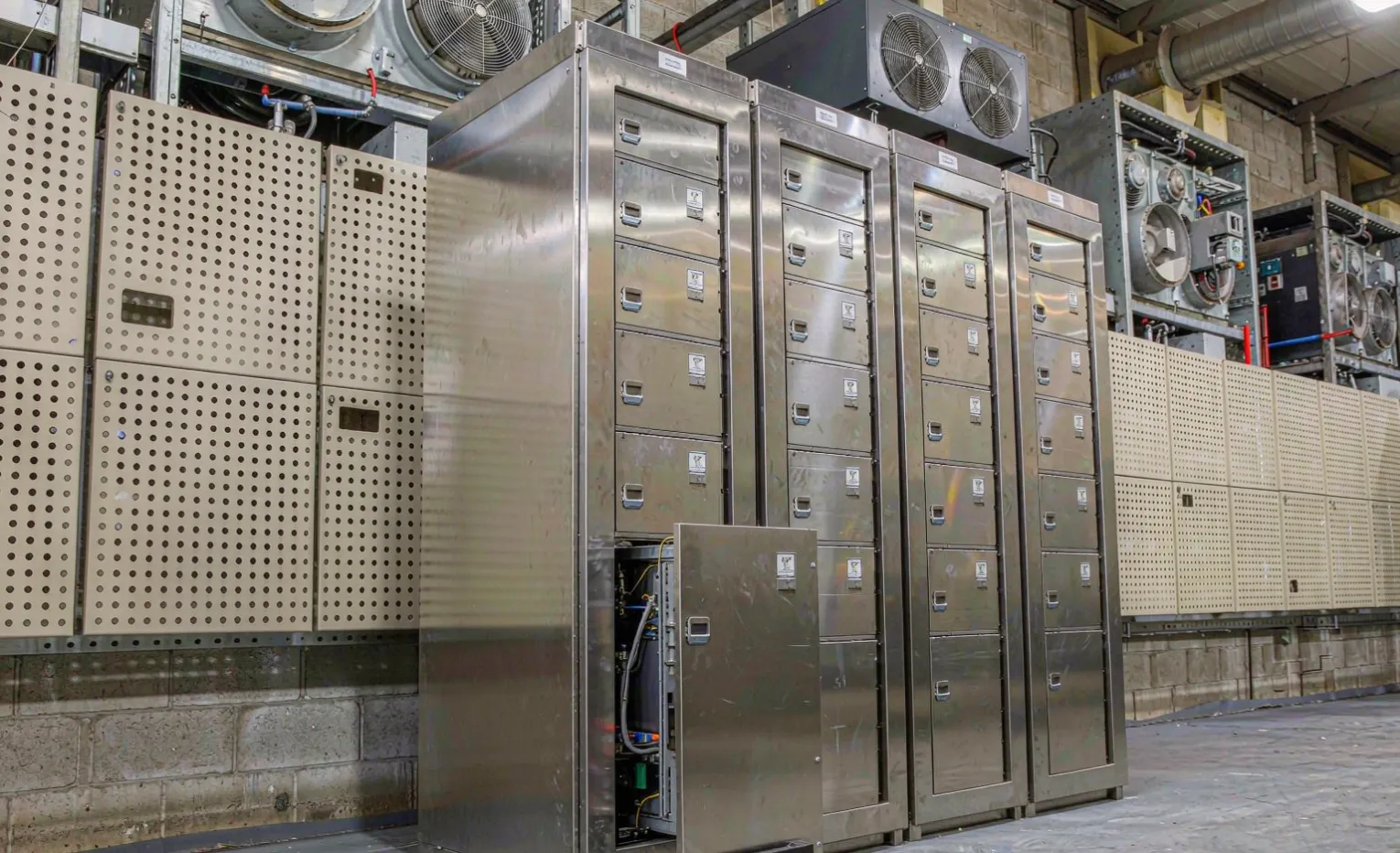
Our guide to the top 10 MCC panel manufacturers in the world ranks the shops that build motor control centers. But once you have picked who builds yours, the spec inside the MCC decides whether your plant runs or stalls: drawout or fixed starter units. Buyers routinely default to one without weighing what the other saves or costs. This is the buyer-side comparison those rankings do not give you.
The whole decision comes down to one trade. A drawout unit lets you pull a failed starter without killing the rest of the bus; a fixed unit welds that capability into a lower price and a smaller footprint. The right call depends on how much a single stopped motor costs you per hour—not on which option sounds more "professional."
What do "drawout" and "fixed" actually mean?
On paper they feed the same motor. In the cabinet they are two different philosophies of failure.
A drawout (or withdrawable) starter mounts the contactor, overload relay, and disconnect on a movable carriage that plugs into the vertical bus through a disconnect and automatic safety shutters. You can rack the whole unit out, and the bus behind it stays isolated and live for the other sections.
A fixed starter bolts and wires those same devices directly to the bus. There is no carriage, no plug, and no shutter. What you gain in simplicity you lose in serviceability: to touch that starter, you de-energize the section.
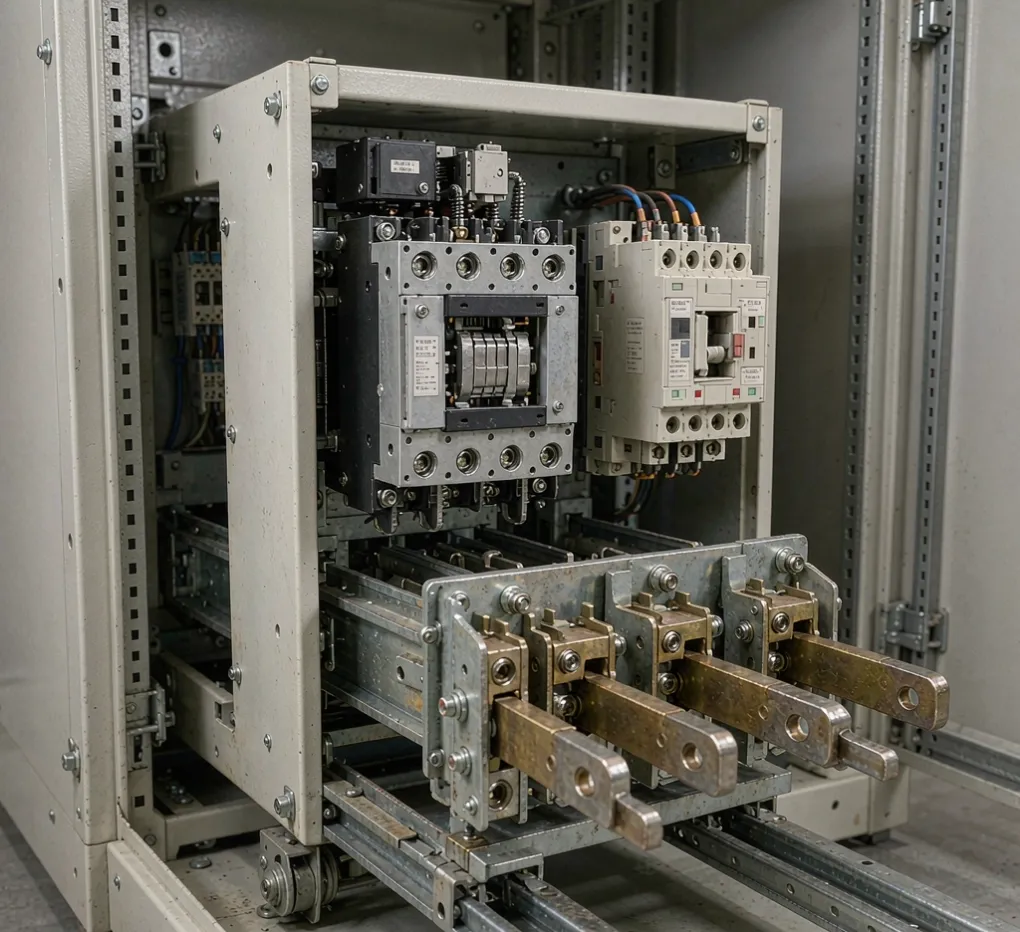
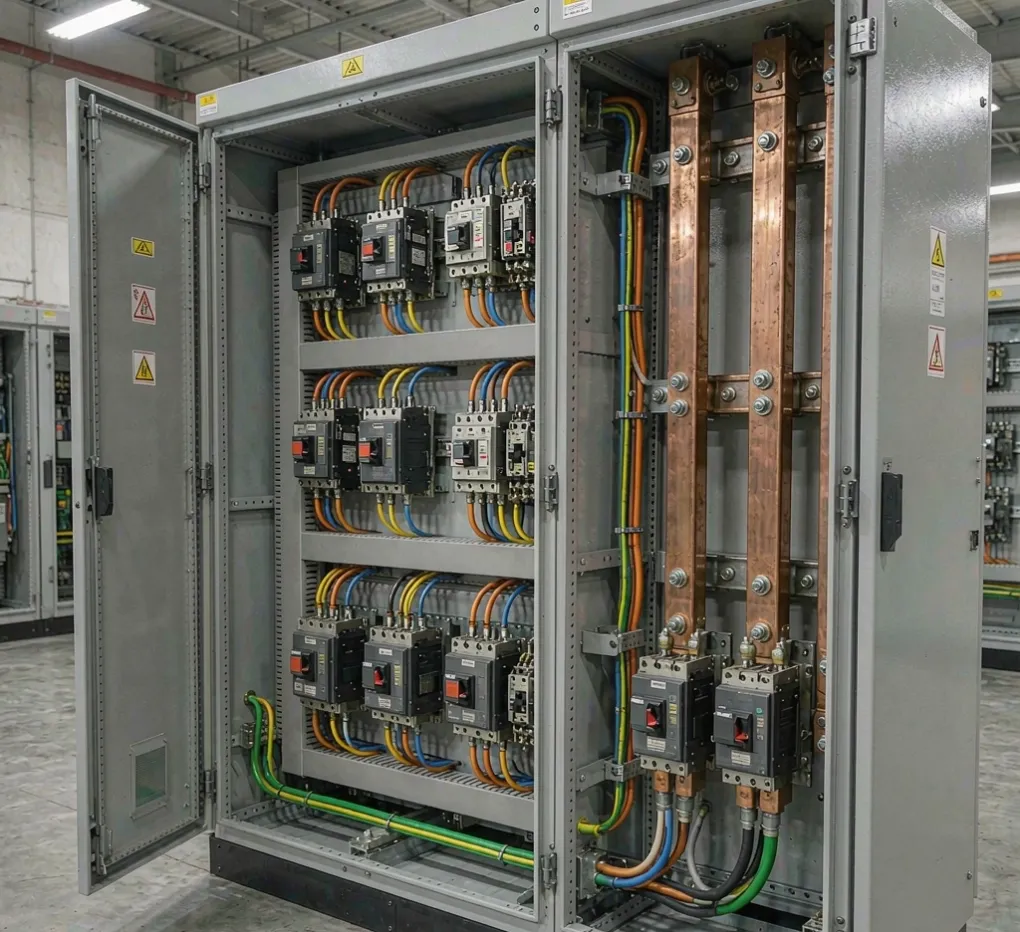
Buyer Decision: If you can tolerate the whole MCC section de-energized while you swap a starter, fixed is the honest, cheap answer. If the motors on that bus feed a continuous process, drawout is the feature you thank yourself for at 2 a.m.
The decision that matters: downtime versus capital
This is the only question that should drive the spec. A drawout section typically runs about 30–60% more per section than a comparable fixed section—the exact gap depends on frame size, form separation, and racking hardware. That premium is not "wasted" if a single stopped motor on that bus costs you more than the premium across the panel's life. On a 24/7 line, a 10-hour unplanned shutdown can dwarf the difference between drawout and fixed across the entire MCC.
The mistake we see most is binary thinking: either every section is drawout (burning capital) or every section is fixed (betting the line on a planned shutdown that never comes). The mature spec is mixed—drawout where the motor cannot go down, fixed everywhere else.
Drawout: what you gain (and what it costs you)
The headline benefit is service without losing the bus. You withdraw the unit, the shutters close behind it, and you work on the starter in an isolated, safe state while the rest of the lineup keeps running. The second benefit is the hot spare: one spare drawout carriage can serve several sections, because you are swapping a self-contained unit rather than rewiring a compartment.
The cost side is real. Drawout sections are deeper (they need racking clearance front and rear), carry more mechanical parts (rails, shutters, interlock), and cost more per section. More parts also means more to wear—though, counterintuitively, drawout is safer to maintain because you never expose the bus to do it.
Drawout and Form separation
Drawout construction makes higher form separation practical. Form separation (defined in IEC 61439-2 for low-voltage assemblies) describes how thoroughly the busbars, functional units, and terminals are physically separated:
- Form 1: no separation.
- Form 2: busbars separated from functional units.
- Form 3: busbars and terminals separated from units.
- Form 4: separation between adjacent units as well.
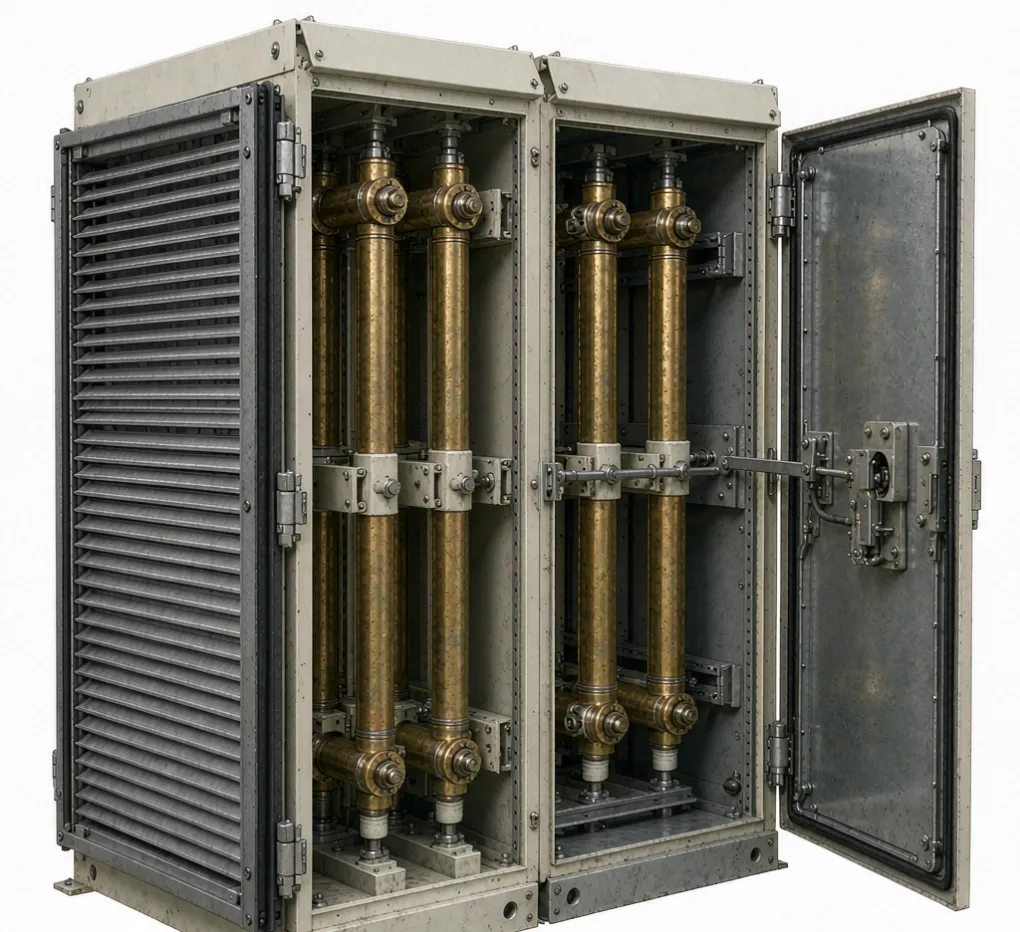
Engineering Note: Form separation is not a marketing label. It is the barrier scheme you can see behind a withdrawn drawout unit, and it is what keeps a fault or a maintenance action in one section from cascading into the next. Fixed construction can reach Form 2 reliably; pushing fixed to Form 4 needs careful, custom barriers. If your risk assessment calls for Form 3 or 4, drawout is the path of least resistance.
Fixed: what you save
Fixed starters trade serviceability for capital and footprint. Per section, they are cheaper, shallower, and mechanically simpler—fewer moving parts means fewer mechanical failure modes. For non-critical motors with planned downtime, fixed is simply the right buy.
The trade-off is rigid: to service a fixed starter, you must de-energize the section (often the whole MCC), and you cannot share a spare carriage across sections—you keep spare contactors and overloads instead, and you rewire in place. That is fine when the motor has a convenient maintenance window. It is a problem when it does not.
Head-to-head comparison
Dimension | Drawout | Fixed |
|---|---|---|
Service a starter | Withdraw unit; bus shutters close; section stays live | De-energize section/whole MCC. |
Spare strategy | One spare carriage serves several sections. | Per-motor spare parts, rewire in place. |
Footprint | Deeper; needs racking clearance | Shallower |
Capital cost | ~30–60% higher per section | Baseline |
Mechanical complexity | Rails, shutters, interlock | Minimal |
Best fit | Critical / continuous-process motors | Non-critical, intermittent duty |
When drawout actually pays for itself
Mixed spec is the goal. Use this to decide per motor, not per lineup:
If this is true | Specify |
|---|---|
A stopped motor costs more than the drawout premium over panel life. | Drawout |
The process is continuous (24/7, no convenient shutdown). | Drawout |
One spare carriage can serve several sections. | Drawout |
Motor is non-critical with planned downtime. | Fixed |
Budget and footprint are tight; duty is light. | Fixed |
Many identical small starters, low consequence of failure | Fixed |
If you cannot answer "How much does an hour of this motor being down cost us?" that gap in your own data is the first thing to close—because it is the only number that justifies the premium.
The standards you will be asked about
The MCC enclosure and bus assembly fall under UL 845 (Motor Control Centers) in North America, while the individual starter units and control sub-panels inside are built to UL 508A. NEMA publishes ICS 2 (controllers) and the MCC product standard that frame the North American context. Internationally, IEC 61439-1 and -2 define assembly and separation requirements. Whatever you specify, get the rating documented and labeled—the mark is only as good as the combination worksheet behind it.
Where a sourcing partner fits
We are a sourcing partner and panel-build service, not an MCC manufacturer and not one of the shops ranked in the guide above. When you send us a motor list and duty profile, we help you decide drawout versus fixed per section, source the starters and protection devices from the lines you already run—Schneider, Siemens, ABB, Mitsubishi, and others—and have the assembly built and documented at a UL-listed shop on a per-order basis.
A few facts that matter when you plan the build:
- Enclosures: carbon steel, 304 or 316 stainless, or galvanized. No aluminum.
- Protection: IP65 as standard; NEMA 4X where the site needs hose-down and corrosion resistance.
- Quantities and lead time: empty enclosures from 5 units (about 15 days); in-stock components typically ship in 3–5 days.
- Compliance: UL listing (UL 845 / UL 508A scope) arranged per order through a UL-listed shop; we document the combination so your label is defensible.
Every assembly we deliver goes through FAT—powering it, running point-to-point checks, and documenting the result before it leaves Foshan. A fault we catch here costs a phone call; the same fault caught in your plant costs a flight.

For the enclosure and rating trade-offs behind the MCC, our electrical enclosure sourcing guide walks through material and rating choices. For the panel build itself, see our custom control panel solutions.
FAQ
Is drawout really worth 30–60% more per section?
Only if a stopped motor on that bus costs you more than the premium over the panel's life. For a critical 24/7 process motor, yes. For a non-critical pump with planned downtime, no—fixed is the honest buy.
Can a fixed MCC be serviced without shutting down the whole lineup?
Not safely. By definition the starter is hard-wired to the bus, so the section must be de-energized to service it. Drawout exists precisely to avoid that.
Do drawout units need more maintenance?
They have more mechanical parts (rails, shutters, racking interlock), so there is slightly more to wear—but they also let you service without ever exposing the bus, which cuts arc-flash exposure. In short, they are safer to maintain.
Can I use one spare drawout carriage for different-size starters?
Only within the same frame size and current rating the carriage is built for. A spare does not fit a larger motor starter; match the frame and rating or keep a second carriage.
Does form separation require drawout construction?
Not strictly, but drawout makes Form 3 and Form 4 far easier to achieve and verify. Fixed can reach Form 2 reliably; pushing fixed to Form 4 needs careful custom barriers.
Which standard covers the MCC assembly versus the starter panel?
The MCC enclosure and bus assembly fall under UL 845 / IEC 61439-2; the individual starter units and control sub-panels inside are built to UL 508A. Both need documented ratings and labels.
Engineering Takeaway
Drawout versus fixed is not "better versus worse" — it is a downtime-versus-capital trade sized to one question: how much does a stopped motor cost you per hour. Specify drawout on the motors that cannot go down and fixed on the rest, document the Form separation you actually need, and you get a panel that costs less over its life without a single weak link. Over-specifying drawout everywhere burns capital; under-specifying it on a critical motor is how a 10-minute fault becomes a 10-hour shutdown.
Related guides
- Top 10 MCC panel manufacturers in the world — the shops that build the MCC behind this decision
- Motor control center buying guide — avoid the rework that fixed-vs-drawout mistakes cause
- Control panel short-circuit current rating guide — the SCCR value that affects both safety and price
- UL 508A control panel suppliers: an export buyer's guide — what a real listing mark does and does not prove
- What is an industrial control panel — the building blocks behind every MCC section
- Electrical enclosure sourcing guide — material and rating trade-offs for the enclosure
Get a per-section drawout/fixed recommendation
Upload your motor list and we will run an engineering review — duty profile, downtime cost, and the compliant build path your MCC needs.
Upload Drawing → Engineering Review → Receive Suggestions