
Oct 6, 2026Buying Guides
Custom Sheet Metal Enclosures: A Buyer's Guide to Drawings, Tolerances & Finishes (2026)
How to buy custom sheet metal enclosures from China — materials, thickness, tolerances, finishes, drawing packages, and what to send suppliers for an accurate quote.
Quick Answer
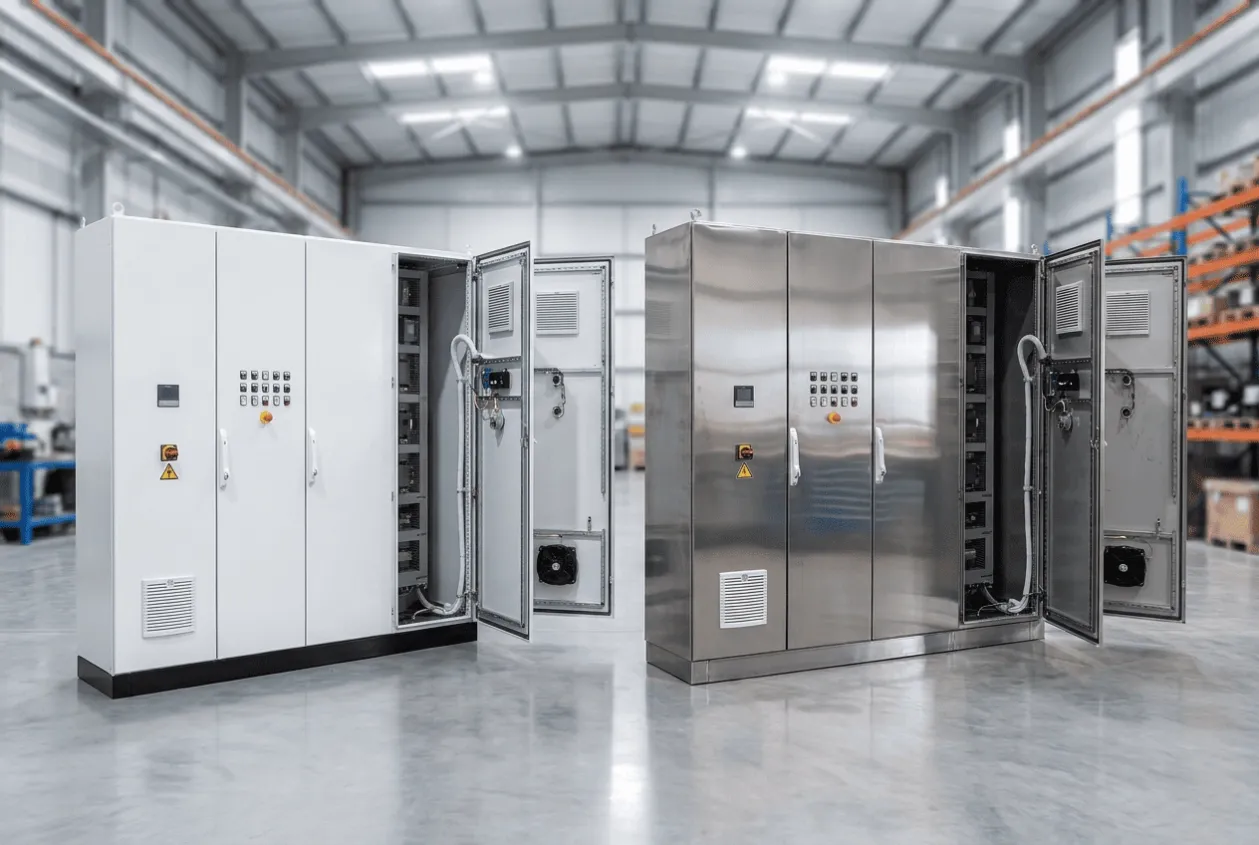
A good custom sheet metal enclosure quote needs five things: material grade and thickness, internal layout and mounting pattern, environmental rating (IP/NEMA), surface finish and coating spec, and annual volume. Send a 2D drawing plus a 3D model if you have one; without them, every quote is a guess.
Buyer Decision: Decide whether the enclosure is a commodity housing or a precision structural part. That determines whether you need a general fabricator or a partner with CNC punching, bending, and coating in one flow.
When a custom enclosure beats a standard catalog box
Catalog enclosures work when your components fit neatly and your cutouts are simple. Custom fabrication wins when:
- Your PCB, VFD, or terminal layout needs a non-standard footprint.
- You need integrated mounting feet, cable glands, hinges, or locks in specific positions.
- The environment demands a coating or material the catalog line does not offer.
- You want your brand color or silkscreen without a separate paint job.
- Annual volume justifies tooling amortization.
Engineering Note: We source carbon steel, 304 stainless, 316 stainless, and galvanized enclosures through Foshan partners. We do not source aluminum enclosures as a standard line; aluminum's galvanic compatibility and structural trade-offs make it a specialty decision rather than a default.
Material choice: carbon steel, stainless, or galvanized
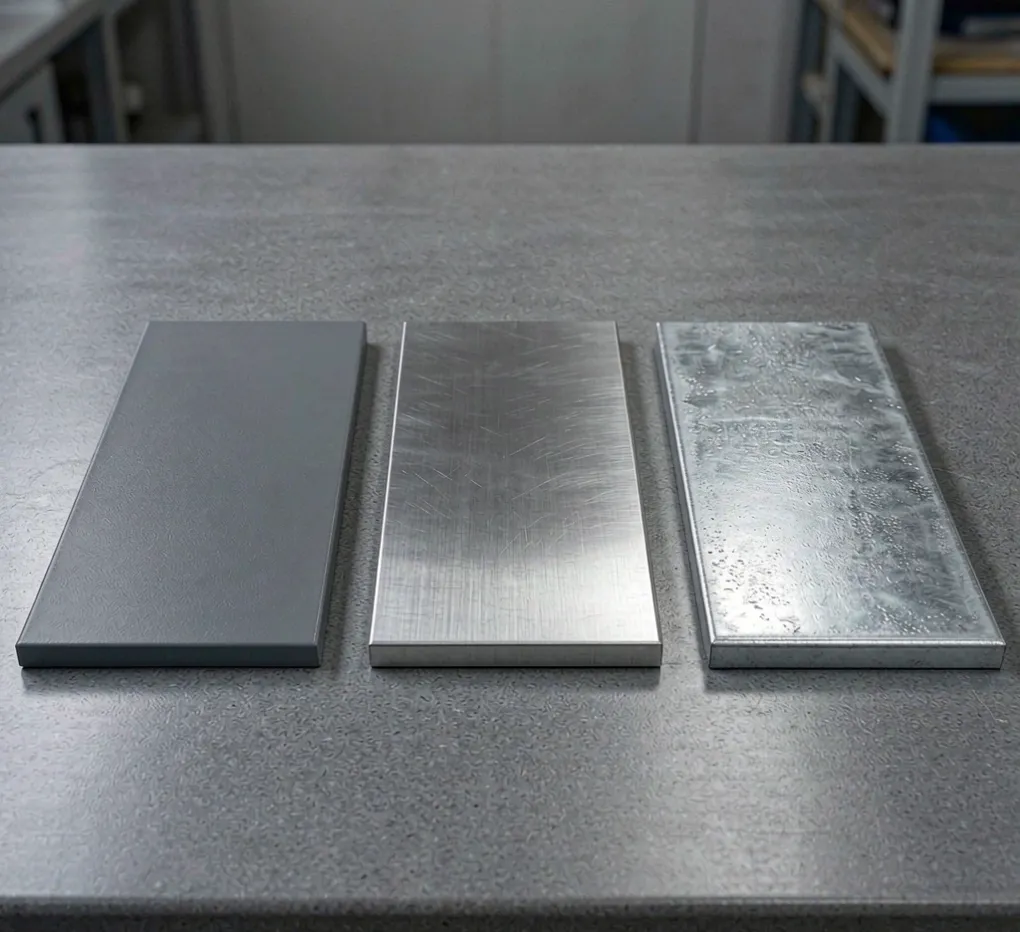
Carbon steel with powder coat
The default for indoor industrial panels. Cost-effective, easy to form, and accepts a wide range of colors.
- Typical thickness: 1.2 mm, 1.5 mm, 2.0 mm.
- Best for: dry plant floors, control rooms, clean-ish environments.
- Weakness: rusts quickly if the coating is damaged or if condensation is present.
304 stainless steel
The workhorse for food, pharma, and moderate outdoor duty.
- Typical thickness: 1.5 mm, 2.0 mm.
- Best for: washdown areas, kitchens, chemical exposure, coastal environments with regular maintenance.
- Weakness: chlorides and salt spray will still pit it over time; 316 is the upgrade.
316 stainless steel
Marine and heavy-chemical grade with added molybdenum.
- Typical thickness: 1.5 mm, 2.0 mm.
- Best for: offshore, coastal, pool environments, and heavy chloride exposure.
- Weakness: significantly higher material cost and longer laser/punch cycle time.
Hot-dip galvanized steel
Zinc-coated carbon steel with sacrificial corrosion protection.
- Typical thickness: 1.5 mm, 2.0 mm, plus zinc layer.
- Best for: outdoor cabinets, telecom boxes, and cost-sensitive projects where stainless is overkill.
- Weakness: cut edges expose bare steel; galvanic compatibility must be checked when mounting dissimilar metals.
Forming process: what actually happens to the sheet
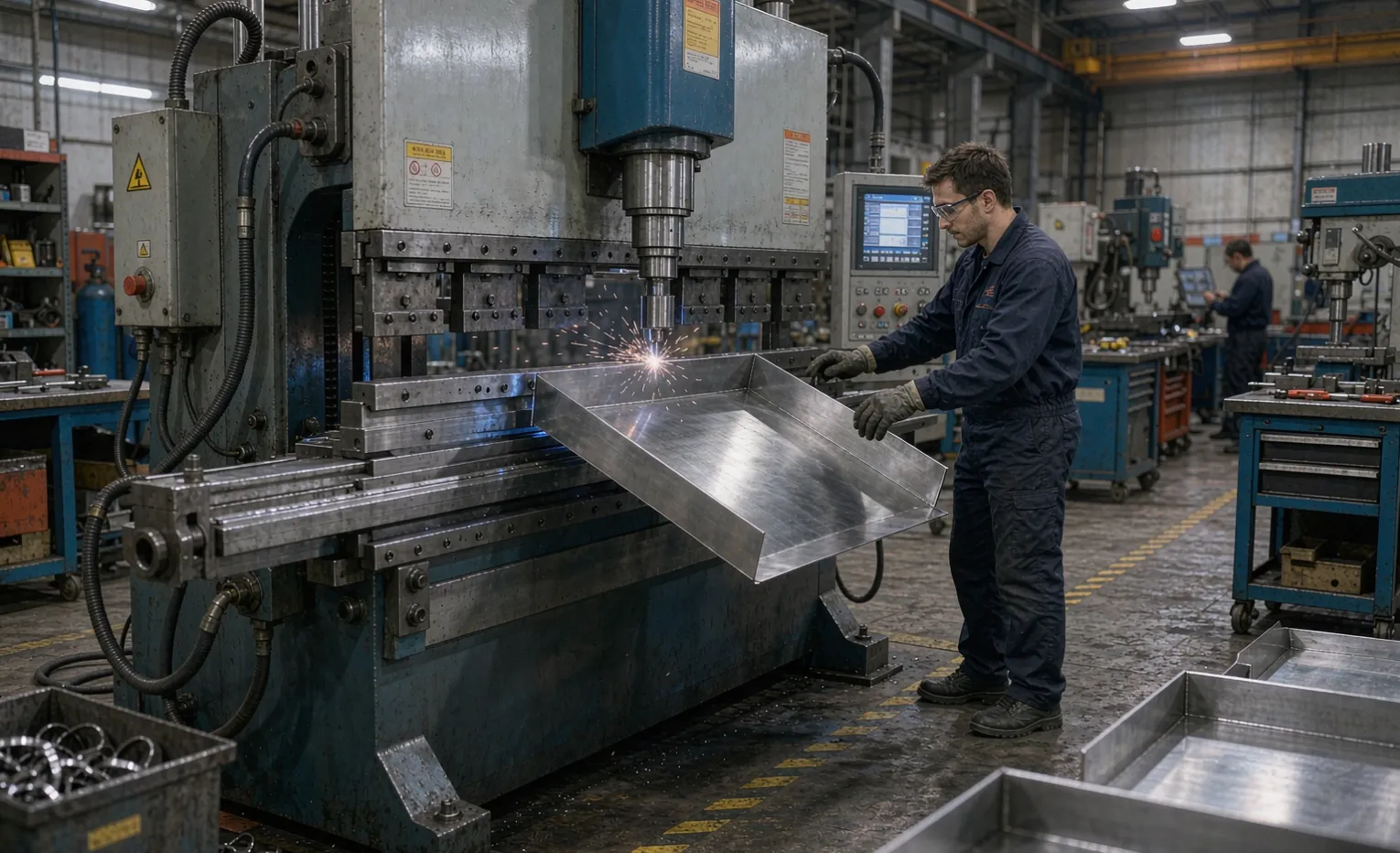
Understanding the basic process helps you write a buildable drawing. Most custom enclosures move through four stations:
1. Cutting
Laser cutting is the default for low-to-medium volume and complex cutouts. It produces clean edges and small kerfs, ideal for gland holes, HMI cutouts, and vent patterns. CNC turret punching is faster and cheaper at higher volumes with simpler hole patterns, but it leaves slight witness marks around holes and is less flexible for organic shapes.
2. Bending
CNC press brakes form the flat pattern into a three-dimensional box. Bend radius, flange length, and bend sequence determine final accuracy. If your design has tight internal corners or overlapping bends, ask the supplier to review bend feasibility before cutting.
3. Welding
MIG welding is common for carbon steel; TIG welding is preferred for stainless to preserve corrosion resistance. Welding distortion is real — long seams can pull a cabinet out of square. Good shops control this with fixturing, stitch-weld sequences, and post-weld straightening.
4. Surface finishing
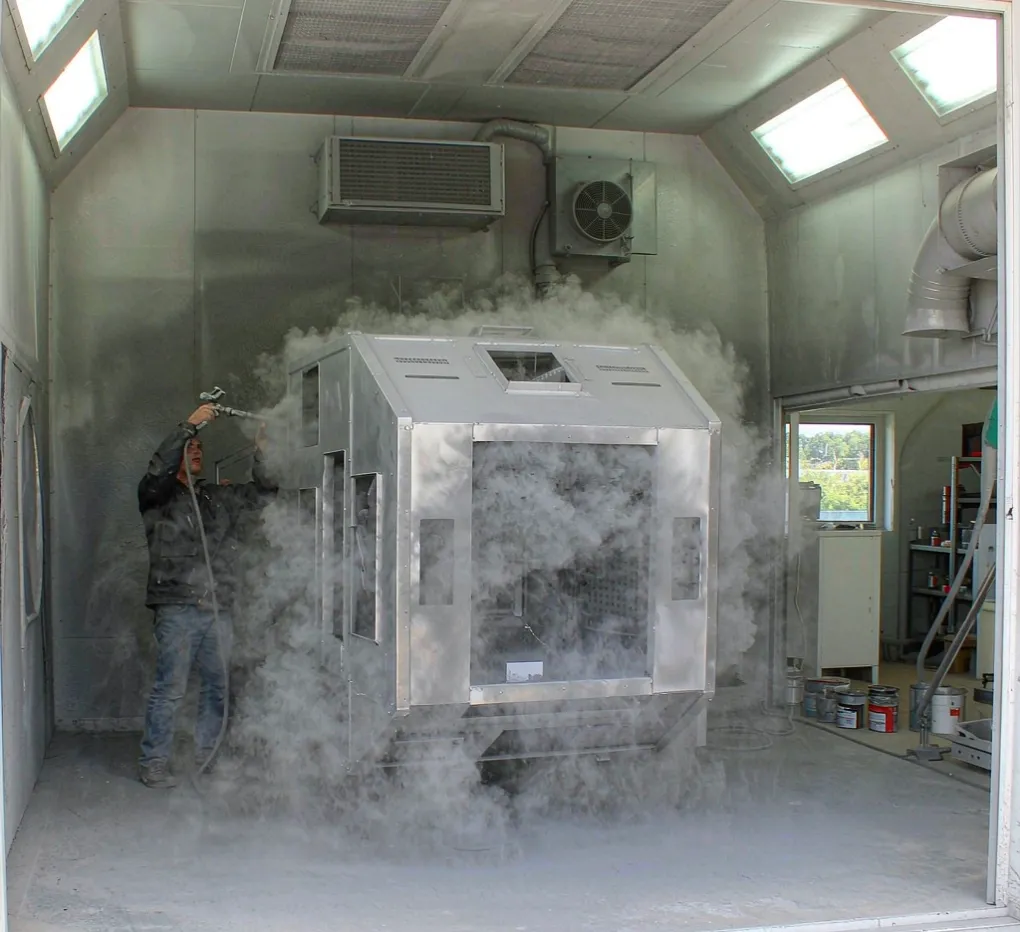
After degreasing and surface preparation, the enclosure receives its coating or passivation. For powder coat, pretreatment usually includes a zinc-phosphate or iron-phosphate conversion coating. For stainless, passivation in nitric or citric acid restores the protective chromium oxide layer.
Wall thickness and structural stiffness
Application | Suggested thickness | Notes |
|---|---|---|
Small wall-mount box (< 400 mm) | 1.2 mm carbon / 1.2 mm stainless | Light duty; watch door sag on wide openings. |
Mid-size floor cabinet | 1.5 mm carbon / 1.5 mm stainless | Standard for most control panels. |
Large floor-standing cabinet (> 800 mm wide) | 2.0 mm carbon / 1.5–2.0 mm stainless | Add internal bracing or door stiffeners. |
Outdoor/transportable cabinet | 2.0 mm minimum | Handles wind load, stacking, and handling stress. |
Engineering Note: Thickness is only half the stiffness story. Bend radius, flange design, and welded braces matter as much as raw gauge. A 1.5 mm box with poor flange design flexes more than a 1.2 mm box with good ribs.
Tolerances you should specify
Unless you state tolerances, the shop will default to its own informal standard. Put these on the drawing:
- Linear dimensions: ±0.5 mm for formed parts, ±0.3 mm for machined cutouts.
- Hole pattern: ±0.2 mm relative to datum for mounting patterns that mate with a PCB or DIN rail.
- Bend angle: ±1° unless the door or lid has a critical seal gap.
- Flatness: 1 mm per 300 mm for mounting surfaces that carry gaskets.
- Coating thickness: 60–80 µm for indoor powder coat, 80–120 µm for outdoor.
Surface finish and coating specs
Powder coating
Most common. Specify RAL color, gloss level, and minimum thickness. Outdoor cabinets should use a UV-stable polyester powder.
Electrogalvanizing / zinc plating
Used on hardware and small parts. Not a substitute for hot-dip galvanizing on the enclosure body.
Passivation (stainless)
Restores the chromium oxide layer after welding and machining. Important for 304 and 316 exposed to moisture.
Painting over galvanized steel
Requires a zinc-phosphate conversion coating or etch primer; otherwise paint peels. Specify the full pretreatment chain.
Cutouts, hardware, and accessories
Before quoting, decide on:
- Cable entry: knockout holes, threaded glands, or open cutouts with grommets.
- Ventilation: louvered vents, filters, fans, or sealed air-conditioning cutouts.
- Door hardware: quarter-turn locks, swing handles, padlock hasps, concealed hinges.
- Mounting: wall brackets, floor stands, pole clamps, or casters.
- Sealing: gasket material (EPDM, silicone, PU foam) and IP/NEMA rating target.
- Internal fittings: DIN rail, mounting plates, equipment rails, grounding studs.
The drawing package suppliers actually need
- 3D model (STEP or IGES): Shows overall form and fit.
- 2D fabrication drawing: Bends, dimensions, tolerances, hole callouts, material spec.
- Cutout detail drawing: Position and size of every gland, fan, HMI, or breaker cutout.
- Surface finish note: Coating type, color, thickness, pretreatment.
- BOM or hardware list: Locks, hinges, gaskets, fasteners, and whether you supply them.
- Quantity and delivery schedule: First article, pilot run, and annual forecast.
Buyer Decision: If you only have a sketch, expect a longer RFQ cycle and a first-article charge. A complete drawing package typically cuts quoting time from two weeks to three days.
Prototyping vs. production
Phase | Quantity | Goal | Typical lead time |
|---|---|---|---|
First article | 1–3 | Validate fit, finish, and dimensions. | 10–15 days |
Pilot run | 5–20 | Verify process stability and supplier quality. | 15–25 days |
Production | 50+ | Optimize tooling and unit cost. | 20–40 days |
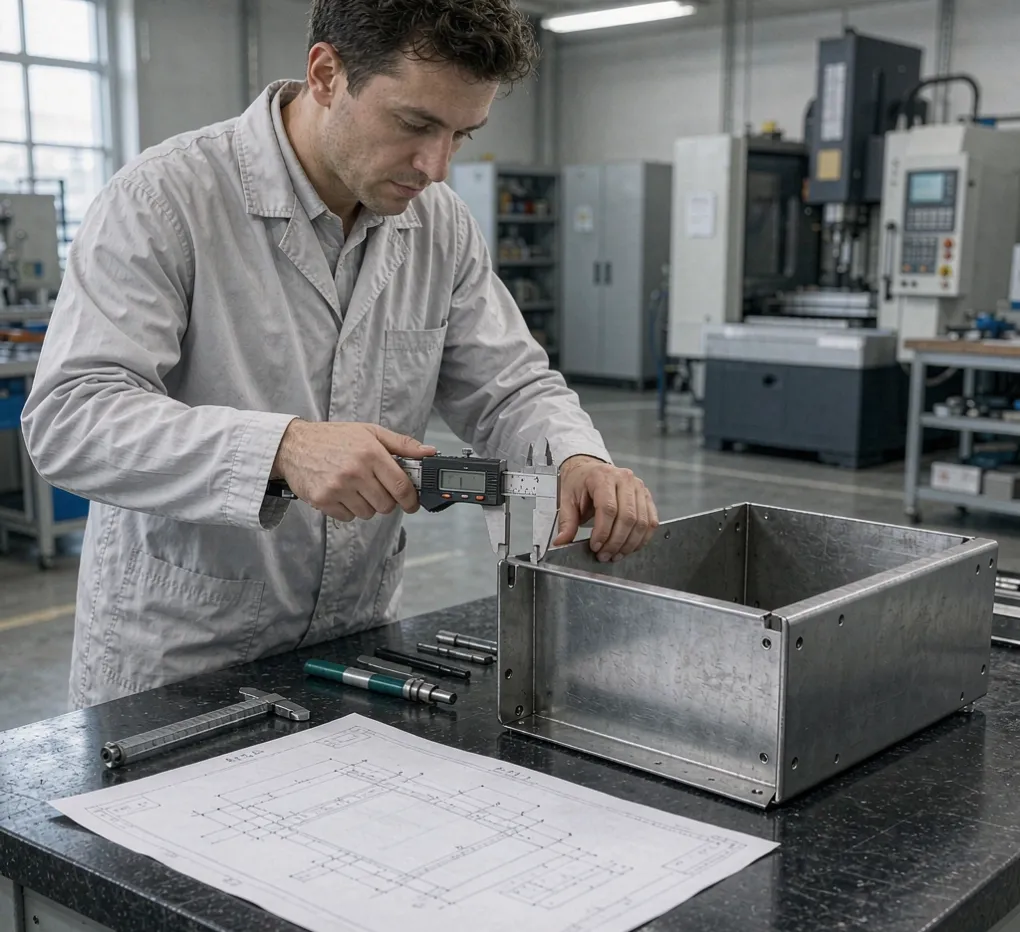
Incoming inspection and first-article checklist
When the first articles arrive, inspect in this order:
- Dimensional report: Compare critical dimensions to the drawing. Pay special attention to mounting-hole patterns and door-gap uniformity.
- Coating thickness: Use a dry-film thickness gauge on multiple faces. Check edges and corners where coating is thinnest.
- Adhesion test: Tape test (ASTM D3359) on a coated sample to confirm the finish does not flake.
- Squareness and flatness: Place the cabinet on a flat surface and measure diagonal differences. A skewed cabinet is hard to seal and harder to mount.
- Hardware fit: Check that locks, hinges, and gaskets fit without forcing. Threaded inserts should accept fasteners cleanly.
- Salt-spray or humidity record: For outdoor or stainless enclosures, request the supplier's test report for the coating or passivation batch.
Engineering Note: UL and IEC enclosure standards focus on safety and performance, not cosmetic perfection. Agree with the supplier on acceptable cosmetic limits before the first article to avoid disputes. For NEMA definitions, refer to NEMA.
Common mistakes buyers make
- Forgetting thermal expansion. Large outdoor cabinets need expansion slots or flexible gasket design.
- Specifying aluminum hardware on stainless doors. Galvanic corrosion will seize the hardware.
- Ignoring IP rating at cutouts. Every gland and vent is a potential leak path.
- Using indoor powder coat outdoors. UV degradation and chalking appear within a year.
- Ordering without a first article. Dimensions that look fine on paper can be off by millimeters in formed steel.
Decision table: which material for which environment?
Environment | Recommended material | Coating/finish | Notes |
|---|---|---|---|
Clean indoor plant | Carbon steel | Powder coat, 60–80 µm | Cost-optimized standard. |
Washdown / food adjacent | 304 stainless | Passivated, #4 brush | Resists frequent cleaning chemicals. |
Coastal / marine | 316 stainless | Passivated | Chloride resistance; highest material cost. |
Outdoor telecom / utility | Hot-dip galvanized | Optional topcoat | Sacrificial zinc protection; inspect edges. |
Heavy chemical exposure | 316 stainless or FRP alternative | Passivated or special coat | Evaluate galvanic pairs carefully. |
Frequently asked questions
What is the minimum order for a custom sheet metal enclosure? Prototype quantities start at 1–3 units. Production minimums vary by complexity; simple boxes often start at 50 units, while custom panels can run in lots of 5 through a coordinated partner.
How thick should an outdoor electrical enclosure be? For outdoor cabinets exposed to wind, handling, or transport, 2.0 mm carbon steel or 1.5–2.0 mm stainless is typical. Thickness alone does not replace proper bracing and gasket design.
Can I get a UL-listed custom enclosure? Yes, but UL listing is per design and often per production facility. We route UL-listed builds through vetted partners and document the listing for that order.
What is the difference between IP65 and NEMA 4X? IP65 and NEMA 4X are roughly comparable for dust and water, but NEMA 4X also includes corrosion resistance. Material and gasket choice matter more than the label.
Should I supply my own locks and hinges? You can, but most Foshan shops stock standard industrial hardware. Supplying your own adds logistics risk; letting the shop source standard items usually simplifies warranty and replacement.
How do I prevent rust at cut edges on galvanized enclosures? Specify edge sealing, touch-up paint, or design with folded edges that hide the cut. For critical outdoor duty, move to stainless or specify post-galvanizing touch-up.
Packaging and shipping for sheet metal cabinets
Sheet metal cabinets arrive dented when buyers underestimate shipping. Specify:
- Internal bracing: Cardboard, foam, or wood supports to prevent door sag and panel flex.
- Edge and corner protection: Especially for powder-coated carbon steel; chips expose bare metal.
- Desiccant: Required for ocean freight to prevent condensation inside the cabinet during transit.
- Pallet or skid: Large floor-standing cabinets must ship on a pallet, not loose.
- Drawing and hardware kit: Include one copy of the approved drawing and a bagged hardware kit inside the cabinet.
Real business fact: We typically allow 3–5 days for component shipment and 10–15 days for custom enclosure fabrication after drawing approval. Combining component and enclosure logistics into one shipment is one of the main reasons buyers use a sourcing partner. For urgent prototypes, we can sometimes parallel-track component sourcing and enclosure fabrication to compress the total cycle.
Engineering takeaway
Custom sheet metal enclosure buying is a drawing-and-spec game. The supplier cannot quote accurately from a description, and the buyer cannot inspect quality without tolerances. Lead with material, thickness, IP/NEMA target, and finish. Add a complete drawing package, a first-article plan, and a clear annual volume. That package separates a smooth build from a string of rework loops.
Related guides
Get a buildable quote
Send your drawing, material preference, and IP/NEMA target. We'll check manufacturability, match the build to a vetted Foshan fabricator, and return a quote with lead time.
Need help specifying or sourcing this for your project? Request a quote - we reply within 1-2 working days with a technical review.