Jul 10, 2026Case Studies
When a PLC Migration Does More Than Replace Hardware
PLC and VFD migration for a chemical water treatment plant, replacing aging control hardware with a more maintainable platform to improve diagnostics, spare support, and reliability.
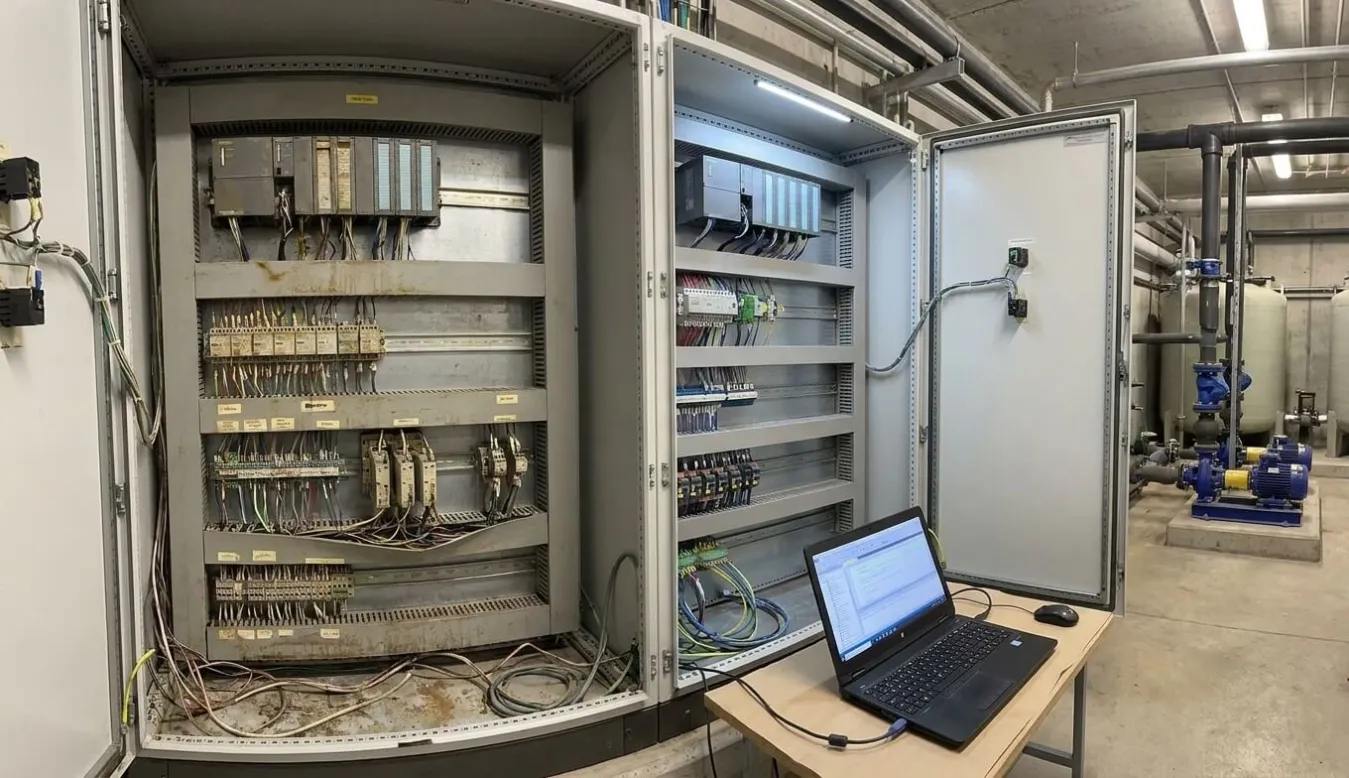
When a PLC Migration Does More Than Replace Hardware—Restoring Maintenance Confidence in a Chemical Water Treatment Plant
A water treatment control system can become risky long before it completely fails. The PLC still runs, the VFD still starts, and operators still manage the process, but every fault takes longer to understand. This case documents how a PLC and VFD migration improved maintainability, diagnostics, and long-term support for a chemical water treatment plant.
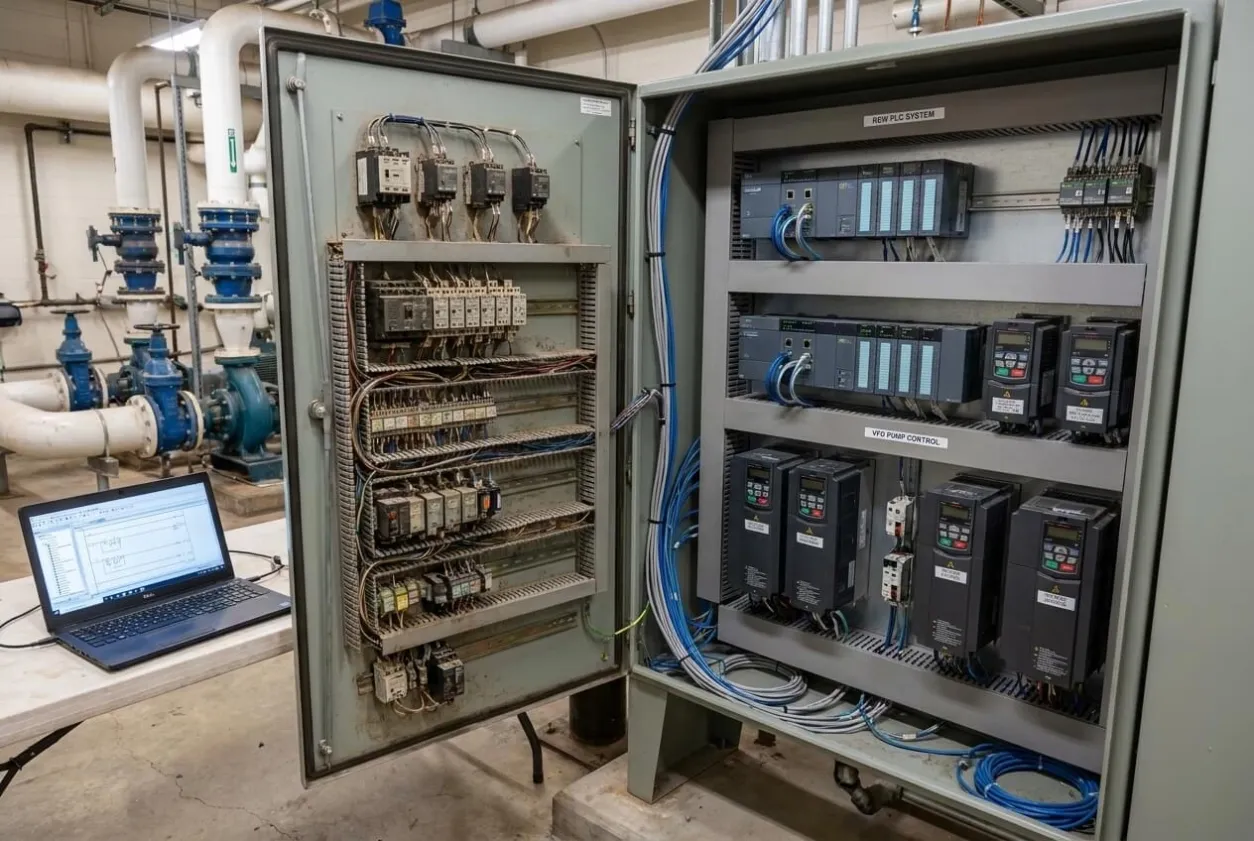
Project Snapshot
Item | Description |
|---|---|
Industry | Water Treatment / Industrial Utilities |
Application | Physical and chemical water treatment automation |
Project Type | PLC and VFD migration, control panel modification, commissioning |
Location | Confidential |
Original Platform | Panasonic PLC, Schneider Altivar ATV71 VFD |
New Platform | Mitsubishi MELSEC iQ-F FX5 Series PLC, Mitsubishi FR-CS80 VFD |
Process Scope | Physical/chemical treatment, sulfide oxidation, filter press sludge treatment, chromium precipitation |
Services | PLC program migration, logic optimization, HMI adaptation, electrical cabinet modification, field testing |
Result | Modernized control system with improved diagnostics, spare strategy, and long-term maintainability |
Project Overview
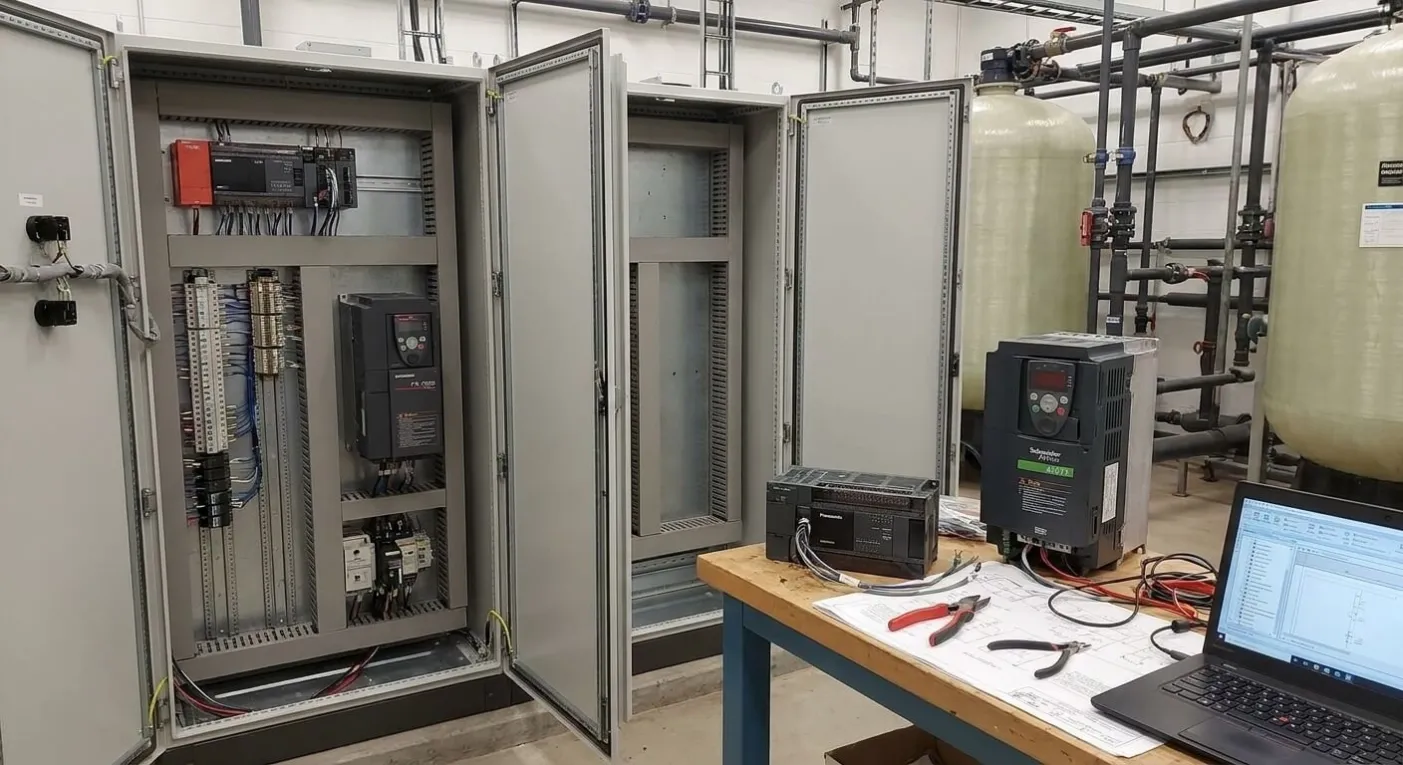
This project involved the modernization of a water treatment plant automation system. The original system used a Panasonic PLC and a Schneider Altivar ATV71 VFD. The migration replaced them with a Mitsubishi MELSEC iQ-F FX5 Series PLC and a Mitsubishi FR-CS80 variable frequency drive.
The plant controlled physical and chemical water treatment, sulfide oxidation, filter press sludge treatment, and chromium precipitation. These processes are not forgiving when the control system becomes unclear. A delayed response, a missing feedback signal, or an alarm that does not explain the real cause can affect water quality, sludge handling, and operator confidence.
The old control system was still working, which made the decision more difficult. Nobody was standing beside a dead PLC asking for emergency replacement. The situation was quieter than that. The system continued to run, but the people responsible for keeping it alive were becoming less comfortable with it.
That is often where real modernization begins.
The maintenance team could feel the support risk growing. Spare parts were not as predictable as before. Fault diagnosis took more time than it should. The old HMI and control logic still carried the process, but they did not give enough help when something went wrong.
The project was not only about replacing hardware. It was about moving the plant to a platform that the site team could understand, maintain, and support with more confidence.
Customer Challenge
From the customer’s side, the concern was practical and familiar to many plants with aging automation systems.
The control system had not completely failed, so it was easy to postpone the migration. At the same time, every maintenance event carried more pressure than before. When a fault appeared, the team had to spend time confirming whether the issue came from the PLC, the VFD, the field device, the wiring, or the process sequence itself.
That kind of uncertainty is exhausting on site.
Operators do not want to stand in front of an HMI and guess why a process step is blocked. Maintenance technicians do not want to open a cabinet and find years of wiring changes that are hard to trace. Plant managers do not want to discover during a breakdown that the spare part lead time is now part of the operating risk.
The customer needed the migration to preserve the process behavior that already worked while removing the weak points that made future support difficult. The new PLC had to carry the original process intent. The new VFD had to match the actual field application. The HMI had to become clearer for operators. The cabinet modifications had to make sense for the next technician, not only for the commissioning day.
The painful point was not the first startup after migration. It was the next fault after handover.
A modernization project only has value if the plant becomes easier to support when nobody from the project team is standing beside the panel.
Engineering Review
The engineering review started with one rule: migration should not be treated as copying.
The old Panasonic PLC program was reviewed to understand the process intent before it was rebuilt on the Mitsubishi FX5 platform. This mattered because the controlled processes were not simple start-stop duties. Sulfide oxidation, chromium precipitation, and filter press sludge treatment all depend on correct sequencing, interlocks, timing, and operator visibility.
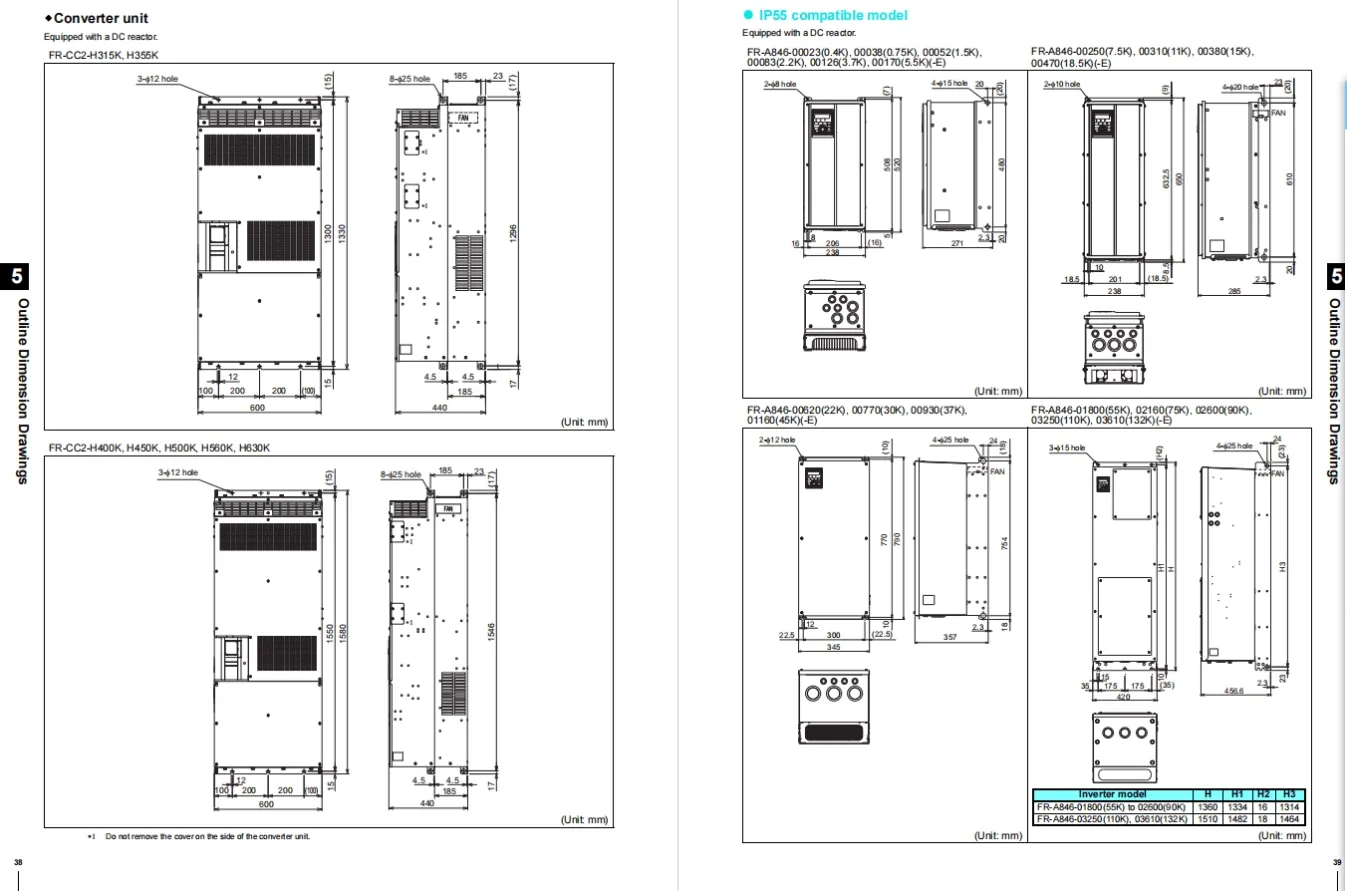
The VFD migration also needed careful review. A Schneider Altivar ATV71 and a Mitsubishi FR-CS80 do not behave identically just because they both control a motor. Terminal behavior, parameter structure, fault feedback, acceleration settings, and control response had to be checked against the real process.
Review Item | Engineering Question | Risk if Ignored |
|---|---|---|
PLC program migration | Does the new FX5 logic preserve the required process behavior? | Sequence failure or unsafe operation |
Logic optimization | Can the old logic be made clearer without changing process intent? | Old problems copied into the new system |
HMI adaptation | Can operators understand the process screens quickly after migration? | Slow response during faults |
VFD replacement | Do FR-CS80 parameters and signals match the application? | Drive fault, poor response, or failed startup |
Field wiring | Are existing signals correctly mapped to the new PLC? | Wrong I/O behavior during commissioning |
Cabinet modification | Are wiring changes traceable and serviceable? | Future troubleshooting difficulty |
Filter press control | Are interlocks and sequence steps verified? | Sludge handling interruption |
Chemical process logic | Are oxidation and precipitation steps protected? | Process quality risk |
Alarm handling | Do alarms explain the cause of stoppage? | Operator confusion |
Commissioning test | Is real field behavior checked, not only software simulation? | Site startup delays |
When Should You Consider This Migration?
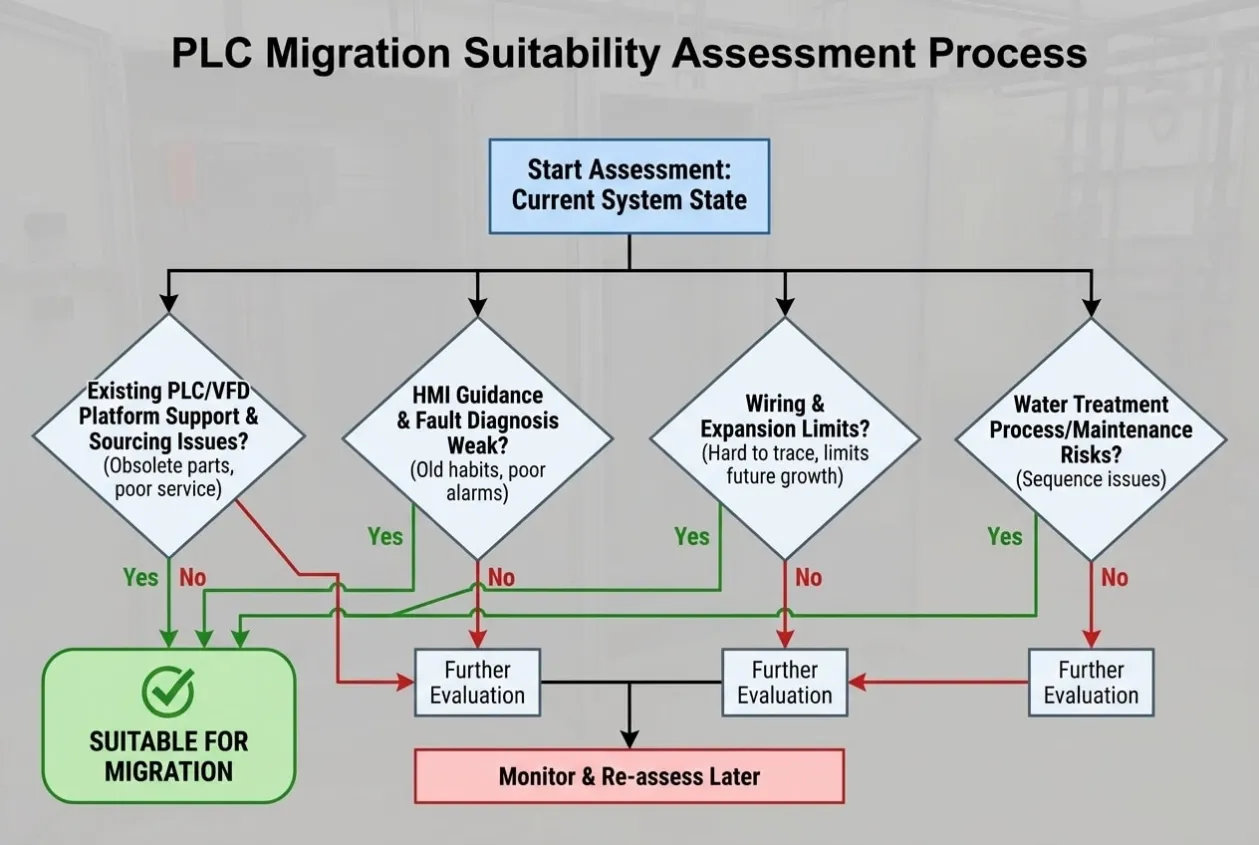
A PLC and VFD migration should be considered when the system is still running but no longer feels easy to support.
This approach may be suitable if:
✓ The existing PLC platform is becoming difficult to source or support.
✓ VFD spare parts or service support is becoming less predictable.
✓ Operators depend on old habits instead of clear HMI guidance.
✓ Fault diagnosis takes too long because alarm information is weak.
✓ Cabinet wiring has been modified many times and is hard to trace.
✓ The plant needs future expansion, but the old platform limits it.
✓ Water treatment sequence issues are creating process or maintenance risk.
For buyers, this is the important point. Migration is not only about replacing obsolete hardware. It is about reducing the risk of being trapped by an old control system when the plant needs fast recovery.
Critical Engineering Decision
The turning point came when we decided not to treat the project as a direct brand replacement.
At first, the migration could have been approached in a simple way. Replace the Panasonic PLC with a Mitsubishi FX5, replace the ATV71 with an FR-CS80, convert the program, adapt the HMI, and test the system. On paper, that would have looked efficient.
But the plant was not only running motors and valves. It was controlling chemical treatment, sludge handling, and precipitation. If the old logic contained unclear sequences, weak alarms, or operator workarounds, copying everything directly would only move those weaknesses into a newer PLC.
That was the moment the discussion changed.
The question changed from “Can we migrate the program?” to “Can we make the system easier to diagnose after migration?”
That decision changed the work. We reviewed the old logic before rebuilding it. We checked how the VFD was used in the process instead of only matching terminals. We adapted the HMI so operators could follow status and alarms with less uncertainty. Cabinet modifications were made with the next maintenance activity in mind, not only the commissioning checklist.
Question | Direct Replacement | Engineered Migration |
|---|---|---|
PLC Logic | Copies old behavior as closely as possible. | Preserves process intent while improving structure and readability. |
VFD Replacement | Matches basic start-stop function. | Reviews parameters, feedback, fault behavior, and field control needs. |
HMI Update | Recreates existing screens with new tags. | Improves operator understanding and alarm visibility. |
Cabinet Work | Focuses on completing the wiring. | Focuses on traceability, labeling, and future troubleshooting. |
Commissioning | Confirms equipment can run. | Confirms the process can be operated and diagnosed confidently. |
Long-Term Value | Replaces obsolete hardware. | Reduces maintenance risk and improves supportability. |
This decision added engineering effort, but it reduced customer risk. The goal was not only to make the new PLC run the plant. The goal was to make the plant easier to understand after the migration.
That is the difference between replacement and modernization.
Solution Delivered
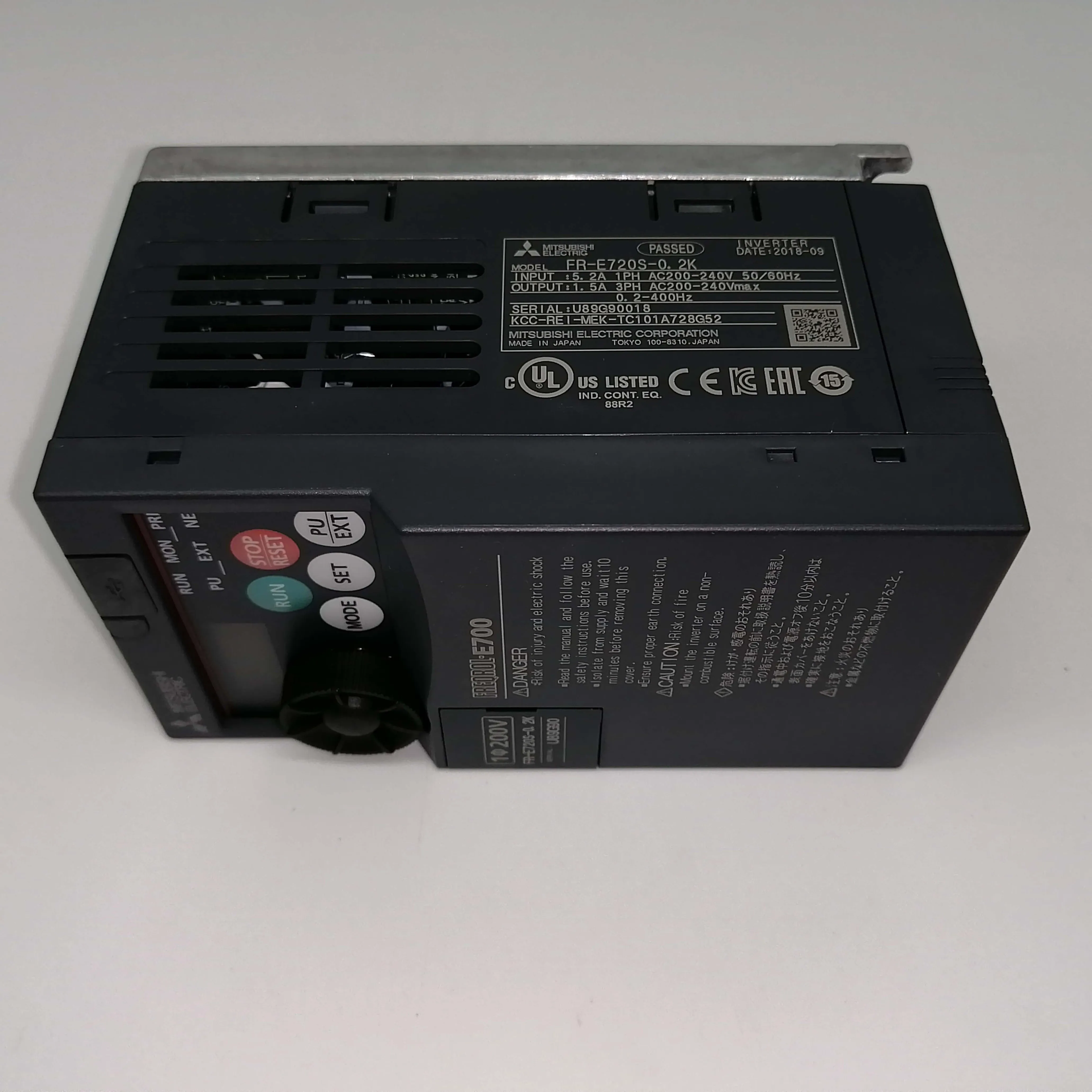
The final solution included migration to a Mitsubishi MELSEC iQ-F FX5 Series PLC[^1], replacement of the existing VFD with a Mitsubishi FR-CS80[^2], HMI adaptation, electrical cabinet modification, field wiring checks, and commissioning.
The PLC program migration[^3] was completed and optimized to support the required water treatment process[^7]. The process intent was preserved, but the logic structure was made clearer so future troubleshooting would not depend only on the person who wrote the program.
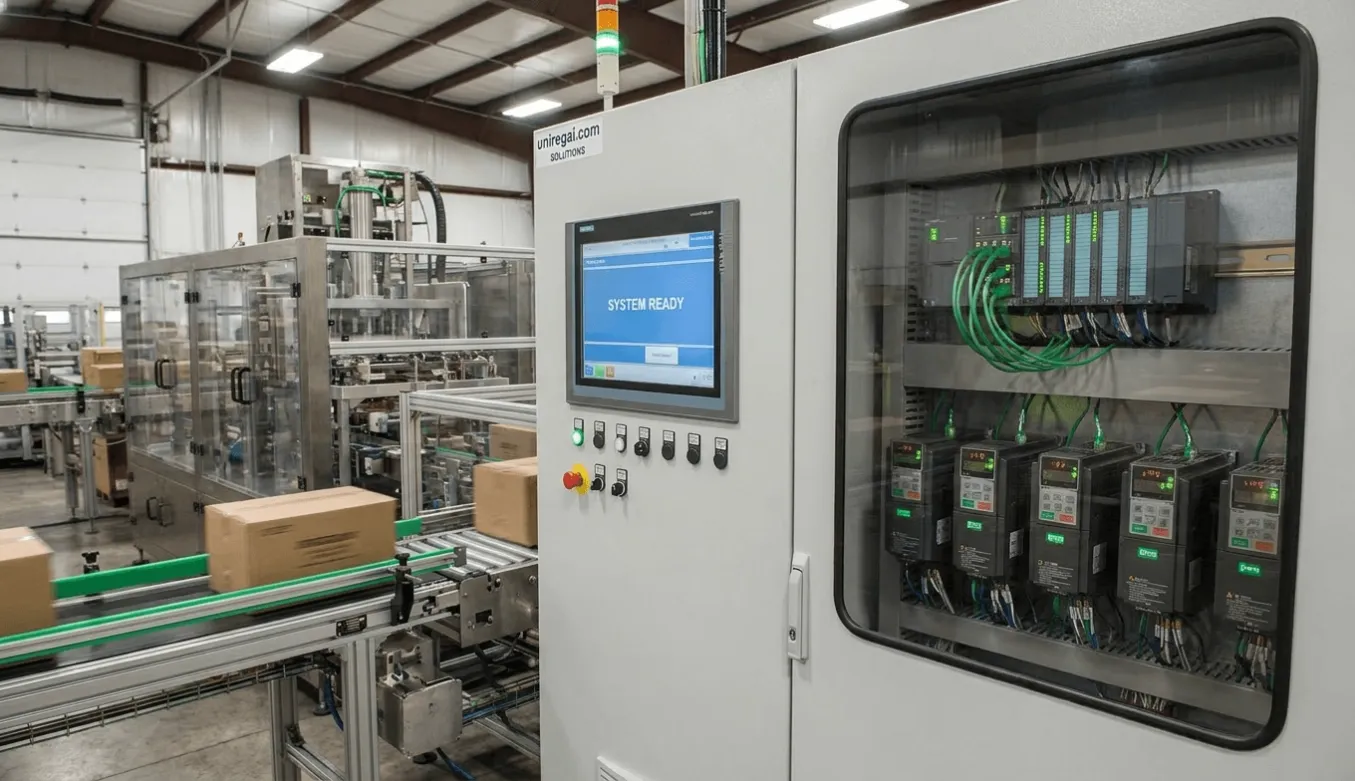
The HMI[^4] was adapted to the new PLC structure. Operator screens were reviewed so equipment status, alarms, and process conditions could be understood more clearly during operation. In a water treatment plant, the HMI should not only show that something is stopped. It should help the operator understand why it is stopped.
The FR-CS80 VFD[⁶] was integrated according to the actual process requirement. Parameters, command logic, fault feedback, and field signals were checked during commissioning[^5] so the new drive would not simply be a physical replacement for the old one.
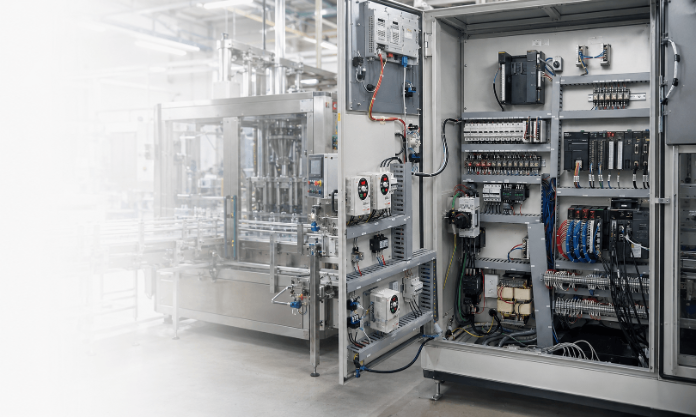
The electrical cabinet was modified to support the new PLC and VFD arrangement. Wiring, terminals, control power, layout, and labeling were reviewed so the customer would not inherit a cabinet that worked on day one but became difficult to maintain later.
The final system controlled the main treatment areas, including physical and chemical treatment, sulfide oxidation, filter press sludge treatment, and chromium precipitation.
Before Shipment Verification
Before commissioning and handover, the system went through checks focused on migration accuracy and field reliability.
Verification Activity | Why It Mattered |
|---|---|
Old program review | Identified process behavior that had to be preserved |
PLC migration check | Confirmed the new FX5 logic matched required operation |
Logic optimization review | Improved readability without changing process intent |
HMI tag verification | Confirmed screen data matched PLC signals |
VFD parameter review | Matched FR-CS80 settings to process requirements |
Field I/O test | Confirmed inputs and outputs matched real devices |
Cabinet wiring inspection | Checked wiring changes, terminals, labels, and routing |
Interlock testing | Verified unsafe or incorrect operation would be blocked |
Alarm simulation | Confirmed alarms appeared with useful meaning |
Filter press sequence test | Checked sludge treatment control behavior |
Chemical process logic test | Confirmed oxidation and precipitation steps followed intended logic |
Final field testing | Verified real plant response before acceptance |
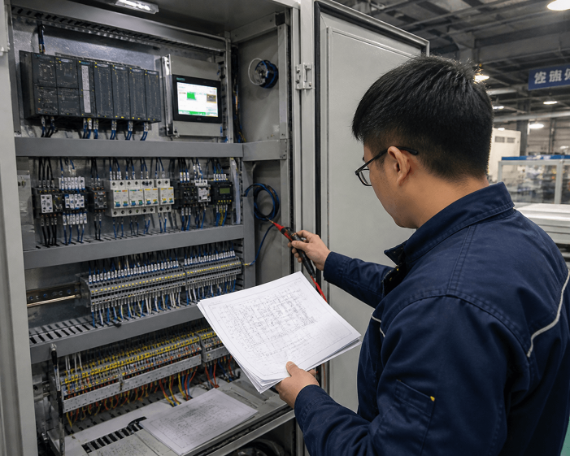
The most important verification was field I/O testing. During migration, old wiring and new logic meet each other, and that is where small mistakes appear. A signal may be named correctly but wired differently. A terminal may have been modified years earlier. A field device may behave differently from the drawing.
The VFD test was also important because drive replacement is rarely just a parameter copy. The new drive had to be checked for command behavior, acceleration, deceleration, fault response, and feedback signals.
The system was not accepted because the PLC program compiled. It was accepted after the control logic, HMI, VFD, cabinet wiring, and field devices were tested together.
Project Results
The water treatment automation system was successfully modernized and commissioned.
The project delivered a PLC platform migration from Panasonic to Mitsubishi MELSEC iQ-F FX5, a VFD migration from Schneider Altivar ATV71 to Mitsubishi FR-CS80, HMI adaptation, cabinet modification, field testing, and commissioning across four process areas: physical and chemical treatment, sulfide oxidation, filter press sludge treatment, and chromium precipitation.
The numbers were useful for the record, but the real result was visible in how the site team interacted with the system after migration.
Operators no longer had to rely only on memory to understand how the process was moving through its sequence. When a process step was blocked, the improved control structure and HMI adaptation gave them a clearer starting point for diagnosis. Maintenance personnel had a more supportable PLC platform, a current VFD solution, and cabinet wiring that was easier to trace.
The customer also gained a better spare strategy. Instead of carrying the risk of aging automation hardware, the plant moved to a platform with stronger long-term availability and better room for future expansion.
The strongest result was that the project changed the conversation. Before migration, the site team was asking how long the old system could continue. After commissioning, they could talk about maintenance planning and future improvements with less uncertainty.
For a water treatment plant, that is the value of modernization. It does not only replace hardware. It reduces the fear of the next fault.
Engineering Notes from Natalie
PLC migration projects can be deceptive.
From outside, they look like a hardware upgrade. Change the controller, replace the drive, update the software, and commission the panel. On site, the work feels different because the old system carries years of process knowledge. Some of that knowledge is in the program. Some are in the wiring. Some are only in the operator’s memory.
That is why I do not like blind conversion.
If we copy everything without review, we may copy the problems too. If we redesign too aggressively, we may lose behavior the plant depends on. The right balance is to preserve process intent while making the new system clearer and easier to support.
This project reminded me that modernization should respect the old system but not be trapped by it.
Good migration does not only change the PLC. It changes how confidently the plant can be maintained.
Lessons Learned
When should a PLC migration be planned?
A PLC migration should be planned when spare parts, diagnostics, software support, or future expansion are becoming difficult. Waiting for full failure usually increases downtime risk.
Is PLC migration only a software conversion?
No. It includes logic review, I/O verification, HMI adaptation, cabinet modification, field testing, and process validation.
Why should old logic be reviewed before migration?
Old logic may contain workarounds, unclear sequences, or outdated assumptions. Migration is a chance to preserve process intent while improving maintainability.
What is the main risk when replacing a VFD?
The new VFD may not behave exactly like the old one. Parameters, fault feedback, control terminals, acceleration, deceleration, and interlocks must be verified.
Why is HMI adaptation important?
Operators need to understand the process after migration. A new PLC with unclear HMI screens still creates operating risk.
What should be verified before handover?
PLC logic, HMI tags, VFD behavior, cabinet wiring, field I/O, alarms, interlocks, and process sequences should be tested as one system.
Key Takeaways
✔ PLC and VFD migration should reduce maintenance risk, not only replace aging hardware.
✔ Old program logic must be reviewed before migration to avoid carrying old problems forward.
✔ Field I/O, HMI behavior, VFD response, and process sequences must be tested together before handover.
Engineering Insight
For water treatment plant modernization, the buyer’s real question is rarely “Which PLC brand is better?” The better question is “Will this migration make the plant easier to maintain after the next fault?”
A modern PLC platform can improve supportability, but only if the migration is engineered properly. The control logic must reflect the real process. The HMI must help operators understand abnormal conditions. The VFD must be integrated according to actual equipment behavior. The cabinet must be modified in a way that future technicians can trace.
This is especially important in chemical water treatment processes such as sulfide oxidation, chromium precipitation, and sludge treatment. These systems need correct sequencing and clear diagnostics because process mistakes can affect water quality, equipment protection, and plant availability.
The value of migration is not the new hardware alone. The value is lower uncertainty during future operations.
Need Similar Support?
Before planning a PLC or VFD migration, ask whether your current system is still easy to support when something goes wrong.
Typical situations include the following:
• Existing PLC platform becoming obsolete or difficult to source
• VFD spare parts taking longer to obtain
• Operators depending on manual knowledge to run the process
• HMI screens no longer helping with fault diagnosis
• Cabinet wiring modified over many years
• Water treatment sequences becoming difficult to troubleshoot
• Existing relay-based control panels ready for PLC migration
If you're planning a migration, sharing your existing drawings, PLC backup, HMI screens, or I/O list can help identify potential risks before implementation.
We can review the migration risk before panel modification, including logic conversion, VFD replacement, field I/O mapping, alarm strategy, HMI adaptation, and commissioning steps needed to reduce downtime risk.
Related Articles: