Jun 26, 2026Control Panels
Can You Customize PLC Control Panels?
Can You Customize PLC Control Panels? Walk into almost any factory today and you will notice something quickly: No two production lines are truly identical. One factory cares about washdown protection
Can You Customize PLC Control Panels?
Walk into almost any factory today and you will notice something quickly:
No two production lines are truly identical.
One factory cares about washdown protection.
Another worries about heat and dust.
A third wants remote monitoring because their maintenance manager spends half his life traveling between sites.
That is why standard off-the-shelf control panels often struggle in real industrial environments.
I have seen companies spend thousands on automation upgrades only to realize the “standard solution” did not fit their machines, operators, or future expansion plans. And unfortunately, by the time they discover the mismatch, production downtime has already started eating into profits.
Yes, PLC control panels can absolutely be customized — and in modern industrial automation, they usually should be. A custom PLC control panel can be designed around specific machine functions, environmental conditions, communication protocols, safety standards, and future scalability requirements. At UniRegal, most of the control panels we supply are customized because real factories rarely operate under “standard” conditions.
And honestly, industrial automation becomes much easier once you stop treating every factory like a copy-paste project.
Why Are Custom PLC Control Panels So Common Today?
Because manufacturing itself has changed.
Modern factories are under pressure to become:
- Faster
- More connected
- More energy efficient
- Easier to maintain
- Compatible with Industry 4.0 systems
A generic panel may technically run a machine.
But a customized PLC control panel is designed to improve the entire operation around that machine.
According to a report from McKinsey & Company, smart manufacturing and automation customization are becoming major competitive advantages in industrial production environments.
Source:
McKinsey Smart Manufacturing Report
This shift is especially noticeable in industries such as the following:
- Food & beverage
- Oil & gas
- Automotive manufacturing
- Water treatment
- Packaging systems
- Pharmaceutical production
Each industry has different operational risks, compliance requirements, and environmental challenges.
Which means their control panels need different solutions too.
What Exactly Can Be Customized in a PLC Control Panel?
Almost everything.
And this is where many first-time buyers underestimate industrial automation.
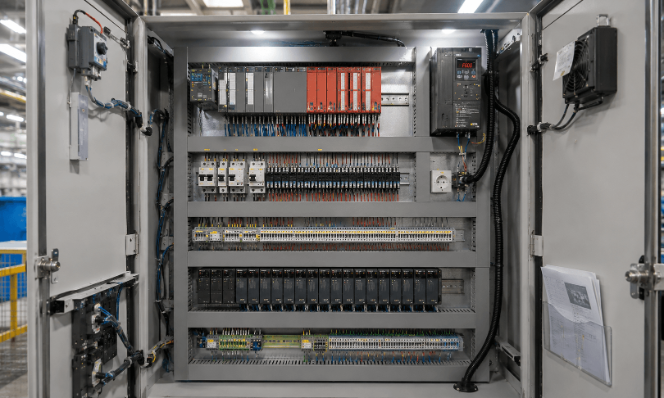
A modern PLC control panel is not just a cabinet with a PLC inside.
It is a fully engineered system.
Customization may include:
PLC Brand Selection
Factories often standardize around brands such as:
- Siemens
- Allen-Bradley
- Mitsubishi
- Omron
- Schneider Electric
This matters because maintenance teams usually prefer systems they already understand.
Nobody wants technicians carrying five programming cables and six software licenses just to troubleshoot one production line.
HMI Configuration
The Human Machine Interface (HMI) can be customized for the following:
- Multi-language support
- Alarm management
- Production monitoring
- Operator access levels
- Remote diagnostics
A poorly designed HMI creates operator confusion very quickly.
And confused operators eventually create expensive maintenance calls.
Enclosure Design
The enclosure itself may require customization based on the following:
- Indoor or outdoor installation
- Dust exposure
- Washdown environments
- Corrosive chemicals
- Ambient temperature
Why Does Customization Improve Long-Term Reliability?
Because industrial environments are rarely forgiving.
A panel designed for a clean indoor environment may fail quickly inside:
- Cement factories
- Marine facilities
- Chemical plants
- Mining operations
- Outdoor installations
Heat, moisture, vibration, and airborne contamination slowly damage electrical systems over time.
According to the National Electrical Manufacturers Association (NEMA), improper enclosure selection and environmental exposure remain major causes of electrical equipment failure.
Source:
NEMA Enclosure Standards
This is exactly why environmental customization matters.
For example:
Environment | Recommended Customization |
|---|---|
Outdoor installation | IP66 / NEMA 4X enclosure |
High humidity | Anti-condensation heaters |
Dust-heavy factory | Filtered ventilation system |
High-temperature area | Panel cooling systems |
Corrosive environment | Stainless steel enclosure |
And honestly, harsh environments expose weak engineering very quickly.
Can PLC panels be customized for future expansion?
Absolutely.
And smart manufacturers usually plan for this early.
One of the biggest mistakes I see is factories designing panels only for current production needs.
Then six months later:
- A new sensor gets added
- Another conveyor appears
- Additional VFDs are required
- SCADA integration becomes necessary
Suddenly, the original panel has no spare capacity left.
Now the company must redesign or replace the cabinet entirely.
That becomes expensive very fast.
A future-ready custom PLC panel may include:
- Spare I/O modules
- Extra DIN rail space
- Additional power capacity
- Ethernet expansion ports
- Remote monitoring capability
- UPS backup integration
Good automation planning is a little like buying warehouse space.
Nobody regrets having slightly more room later.
How Does Customization Affect Control Panel Cost?
This is where buyers sometimes become nervous.
Yes, customization usually increases initial project cost.
But focusing only on upfront pricing is often a mistake.
Because cheap automation systems become expensive later through the following:
- Downtime
- Troubleshooting
- Component incompatibility
- Difficult maintenance
- Premature failure
According to Deloitte manufacturing research, unplanned industrial downtime costs manufacturers billions annually worldwide.
Source:
Deloitte Smart Factory Research
In real factories, reliability usually matters more than saving a few hundred dollars on enclosure design.
What Should Buyers Prepare Before Requesting a Custom PLC Panel?
The more details you provide early, the smoother the project becomes.
A professional supplier will usually request the following:
- Voltage requirements
- I/O list
- Machine process description
- Preferred PLC brand
- Environmental conditions
- Network communication requirements
- Safety standards
- Available installation space
And honestly, this stage matters more than many people realize.
Poor communication during planning creates expensive revisions later.
How Long Does It Take to Build a Custom PLC Control Panel?
That depends on complexity and component availability.
Typical timelines look like this:
Project Type | Estimated Lead Time |
|---|---|
Small PLC panel | 2–4 weeks |
Medium automation system | 4–8 weeks |
Large integrated control system | 8–12+ weeks |
Engineering, sourcing, testing, and customer approvals all affect delivery time.
And currently, global PLC component supply fluctuations still impact some lead times.
More Related Questions
Can custom PLC panels support remote monitoring?
Yes. Many modern PLC systems support SCADA integration, cloud monitoring, and remote diagnostics.
Are custom PLC control panels worth the extra cost?
In most industrial environments, yes. They improve compatibility, reliability, and long-term maintenance efficiency.
Can old PLC systems be upgraded into new control panels?
Absolutely. Retrofit automation projects are extremely common.
What certifications may custom PLC panels require?
Depending on the market, UL, CE, IEC, or local electrical compliance certifications may apply.
Can custom PLC panels include cybersecurity features?
Yes. Modern industrial automation increasingly includes secure remote access and network protection.
What industries use custom PLC control panels most?
Manufacturing, water treatment, oil & gas, food processing, mining, and energy industries all rely heavily on customized automation systems.
Conclusion
Custom PLC control panels are no longer considered special projects in industrial automation — they are becoming the standard approach for reliable manufacturing. Every factory has different operational goals, environmental risks, and expansion plans. In my experience, the best PLC control panels are not the most complicated ones. They are the ones engineered specifically for the people, machines, and production realities they must support every single day.