
Oct 6, 2026Buying Guides
The Hidden Costs of Choosing the Cheapest Spare Parts
The Hidden Costs of Choosing the Cheapest Spare Parts: What Industrial Buyers Learn After a Failure Executive Summary: In industrial procurement, a lower quotation is often a down payment on future.
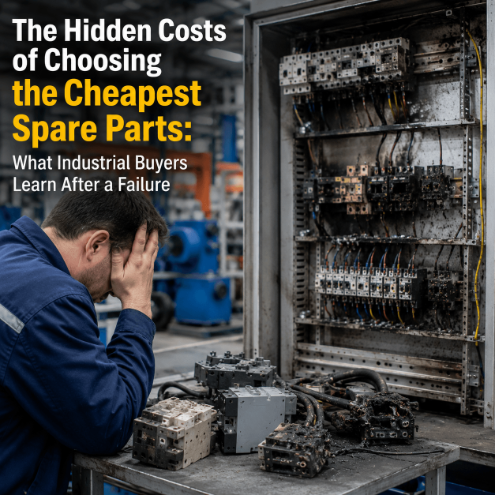
The Hidden Costs of Choosing the Cheapest Spare Parts: What Industrial Buyers Learn After a Failure
Executive Summary: In industrial procurement, a lower quotation is often a down payment on future downtime. This article explores why the "Total Cost of Ownership" (TCO) outweighs the initial purchase price and how low-cost sourcing strategies can inadvertently compromise your facility's operational resilience.
1. The Procurement Paradox: When "Savings" Become Liabilities
In high-level procurement meetings, cost reduction is the standard metric. A lower quotation or a "functionally equivalent" alternative looks efficient on a spreadsheet. However, industrial systems do not operate in a digital vacuum. They operate in the punishing reality of
- Thermal Cycling & Heat Buildup
- Mechanical Vibration & Harmonic Distortion
- EMI (Electromagnetic Interference) & Signal Noise
- Continuous 24/7 Load Cycles
The true difference between a premium industrial component and a budget alternative rarely appears during installation. It manifests months later through intermittent failures—the most expensive type of downtime because they are the hardest to diagnose.
Key Insight: Experienced engineers don't ask what a part costs today; they ask what the system looks like after 20,000 operating hours.
2. Treating Spare Parts as Commodities: A Critical Strategic Error
A dangerous trend in industrial sourcing is treating sophisticated PLC modules, sensors, or power supplies as generic commodities like office supplies.
Industrial components are dynamic nodes within a complex ecosystem. A single relay inside a control panel is not just a switch; it is a thermal management point and an electrical gate.
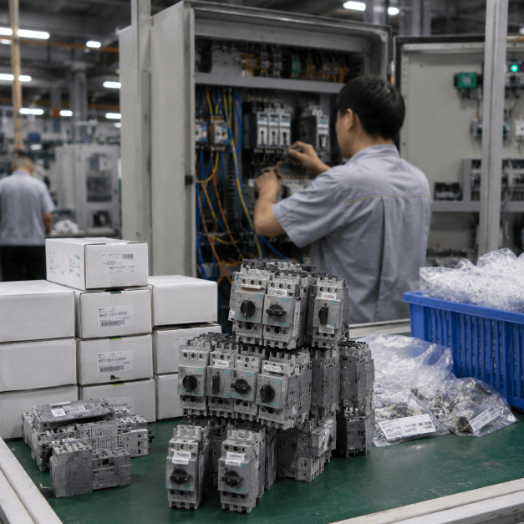
The Ecosystem Impact:
- Power Quality: A budget power supply may meet voltage specs but introduce "ripple voltage" that gradually destabilizes the internal circuitry of expensive PLC CPUs.
- Thermal Stress: According to Schneider Electric, every 10°C rise in operating temperature can reduce the life of electronic components by 50%. Lower-quality parts often have higher internal resistance, contributing to a "thermal chain reaction" inside the cabinet.
3. The Financial Reality of Unplanned Downtime
Downtime is no longer just a "maintenance headache"—it is a catastrophic business risk.
According to Siemens Manufacturing Insights, unplanned downtime costs industrial manufacturers an estimated 100,000 per hour in lost production, wasted raw materials, and emergency labor.
- Source: Siemens - The True Cost of Downtime
Senseye Predictive Maintenance further reports that unplanned downtime consumes between 5% and 20% of a plant's productive capacity. When you compare a 50,000 production loss, the "cheapest" option becomes the most expensive mistake in the facility.
4. The "Invisible Failure": Why "Equivalent" Isn't Always Equal
The most dangerous assumption in sourcing is that matching basic specifications (voltage, dimensions, and connectors) equals compatibility. Industrial systems rely on signal integrity and timing.
Why "Low-Cost Equivalents" Create System Instability:
- Micro-Arcing: Lower-grade contact materials in relays create tiny arcs that eventually lead to signal "bouncing," causing the PLC to trigger random resets.
- Sensor Drift: Cheaper sensors often lack proper temperature compensation, leading to "ghost readings" that cause the logic to hunt for stability, stressing your VFDs and motors.
- EMI Vulnerability: Premium parts include superior shielding. Cheap parts often omit this, making the system prone to interference when nearby high-power equipment starts up.
This leads to troubleshooting complexity. As noted by McKinsey & Company, maintenance inefficiency—often driven by intermittent faults—remains one of the largest hidden losses in manufacturing.
5. The Rising Threat of Industrial Counterfeits
As global supply chains become more fragmented, the risk of counterfeit components entering the "gray market" has skyrocketed.
The OECD and EUIPO estimate that counterfeit goods represent over $500 billion in global trade annually. In the industrial sector, this includes everything from semiconductors to circuit breakers.
Counterfeit parts are designed to pass initial testing. They look identical to the naked eye. However, they fail prematurely under real-world stress, often without warning. This isn't just a purchasing risk—it's a functional safety threat to your personnel and equipment.
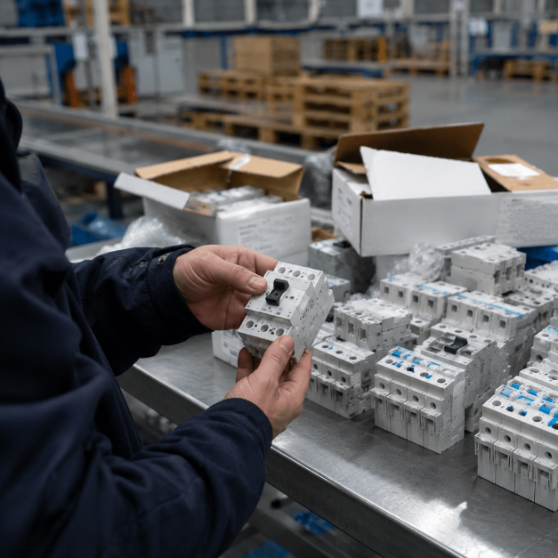
6. Case Study: The Relay That "Never Failed"
A high-speed packaging facility experienced random line stoppages for eight months. No hardware "died," but the PLC would occasionally reset without a clear alarm. The maintenance team spent over 200 man-hours auditing code and replacing sensors.
The Root Cause: A batch of low-cost replacement relays had been installed. Under continuous high-frequency switching, these relays developed thermal instability. They would "glitch" for milliseconds—not long enough to show a hard fault, but long enough to destabilize the PLC's input bus.
The Lesson: The "cheap" relays cost the company 80,000 in diagnostic time and lost production.
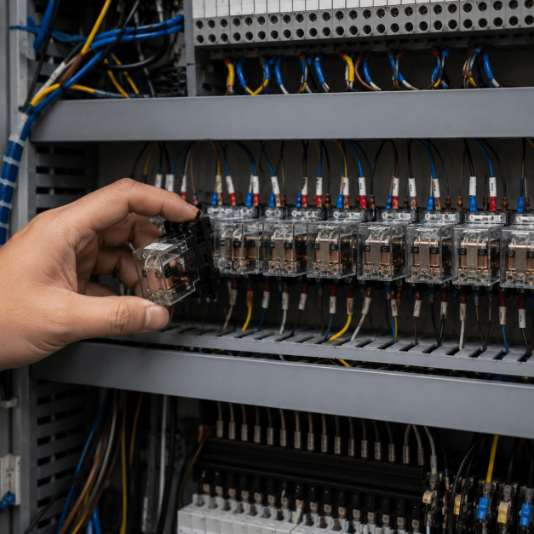
7. A Better Framework for Industrial Sourcing
Professional industrial buyers are shifting their focus from purchase price to lifecycle reliability. This includes evaluating the following:
- Traceability: Can the supplier guarantee the origin and revision history of the part?
- Version Parity: Is the firmware and hardware revision compatible with the existing system, not just the part number?
- Technical Support: Does the vendor understand the engineering context, or are they just shipping a box?
IBM Research has shown that resilient supply chains prioritize "Trusted Partners" over "Transactional Vendors" to ensure long-term operational continuity.
Final Thoughts: The Real Price Tag
In the industrial world, the real price of a component is never what you paid for it on the invoice. It is the cost the system pays for it every day it sits in the rack.
Choosing a partner like UniRegal means investing in operational peace of mind. We ensure that your spare parts strategy supports your production goals, reducing troubleshooting complexity and protecting your bottom line from the "hidden costs" of cheap sourcing.
Don't gamble with your uptime. Contact UniRegal today for a comprehensive spare parts audit and ensure your facility is built for long-term reliability.
Need help specifying or sourcing this for your project? Request a quote - we reply within 1-2 working days with a technical review.