
Buying Guides
Industrial UPS Buying Guide for Control Panels
How to size an industrial UPS for a PLC or SCADA control panel: runtime, topology, UL options and sourcing tips so your line stays online through outages.
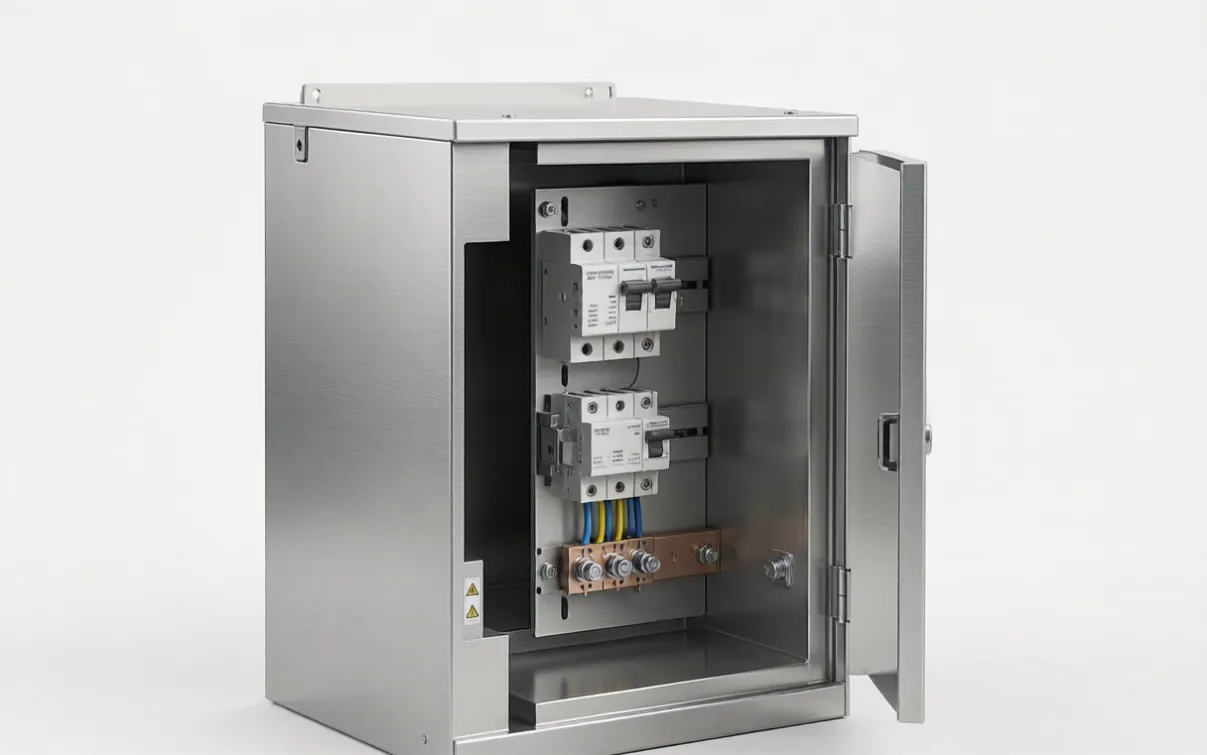
What an industrial UPS actually protects
A control panel loses power and the whole line stops. An industrial UPS sits between the mains and your PLC, HMI, VFD and SCADA hardware so a momentary outage, voltage sag or generator switch-over does not crash the controller or corrupt a running sequence. For most plants the cost of one unplanned stop is far higher than the UPS itself, so the buying decision is really about how much downtime you can tolerate, not the cheapest box.
Step 1 — calculate the real load
Do not guess. Add up the watts (or VA) drawn by everything the UPS must hold up:
- PLC CPU and I/O modules
- HMI / operator panel
- Network switches, comms modules
- Small relays, sensors on the control circuit
- VFD control board only (not the motor — the motor can ride through a short stop)
Size the UPS at 1.25–1.5× the measured VA to leave headroom for inrush and future additions. If you only know the panel's nameplate, send us the I/O list and we will total it for you.
Step 2 — pick the runtime you need
Runtime is the minutes the load stays up after mains fails. Match it to your recovery path:
If your recovery is… | Target runtime |
|---|---|
Generator starts in <30 s | 5–10 min |
Manual transfer / utility back in <5 min | 15–30 min |
Remote site, hours to restore | 30–60+ min + external battery |
Longer runtime = more battery, more weight, more cost. Right-size it; do not over-buy.
Step 3 — choose the topology
- Line-interactive — covers sags, surges and short outages. Fine for most panels.
- Online (double-conversion) — fully isolates the load from dirty mains. Use for SCADA, critical process and sites with unstable power.
- External-battery (EXT) — same UPS, separate battery cabinet for 30–60+ min without a bigger footprint.
Step 4 — UL, NEMA and environment
- In North America, specify UL 1778 for the UPS and pair it with a UL 508A panel build when the project requires it. We route UL-required orders to UL-listed workshops.
- Outdoor or washdown sites need NEMA 4X / IP66 enclosures; coastal sites want 316 stainless.
- Allow ventilation — batteries age faster in heat.
Step 5 — source it without the markup
You do not need a single factory. As a Foshan sourcing partner we consolidate the UPS, the enclosure, the PLC and the testing into one shipment, and we can match Mitsubishi, Siemens, ABB or Allen-Bradley component brands your panel already uses. Spare modules typically ship in 3–5 days from stock, so a failed UPS does not become a weeks-long line stop.
A worked example
A packaging line panel: PLC CPU and I/O 120 VA, HMI 40 VA, two network switches 30 VA, relays and sensors on the control circuit 20 VA. Total 210 VA. Apply the 1.25 to 1.5 headroom factor and you are specifying roughly 300 VA.
At that load a typical 1 kVA online unit gives around 20 to 25 minutes on internal batteries; the same unit with an external battery cabinet gives 60 minutes or more. If your generator starts in 30 seconds you are buying 20 minutes of runtime you will never use — that money is better spent on a second unit for redundancy, or on a maintenance bypass so the UPS can be serviced without dropping the load.
The full method is set out in how to size an industrial UPS for a control panel , and the choice between topologies is compared in UPS topology comparison .
Battery life, and why it decides the total cost
VRLA batteries in industrial UPS units are usually replaced every three to five years. Heat is the main enemy: every 10 °C above roughly 20 to 25 °C halves the expected life. That is why we ask about enclosure ventilation and ambient temperature before quoting, rather than after the first failure.
Ask for the battery as a separately priced line item, with the replacement interval stated in writing. A cheap unit with an expensive short-life battery pack costs more over ten years than the unit that was 20% dearer up front.
FAQ
Can you build around parts we already own?
Yes. Send the part numbers and we confirm enclosure, power and protection sizing before quoting.
What is the minimum order?
Complete wired panels start at one unit. Empty enclosures have a five-unit minimum.
How long does a build take?
Complete custom panels run 35 to 40 days from drawing approval; empty enclosures run 15 to 20 days. Stock components ship in 3 to 5 days.
Do you handle UL?
UL-required orders are routed to UL-listed partner workshops, and we confirm the applicable file and scope in writing before the order.
Common mistakes we see
- Sizing only for the motor, not the control circuit (the motor is fine; the controller is what crashes).
- Forgetting comms gear and HMI in the load total.
- Buying maximum runtime "just in case" and paying for batteries that age out unused.
- Mixing brands that need different config tools.
Talk to our team about your project
Send us your I/O list, required runtime and site environment. We will return a sized UPS proposal — enclosure, topology, UL status and lead time — as one package, not three separate quotes.
Related: Industrial UPS Systems · UPS sizing checklist for control panels · Why control panels need UPS backup power
Need help specifying or sourcing this for your project? Request a quote - we reply within 1-2 working days with a technical review.