
Oct 6, 2026Buying Guides
Food Panel Cost Drivers: What Changes the Price
Where food-grade panel budgets actually go: enclosure grade, sealing, washdown hardware, cooling, documentation. Fix these before comparing quotes.
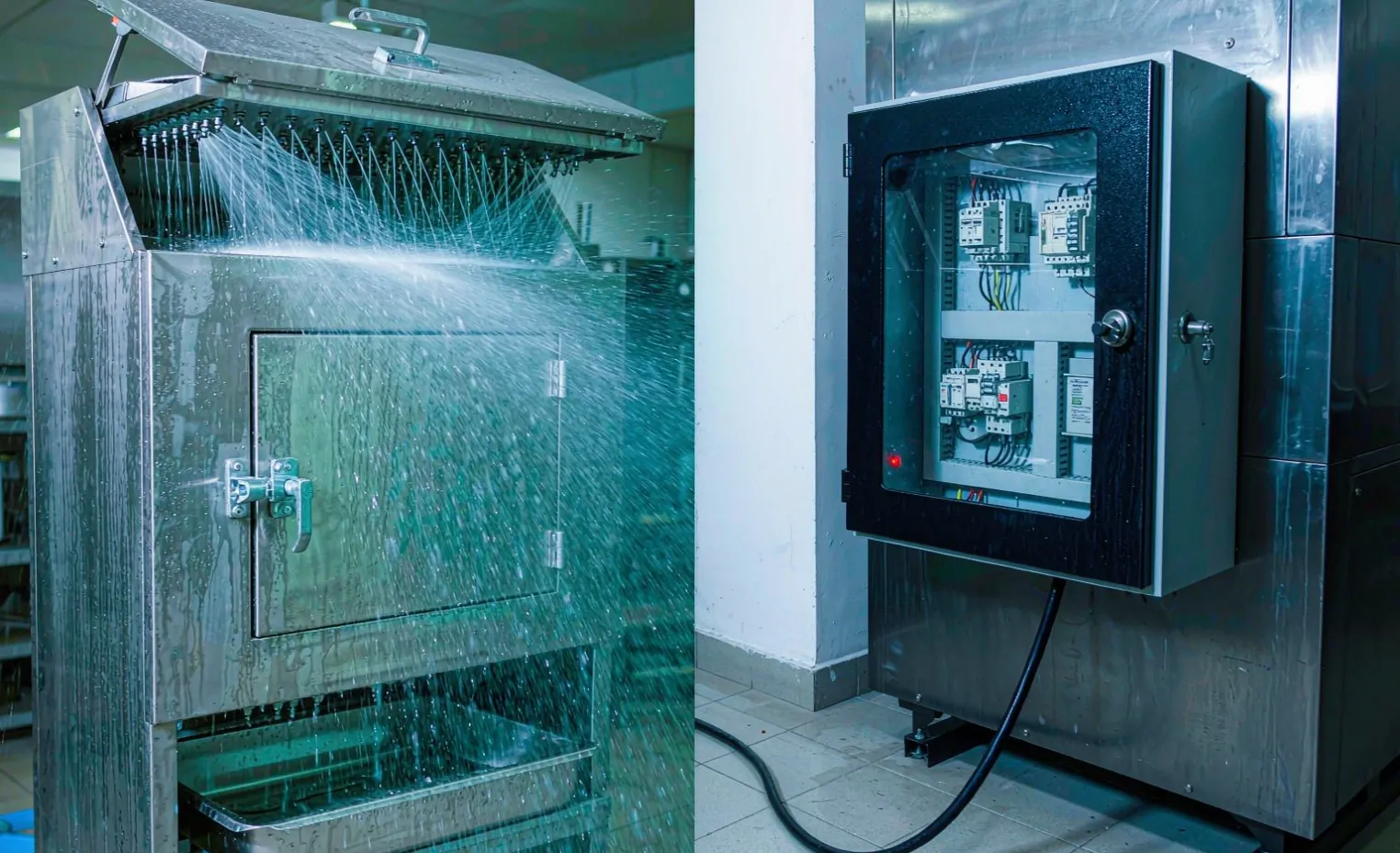
What a food-grade control panel must survive
A control panel on a food line lives next to water, caustic cleaners, steam and acidic washdown every shift. The default spec is a 316 stainless or corrosion-coated enclosure rated NEMA 4X / IP69K, with components chosen for the zone and a layout that leaves no ledge for product or bacteria to collect. Below is the buying checklist we use when sourcing panels for OEMs and plants — the same points that decide whether a panel lasts two years or ten.
Why food environments break ordinary panels
Three things kill a standard panel in a plant:
- Washdown ingress — high-pressure, high-temperature sprays drive water past seals that were fine in a dry cabinet room.
- Corrosion — chlorinated and acidic cleaners eat uncoated carbon steel and even 304 stainless at weld points.
- Hygiene ledges — bolt heads, overlapping flanges and flat tops trap residue that fails an audit.
If the panel is specified like a dry-facility cabinet, it will rust or fail sanitation within a season.
Enclosure material: 304 vs 316 stainless
Factor | 304 stainless | 316 stainless |
|---|---|---|
Corrosion resistance | Good in mild duty | Best against chlorides / cleaners |
Cost | Lower | ~15–30% higher |
Best use | Dry or light-washdown zones | Wet, caustic, coastal, high-salt lines |
Weld care | Needs proper passivation | Needs proper passivation |
For most washdown lines we default to 316 stainless because the small material premium is nothing next to a premature failure and the downtime it causes. Coated carbon steel is a budget option only where washdown is light and non-corrosive.
Rating you actually need: NEMA 4X vs IP66 vs IP69K
- NEMA 4X — corrosion-resistant and splash-tight; the baseline for food plants in North America.
- IP66 — strong jet protection, common in Europe; does not by itself imply corrosion resistance.
- IP69K — high-pressure, high-temperature washdown proof; the right call where daily sanitizing uses steam or pressure washers.
Pick the rating to the worst cleaning cycle the panel will face, not the mildest. A panel rated only for light splash will not survive a daily pressure wash.
Sanitation standards in plain terms
You do not need to be a compliance officer, but three references come up constantly:
- 3-A — hygienic design standard common for dairy and food contact equipment in the US.
- EHEDG — European Hygienic Engineering & Design Group guidance for cleanable design.
- FDA / USDA — material and contact-surface expectations for food zones.
We flag these on drawings and choose gaskets, drains and standoffs so the enclosure meets the audit, not just the schematic.
Common mistakes we see
- Buying a NEMA 4 enclosure instead of 4X — "4" is not "4X"; the X adds corrosion resistance, which is the whole point near cleaners.
- Flat-topped enclosures — residue pools on top; specify sloping or standoff-mounted tops.
- Indoor-rated components in a wet zone — HMI, connectors and terminals must match the panel's washdown rating.
- Ignoring cable entry — poorly sealed conduits are the #1 ingress path; use proper liquid-tight glands and sealed entries.
- Skipping FAT under washdown simulation — a panel that passes dry commissioning can still leak; test the seal, not just the logic.
The buying checklist
You provide | Why it matters |
|---|---|
Line zone (wet / caustic / coastal) | Drives 304 vs 316 and coating |
Cleaning method (spray / steam / pressure) | Sets NEMA 4X vs IP69K |
Required standard (3-A / EHEDG / FDA) | Determines gaskets, drains, finishes |
Control platform (Mitsubishi / Siemens / ABB) | Keeps spares consistent with your plant |
Mounting constraint (floor / wall / sloping top) | Removes hygiene ledges |
Send those five points and the panel can be specified without a second round of questions.
How we source it
As a Foshan sourcing partner we consolidate the enclosure, the PLC and HMI, the washdown-rated components and the testing into one shipment, built around the platform your maintenance team already knows. Spare modules typically ship in 3–5 days from stock, so a failed panel does not become a line-stop that waits on a single factory's lead time.
Frequently asked questions
Do I need 316 stainless or is 304 enough? For any wet or caustic washdown line, 316 is the safer default. 304 is acceptable only in light, non-corrosive duty.
Is NEMA 4X the same as IP69K? No. NEMA 4X adds corrosion resistance; IP69K adds high-pressure, high-temperature washdown proofing. Many food lines need both, expressed as NEMA 4X / IP69K.
Can a panel be both UL listed and food-grade? Yes. A UL 508A build in a 316 NEMA 4X enclosure is common for North American plants; we route UL-required orders to UL-listed workshops.
How long does a food-grade panel take? Enclosure lead time is typically around 15 days; component spares ship in 3–5 days. We confirm both when we return the proposal.
What kills these panels fastest? Flat tops that pool residue, indoor-rated components placed in wet zones, and unsealed cable entries. All three are avoidable at spec time.
Should the panel be floor or wall mounted? Whatever keeps every surface cleanable. Wall or standoff mounting with a sloping top avoids the hygiene ledges that floor units collect.
Talk to our team about your line
Send the five checklist points above and we will return a sized, food-grade proposal — enclosure material, washdown rating, standard compliance and lead time — as one package. Related: Control Panels for Food Processing Equipment · UL Listed Control Panels from China · Browse Solutions
Where to start if you are still comparing options
Price only makes sense once the washdown zones are settled. Before you compare quotes, write down which zones get hit with high-pressure hot water and which only get a wipe-down — that single decision moves the enclosure rating, the material grade and the gland specification far more than panel size does. If you are still building that list, the zone-by-zone table in our food processing control panels spec guide is the same one I use before asking a workshop for a number. Send it with the drawings and the first quotes you get back are usually comparable.
Need help specifying or sourcing this for your project? Request a quote - we reply within 1-2 working days with a technical review.