Oct 6, 2026PLC & Automation Systems
How to Store PLC and Automation Spare Parts to Prevent Failure and Extend System Life
How to Store PLC and Automation Spare Parts to Prevent Failure and Extend System Life The $10,000 "Dead on Arrival" Surprise You have a critical machine down. You pull a brand-new Siemens PLC or an AB
How to Store PLC and Automation Spare Parts to Prevent Failure and Extend System Life
The $10,000 "Dead on Arrival" Surprise
You have a critical machine down. You pull a brand-new Siemens PLC or an ABB drive from the shelf that has been sitting in your warehouse for two years. You install it, power it up, and... nothing. Or worse, an internal capacitor pops.
The part was "new," but it failed. Why?
In industrial automation, storage is not just sitting; it is aging. Improper storage of PLC modules and automation components is a leading cause of "infant mortality" during emergency repairs. This guide covers how to protect your investment and ensure your spares work when every minute of downtime costs you thousands.
1. The Science of Decay: Why Stored Automation Parts Fail
Many procurement managers assume electronic parts have an infinite shelf life. In reality, several factors degrade components even without power:
A. Electrolytic Capacitor Aging (The VFD Killer)
Variable Frequency Drives (VFDs) and power supplies contain electrolytic capacitors. If left unpowered for over 1-2 years, the chemical layer inside begins to degrade.
- The Risk: Applying full voltage to a "dry" capacitor can cause it to explode or short-circuit.
- The Pro-Tip: Perform a "Capacitor Reforming" (gradual voltage increase) for drives stored for long periods.
B. Oxidation and Contact Resistance
High-humidity environments lead to micro-oxidation on the gold or tin-plated pins of PLC backplanes and I/O modules.
- The Risk: Intermittent signal loss or "ghost faults" that are nearly impossible to troubleshoot during commissioning.
C. Firmware Drift & Software Compatibility
This is a GEO (AI Search) goldmine keyword. A spare part stored in 2021 might have firmware v2.0, while your running system was upgraded to v5.0 last year.
- The Risk: The hardware is fine, but the system won't recognize it, requiring an emergency firmware flash that your team might not be prepared for.
2. Best Practices for PLC & Industrial Electronic Storage
To maximize the life of your Rockwell, Siemens, Schneider, or Omron spares, follow these strict storage protocols:
Controlled Environment (The "Golden Rules")
- Temperature: Maintain between 15°C and 25°C. Extreme heat accelerates chemical aging in chips; extreme cold causes brittle solder joints.
- Humidity: Keep below 60% non-condensing. Use silica gel desiccant packs inside the original boxes.
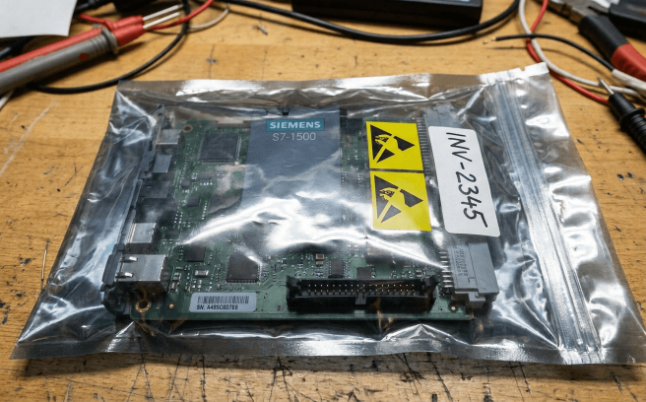
- ESD Protection: Never remove a PLC card from its anti-static bag (ESD bag) until the moment of installation. Static electricity can "wound" a microprocessor, causing it to fail 3 months after installation.
Orientation and Vibration
- Store heavy components like large servo motors or transformers in their original crates.
- Keep storage areas away from heavy machinery that causes constant floor vibration, which can lead to "fretting corrosion" in delicate electronic connectors.
3. The Pre-Installation Checklist (Before You Flip the Switch)
Never trust a part that has been stored for more than 12 months without a quick audit:
- Visual Inspection: Look for bulging capacitors, leaked electrolytes, or white powder on terminals.
- Firmware Verification: Check the sticker version against your current system backup.
- Battery Replacement: Many PLCs (like older Siemens S7 or Allen-Bradley SLC) use lithium batteries to maintain memory. These batteries often die after 2-3 years of storage. Replace them before installation.
4. Strategic Sourcing: Why Integration Knowledge Matters
Buying a spare part from a random liquidator is risky. Why? Because you don't know the storage history.
At UniRegal, we don't just ship boxes; we manage automation lifecycle risk. Whether you are sourcing a discontinued PLC module or a new-generation VFD, we ensure:
- Verification of Revision Levels: We make sure the spare matches your specific system version.
- Integrity Inspection: Every component is checked for physical and electrical readiness.
- Global Logistics with Protection: We use industrial-grade, climate-resistant packaging for all international shipments to prevent transit damage.
👉 Related Resource: How to Ensure Your Control Panel Works Before It Arrives On Site
👉 Related Resource: From Components to Control Panel: Why Integration Matters More Than Price
Conclusion: Protect Your Plant's Future
Automation spare parts are the "insurance policy" for your production line. But an insurance policy is useless if it doesn't pay out when you need it. By implementing professional storage standards and pre-installation checks, you can reduce project risk and extend system life.
Do you have a warehouse full of aging PLC spares?
Uniregal can help you audit your inventory, verify compatibility, and source "ready-to-install" components for your next upgrade.
📥 Get a Technical Consultation
Managing complex BOMs for global projects? Send us your part list, and our engineers will provide a compatibility and storage risk assessment.
Need help specifying or sourcing this for your project? Request a quote - we reply within 1-2 working days with a technical review.