
Industrial Enclosures
Custom Sheet Metal Enclosures | Laser-Cut Cabinets | UniRegal
Custom sheet-metal enclosures to your drawings - communication racks, power cabinets, battery cabinets, 1U/2U chassis. Laser-cut, powder-coated, tolerance-controlled.
Specifications
- Process
- Laser cutting, CNC bending, welding, powder coating
- Materials
- Cold-rolled steel, electrolytic plate, aluminium profile (6063-T5)
- Thickness
- 0.5-2.0 mm per drawing (typical)
- Typical products
- Racks, power & battery cabinets, consoles, 1U/2U chassis, LED & server enclosures
- General tolerances
- Per GB/T 1804 general-tolerance practice
- Door fit
- Door diagonal tolerance within 3 mm per metre
- Finish
- Powder coating (colour per RAL); bare or treated metal available
- Volume
- Single prototypes to production runs
- Inputs
- Drawing (PDF/CAD) + BOM; DFM review before quotation
Custom Sheet Metal Enclosures Built to Your Drawings
Beyond our standard cabinet lines, we manufacture custom sheet-metal enclosures to customer drawings - from single prototypes to production runs. If your product needs a housing that no catalogue item provides, send us the drawing: we laser-cut, bend, weld and finish it in-house, and return a DFM (design-for-manufacturing) review before any commitment.
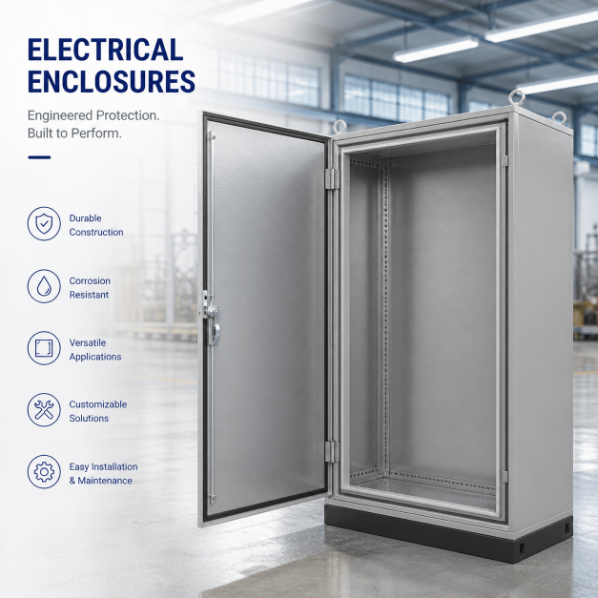
What we build: communication racks and cabinets, power and battery cabinets, control consoles, 1U/2U chassis, LED and server enclosures, aluminum-profile frames, plus the brackets, panels and covers that go with them.
Quick Answer: Can You Manufacture My Enclosure Design?
Almost always - if it can be laser-cut, folded and welded from sheet metal, we can build it. Send a drawing with dimensions, material, thickness and finish, and we will confirm manufacturability, point out any geometry that will add cost (deep draws, tight internal radii, tapped holes near bends), and quote the part. Drawings that specify standard sheet thicknesses and bend radii move fastest.
How We Build Custom Enclosures
Parts start as flat blanks on a laser cutter, which holds tight, repeatable dimensions without expensive tooling - the reason single prototypes and small batches are economical. Blanks move to CNC bending, then welding and finishing. Because cutting and bending are numerically controlled, the first article already carries production tolerances, and repeat orders match the original.
Materials and Thickness
We work in cold-rolled steel, electrolytic plate, and aluminium profile (6063-T5), typically 0.5-2.0 mm per drawing. Cold-rolled steel gives the best strength-to-cost for racks and machine housings; electrolytic (EC) plate improves corrosion and paint adhesion where exposed edges matter; aluminium profile is for light, corrosion-resistant frames and instrumentation housings.
Tolerances You Can Plan Around
General dimensions follow GB/T 1804 general-tolerance practice, and critical features - mounting-hole patterns, cut-outs for connectors, pressed-nut holes - are held to the tighter values written on the drawing. Practical expectations for a 1-2 m enclosure: cut-part diagonals within roughly 0.3-0.5 mm, door diagonals within about 3 mm per metre, and aluminium-profile lengths per drawing with a few tenths of a millimetre on short pieces. If your design needs a specific tolerance call-out, put it on the drawing and we will confirm we can hold it before quoting.
Finishes and Hardware
Standard finish is powder coating in your RAL colour, over a phosphate pre-treatment so the coating bonds and resists chipping at edges. Bare, oiled, zinc-plated and passivated parts are also available for internal components when the drawing specifies them. Hinges, latches, handles, vent grilles and gaskets can be factory-fitted, or supplied loose for your assembly line.
Quality Details That Decide How an Enclosure Ages
Sheet-metal quality is decided by small things. Cut edges should be deburred - no burrs, sharp corners or rough edges on folded parts - and exposed edges folded back so assemblers do not cut themselves or damage cable. Coating must be even: uneven film thickness is where rust starts. Ventilation slots and fan openings should be positioned so heat from electronics exits the top, and any cable-entry edges should be protected so wiring insulation is not chafed over years of vibration. These are the checks we apply on the bench before a part ships.
Factory Quality System and Inspection
Product-level checks - deburring, coating quality, tolerances - sit inside a factory-wide ISO 9001-certified quality management system. Every job passes three inspection gates: incoming material checks on steel, electrolytic plate and aluminium stock; in-process inspection after laser cutting, bending and welding; and a final outgoing inspection of dimensions, hole patterns, finish and hardware against the drawing before packing.
Inspection records are kept per batch, and routine inspection records are available on request - useful when your QA team needs traceability for enclosures entering a certified machine or panel build.
What to Send for a Custom Enclosure Quotation
Send the drawing (PDF, or CAD if you want a precise DFM pass) plus a short BOM: quantity, material, thickness, finish and any hardware list. If you only have a sketch or a similar product to copy, send photos with dimensions and we will work up a proposal drawing for approval. Tell us the operating environment - indoor electronics, outdoor, coastal, washdown - because it changes material, finish and sealing choices.
Where Custom Sheet-Metal Enclosures Are Used
The same workshop builds housings for electrical and electronics products - control consoles and operator desks, power and battery cabinets for UPS and energy-storage projects, communication and server racks, LED driver boxes, sensor and controller housings - and the sheet-metal parts of larger assemblies such as the control panels and distribution boards we supply. When an enclosure project grows into a complete panel or switchgear project, we can quote both from the same drawings.
Frequently Asked Questions
1. What file formats do you accept for drawings?
PDF dimensioned drawings are enough for a quotation. For manufacturing we prefer CAD (DWG/DXF or STEP) so we can check bend allowances and hole patterns digitally. A BOM with material, thickness, finish and hardware saves a clarification round.
2. What tolerance can you hold on a laser-cut enclosure?
General dimensions follow GB/T 1804 general-tolerance practice; typical laser-cut part diagonals under 1 m stay within about 0.3-0.5 mm (0.3 mm on frame members, about 0.5 mm on other parts) and door diagonals within about 3 mm per metre. Critical hole patterns and press-nut positions are held tighter when the drawing calls them out. Tell us the tolerance-critical features and we will confirm what we hold before quoting.
3. Do you make single prototypes or only production volumes?
Both. Because laser cutting needs no dedicated tooling, one prototype costs only marginally more per part than a small run - so we regularly build a first article, let you test it, then move to production quantities with identical settings.
4. Can you paint or plate parts in specific colours or finishes?
Yes - powder coating in your RAL colour over phosphate pre-treatment is standard. We can also supply bare parts, zinc-plated and passivated components, and masked areas where conductivity or earthing points must stay unpainted.
5. How do I make sure the first batch fits my assembly line?
Put the critical-to-fit dimensions (mounting hole patterns, cut-outs, hinge positions) on the drawing with tolerances, and we will hold them and record them on the inspection report. For larger programs we can produce a pre-production sample and have you fit-check it before the full run is cut.
6. Can you also assemble and wire the enclosure into a finished panel?
Yes - the same fabrication network builds complete control panels and distribution boards. If your housing is the start of a panel project, mention it in the enquiry and we will quote enclosure and assembly together, which usually saves you one layer of handling and one shipping cost.
7. What inspection do parts go through before shipment?
Each job passes incoming material checks, in-process inspection after cutting, bending and welding, and a final outgoing check of dimensions, hole patterns, finish and hardware against your drawing. Routine inspection records are available on request, and critical-to-fit dimensions can be reported explicitly if you list them on the drawing.
Request a Custom Enclosure Quotation
Send your drawing and BOM, or a photo with dimensions if the design is not yet final - we will come back with a manufacturability note and a quotation. Use the contact form, or mention your WhatsApp number in the message - most inquiries receive a response within 24 hours.